Connect with us

%

Snakes In Spain: Where You Are Most Likely To Come Across One

Published

on

snakes-in-spain:-where-you-are-most-likely-to-come-across-one

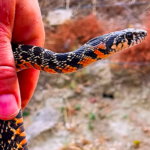
The horseshoe whip snake, is found across much of the southern half of the Iberian Peninsula. Photo credit: Molly Grace

Imagine opening the door to your garden shed, moving a pile of firewood or walking through long grass on a warm morning and finding a snake curled up just metres from you. For many people in Spain, that would be enough to make them freeze or even send them running. But while snakes can turn up in gardens, farms, countryside and even around homes, not every snake is a viper and most of Spain’s snakes are not dangerous to people.

Knowing where they are likely to be found, and recognising that several species deliberately resemble more dangerous snakes, can make an unexpected encounter considerably less alarming. Spain has a surprisingly varied snake population, with the Ministry for the Ecological Transition’s national inventory including species such as the viperine snake, southern smooth snake, false smooth snake, horseshoe snake, Montpellier snake, ladder snake and grass snake, alongside three native vipers.

Where in Spain are you most likely to see a snake?

There is no single snake hotspot. Different species favour different environments, but warm Mediterranean landscapes, scrubland, open countryside, rocky areas, farmland and places close to water can all provide suitable habitat. Southern Spain has a particularly varied snake population.  The horseshoe whip snake, for example, is found across much of the southern half of the Iberian Peninsula and along parts of the Mediterranean coast, where it can inhabit warm, open and rocky environments.

Central Spain can also provide excellent habitat. The protected Quintos de Mora estate in Toledo province records several species, including the Montpellier snake, ladder snake, horseshoe whip snake, viperine snake, grass snake and Lataste’s viper. Northern Spain should not be overlooked either. The cooler and wetter conditions support species such as Seoane’s viper and the European smooth snake, while rivers, streams and other wet habitats can attract water-dependent snakes.

One of Spain’s most widespread snakes lives near water

If you see a snake beside a stream, pond, reservoir or another source of water, it could be a viperine snake (Natrix maura). Despite its name and appearance, it is not a viper. The species can imitate the appearance and defensive behaviour of a viper, making it easy for someone unfamiliar with snakes to mistake it for a venomous species.

It is also remarkably widespread. Spain’s national reptile atlas records the viperine snake in every Spanish province, describing it as common across much of its distribution. In the south, however, it becomes more localised around the remaining places where water is available. 

False smooth snake among Spain’s less familiar species

The false smooth snake (Macroprotodon brevis) is another Spanish species many people would struggle to identify. It is found principally in the southern half of the Iberian Peninsula, while the southern smooth snake (Coronella girondica) is another relatively discreet species occurring across much of the peninsula. Both appear in the Ministry for the Ecological Transition’s national reptile inventory. 

Other snakes found in Spain include the horseshoe snake, Montpellier snake, ladder snake, grass snake and collar snake. The Asociación Herpetológica Española’s identification guide covers 83 reptile species found in mainland Spain, the Balearic Islands and the Canary Islands, showing just how varied the country’s reptile fauna is. 

Where are Spain’s vipers?

Spain has three native viper species: the asp viper (Vipera aspis), Lataste’s viper (Vipera latastei) and Seoane’s viper (Vipera seoanei). 

Their distributions differ considerably. The asp viper is principally associated with northern and north-eastern Spain, Lataste’s viper has a much wider distribution across the peninsula, and Seoane’s viper is associated mainly with northern and north-western areas. That means finding a snake in Andalucía, Madrid or Valencia does not automatically mean you have encountered a viper. Proper identification matters.

Snakes can find their way into Spanish homes

For a snake, a garden, finca or rural property can provide several things it needs: shelter, warmth, prey and quiet places to hide. Gaps beneath doors, cracks around walls, garages, sheds, storage areas, piles of wood and dense vegetation can all provide opportunities for snakes to shelter close to buildings. Areas supporting rodents can also provide a reliable food source.

If you find one inside your property, do not attempt to pick it up or corner it. Keep children and pets away, give the snake space and contact the appropriate local wildlife or animal-control service if it cannot safely leave.

Snakes are protected in Spain

There is another reason not to harm snakes, other than the fact that it’s simply not right. Spanish biodiversity legislation provides legal protection for wild animals, with additional protection applying to species included in the national List of Wild Species under Special Protection. Depending on the species and circumstances, protections cover actions including killing, harming, capturing, pursuing or disturbing wild animals. 

So if a snake appears in your garden, the safest approach is also the responsible one: keep your distance, keep pets and children away and seek professional assistance if necessary. For most people, seeing a snake in Spain will be an unexpected encounter rather than a dangerous one. Knowing which species live in your area and understanding their habitats can make it much easier to tell the difference between a genuine risk and a harmless reptile simply trying to find somewhere to hide.

%

La Mata Celebrates Its Patron Saint Fiestas

Published

on

la-mata-celebrates-its-patron-saint-fiestas

Presentation of La Mata Fiestas. Credit: Ayuntamiento de Torrevieja.

La Mata will celebrate its patron saint fiestas from Saturday, September 12 to Wednesday, October 7, with almost a month of religious ceremonies, live music, food and family activities.

The programme combines long-standing traditions with entertainment for all ages, culminating in the procession of the Virgen del Rosario and continuing through to the final celebrations on October 7.

Traditional Surriagaso launches almost a month of celebrations in La Mata

Celebrations begin on Saturday, September 12 at noon with the traditional Surriagaso, accompanied by music, DJs and water activities.

The following morning brings one of the first religious events of the programme. A pilgrimage will leave the parish church at 9:30 AM on Sunday, September 13 and make its way to Eduardo Gil Rebollo Park.

An outdoor Mass will then be held at 11:00 AM, bringing residents together as the patron saint celebrations get under way.

The programme continues the following weekend with activities combining local traditions with entertainment for younger residents.

Children’s run, foam party and outdoor cinema fill the September programme

Children take centre stage on Saturday, September 19 with a San Fermin-style children’s run beginning from Plaza Gaspar Perello at 11:30 AM.

The run will be followed by a foam party, while the day’s entertainment continues in the evening with an outdoor cinema session in Plaza Encarnacion Puchol from 8:45 PM.

The traditional dawn Rosary takes place at 7:30 AM on September 20, followed by Mass. Later that day, the popular bar route begins at noon.

Further highlights arrive the following weekend, including the floral offering on September 26.

Food takes centre stage on September 27 with the paella competition beginning at 10:00 AM. Inflatables, music and another foam party will accompany the competition, creating a full day of family entertainment.

Multicolour Parade and Virgen del Rosario procession headline October events

Some of the biggest events of the La Mata fiestas will arrive during the first weekend of October.

The Multicolour Parade takes place at 6:00 PM on Saturday, October 3, bringing a colourful procession through the town before live music from Orquesta Atenas begins at 10:00 PM.

Religious celebrations take centre stage the following day.

On Sunday, October 4, the main Mass begins at 7:30 PM before the Virgen del Rosario is carried through La Mata in the traditional procession.

Fireworks will follow the procession, providing one of the major spectacles of the fiestas.

After almost a month of religious events, music, food, children’s activities and community celebrations, La Mata’s 2026 patron saint fiesta programme will conclude on Wednesday, October 7.

Continue Reading

%

Naming A Charity In Your Will: What Expats In Spain Should Know Before Signing

Published

on

By

naming-a-charity-in-your-will:-what-expats-in-spain-should-know-before-signing

The details matter. Credit: New Africa / Shutterstock

Imagine a British retiree who has lived in Spain for twenty years, has no children, and has always supported a particular charity back home. Naturally, she wants that charity to receive something when she is gone. It sounds simple enough. But it is rarely as straightforward as it seems, particularly once Brexit is added to the mix.

The starting point is usually good news. If you have no forced heirs under Spanish law, you are generally free to leave your estate, or part of it, to whichever cause you choose. Spanish and foreign charities alike can, in principle, be named as beneficiaries in a Spanish will.

Where things get more complicated is on the tax side. Unlike individuals, charities and foundations are not taxed under Spanish Inheritance and Gift Tax. That might sound reassuring, but it does not mean the inheritance arrives tax-free. Depending on how the organisation is structured, it could still face Corporate Income Tax or, if based outside Spain, Non-Resident Income Tax.

Spain does offer a beneficial tax regime for qualifying non-profit organisations, but it is not automatic. The organisation must meet a list of requirements and formally apply for it. And, crucially, this regime has traditionally been available mainly to entities based in the EU or the European Economic Area. Since the United Kingdom left the EU, it appears that UK-registered charities may no longer qualify for this route in the same way they once did, which could mean a higher tax bill than the testator ever intended.

There is a further wrinkle. Some UK charitable structures operate as trusts rather than as charities with their own separate legal personality. Spanish law does not recognise trusts, which can create additional uncertainty over how the inheritance is treated for tax purposes.

None of this means you should abandon the idea. It simply means the details matter. Before finalising a will that leaves assets to a charity, it is worth confirming exactly how that organisation is structured and reviewing what the tax outcome is likely to be under current rules. At White & Baos Lawyers, we help clients get this right from the outset, so that a generous gesture reaches its intended cause as fully as possible. Reach out to us, today, and we will walk you through it.

You may be interested in the following services and articles:

Inheritance and Wills in Spain in favour of charities, NGOs, non-profit foundations , social organizations , etc. Legal Advice : The executor.

We answer the most frequently asked questions about granting a Will in Spain and abroad. Basic advice. Inheritance. Legal advice.

SPANISH WILLS FOR ALL WORLDWIDE ASSETS

Carlos Baos (Lawyer)

White & Baos.

Tel: +34 966 426 185

E-mail: info@white-baos.com

White & Baos 2026 – All Rights Reserved.

Continue Reading

%

Marbella Moments: Avocadon’t

Published

on

marbella-moments:-avocadon’t

Marbella has been hit by a new plight: the invasion of the avocado in unexpected dishes.

Avocadoes are apparently healthy but based on the amount of sauce I need just to cover the taste to be able to eat it, maybe not so much for me. I can eat one if life depends on it but I certainly wouldn’t order one to suffer by choice.

Nevertheless, recently they’ve been turning up everywhere and in everything, including dishes where you would never think to say, “No avocado, please.”

I’ve ordered fried eggs on toast and the toast came pasted with avocado. I’ve ordered bruschetta and found it mixed in with the tomato. I’ve ordered eggs Benedict and there it was: avobloodycado hiding under the eggs.

Is this one of those Emperor’s New Clothes situations, with chefs trying to elevate a typical dish by shoving in avocado? If it’s on the side, you can choose not to eat it, but when it comes camouflaged or smushed with tomatoes, I’m at least thankful I’m not allergic.

Has restaurant food become presumptuous, or are my taste buds simply old-fashioned? If you want to create a variation, why not call it something different? Please don’t give it a standard name that has existed worldwide for years and then serve your own interpretation without explaining.

It’s not just English restaurants, either. Often, the fancier the Spanish restaurant, the less food on the plate, the higher the price and the bigger the surprise.

I love good food and eating out, but if you want to improvise with traditional dishes, please write it on the menu and let us know before we order. Thank you.

Continue Reading
Advertisement
Advertisement

Spanish Real Estate Agents

Tags

Trending

Copyright © 2017 Spanish Property & News