Connect with us

News from Spain

Spain is about to get a rare six planet show and most people won’t even know it’s happening

Published

on

A rare six planet alignment will be visible from Spain on 12 August, alongside the peak of the Perseid meteor shower.
Credit : Kim Steinberg, Shutterstock

Most people already know that 12 August is the night to watch the Perseid meteor shower, but that’s only half the story. If the skies stay clear, anyone looking up from Spain could also catch a rare six planet alignment, with Jupiter, Mercury, Mars, Saturn, Uranus and Neptune appearing across the same stretch of sky. Astronomers say alignments involving this many planets don’t happen very often, making it one of the standout nights for skywatchers this summer.

You don’t need to be an expert to enjoy it. In fact, for most people the appeal is simply being outside on a warm August evening and seeing more planets than you would normally expect in a single night. If you’re lucky enough to be away from city lights, you could have a front row seat to one of the year’s most striking celestial displays.

Why this planetary alignment is attracting so much attention

The phrase ‘planetary alignment‘ often sounds more dramatic than the reality, and it’s easy to see why there’s confusion.

The planets are not actually lining up in space one behind another. What happens is that, from our point of view on Earth, several planets appear to gather along the same path across the sky. Astronomers call this path the ecliptic, which is also the route followed by the Sun and the Moon throughout the year.

Small alignments happen fairly regularly. Spotting two or three planets close together is nothing unusual. Seeing six planets appearing in the same part of the sky, however, is much less common.

That’s why 12 August has already been highlighted by astronomy platform Star Walk as one of the key dates of the year for anyone who enjoys watching the night sky.

Adding to the excitement, the alignment arrives on exactly the same night that the Perseid meteor shower is expected to reach its peak. It’s unusual to have two headline astronomical events sharing the same evening, which is why many amateur astronomers have already circled the date on their calendars.

Which planets will you actually be able to see?

This is where expectations need a little reality check.

Although six planets are taking part in the alignment, not all of them will be equally easy to spot.

If you’ve never looked for planets before, Jupiter will probably catch your eye first. It is one of the brightest objects in the night sky and is difficult to miss when conditions are good.

Saturn should also stand out, while Mars will be recognisable thanks to its familiar orange red colour.

The remaining planets are more challenging.

Mercury spends most of its time close to the Sun from our perspective, so it only appears for short periods around sunrise or sunset. Finding it usually requires good timing and an unobstructed horizon.

Then there are Uranus and Neptune. They are simply too faint for most people to see with the naked eye, so binoculars or a telescope will be needed if you want to add them to your list.

Even if you only manage to spot three planets, it’s still an impressive evening. Most of us go through daily life without noticing what’s happening above our heads, and events like this offer a reminder that the night sky is constantly changing.

Where should you go to get the best view in Spain?

The best viewing tip has nothing to do with buying expensive equipment. Your location matters much more than your telescope.

If you’re surrounded by street lights, apartment blocks and illuminated roads, you’ll lose much of the detail. A short drive into the countryside can make a remarkable difference.

Spain has no shortage of places with excellent dark skies. Rural inland areas, mountain viewpoints, national parks and quiet stretches of coastline often provide ideal conditions for stargazing.

Weather is just as important. A perfectly timed astronomical event can disappear behind cloud in seconds, so it’s worth checking the forecast before heading out.

If you’re planning to use binoculars or a telescope, try to arrive before it gets fully dark. Give your eyes around 20 to 30 minutes to adjust naturally, and avoid looking at your phone too often, as bright screens quickly reduce your night vision.

Many local astronomy groups across Spain also organise public observing sessions whenever major celestial events take place. They’re a great option if you’re unsure where to look or simply want someone to point out the planets for you.

A reminder that some of the best summer experiences are completely free

There is something refreshing about an event like this. No tickets, no queues and no booking required.

All you really need is a clear sky and a little patience.

Planetary alignments have fascinated people for thousands of years. Ancient civilisations carefully followed the movements of the planets to create calendars and better understand the changing seasons. Today we know these alignments are simply the result of the planets following their own orbits around the Sun, but that doesn’t make them any less captivating.

For many families, 12 August could become one of those evenings that is remembered long after summer ends. Children might see Saturn for the first time. Someone else may finally understand why Jupiter shines so brightly compared with the surrounding stars. Others may simply enjoy sitting outside while the Perseids streak overhead.

Whether you’re a keen astronomer or someone who rarely looks up after dark, this is one of those occasions that rewards curiosity. Six planets, one of the year’s biggest meteor showers and, hopefully, clear summer skies make for a combination that doesn’t come along very often.

So if the forecast looks promising, it might be worth swapping an evening in front of the television for one under the stars. On 12 August, Spain’s night sky could put on one of its finest displays of the year.

%

Search For Missing Neighbour Ends With Bizarre Underground Rubbish Bin Rescue

Published

on

search-for-missing-neighbour-ends-with-bizarre-underground-rubbish-bin-rescue

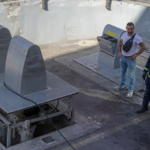
what had started as a two-minute mission to rescue a set of keys became an unexpected prison. Photo credit: Policía Arganda del Rey on Facebook

We’ve all done it, dropped our keys somewhere awkward, stared at them for a moment and wondered whether it’s worth trying to get them back. For one man in Madrid, that split-second decision turned into a 45-minute ordeal inside an underground rubbish container, complete with desperate cries for help and a rescue by firefighters. It sounds like something from a comedy sketch, but for the man involved it was anything but funny at the time.

The incident happened in Arganda del Rey, on the outskirts of Madrid, after the man accidentally dropped his house keys into an underground rubbish container. Rather than accepting defeat and arranging a replacement set, he decided to climb inside to retrieve them. It seemed like a quick solution, unfortunately, it wasn’t.

A simple plan that quickly went wrong

After climbing into the container, the man managed to get inside but soon discovered there was one major problem. The safety system designed to stop people falling into the underground bin also made it almost impossible for him to climb back out. Suddenly, what had started as a two-minute mission to rescue a set of keys became an unexpected prison.

For around 45 minutes, , unable to free himself. Realising nobody knew where he was, he began shouting: “Please, help!” It was a plea that fortunately didn’t go unheard.

His cries for help attracted attention

A nearby neighbour, identified as Gustavo, heard someone shouting from the street and initially struggled to work out where the voice was coming from. It wasn’t every day someone called for help from inside a rubbish container.

After locating the trapped man, Gustavo contacted the emergency services and stayed nearby to reassure him while firefighters made their way to the scene. As more neighbours realised what had happened, a small crowd gathered around the container, hoping the rescue would be straightforward.

Firefighters came to the rescue

Getting the man out wasn’t as simple as opening a lid, the underground waste containers use a counterweighted mechanism designed to make them safe and secure, meaning firefighters had to lift part of the system before they could reach him.

After around three-quarters of an hour trapped inside, the man was finally pulled to safety. Witnesses said he emerged covered in sweat, visibly shaken, with cuts to his hands after repeatedly trying to climb back out and an unpleasant odour that could make cats cry. Neighbours quickly handed him water while he recovered from the ordeal. Fortunately, despite the uncomfortable experience, he did not suffer any serious injuries.

An embarrassing story with a happy ending

Looking back, it’s easy to imagine the man wishing he’d simply called a locksmith. Replacing a set of keys is rarely cheap, but it’s probably preferable to spending 45 minutes inside a rubbish container waiting for firefighters to arrive.

The incident has attracted plenty of attention because it’s exactly the kind of situation many people can imagine themselves getting into. Faced with the choice between losing something valuable and trying to retrieve it, plenty of us might think, “I’ll just be a second.” Sometimes, however, those “quick jobs” have a habit of lasting much longer than expected.

A reminder to think twice

While the story has raised a few smiles, it also carries an important message. Underground rubbish containers are designed with safety features that prevent people from easily entering or falling inside. Those same features can make it extremely difficult to get back out without assistance.

Trying to recover dropped belongings may seem harmless, but climbing into these containers can quickly become dangerous, particularly in hot weather or if nobody knows where you are. This time, the man’s calls for help were heard by someone passing nearby. Had the street been quieter, the outcome could have been very different.

So, the next time your keys, phone or wallet disappear somewhere awkward, it might be worth taking a moment before climbing in after them. After all, a call to a locksmith is probably less memorable than becoming the neighbourhood’s most unexpected rescue story.

Continue Reading

%

Nearly 400,000 Hit By Cybercrime In Spain As People In Their 50s And 60s Are Caught Most Often

Published

on

nearly-400,000-hit-by-cybercrime-in-spain-as-people-in-their-50s-and-60s-are-caught-most-often

Unrecognised payments can leave cardholders racing to freeze their accounts. Credit: Fizkes / Shutterstock

One unfamiliar payment can quickly become a frozen card, urgent calls to the bank and fears that more money could disappear. Nearly 400,000 people were recorded as cybercrime victims in Spain in 2025, with those aged 51 to 65 hit most often and online offences reaching their yearly peak in July.

Why Spain’s July cybercrime peak matters for cardholders now

An ordinary bank notification can become a costly problem when the payment on screen was never made by the account holder. The fallout can mean urgently freezing a card, checking every recent transaction, contacting the bank and filing a police report.

New figures released by Spain’s Interior Ministry on July 10 show how common those situations have become. Police forces recorded 488,426 cybercrimes in 2025, an increase of 5.1 per cent compared with the previous year. Cybercrime accounted for 19.8 per cent of all recorded crime in Spain, equivalent to almost one offence in every five.

July 2025 produced the highest monthly total, with 44,999 cases. May followed with 43,862, September recorded 42,922 and March had 42,027. December was the quietest month, although police still registered 36,422 cybercrimes. The report says cybercrime was distributed relatively evenly throughout the year, so the figures do not establish that summer holidays caused July’s higher total. Nor do they predict that July 2026 will follow the same pattern.

Nevertheless, the report’s publication during the current summer period gives residents a timely reason to examine unfamiliar card payments, booking messages and supposed bank alerts more carefully.

People aged 51 to 65 were the most frequently recorded victims

The Interior Ministry counted 383,285 cybercrime victims during 2025, 9.3 per cent more than in 2024. People aged between 51 and 65 were the most frequently recorded victims among both men and women. The ministry said this age group was mainly affected by fraud involving credit cards, debit cards and travellers’ cheques.

Across the victim data, that category of fraud affected 146,737 people. The report does not, however, say that every person aged 51 to 65 faces a greater individual risk than someone in another age group, or that criminals deliberately chose victims because of their age. 

Nearly nine in ten cybercrimes recorded in Spain were fraud

Online fraud accounted for 429,677 cases, almost nine in every ten cybercrimes recorded by the National Police, Guardia Civil, regional police forces and local officers. This broad category covers scams carried out through phones, computers and online accounts, including fake bank messages, unauthorised card payments, phishing links and fraudulent online purchases. The number of cases was 4 per cent higher than in 2024.

Andalucía registered 89,124 cybercrimes, the largest raw regional total, followed by Cataluña with 73,400 and Madrid with 72,217. Together, the three regions accounted for 48 per cent of the national total.

Police detained or investigated 19,876 people in connection with cybercrime during the year. The proportion of recorded cases classed as solved rose to 14.6 per cent after an 11.4 per cent annual increase in clarified cases.

How to limit losses after an unrecognised card payment

Spain’s Banco de España advises cardholders to contact the card issuer or bank as soon as an unfamiliar charge appears. Many banking applications allow a card to be temporarily frozen immediately, helping to prevent further payments while the transaction is checked. The bank should be contacted through its official application, website or a trusted telephone number, rather than through a link or number contained in the suspicious message.

Account movements should be reviewed, messages and screenshots preserved and a police complaint filed when fraud is suspected. The Banco de España says unrecognised transactions should be reported as soon as possible, even though the legal period for making a claim can extend to 13 months from the date of the payment.

The Spanish National Cybersecurity Institute (INCIBE) also operates the free and confidential 017 helpline from 8am to 11pm every day. Advisers provide technical, practical and legal guidance to residents dealing with online security incidents.

INCIBE can also be contacted through WhatsApp on 900 116 117 or Telegram using the account @INCIBE017. Fraud victims can report incidents to the National Police, Guardia Civil or the relevant regional police force.

With Spain’s latest figures showing both victim numbers and computer fraud continuing to rise, checking card notifications promptly may stop one suspicious transaction from becoming a serious monetary loss.

Continue Reading

%

Spain Heatwave Linked To 463 Deaths

Published

on

spain-heatwave-linked-to-463-deaths

Extreme temperatures topped 40°C in parts of Spain during the latest heatwave. Credit : Carlos Koblischek, Shutterstock

Spain may have officially come out of its second heatwave of the summer, but health experts say the risk from extreme temperatures is far from over. Preliminary estimates suggest the six day heatwave that ended on Thursday 9 July was linked to 463 deaths, making it deadlier than the country’s first heatwave in late June.

While temperatures are expected to ease slightly over the weekend, much of Spain will continue to experience unusually hot weather. Authorities are urging people, especially older adults and those with existing health conditions, to remain cautious even though the heatwave has technically come to an end.

Spain’s second heatwave becomes the deadliest of the summer so far

According to Spain’s Daily Mortality Monitoring System (MoMo), 463 deaths are currently estimated to be linked to the second heatwave, which lasted from Sunday 5 July until Thursday 9 July.

The figure is already significantly higher than the 333 heat related deaths recorded during the first official heatwave between 21 and 25 June.

The sharpest rise came during the final two days of the latest heatwave. An estimated 261 people died on 8 and 9 July alone, with Thursday proving the most severe day.

MoMo estimates that 138 deaths were associated with extreme temperatures on 9 July, while 123 were recorded the previous day, reflecting the impact of soaring temperatures across much of the country.

These numbers remain preliminary and are expected to be refined over the coming week as more data becomes available.

It is also important to understand what these figures represent. MoMo does not record confirmed heat related deaths individually. Instead, it uses a recognised statistical model that compares expected mortality with the number of deaths actually recorded, while taking daily temperature data into account. The difference, known as excess mortality, provides an estimate of the number of deaths that may be associated with extreme heat.

Who is most at risk during periods of extreme heat?

Health authorities have repeatedly stressed that extreme heat does not affect everyone equally.

Older people, those with chronic heart or respiratory conditions and individuals with other underlying illnesses remain the most vulnerable. High temperatures can place additional strain on the body, worsening existing medical conditions and increasing the risk of serious complications.

During the final day of the heatwave, thermometers climbed above 42C in several parts of Spain, while almost the entire country was placed under weather alerts.

Only Cantabria and Asturias escaped heat warnings, with around 10 regions placed on orange alert, indicating a significant risk to health from exceptionally high temperatures.

Although many people associate heat related illness with dehydration or heatstroke, prolonged periods of very high temperatures can also place significant stress on the cardiovascular and respiratory systems, particularly among vulnerable groups.

The heatwave may be over but Spain is still facing very high temperatures

From Friday onwards, meteorologists say Spain will no longer meet the strict criteria used to classify a heatwave. However, that does not mean temperatures will suddenly return to normal.

According to Aemet spokesperson Rubén del Campo, much of the country will continue to experience very high temperatures over the coming days, despite the official end of the heatwave.

For anyone spending time outdoors, the advice remains largely unchanged. Staying hydrated, avoiding strenuous activity during the hottest part of the day and checking on elderly relatives or neighbours continue to be among the most effective ways to reduce the health risks associated with prolonged hot weather.

The latest figures also highlight the broader impact of this summer’s extreme temperatures.

According to MoMo, 621 estimated heat related deaths were recorded during the first nine days of July alone.

Looking at the wider picture, June ended with an estimated 939 deaths linked to extreme temperatures.

Since 15 May, when Spain’s Ministry of Health activated its annual summer heat plan, an estimated 1,667 deaths have been associated with excess temperatures across the country.

Those figures underline a growing reality for Spain. Even when an official heatwave comes to an end, the health risks often continue for days afterwards, particularly during prolonged periods of exceptionally hot weather. With much of the country still facing temperatures well above seasonal averages, health officials continue to encourage residents and visitors alike not to let their guard down simply because the heatwave has officially ended.

Continue Reading

Trending

Copyright © 2017 Spanish Property & News