Barcelona
Spain’s General Strike Draws Uneven Participation And Large Street Protests

Spain’s main unions used the November 11 general strike to send a warning to the government that will emerge from the snap election of November 29: it will have to negotiate with workers’ organizations and address their demands, regardless of its own political color. “If they reach power, they will have to reach an understanding with us,” UGT general secretary Pepe Álvarez warned, alluding to the People’s Party (PP), which is currently in the opposition but leading voting intention polls. The PP had criticized the stoppage, calling it a “preventive electoral strike” against the mainstream conservatives, led by national PP leader Alberto Núñez Feijóo.
The day unfolded across Spain under very inclement weather, with driving rain in many cities and the effects of Storm Charles, which forced the cancellation of marches scheduled in Andalusian capitals. The impact of the strike was more visible on the streets, roads and access points to logistics hubs than in stores or workplaces themselves, in part because of the extent of remote work and the mobility difficulties.
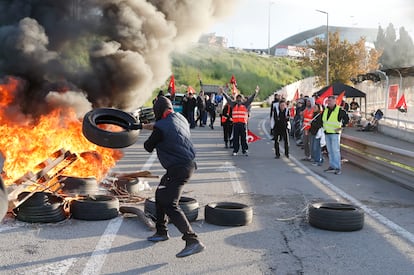
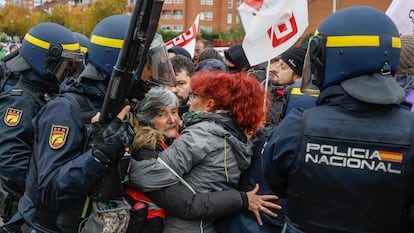
The demonstrations were overwhelmingly peaceful, although clashes were recorded in Madrid, where there were police charges, and in Barcelona. In the Catalan capital the protest descended into looting by groups of hooded individuals, who also launched pyrotechnic devices at the regional police force, the Mossos d’Esquadra, near Plaça de Catalunya. During the day there were more than 1,500 incidents across the territory involving pickets and demonstrators, according to the Interior Ministry. More than 50 people were arrested at pickets and that total rose to almost 70 in the subsequent disturbances.

Union leaders criticized the police response as excessive and for the use in some cases of pepper spray. The two main unions, CC OO and UGT, denounced disproportionate use of police force and announced they would study possible legal actions. The employer associations CEOE and Cepyme condemned the vandalism and demanded respect for the right to work of those who wished to go to their jobs.
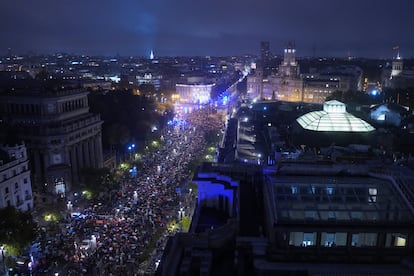
In Madrid more than 120,000 people, according to the Government Delegation’s estimate (between 600,000 and 750,000, according to the organizers) took part in the demonstration at 6.00 pm. A tide of demonstrators defied the bad weather, from university students to government employees and pensioners, illustrating the breadth of the social concerns, which include a lack of affordable housing, low salaries and cost of living concerns. The march set off from Atocha station, passed along Gran Vía and reached Plaza de España, where a police cordon had been deployed.
Chanting “This is class struggle” and “Madrid will be the tomb of rentiers,” protesters marched through the capital’s streets in heavy rain at the end of a day of strike action that began to take shape after the eviction of Maricarmen Abascal, an 87-year-old Madrid resident who died on October 7, two weeks after being forced to leave her home. Her fight, and her call for young people to “fight for what’s yours,” inspired a prolonged encampment in Sol square and led a group called the Tenants’ Union (Sindicato de Inquilinas) to make the first call for a nationwide strike.
The unions highlighted the high turnout in industry, automotive, logistics, energy and port facilities. By contrast, public administrations, health, education and much of the services sector registered a more limited impact. The unions placed territorial participation in a range from 41% in regions such as Castilla-La Mancha and Extremadura to more than 80% in Catalonia and Andalusia.
Transportation was one of the areas most affected by the strike. The state railway company, Renfe, reported 6.83% participation among its night and morning shift workers. However, 24% of high-speed and long-distance commercial services were cancelled and 10.17% of scheduled Cercanías, Rodalies, Avant and medium-distance public services were suspended. In air travel, the airport operator Aena recorded 234 cancellations out of 4,529 scheduled flights until 10.00 am, representing 5.16% of the total.
Madrid concentrated some of the most serious incidents of the day, particularly at the wholesale food market Mercamadrid and at EMT bus depots. There were also temporary closures on roads, including the M-30, the A-42, the A-5 and the A-6. In Catalonia pickets blocked access to Barcelona and caused restrictions on the AP-7, the A-2 and the Ronda Litoral.

There was no widespread closure of retail stores. Supermarkets and major distribution chains kept their establishments open, although with staffing and schedule variations. The unions put participation at 60.8%, while employers said that small shops operated practically normally.
On television, the main national channels maintained their broadcasts, although there were two notable episodes in the public audiovisual sector: Canal Sur interrupted its programming, and RTVE Catalonia had to move the program Cafè d’idees to another set after a group of demonstrators entered the facilities.
An ‘unorthodox’ strike
Under the slogan Salaries, housing, prices, it was the first general strike called by the unions in 14 years, and even then it was viewed as “unorthodox” since it was not a response to a specific piece of legislation or to any single government body. Instead it grew out of a wave of public outrage over an eviction and out of protests organized by a group that is not a labor union. It also falls 18 days before a general election, and it comes after a train accident that has brought about “a certain shift in the country’s mood,” according to CC OO leader Unai Sordo.
Sign up for our weekly newsletter to get more English-language news coverage from EL PAÍS USA Edition