
Almeria
Stolen van dumped in Níjar found packed with fuel for drug boats and migrant ‘taxis’


Guardia Civil officers opened the back of the van and found 77 canisters of petrol. Credit: Ivanb.photo / Shutterstock
A stolen van abandoned on the edge of Níjar looked like a routine theft until Guardia Civil officers opened the back and found 77 canisters of petrol. Investigators believe the fuel was destined for drug-running speedboats and the small boats known as ‘pateras taxi’ that carry migrants along the coast.
A theft in Granada led Guardia Civil to Almería
The investigation began in May, after a van was reported stolen in La Alpujarra, the mountainous inland district of the Granada province. Officers eventually traced it more than 150 kilometres south, to Níjar, the eastern Almería municipality that also takes in the Cabo de Gata-Níjar Natural Park. The van had been abandoned there, and inside the vehicle officers found a total of 77 plastic fuel containers full of petrol. The case quickly changed from an ordinary vehicle theft into something that was clearly much bigger.
The fuel network feeding narco-boats and migrant ‘taxis’
Guardia Civil believe the petrol was bought at a service station near Alhama de Murcia and driven south specifically to resupply boats working the Almería and Murcia coastline, a practice known locally as petaqueo. Two kinds of vessel rely on fuel drops like this one: Narcolanchas, that are fast and unmarked speedboats used to run drugs across from north Africa, and pateras taxi, which are smaller boats that carry migrants directly onto Spanish beaches for a fee (rather than leaving them to make the crossing unassisted).
Both need a steady, discreet supply of petrol that never has to touch a normal filling station near the coast, which is what makes networks like this one valuable to organised crime, and hard for officers to trace back to source.
Two men from Librilla were arrested with prior drug convictions
Guardia Civil arrested two men, aged 33 and 42, both residents of Librilla in the Región de Murcia. Both had previous convictions linked to drug trafficking, according to the investigation. They now face charges of theft for use of the van and an offence against collective safety, over the alleged storage of a large quantity of flammable fuel inside an unsecured vehicle.
Part of a wider crackdown on Murcia’s fuel-smuggling gangs
The arrests come just a week after the Guardia Civil dismantled a separate criminal group operating in Lorca and Puerto Lumbreras, in the Región de Murcia, accused of stealing tractors and running its own petaqueo racket. Six people were arrested there on August 17. Guardia Civil has not linked the two cases directly, but both fit a pattern seen along the Almería-Murcia coastline this summer. A separate operation was reported elsewhere in Spain that ended in 78 arrests and the seizure of assets worth €24 million, as authorities squeeze the same drug and migrant-smuggling supply chains from several directions at once.
Guardia Civil said the investigation into the Níjar case remains open, and further arrests have not been ruled out.



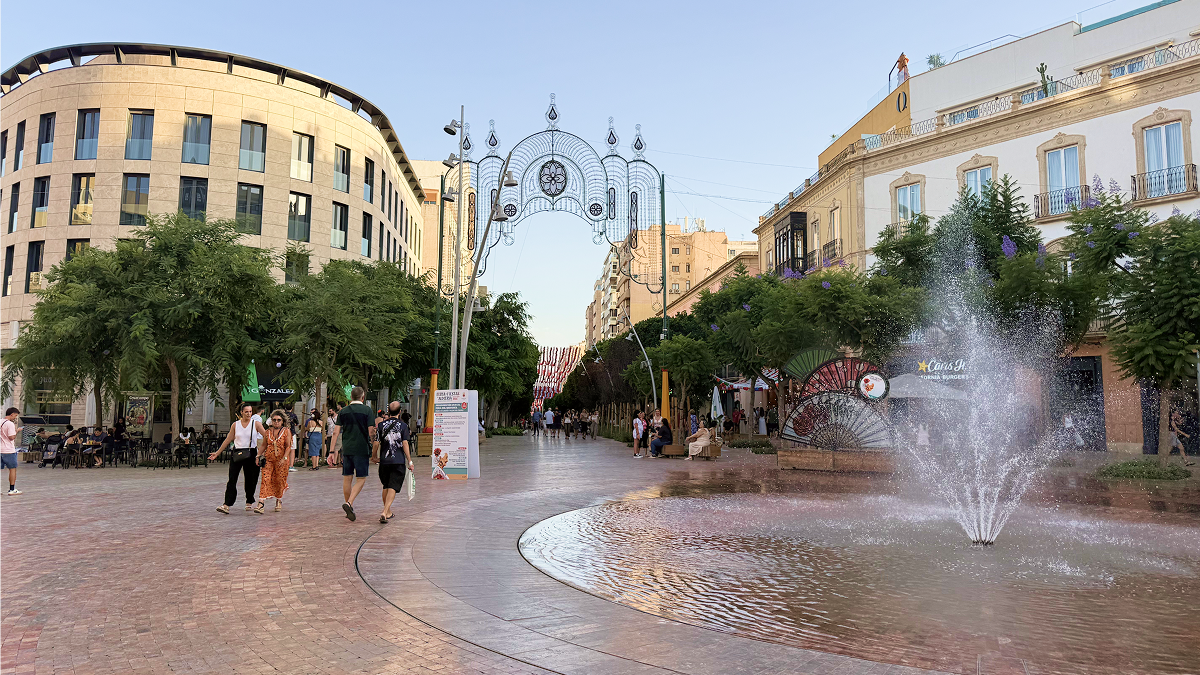
Puerta de Purchena, where the newly pedestrian Paseo now leads straight into the Feria. Credit: Euro Weekly News
For more than a year Almería’s main promenade has been a building site. Now, largely car-free after an €11.2 million transformation, the Paseo de Almería returns as the centre of the city’s Feria for the first time since the works began, backed by new bus routes and one of its biggest security operations yet.
The pedestrianised Paseo returns as the Feria’s stage for the first time
Almería City Council has spent €11.2 million rebuilding Paseo de Almería as a largely car-free public space under its ‘Ciudad de Plazas’ project, removing 9,700 square metres of asphalt, planting more than 320 trees and reserving just 3,600 square metres of restricted lane for residents, public transport and emergency vehicles. The works began in January 2025 and left the promenade unable to host the Feria’s usual activities while they were under way.
This year, for the first time since the transformation began, the council has restored what mayor María del Mar Vázquez called the Paseo’s historic role as a festival hub, with a miniature fair entrance at Puerta de Purchena, seven ambigú stalls (food and drink stands) spread across five plazas and a photocall area. For the nine days of the fair, between Friday August 21 and Saturday August 29, even that restricted resident and public transport lane is closed completely between Puerta de Purchena and the junction with Calle Lachambre and Calle Rueda López, with just two crossing points left open for people needing to reach the other side, according to the council’s full mobility guide.
The fairground goes car-free every night
From 6pm to 6am each day between August 21 and 29, the Recinto Ferial (fairground) is closed to general traffic altogether. Only public transport and residents with a permit can enter, through checkpoints at the Camino de la Goleta roundabout and Avenida Vega de Acá, or a new checkpoint at the junction of Árbol de la Seda and Camino de la Goleta.
One-off closures apply on top of that. The Dianas Floreadas parades on August 22, 23, 26 and 29 bring progressive traffic stops from 11am, a historical re-enactment through the centre closes streets on August 23, and the Batalla de Flores parade shuts Avenida Federico García Lorca and central streets including the Rambla from mid-afternoon on August 24.
Eight new bus routes link the city for €1.30 a ride
The city council has added eight special lines, labelled F1 to F8, connecting neighbourhoods including La Salle, Calle Granada, Pescadería, Piedras Redondas, El Alquián, Retamar, Torrecárdenas and Cruz Roja directly to the fairground. They run from 8pm to 7am, starting an hour earlier on August 26, 28 and 29, with a flat fare of €1.30 across the whole special network.
Traffic councillor María del Mar García Lorca said the reinforced service was designed to give residents ‘comfortable and accessible’ travel to and from the fair. Twenty-six vehicles have been assigned to the special routes alone, with the wider network running up to 60 buses at peak times.
More than 300 police officers a day, plus drones and a new mounted unit
Security for this year’s fair involves more than 300 officers and staff a day, drawn from the Policía Local, Policía Nacional, Guardia Civil, Bomberos de Almería (the fire service), Protección Civil and private security firms, alongside medical teams.
New this year is an aerial drone system giving live video coverage of the fairground and surrounding streets, and a mounted police unit joining patrols for the first time. Rapid-intervention and canine units are also deployed, alongside breathalyser checks on drivers and food safety inspections across the site’s stalls.
Mayor María del Mar Vázquez asked residents to ‘enjoy the fair with responsibility, civility and confidence’ in the measures put in place to keep it safe.
David Bisbal returned home for the fair’s biggest anniversary
Almería-born singer David Bisbal gave the traditional sermón (a ceremonial address in the Virgin’s honour) at the Virgen del Mar sanctuary on Friday August 21 at 7:30pm, as the city marked 75 years since she was granted her canonical coronation. He also gave a spectacular performance while closing the final night at Cooltural Fest, the city’s biggest music festival of the year, that brought more than 60 acts to Almería this year, including Lori Meyers, Ana Torroja, Hombres G and Rigoberta Bandini.
Behind a newly built 22.5-metre illuminated entrance gate, the fair runs to 21 casetas (marquees), three bullfights and a closing procession honouring the Virgen del Mar on August 30, when Almería’s newest public space will complete its very first Feria.
Almeria
David Bisbal’s incredible Almería homecoming turns Cooltural Fest into ‘one enormous chorus’

David Bisbal performs during his headline set at Cooltural Fest in Almería. Credit: Juan Marin Escoriza
David Bisbal turned his own hometown audience into one enormous chorus as he closed Cooltural Fest on its final night. The singer was one of the main attractions at a festival that one audience member says keeps getting better: bigger, louder and, in their words, more inclusive than anywhere else they’ve been.
Bisbal closes the festival with a tribute-filled homecoming set
David Bisbal closed this year’s four-day Cooltural Fest, one of the headline events of Almería’s summer feria calendar, on Sunday August 23 at the Recinto Ferial in his home city. The festival ran from Thursday August 20, and Bisbal shared Sunday’s bill with Vera GRV and Nixon, though the closing slot was always his.
The show, which began around 11.15pm, was later described as “apoteósico”, all-out spectacular, built around hits including “Ave María“, “Bulería” and “Lloraré las penas“, alongside tributes to Camilo Sesto and Julio Iglesias. Bisbal returned to the phrase “mi Almería” (my Almería) throughout, and by the closing numbers the fairground had reportedly become an enormous chorus, with thousands singing every line back at him.
It capped a busy few days for the singer in his home province. Two days earlier, on Friday August 21, Bisbal addressed the Virgen del Mar procession at the saint’s sanctuary, an appearance presented by his partner Rosanna Zanetti. The Cooltural Fest set was billed as his only Almería concert this summer, and arrives ahead of his new album, Eternos, due for release on Thursday October 2.
‘Everyone danced and sang every song’ on the closing night
For Paula Jiménez, 31, who attended all three days of the festival, the Bisbal set lived up to the billing. “On Sunday the most anticipated concert was obviously Bisbal, everyone danced and sang every single song,” she said.
Bisbal was not the only highlight of the weekend, though. On Friday, Paula said the crowd’s most enthusiastic reaction came for “Malibu” by underground artist Rusowski. “The crowd danced to it with so much energy, it was great fun,” she said. Saturday brought a surprise in Ultraligera, a band she hadn’t come across before. “Their stage show and the quality of the set really surprised me,” she added.
Bigger crowds, yet no queues this year
Cooltural Fest’s attendance has grown year on year, and Paula said this year’s crowd was noticeably bigger than the last edition. The site layout had changed too, with the entrance and the toilets moved to different spots around the grounds. “The toilets are now closer to the entrance, which was appreciated, and there are more near the Cupra stage,” she said. Despite the extra numbers, she affirmed that the reorganised layout meant no long waits for food or the toilets across the weekend. “The toilets especially weren’t overwhelmed like I’ve seen at other festivals,” she said.
One of Europe’s most inclusive festivals
The festival’s growth has come alongside a long-running employment and accessibility programme run with the Fundación Music For All, which has placed more than 50 people with disabilities in festival roles each year, including bar work, cleaning, access control and backstage support.
“We’re proud that each year there continue to be advances in this area,” said Crash Music director Diego Ferrón, whose company organises Cooltural Fest. Provincial equality representative Lorena Nieto has called it “the most relevant inclusive cultural project in the province.” On-site measures this year included sign language interpreters, subtitled performances and sensory-friendly spaces, part of more than 50 accessibility services built into the festival. Paula Jiménez said the improvements were visible on the ground.
“What makes it so inclusive is how well they manage the spaces so they work for people with different needs, as well as subtitling the songs during concerts and including sign language interpreters,” she said. “I’ve seen more people with functional diversity here than at any other festival.”
Next year’s 2027 edition marks the festival’s 10 year anniversary, and after this year’s line-up being a little askew from their usual style of heavily indie based acts, the anniversary edition could promise a spectacular return to its roots with some huge national and international names on the bill.
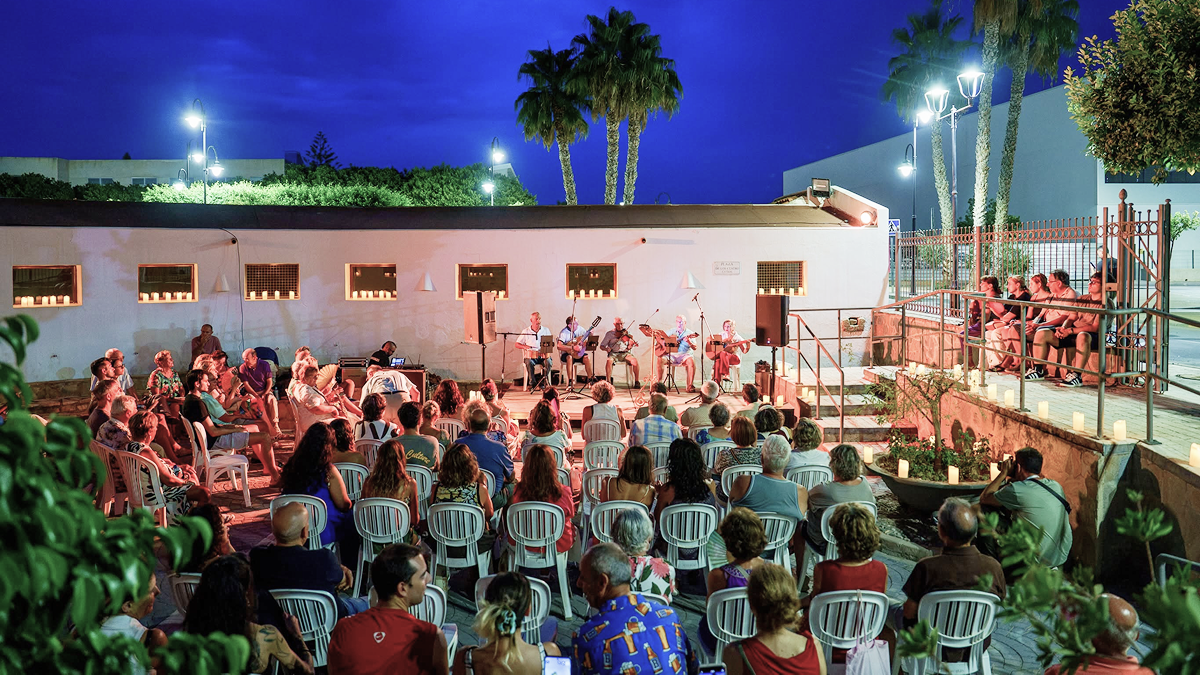
Poets and musicians performed by candlelight in Vera’s Plaza de los Cuatro Caños. Credit: Ayuntamiento de Vera
Rows of candles lit the walls of a square where residents once did their washing, as poets took turns at the microphone and musicians performed close by. It was the fifth year running that Vera has turned one of its oldest corners into a stage for an evening of verse and ambient music.
Poets took the mic surrounded by candlelit walls
Vera’s Plaza de los Cuatro Caños hosted the fifth edition of La Noche de Poesía y Música a la luz de las velas (the Night of Poetry and Music by Candlelight) on Wednesday, August 19. Poets read from a small stage set up in the square as musicians played guitar and violin beside them, with candles lining the walls and niches around them. The Ayuntamiento de Vera (Vera town council), which organises the event, said the evening drew both residents and visitors into what it described as a close, unhurried atmosphere.
Culture councillor Antonio Soler also attended the evening, taking his place among the crowd.
A square where residents used to do their washing
The Plaza de los Cuatro Caños takes its name from a 19th-century fountain with four spouts, built alongside the town’s old municipal laundry. For decades it was one of the places residents gathered to wash clothes and collect water, long before running water reached homes directly.
Of course, washing bedsheets at the public square disappeared as Vera modernised, but the fountain and its square remain among the most recognisable corners of the town’s historic centre, a short walk from the fortress-church of Nuestra Señora de la Encarnación.
A bit of history: Vera itself was rebuilt after a devastating earthquake
The town’s current centre, including the Cuatro Caños square, sits curiously on the site Vera moved to after disaster struck its original hilltop settlement on Espíritu Santo hill. An earthquake on November 9, 1518, destroyed much of the old town, forcing residents to rebuild on flatter ground nearby.
The new town was built as a walled enclosure with eight towers and two gates, centred on the fortress-church constructed partly as a defence against Barbary pirate raids along the coast. Little of the original hilltop settlement survives today, and the rebuilt centre has shaped Vera’s layout ever since.
A tradition that has grown since its first year in 2022
The candlelit poetry night began in July 2022, when 12 poets, five musicians and three presenters filled the square for its debut, drawing a full house of residents keen to see the tradition begin. Then-culture councillor María Manuela Caparrós said the idea was to showcase the art of reciting and enjoy a summer evening surrounded by music and warm candlelight, creating a magical and romantic atmosphere.
Five years on, the council said it intends to keep using spaces that form part of Vera’s identity for cultural events, following a summer that has also included its weekly Sunset Symphony concerts in the town.

Díaz-Canel Afirma Que El Diálogo Con Estados Unidos Está “estancado”

Silvia Pérez Cruz Lleva Su Canto A Una Habana En Penumbras

British Woman Stranded In Spain After UK EVisa System Fails To Recognise Her

Attaoui Saca Un Bronce En 800m De La Casi Nada
Flames force Spanish troops to evacuate 1,000-year-old kings’ bones from burning monastery

Última Hora Del Terremoto En Colombia, En Directo | Al Menos 132 Muertos Y 570 Heridos Por El Seísmo De Magnitud 7,4


-
 800 metros lisos2 weeks ago
Attaoui Saca Un Bronce En 800m De La Casi Nada
-
aragon wildfire2 weeks ago
Flames force Spanish troops to evacuate 1,000-year-old kings’ bones from burning monastery
-
 Bogotá2 weeks ago
Última Hora Del Terremoto En Colombia, En Directo | Al Menos 132 Muertos Y 570 Heridos Por El Seísmo De Magnitud 7,4
-
Mallorca2 weeks ago
Qatar Royal Family’s £300m ‘Palace in the Sky’ lands in Mallorca ahead of historic eclipse
-
Latest2 weeks ago
EU Curbs On ‘forever Chemicals’ In Food Packaging Kick In
-
Benalmadena pueblo2 weeks ago
Five days that turn Benalmadena pueblo into a giant street party and everyone’s invited
-

 ElPais2 weeks ago
The Total Eclipse In Spain, In Pictures
-
climate change2 weeks ago
Jellyfish strike France’s biggest nuclear plant again and shut down three reactors