
ElPais
The Julio César Chávez Family: Mexico’s Most Famous Boxing Dynasty Faces A Different Kind Of Fight












The port and ferry terminal in Helsingborg are bustling with activity. Everything operates with an almost choreographed efficiency. Ferries maneuver slowly; refrigerated trucks wait their turn to board alongside cars, cyclists, and workers who cross the Øresund Strait as if taking a commuter train. After all, only 2.5 miles separate Swedish Helsingborg (population 114,000) from Danish Helsingør. From the waterfront, under the oblique light of northern Europe that lengthens the evenings over the water, the strait is so narrow it is hard to see it as a strategic border. But that maritime line, which looks ordinary on maps, is today one of the flashpoints between Russia and NATO. It is the setting of a gray, hybrid war of maritime sabotage and ghost ships.
The Øresund Strait, also known as the Sound, is one of three gateways from the Baltic Sea to the Atlantic Ocean, along with Denmark’s Great Belt and Little Belt. That means every vessel entering or leaving the Baltic — cargo, energy, oil, data cables, or military — passes through this corridor.
For centuries, controlling Øresund meant controlling access to the Baltic, says Per Svensson, 62. Tanned from his morning walks, he downs a black coffee in a café near the Helsingborg ferry terminal as he recounts working for two decades on the port’s ships. Now he likes to sit and watch the ferries and freighters coming and going — and read about the region’s history. “These waters have always been ordinary to us, not a border. Now everything seems to have changed,” he says, pensive.

Historically, these straits were a source of power and wealth for Denmark, which for four centuries collected maritime tolls. In post–Cold War Europe, that geostrategic significance faded somewhat under decades of Nordic integration, short ferry crossings, and weekend tourism. There are no tolls today. But the strait’s old strategic importance has returned forcefully amid Russian efforts to move the hydrocarbons that fuel its war against Ukraine.
In 2025, Nordic authorities verified the passage of at least 292 vessels linked to Russia in the region. Ships that left Russian Baltic ports transited Øresund or the Great Belt to the North Sea and from there to the Atlantic. From the terrace of the luxury Clarion hotel in downtown Helsingborg, where NATO foreign ministers met last week, you can see those vessels almost every day, says Sweden’s Foreign Minister Maria Malmer Stenergard.
They look like ordinary ships, but beneath a dense layer of bureaucracy they are part of what is called the ghost fleet, or shadow fleet, Malmer Stenergard says. These are aging vessels with opaque ownership structures designed to make them hard to trace, flying flags of distant countries that change frequently — ships the Kremlin and its orbit use to move hydrocarbons. It is their way of evading Western sanctions over the war in Ukraine.
Intelligence reports have also recently documented that many of those ghost ships carry armed contractors on board whose job is to protect the cargo, and who give those vessels a military aura. “You cannot prove they are Russian military, but there is evidence they are linked to paramilitary companies with ties to the Kremlin,” a Swedish official says.
Russia’s war against Ukraine, which shook Europe more than four years ago and changed its landscape and mindset forever, produced a structural shift in the Nordic region that today, under the Kremlin threat, has been hardened. The invasion ordered by Vladimir Putin pushed Finland and Sweden into NATO. Both Nordic countries provide the Alliance with invaluable strategic and geographic capabilities. Their accession, together with the existing membership of Estonia and Denmark, changed the Baltic’s standing. With the exception of the Russian exclaves of Kaliningrad and St. Petersburg, it became an allied sea — almost a “NATO lake,” as experts put it. That raised the value of strategic points such as Helsingborg.
Conflict in the shadows
Far from being placid, the Baltic is now one of the primary laboratories of Russia’s hybrid warfare, says Elisabeth Braw, a researcher at the Atlantic Council’s Transatlantic Security Strategy Center.
There are no fleet battles or classic naval engagements. The Kremlin uses more ambiguous tactics, such as sabotage or damage to maritime infrastructure, interference with navigation systems, manipulation of AIS signals, covert operations that are hard to attribute, and espionage activities.
And at the heart of that hybrid war is the ghost fleet. “Russia has discovered these ships can be used for more than moving oil — to cause damage in the Baltic — so they are exploiting them,” warns Braw, who has extensively researched the Kremlin’s hybrid warfare.

Moscow has found it can inflict substantial damage without using military forces. There is also an environmental risk from those decrepit tankers carrying Russian hydrocarbons. Since October 2023, authorities in the region have recorded at least 11 significant incidents of damage to submarine cables — mainly telecommunications and power lines; some incidents involved gas pipelines and other critical infrastructure, according to an Estonian intelligence report. Although most investigations have not officially attributed the incidents to the Kremlin, several of the most serious cases have involved vessels linked to Russian ports or the ghost fleet.
Ships such as the Fitburg, detained by Finnish authorities in December 2025 after being implicated in damage to telecom cables between Finland and Estonia. The freighter was sailing under the flag of Saint Vincent and the Grenadines, had departed St. Petersburg, and was found with its anchor down in Finnish waters — a pattern that bears a strong resemblance to the Russian shadow fleet.
Thus, Helsingborg, a bottleneck of the Baltic, has shifted from a peripheral, quiet place to an area under watch. The small southern Swedish port city and the Øresund Strait are now part of the Atlantic defensive architecture.
Maritime law establishes that vessels that appear linked to the Russian ghost fleet have the right to sail. And unless there is evidence of environmental risk, illegal fishing, or another crime against maritime traffic, Swedish, Danish, Estonian, or Finnish authorities have limited room to act.
A few months ago, however, the Swedish government enacted a legal change that expands the Coast Guard’s powers to request insurance information and to monitor ships merely transiting Swedish territorial waters and even Sweden’s Baltic exclusive economic zone. “We are not at war, but we are not at peace either,” Prime Minister Ulf Kristersson has said.
Back at Helsingborg’s port, whose terminal almost fronts the terraces of waterfront restaurants and cafés crowded under the May sun, Karin Akerman says she is “a little worried.” The 55-year-old teacher has two teenage grandchildren and fears the war may one day reach her waters. “We always thought we would never experience a conflict, but nothing feels safe anymore,” she says. Nearby, in a small square, two teenagers record a TikTok video. For a couple of days the town’s attraction has been the tide of police and military personnel deployed during the NATO meeting. “Nothing ever happens here. And I don’t think anything will happen,” one of them says.
Not far away, at various points along the Skåne coast, concrete bunkers built during World War II and expanded during the Cold War still face the Sound. For years they were historical, anachronistic remnants of a Sweden on alert when the Baltic was seen as a potential line of confrontation with the Soviet Union. Now, in a country that is continuing to militarize and which talks about submarine cables, maritime surveillance, espionage, and hybrid warfare, they make sense again to many.
Sign up for our weekly newsletter to get more English-language news coverage from EL PAÍS USA Edition
Abelardo de la Espriella
In The Final Stretch Of Colombia’s Presidential Campaign, Undecided Voters Are In High Demand


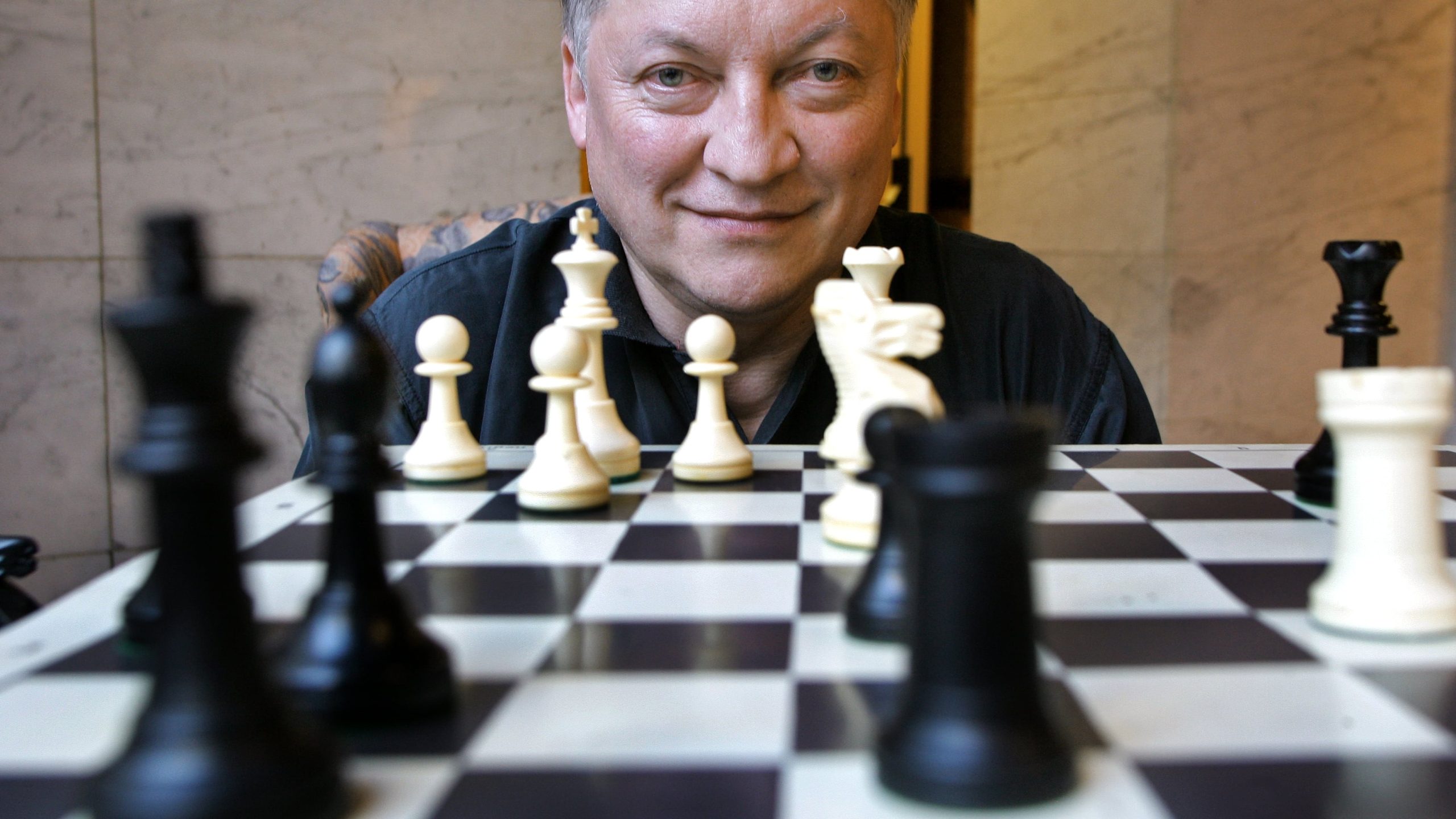
Anatoly Yevgenyevich Karpov is the most decorated and acclaimed of the championship chess players produced by the Soviet Union — the world’s largest country until its dissolution in 1991 — where chess was a deeply rooted national passion. A six-time world champion and winner of more than 160 tournaments, Karpov turned 75 on Saturday. He is living with serious health problems and is confined to Russia because, as a member of Vladimir Putin’s party in the State Duma, Russia’s lower house, he is on the list of sanctioned individuals barred from traveling to the West. This is despite having spoken out against the invasion of Ukraine in 2022 — although, just days earlier, he had voted in favour of annexing the Ukrainian provinces of Donetsk and Luhansk.
Those close to him have been deeply worried ever since. Eight months later, he was found unconscious on the pavement of a street near the State Duma with a severe head wound; there is no strong evidence that it was an attack rather than an accident. Sources close to him say he has not been the same since he left the hospital and has barely any public life.
In a sad irony, EL PAÍS’s last interview with him — in the Spanish city of Vigo in September 2021 — had much to do with healthy brain aging. He appeared in good shape, enjoying fine food and life, full of projects, and still with a prodigious memory and an unbounded love of chess. There are grounds to rank him among the greatest athletes in history — his achievements, impact, and symbolism go far beyond chess — and his life might deserve a film with a far broader scope than The World Champion, which focuses on his duels with dissident Viktor Korchnoi, the most tense game in chess history.
He had a brush with death shortly after birth, grew up sickly near a malfunctioning nuclear plant, restored the national pride that Boris Spassky had lost to the U.S. chess player Bobby Fischer, was decorated in the Kremlin after defeating Viktor Korchnoi, and sustained with Garry Kasparov the greatest rivalry in the history of individual sports. No one has won more tournaments than he has.
His early years were traumatic. While he watched, from his bedroom window, children his age playing in the street, Tolia — the affectionate diminutive for Anatoly — spent many days ill, confined to bed. He took refuge in chess, which he had discovered at the age of four with his father. His mother, Nina Grigorievna, once removed the board and pieces from his room. “But soon I got scared and gave them back. I would see him staring at the ceiling and realized the chess pieces were still jumping around in his head — he was playing without a board,” she explained years later.
His rise to international fame came in 1969, when he became world junior champion. In 1973, he began his climb to the summit, defeating all his rivals in the World Championship Candidates cycle. Only Fischer remained. In 1975, the brilliant U.S. player forfeited the title after falling out with the International Chess Federation (FIDE), and Karpov became champion without moving a pawn. But unlike his predecessors, he played every tournament he could — and won almost all of them for a decade (1975–1985).

Karpov not only restored the national honour lost by Spassky to Fischer — for the Soviet government, chess was the showcase of communism’s intellectual superiority over capitalism — but became a national hero when he defended the title twice, in 1978 and 1981, against the “traitor” Korchnoi.
Before that, he had met Fischer several times in secret, trying to persuade him to play the match millions of fans longed for. The talks went nowhere. And then came Korchnoi, winner of the Candidates Tournament after defecting from the USSR and therefore Karpov’s official challenger in Baguio, Philippines, in 1978. The dissident used the global spotlight to demand, loudly and relentlessly, the release of his wife and son, held in the USSR. Beyond the scandal, the match was thrilling in purely sporting terms. It was played to six wins, with no limit on the number of games. Despite his exhaustion — gaunt, several kilos lighter — Karpov somehow found the strength to land the decisive blow in the final game, after three months of fighting.
The icy Tolia was world champion again, in highly charged political circumstances, as shown by an effusive telegram from Soviet leader Leonid Brezhnev. Now a national hero, Karpov kept winning tournament after tournament and renewed his title against Korchnoi again in 1981. Everything suggested he would finally enjoy the happiness of a champion and national idol: married, with a son, a degree in economics, a doctoral thesis on the use of leisure time, three‑time world champion, close to reaching a hundred tournament victories, the undisputed number one, and with no rival of comparable stature in sight.
In reality, that bright horizon did not last long. In distant Azerbaijan, another genius was rising: Garry Kimovich Kasparov, whose meteoric ascent was repeatedly obstructed by the parasitic bureaucrats around Karpov, the Kremlin’s hero. One of them, Nikolai Krogius, delivered a lapidary line: “Why do we need another world champion if we already have one?”
But Kasparov reached the summit, and the five matches between them (1984–1990) have no parallel in sports history: more than 500 hours sitting face‑to‑face on stage, thousands more obsessively thinking about each other under immense political pressure — Karpov symbolizing the old guard, Kasparov the perestroika (renewal) of Mikhail Gorbachev — as well as economic and sporting pressures. Counting only the 144 games they played in world championship matches, the score favours Kasparov by the narrowest of margins: two points.
Kasparov’s reign brought a schism, with two world champions. While in his forties, Karpov still managed to win the official FIDE title three more times (1993, 1995 and 1998), while also engaging in major social causes: UNICEF ambassador for Eastern Europe and president of an association supporting victims of the Chernobyl nuclear disaster. None of this stopped him from playing rapid tournaments, giving exhibitions and lectures, all while serving as a member of the State Duma.
And then came the ill‑fated year of 2022. Those who know him well insist that Karpov’s strong opposition to the invasion of Ukraine is entirely sincere, which raises doubts about whether the sanctions against him are fair. It is also known that the travel ban imposed by international sanctions depressed him. Whether his hospitalization was due to a freak accident or an attack, it likely would not have happened without the invasion, because he used to spend at least half the year travelling. While Kasparov sits high on Putin’s list of enemies, Karpov has already become a victim of the autocrat whose party he still belongs to — however hard that may be to understand.
Sign up for our weekly newsletter to get more English-language news coverage from EL PAÍS USA Edition
The Øresund Strait, The New Frontier In Russia’s Hybrid War Against NATO

E

E


-

 Competiciones3 weeks ago
E
-
blackout April 20253 weeks ago
Insurance company Mapfre decides to pay out €14 million compensation for 2025 blackout
-
 Foreign demand3 weeks ago
Who Bought Where In The Second Half Of 2025?
-

 New Developments3 weeks ago
Stylish 3-Bedroom Apartment With Panoramic Sea Views – Benalmádena
-
 America3 weeks ago
E
-

 New Developments2 weeks ago
Inside The Most LUXURIOUS Apartment Building In Spain!
-

 New Developments3 weeks ago
Luxury Villas For Sale, Estepona – ProjectL1
-

 Holiday rentals4 weeks ago
Why Removing Tourist Lets Isn’t Fixing Spain’s Rental Shortage