
Bill Clinton
They Steal Our Data, They Steal Our Democracy. The Moral Catastrophe Of Big Tech’s Totalitarians-For-Profit

On November 10, 2019, Dr. Ursula von der Leyen, the president-elect of the European Union, made the trip from Brussels to Berlin to present me with the Axel Springer Award for The Age of Surveillance Capitalism. She seemed to grasp her historical moment at a time when Europe stood out as the only geopolitical force capable of stopping the freefall into digital dystopia.
“We believe in a human-centric approach. Europe puts values, rights, trust and the rule of law above all else. This must also apply to the European approach to the Digital age. For us, new technologies will never mean new values… The individual is first and foremost a citizen – with rights and control over our own lives…Analog or digital…”
The president-elect understood that those values would be ground to dust by the other great powers. “In the U.S., the market traditionally comes first… In Asia…the government tends to dominate, and the individual has to accept a subordinate role to the group. Russia… requires internet providers to install network equipment capable of identifying the source of traffic and filter content.”
“In contrast,” she emphasized, “Europe has a long tradition in balancing the power of government and market while attaching particular priority to the individual. That is Europe’s great advantage in shaping the digital age. Moreover, it is not too late. Of course, progress is not a given. We have to keep pushing.”
I recall the feeling in the room after her remarks. The freezing wind scraped the windows above the city, but inside we shared a sense of hope, warmth and solidarity. The woman who was to lead the EU grasped the significance of this next great civilizational transformation. We were relieved too by her understanding that among the great powers only the EU was prepared to act on the values, rights, and laws that could forge a democratic and digital century for Europe and the many others around the world desperate to outrun dystopia.
The dominant paradigm: 1997
Most of us know that Democratic societies are under siege across the globe, and authoritarians are on the rise. We know that Big Tech is bigger than ever. The flywheel that drives tech’s most recent stage of development, often characterized as “Generative AI,” lays claim to the totality of human-generated information, capital, and natural resources. These facts are in plain sight, but less obvious is their explanation. Why democratic contraction and explosive authoritarian expansion? These are not random events or mere coincidence. They are twins born, two sides of one coin, an accidental dystopia crafted by democratic political leaders in a bonfire of ignorance, moral disorientation, and intellectual confusion.
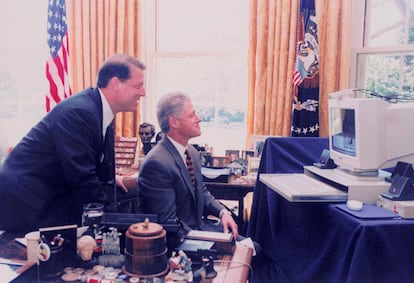
Let’s visit for a moment a sunny July 2, 1997, at the dawn of the public internet when then-U.S. president Bill Clinton stepped up to a White House podium and introduced the Clinton-Gore Whitepaper on Electronic Commerce to a grand hall packed with the glitterati of the U.S. tech sector. The whitepaper was a critical point of origin for the madness that would curse the decades that followed. Clinton described electronic commerce as “the wild West of the global economy,” and then he pledged to keep it so.
“The Internet,” he said, should be a global free trade zone, a place where government makes every effort not to stand in the way… It was the textbook rendering of the neoliberal creed that elevates a free market above all other societal considerations.

Clinton and Gore wrapped their ideology in Silicon Valley’s crackpot mythology of the internet as an extra-societal zone called “cyberspace” where the norms, rights, and laws of real-world democracies do not apply. The priority was business unrestricted by democratic governance. “We want the private sector to regulate itself. We want to encourage all nations to refrain from imposing discriminatory taxes, tariffs, unnecessary regulations, cumbersome bureaucracies.”
The U.S. abdication of the new global information space to private capital at that early stage of a vast structural transformation to an information civilization was a tragic “own goal” that left a void where democratic governance should have been. The U.S. and its sister democracies abandoned whole societies, including their own, to new forms of digitally mediated violence from state and market actors. They surrendered the opportunity to lay the foundations of a democratic digital century during its critical first decades, depriving the world of a clear alternative to the Chinese model of an authoritarian surveillance-based information civilization.
If this sounds eerily familiar, it’s because democratically elected leaders around the world are reenacting this drama, now under the moniker of so-called “Artificial Intelligence.”
Voids are fleeting, and the void of democratic governance at the birth of the public internet was quickly filled by surveillance capitalism and the kinds of predators who stalk every lawless gold rush.
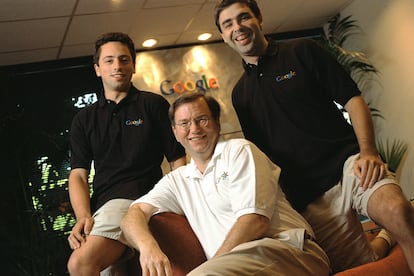
One year after Clinton’s giveaway, a 1998 BBC interview with Eric Schmidt anticipated the antidemocratic whirlwind to come. When asked about Silicon Valley’s politics, the then-CEO of software company Novell who would soon be tapped as Google’s first chief executive, barked his answers without hesitation: “We are anti-government, anti-regulation, anti-Congress.”
BBC: You want a jungle, in fact, don’t you? Where the most powerful survive, and there’s no safety net for those underneath?
Schmidt: That’s correct!
BBC: Are you proud of it?
Schmidt: (replying with a broad grin) Yes!
What made Schmidt’s demand for complete and unaccountable authority even more brazen was his understanding that in the absence of democratic governance an internet owned and operated by Silicon Valley was certain to transform societies in unimaginable and dangerous ways. “We’ve never run an experiment where all hundred or two hundred million people who are connected to the network, their voices are actually heard… We’ve never run such a large experiment in anarchy in the history of the world. All sorts of things are going to happen.”
Despite the unprecedented and therefore impossible-to-anticipate risks he foresaw, Schmidt insisted that he and his colleagues had the right to lead it all without interference, conjuring the same empty arguments that Gilded Age oligarchs relied on a century earlier and tech industry leaders parrot today.
“We want the government out of our business”, Schmidt told the BBC. “We want to be free to pursue our own interests…we also want government to leave us alone.”
Thanks to the Clinton-Gore doctrine, the Silicon Valley elite got its way by simply claiming experimental authority over a world-historic transformation in the global conditions of human communication, information integrity, the fate of truth, and the distribution of knowledge in an information civilization.
Thus began a multi-decade experiment that continues to this day, replete with the uncertainties and tragedies of global information anarchy based on “self-regulating” private ownership of the information space without constraint or accountability. There were to be no rights and no rights to have rights in this vision, neither for human subjects nor citizens. There were no guiding laws, no transparency, no democratic governance…. It was to be the companies who determined the answers to every question of knowledge, authority, and power: Who knows? Who decides? Who decides who decides?
What could possibly go wrong?
The new economic logic was born at Google in 2002, barely a year after Eric Schmidt was chosen as the startup’s first CEO. It was the gloomy emergency of the dot-com bust, and the Valley had yet to figure out how to turn “users” and their data into money.
In the heat of crisis, a small band of engineers and data scientists working closely with Google founders Larry Page and Sergey Brin stumbled into a discovery and a big idea. First, they determined that with each internet engagement, “users” unknowingly leave a trail of behavioral signals that can be captured, rendered as data, aggregated, and analyzed to reveal hidden depths of highly predictive personal information, and used to forecast future behavior.
Next came Larry Page’s big idea. The experiences and behaviors of every person who touches the internet will become searchable, knowable, actionable. These enormous flows of personal data would enable behavioral predictions that can be sold in bulk like any other commodity — barrels of oil, tons of wheat, beginning with the famous “click-through rate.” Each step in the operation was designed to evade “user” awareness.
I’ve called these new data flows “behavioral surplus” because they were more than the company needed to support its “user” services. From Google’s viewpoint, the user as an actual human being was no longer the endgame. “Users” were redefined as passive zero-cost reservoirs of human- generated data for extraction, revenue, and profit with no further relevance to surveillance capitalism’s commercial project.
Now Google’s computers, referred to as “our AI,” told advertisers where to place their bets, and the money flowed. Everything depended on maximum data extraction tending toward totality. Each step in the operational sequence was designed to evade user awareness. The more data, the more accurate the predictions, the more knowledge, wealth and power for Google.
In real life, if you secretly take something from someone and sell it for your own profit, it’s called stealing. Back in Google’s infancy, these operations still required a moral reckoning. Some of the leadership team argued for transparency. Page and Brin insisted on aggressive data capture and retention. Page feared that transparency would lead to open rebellion from “users” and mobilize lawmakers into action against the company. Ultimately it was Page who made the final pronouncement: “THEY CAN NEVER KNOW.”
Rather than simply serving its “users,” Google would serve “users’” behavioral surplus to the machines. CEO Eric Schmidt quickly instituted a “hiding strategy.” Democracy may die in the dark, but it was decided that the operations of surveillance capitalism can only flourish in the dark. These choices condemned Google, and eventually the tides of surveillance capitalists that followed, to a permanent death match with democracy.
Surveillance capitalism now intermediates nearly all human engagement with digital architectures, information flows, digital products and services, and nearly all roads to economic, political, and social participation lead through its institutional terrain. The whitepaper laid down the paradigm and vocabulary for a new age in which the tech companies self-regulate but the people cannot. Every U.S. president to follow doubled down on Clinton’s message. Above all, democratic societies paid a high price for the political failure of leaders who nurtured a predatory new economics without considering the consequences that follow when human behavior is the commodity that drives economic growth.
It is astonishing to consider that in this zombie march toward dystopia our information spaces remain available for sale or hire by any individual, corporation, politician, dark money cabal, foreign power, disinformation factory, troll farm, authoritarian dictator, sociopath, narcissist, megalomaniac, malignant billionaire (or trillionaire) whether pursuing a personal, commercial, or political, agenda behind the cloak of secrecy that only the unique shadow privileges of the platforms can provide.
Information anarchy, including disinformation, polarization, and electoral dysfunction, favors autocracy, reshaping politics and polity across the world. Why? Because in the drive for totalities of human data, the algorithmic privileging of corrupt information is good for business, magnetizing engagement and exploding data flows. No democracy can long survive these conditions.

Today’s information spaces are a universe removed from the democratic archetype of the public square, leaving democracies in every region to face unrelenting pressure. From Brazil to Romania to Norway, Poland, Spain, Australia, India, Germany, the U.K. and beyond, we see democratic leaders struggling in the void, forced to improvise solutions to each new crisis. In most cases, there is genuine desperation to protect elections or institutions or people from chaos and even death by information anarchy. In May 2022, the Biden-appointed Commissioner of the U.S. Food and Drug Agency, Dr. Robert Califf, went on CNN to discuss the Agency’s finding that “misinformation” had become the leading cause of death in America, with a “disturbing” effect on Americans’ life expectancy.
Fool me twice
In 2019, I believed that the coming third decade was likely to be the moment when the democracies, led by the EU, would finally reclaim the void for democratic renewal and reconstruction. Instead, Mr. Sam Altman and his company, OpenAI, sought first-mover advantage in 2022 by abruptly releasing their AI ChatGPT directly into the consumer space, with no warning or institutional preparation. Altman and his team had no idea what to expect, only that they wanted to be first.
Journalist Karen Hao closely followed those early years of OpenAI’s arrival on the world stage with its obsessive drive toward dominating the totality of every resource. Its generative AI is “trained on more data and compute than have ever been used before…the maximalist form of deep learning,” she observes. “It feeds on the exploding troves of data amassed through surveillance capitalism…and abetted by the culture of AI research that views consuming as much data as possible as its moral responsibility.”
Here was a fresh round of theft, as contemptuous and brazen as the first. The race for totalities of data drowned out every moral and legal question as the AI companies went after everything: voices, faces, copyrighted materials, scraping every internet page and still warning that it wasn’t enough. Meta investors were assured that the company was feeding its AI by vacuuming up the hundreds of billions of images and videos on its pages along with posts, messages, comments. CEO Mark Zuckerberg confided that Meta planned to track, capture, and render as data the behaviors of its users as they interact with its AI services and products. Artists and lawyers, no longer naive, accused the companies of “stealing the world’s IP.”
Totalitarians-for-profit
The surveillance capitalist bosses are best understood not only in their economic roles as oligopolists and monopolists or in their societal and political roles as oligarchs, but rather in their unprecedented civilizational role as totalitarians-for-profit, rooted in the virgin spaces of an unprecedented market in human prediction that they themselves created.
Totalitarianism-for-profit is a new regime of power that departs in fundamental ways from the political totalitarianism analyzed in the wake of World War II by 20th-century thinkers such as Hannah Arendt, George Orwell, and many others. It does not achieve total domination through ideology and terror, as Hitler and Stalin once did.
Totalitarianism-for-profit introduces a vision of the future in which every societal domain is remade as information science that only the tech leaders can govern. Citizens have no standing in that imagined future. After decades of capturing, analyzing, and trading on behavioral surplus, there is little violence left to surprise us in the shift to the next stage of totalizing evolution when humanity is recast as simply “a human surplus,” the detritus of the fraught sub-optimized age of humans.
Far from mere “bros,” these corporate chieftains can fairly be described as the most dangerous leaders in the history of modern capitalism. Most recently, their abrupt introduction of so-called “generative AI” into the consumer space and the totalitarian ethos of their work expressed in the absolutist claim on all the world’s content, capital, and energy resources has only intensified the danger that we should ascribe to the men — not simply the machines.
This data-powered totalitarianism-for-profit aims toward a future that is decentered from the human, and in that essence claims its role as the enemy of democracy. It is not the future that we seek. It is not the inevitable fate of our people and our time.
Key to this drama is the lesson that surveillance capitalism was invented by a specific group of human beings in a specific time and place for specific reasons. It does not represent the destiny of digital technology, nor is it a necessary expression of information capitalism. It was intentionally constructed at a moment in history to solve someone’s problem and advance someone’s interests.
What does it mean to lose democracy?
Will our children understand the meaning of the phrase “liberal democracy” and its moral promise?
In 2024, the number of autocracies exceeded the number of democracies for the first time since 2002, the year surveillance capitalism was invented. That year, 91 autocracies accounted for 72% of the world population. There were 88 democracies in 2024, and among them only 29 were liberal democracies, the least common regime type accounting for less than 12% of the world’s population that year (900 million), the lowest in 50 years.

The year 2025 was worse. In 2024, the level of democracy for the average world citizen returned to 1985 levels. In 2025, it reached 1978 levels. There were 92 autocracies with 6 billion people, or 74% of the world population, and 87 democracies. With the U.S. losing its status as a liberal democracy, that regime type accounted for only 7% of the world population. According to the researchers at V-Dem, the Swedish institute that tracks these data each year, disinformation and polarization are key drivers of this democratic collapse and the rise of autocracies.
If you were a mere oligarch, or even some kind of tech bro, and you learned about all this, wouldn’t your very first reaction be to fix it? Because they can fix it. So why don’t they? Because these conditions are essential to their power over society. The only threat to that power is democracy itself: the rule of law, the governance of democratic institutions, privacy laws that kill behavioral surplus, laws that prosecute the tech leaders as thieves. They will not fix this.
The totalitarian-for-profit leaders of big tech reserve their most intense fear for the European Union. Their anxiety reflects the EU’s substantial legislative and judicial achievements: GDPR, E-privacy, the right to be forgotten, the Digital Services Act, the Digital Markets Act, the AI Act… The corporations regard these bodies of law as existential threats.
As the first comprehensive attempt at AI governance in the world and certain to trigger a multinational “Brussels” effect, the AI Act mobilized tech leaders to supercharge their ground troops of lawyers and lobbyists tasked with the goal of peeling back the most significant demands of the new legislation.
Europe, like the rest of the world, was relentlessly targeted by the forces of disinformation and polarization, fighting autocratic political factions within its political institutions as well as many of its member states. Elon Musk tried to tip the electoral scales in Germany in favor of the radical right. Mark Zuckerberg made a ridiculous video that blasted into the information space on January 7, 2025, shortly before the inauguration of his new patron, Mr. Trump. It included a special message for President von der Leyen: “We’re going to work with President Trump to push back on governments around the world that are going after American companies and pushing to censor more… Europe has an ever-increasing number of laws institutionalizing censorship and making it difficult to build anything innovative there.” Then came Mr. Trump and his Orwellian language games organized to diminish and insult the very actors that he most fears.
Back to the future: 2025
The language of many EU leaders appeared to change. Suddenly Clinton was in the room, and his 1997 speech was on the table. Now it was all “rollbacks of regulations,” “simplification,” “competitiveness,” “stress-testing,” “implementation dialogues,” “omnibus legislation,” “too much bureaucracy slowing us down,” “but we need further study and long delays in implementing changes.” The time-worn cliché, “innovation,” was dragged back into the center of debate — always under attack from regulations! and the rights of citizens!
Many of Europe’s most prominent civil society organizations issued thoughtful analyses showing how proposed legislative changes would weaken or destroy the hard-won rights and protections of the AI Act and other key legislative victories of the last decades.
President Von Der Leyen’s speech at the Copenhagen Competitiveness Summit in late 2025 responded to this new environment, channeling Clinton like the ghost of Christmas future: “speed up,” “combine public and private capital,” “scale up faster, cheaper,” “simplification,” “we need deregulation!”
President von der Leyen’s language moves back in time to the dawn of all things digital when the harms and violence that follow from the commodification of humanity and its revision as mere human surplus were not yet known to us. When we could not have imagined the eagerness to trade democracy and the rights of the many for the wealth and power of the few.
There is also deep irony in play. The situation is framed as a conflict between innovation and regulation, when neither one is relevant to the facts of the moment.
The tech companies are infinitely wealthy, and there is nothing to stop them from “innovating,” whatever that means. The facts suggest that they do not want to innovate. Surveillance capitalism has been insanely rewarding for the companies, executives, and investors. Even as they move forcefully into new dimensions of AI, they double down on the goals and operational imperatives of surveillance capitalism and the totalitarian-for-profit vision.
As to “regulation,” when we consider the harms produced by these commercial operations, harms so powerful that they are destroying democracy all over the world, one sees that the window for effective regulation has closed. When business practices extract an unacceptable moral and human cost, the historical experience has been to recognize the need for abolition, not to bargain over rules of engagement. Regulation did not address the scourge of child labor. Nor was there any meaningful way to regulate human slavery. Societies do not bargain with moral catastrophe. They recognize the need for fundamental change. If the culpability of the surveillance capitalists in the destruction of democracy is not such a moral catastrophe, then nothing is or ever will be.
Is President von der Leyen failing us, or are we failing her? Europe moves to the right, impelled by the very forces and dynamics that her 2019 solutions were intended to vanquish. The right has organized itself around new levers of power across EU institutions. The algorithms are on their side.
What the future needs from us
If democracy is to survive another generation, then the violence of the unprecedented market-based totalitarian powers now concentrated in the dominant tech corporations must be confronted and dismantled as we reset our societies for democratic success. Spanish Prime Minister Pedro Sánchez has grasped this democratic emergency perhaps more than any other current political leader. His powerful 2026 address to the World Government Summit in Dubai called for a new movement led by a “coalition of the digital willing” to “take back control” from the “failed states” of lawless social media platforms. Sánchez announced a series of policies with which Spain intends to lead by example. These include 1) Holding Tech executives criminally liable for illegal and toxic content on their platforms. 2) Criminalizing algorithmic manipulation and amplification of illegal content. 3) Identification of a hate and polarization “footprint” to reveal harmful platform operations and assign “legal, moral, and financial costs” to their deployment. 4) Investigation and pursuit of grok, Instagram, TikTok, and others whose manipulative “infringement” on, for example, election content, constitutes “foreign coercion.”
Importantly, in survey after survey and poll after poll, the people of the EU, and those in other nations and continents, especially our young Gen Z forced to come of age in the heated fishbowl of Clinton’s wild West internet, yearn to align themselves with the kind of future promised by President von der Leyen in 2019. They are eager to close the books on citizens’ helplessness, lawmakers’ complicity, and the myth of inevitability that freezes so many of us in deathlike resignation. And let’s be clear. The solution to today’s crisis will not be solved by trading the private power of the tech giants for the public power of the state. We return to the beginning and fill the void with mediating institutions designed to protect people and democracy from the equally dangerous pursuits of total power derived from the market or the state.
This is what the future needs from us now if democracy is to survive another generation. Situational awareness, grasp of the historical moment, and a sense of the immense opportunity to rescue and expand our democratic inheritance can help ignite a new conversation and a new movement that reaches across societies and continents.
Allegiance to democracy necessarily originates in allegiance to the well-being and capabilities of people. The concept of “democracy” is the one breakthrough idea in the long human story that insists on the worthiness of human beings, and thus our inalienable right to self-govern. It is in its essence an expression of respect for and faith in self and others.
It follows, then, that at its roots, the defense of democracy is an act of love we pay forward to a still indeterminate future. This requires mustering our faith in community, country, and in the global society to which we entrust our children and the generations that follow. But the work doesn’t stop there. If democracy is to survive the coming decades, it will be because enough people in enough societies chose to love the human and the kind of future only we can make. As you well know, love is always a gamble, but who among us has refused the bet?
She said it that night in Berlin: Europe puts values, rights, trust and the rule of law above all else. That is Europe’s great advantage in shaping the digital age. Moreover, it is not too late…progress is not a given. We have to keep pushing. YES! LET’S DO THAT!
Sign up for our weekly newsletter to get more English-language news coverage from EL PAÍS USA Edition








Marbella reinvented: Costa del Sol City heading for image change
Spain is about to get a rare six planet show and most people won’t even know it’s happening
Malaga’s splash park reopens just in time for the heat

Los Aficionados Al Ciclismo En Barcelona: “Que Venga El Tour De Francia Es Como Ir Al Mundial De Fútbol”

When is the next F1 race? British Grand Prix schedule and details for 2026
Lorry snags power cable on A-7 in Mijas, creating danger for drivers and residents


-
 Antoni Gaudi1 week ago
Los Aficionados Al Ciclismo En Barcelona: “Que Venga El Tour De Francia Es Como Ir Al Mundial De Fútbol”
-
 Uncategorized2 weeks ago
When is the next F1 race? British Grand Prix schedule and details for 2026
-
Calahonda2 weeks ago
Lorry snags power cable on A-7 in Mijas, creating danger for drivers and residents
-
Alhaurin El Grande1 week ago
Alhaurin el Grande and Coin launch historic 1.5 million kilo season for premium tomato
-

 Business & Finance1 week ago
Cheap Flights And Mass Tourism Are Adding €3,800 To The Cost Of The Average Spanish Home, New Report Warns
-
Latest1 week ago
Conservatives And Far Right To Govern Spain’s Andalusia Region
-

 Aleksandar Pavlovic2 weeks ago
Paraguay Elimina A La Apagada Alemania En Los Penaltis Para Firmar La Primera Gran Hazaña En Las Eliminatorias Del Mundial
-

 Donald Trump2 weeks ago
US Supreme Court Is Set To Rule On Cases That Will Define The Limits Of Presidential Power