
market
Too many holiday-homes is not Spain’s housing problem


Spain’s coastal housing problem is not too many holiday homes, but too little housing supply. Restricting second homes and tourist accommodation won’t fix that — making it easier and cheaper to build might.
Appraisal-company Tinsa has done some research into the question of housing supply, demand and prices on the Spanish coast in its new Housing on the Coast 2026 report. The numbers are interesting. The interpretation deserves a closer look.
Coastal house prices rose 13.5% year-on-year in the first quarter of 2026, whilst new-build permits increased 21.7% last year. Demand remains strong, though there are signs of it losing momentum in some areas.
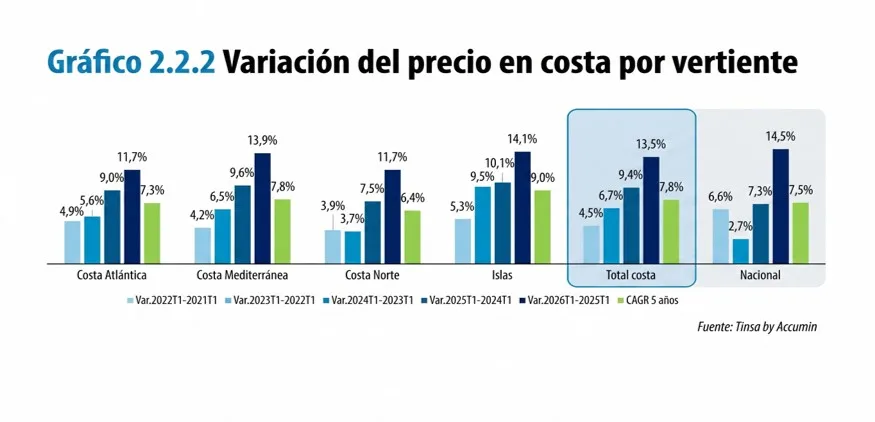
Much of the report is framed around another finding: homes on the coast are increasingly unaffordable for people on local incomes, with the theoretical cost of buying reaching 40% of average disposable household income. From there it is a short step to the familiar narrative about second homes, holiday lets and tourist demand squeezing locals out of the market.
But there is another way of reading the same numbers.
A second-home market is supposed to attract second-home buyers
Large stretches of the Spanish coast are primarily holiday, retirement and second-home markets. Comparing local salaries with the price of villas and apartments bought by wealthier households from Madrid, northern Europe or elsewhere tells us something interesting about those markets, but it does not necessarily identify Spain’s main housing problem.
The more serious affordability problem is where households need homes close to employment and services, particularly in and around major cities and other high-demand economic centres.
And here the evidence increasingly points back to supply.
The Bank of Spain describes the rigidity of Spanish housing supply as structural, citing problems developing build-ready land and the complexity of planning and land-management procedures. It says these constraints prolong construction times and identifies supply inelasticity as the main cause of housing affordability problems.
The OECD similarly identifies limited buildable land, lengthy and uncertain planning procedures, rising construction and labour costs, and regulatory uncertainty as barriers to new supply, particularly for lower-margin affordable and rental housing.
Builders follow the money
That helps explain another revealing feature of the coastal market. Although construction is increasing, much of it is concentrated on holiday homes, where developers can earn better margins. The report itself notes that new construction remains constrained by land availability, building costs, labour shortages and regulatory uncertainty, while developers favour more profitable holiday housing.
That should hardly come as a surprise. When housing is expensive, slow and risky to produce, developers have an obvious incentive to build for buyers with the deepest pockets.
Nor is restricting tourist and holiday accommodation necessarily turning those properties into ordinary homes. Despite a significant increase in regulation, the report acknowledges that this has not so far produced either more housing for permanent residents or lower prices.
The bigger story suggested by these numbers is therefore not that Spain has too many holiday homes. It is that housing supply struggles to respond to demand. The coastal luxury market is one very visible consequence of that problem, rather than necessarily its cause.




Author:  Mark Stücklin
Posted on
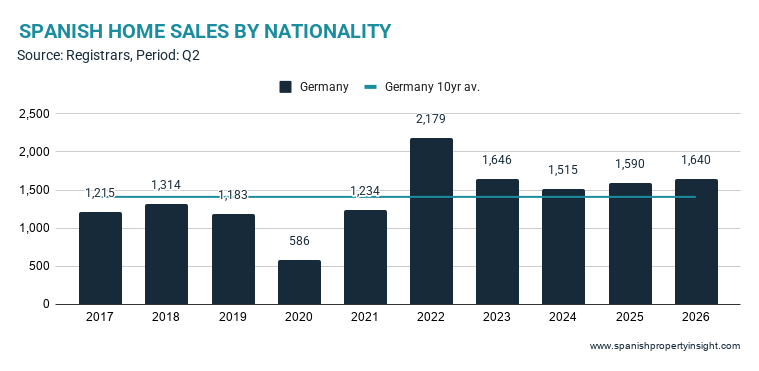
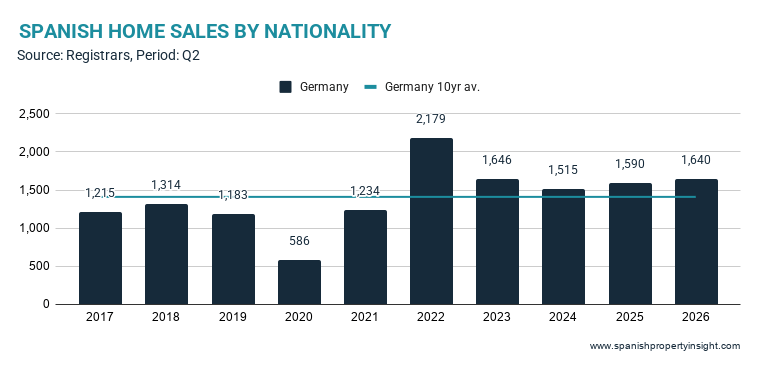
German demand for Spanish property continued to grow in the second quarter, but once again failed to keep pace with the wider foreign market. As a result, German buyers’ share of foreign demand fell to its lowest level in this series.
German buyers were involved in 1,640 Spanish property purchases in Q2 2026, up 3.1% compared with the same period last year. That was the second consecutive year of Q2 growth following declines in 2023 and 2024.
However, total foreign demand grew much faster, rising 11.3% year-on-year to 26,836 purchases. So although more Germans were buying, their relative importance to the foreign market continued to decline.
German buyers accounted for 6.1% of all foreign purchases in Q2, down from 6.6% a year earlier and 9.1% at the recent peak in 2022. That is also the lowest German foreign market share (FMS) in the period covered by this data, going back to 2017.
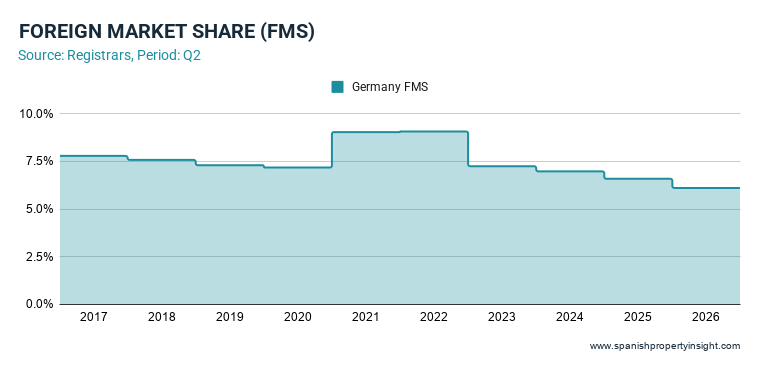
The first-half figures were slightly weaker. German buyers acquired 3,149 homes in H1 2026, down 2.1% compared with 3,216 in the same period last year.
Above average, but losing relative momentum
In absolute terms, German demand remains reasonably healthy. Q2 sales were 16% above the ten-year average of 1,410 transactions and 35% higher than in Q2 2017.
But that growth looks modest beside the foreign market as a whole. Using Q2 2017 as an index of 100, German demand now stands at 135, whilst total foreign demand has climbed to 172.
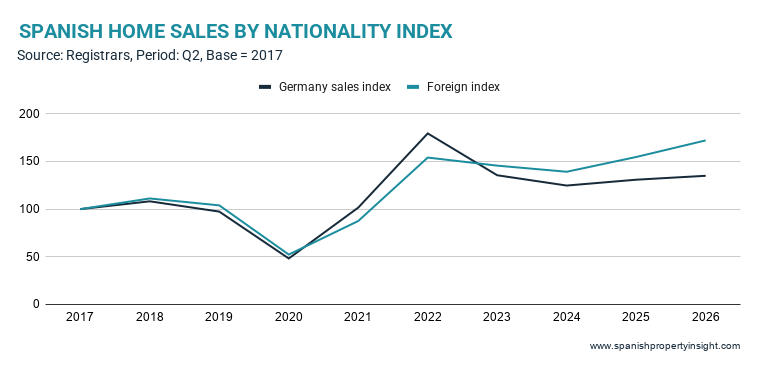
The picture is therefore quite different from booming markets such as the Netherlands. German demand remains substantial and is still growing on a quarterly basis, but other foreign nationalities are expanding faster and gradually taking a bigger slice of the market.
The rolling trend points to a broadly stable market
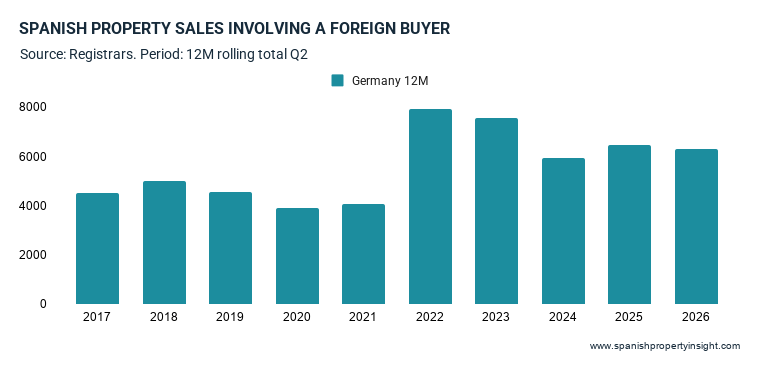
Looking at the four-quarter rolling total, which smooths out fluctuations in individual quarters, German demand appears broadly stable but slightly weaker than a year ago. German buyers were involved in 6,292 Spanish property purchases in the four quarters to the end of Q2 2026, down 2.8% compared with the equivalent 12-month total a year earlier. That follows a 9.2% recovery in the previous 12-month period. The rolling total remains well below the post-pandemic peak of almost 8,000 reached in 2022, but comfortably above the levels seen before the pandemic.
Spain’s coastal housing problem is not too many holiday homes, but too little housing supply. Restricting second homes and tourist accommodation won’t fix that — making it easier and cheaper to build might.
Appraisal-company Tinsa has done some research into the question of housing supply, demand and prices on the Spanish coast in its new Housing on the Coast 2026 report. The numbers are interesting. The interpretation deserves a closer look.
Coastal house prices rose 13.5% year-on-year in the first quarter of 2026, whilst new-build permits increased 21.7% last year. Demand remains strong, though there are signs of it losing momentum in some areas.
Much of the report is framed around another finding: homes on the coast are increasingly unaffordable for people on local incomes, with the theoretical cost of buying reaching 40% of average disposable household income. From there it is a short step to the familiar narrative about second homes, holiday lets and tourist demand squeezing locals out of the market.
But there is another way of reading the same numbers.
A second-home market is supposed to attract second-home buyers
Large stretches of the Spanish coast are primarily holiday, retirement and second-home markets. Comparing local salaries with the price of villas and apartments bought by wealthier households from Madrid, northern Europe or elsewhere tells us something interesting about those markets, but it does not necessarily identify Spain’s main housing problem.
The more serious affordability problem is where households need homes close to employment and services, particularly in and around major cities and other high-demand economic centres.
And here the evidence increasingly points back to supply.
The Bank of Spain describes the rigidity of Spanish housing supply as structural, citing problems developing build-ready land and the complexity of planning and land-management procedures. It says these constraints prolong construction times and identifies supply inelasticity as the main cause of housing affordability problems.
The OECD similarly identifies limited buildable land, lengthy and uncertain planning procedures, rising construction and labour costs, and regulatory uncertainty as barriers to new supply, particularly for lower-margin affordable and rental housing.
Builders follow the money
That helps explain another revealing feature of the coastal market. Although construction is increasing, much of it is concentrated on holiday homes, where developers can earn better margins. The report itself notes that new construction remains constrained by land availability, building costs, labour shortages and regulatory uncertainty, while developers favour more profitable holiday housing.
That should hardly come as a surprise. When housing is expensive, slow and risky to produce, developers have an obvious incentive to build for buyers with the deepest pockets.
Nor is restricting tourist and holiday accommodation necessarily turning those properties into ordinary homes. Despite a significant increase in regulation, the report acknowledges that this has not so far produced either more housing for permanent residents or lower prices.
The bigger story suggested by these numbers is therefore not that Spain has too many holiday homes. It is that housing supply struggles to respond to demand. The coastal luxury market is one very visible consequence of that problem, rather than necessarily its cause.

Lewis Hamilton calls for Ferrari investigation after Azerbaijan Grand Prix flop

New Asbestos Certificate Required To Sell Or Rent Property In Catalonia

Market Snapshot: German Market In Q2 2026


-
Latest2 weeks ago
The Vocabulary You Need To Understand The Spanish Citizenship Process
-

 Argentina2 weeks ago
The Falklands: The Open Wound That Unites Argentines
-

 Alex Saab2 weeks ago
Maduro Ally Alex Saab Pleads Guilty In US Money-Laundering Case
-

 New Developments2 weeks ago
How To Get A Tourist Rental Licence In Andalusia (Spain) – Step-By-Step Guide 2025
-

 Uncategorized2 weeks ago
‘Lewis will never trust Charles again’ – F1 journalist issues shocking Ferrari statement – GPFans.com
-

 %2 weeks ago
Benahavis Wildfire Stabilised: 300 Hectares Burnt
-

 Arganzuela1 week ago
Detenido Un Hombre Por La Muerte De Una Mujer De 47 Años En El Distrito De Arganzuela De Madrid
-
Best airlines1 week ago
Spanish airline Vueling named Europe’s best low-cost carrier for 2026