
Donald Trump
US Inflation Eases Slightly To 3.4% In July, But Remains Well Above The Fed’s Target













America
Primaries In Connecticut, Minnesota, Vermont, And Wisconsin: What To Know About Election Day On August 11


Donald Trump
‘No Child Should Have To Go Through This’: The Lives Of Three Siblings In Texas After Their Parents’ Deportation


Sarah Moreno will turn 15 on August 26. That same month, she will return to school. Any other teenager her age in Texas would be with her parents preparing for the start of classes, but even more importantly, her quinceañera, the Latin American tradition celebrating a girl’s 15th birthday. She and her two siblings, 16 and 13, can no longer live with their parents. Their parents were deported, and now they are struggling to pay the rent, buy food and find someone who can drive them an hour to the Brownsville border crossing to visit their parents in Matamoros, Mexico.
“I had never felt so much stress. Before all this happened, I only worried about my grades, my after-school activities,” the girl says in a video call from Matamoros while visiting her parents.
On December 28, 2025, the family was broken apart. Sarah and her younger sister were in the car with their parents: their mother, Jessica Treviño, 34, has been a beneficiary of Deferred Action for Childhood Arrivals (DACA) since 2015, and her permits were valid through April 2027.
It had been a normal day for Sarah. The family had bought breakfast and coffee at a Starbucks in Álamo, where they lived, and were on their way to church. U.S. Immigration and Customs Enforcement (ICE) agents began following them in unmarked vehicles. Her father, frightened, tried to flee until he stopped the car at a Home Depot. An ICE vehicle rammed them from the front. The airbags deployed and the coffees spilled. Officers pulled the family from the vehicle, and Sarah recalls seeing them strike her father.
“I was telling them, ‘Don’t hit him. Why are you hitting him? He didn’t do anything wrong.’ And they started yelling at me and my sister, telling us that because of him they would also take our mother,” Sarah recalls. The teenager says one of the agents shoved her hard and slammed her against the car door. The blow left a bruise on her neck: “That day I was in shock.”
That night, at her grandmother’s house, Sarah remembers having nightmares about what had happened: “I would wake up with teary eyes, full of tears, trying to understand whether what I had lived through was a dream or real.”

‘My home is in Texas’
Every time her children visit her in Matamoros, Jessica Treviño is heartbroken when they leave. She would like to be at her home in Álamo making sure her three children are eating well, have clean clothes, and are getting ready to go back to school. “I feel like my home is there, in Texas. It has been very hard because my children come every weekend, they leave, and it hurts because I can’t go with them. This really changed their lives,” the mother says.
Treviño says that her eldest son took his sisters to school during the previous school year and had been working to supplement the money their parents send them from Mexico. Sarah, Treviño explains, used to cook with her at home so has taken on most of the responsibility for preparing meals.
When they were in the United States, Treviño says she loved having food ready for her children when they came home from school. On Tuesdays, they watched movies. On Wednesdays, Fridays and Sundays, they went to church. On Saturday evenings, they went out to dinner as a family. “It hurts me a lot to be separated from them. I feel powerless, like I can’t do anything, like I’m tied up. The only thing that divides us is a river, a border. I’m really desperate.”
When they were detained last December, Treviño told agents she had DACA, a benefit that protects her from deportation. If she could not be deported, she should not have been held in detention: “They said it didn’t matter, that that wasn’t a legal status,” she recalls. She spent almost 90 days at the ICE facility in the Rio Grande Valley, near the Texas border, until, at her final hearing, a judge granted her voluntary departure on the grounds that there was no evidence her DACA status was valid. Because she was in detention, she was unable to retrieve the permit from her home and present it as proof.
In an email to EL PAÍS, a spokesperson for the Department of Homeland Security (DHS) said that Treviño “knowingly accepted voluntary departure and waived her right to appeal. She departed the United States on March 25, 2026, and will not return.” Treviño, however, insists that she refused to accept that option.
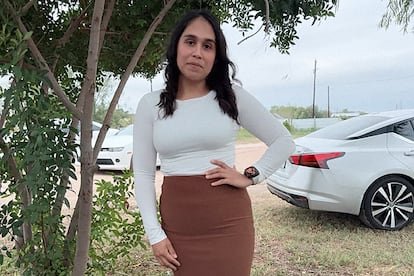
Her lawyer, David Rozas, says Treviño was “forced” into a voluntary departure but was ultimately subjected to a harsher measure: she was deported to Mexico, a penalty that can result in a longer bar on returning to the United States. Afterward, she received a letter from U.S. Citizenship and Immigration Services notifying her of its intent to revoke her DACA status on the grounds that she had left the United States without authorization.
“It’s the irony that the U.S. government fully knows she has DACA and deported her,” the attorney says. “She was forced to accept a voluntary departure. But then they didn’t allow her a voluntary departure; they ended up deporting her, and it was only after that that she received a notice saying, ‘hey, by the way, we’re going to revoke your DACA because you left the country.’”
The lawyer says cases like Treviño’s are becoming increasingly common among DACA recipients, particularly those living in border states.
They are now suing the government in a Texas court in an effort to allow the mother to return to the United States. “We are arguing to the judge that what was presented as voluntary departure and then turned into a deportation order was made under false pretenses, because she did not want to leave and she had valid DACA; she just couldn’t show it at the time.”
Under Donald Trump’s second administration, 86 DACA beneficiaries have been deported, according to a letter sent by the Department of Homeland Security to Democratic Senator Richard Durbin of Illinois.
A return to routine
In March 2026, Sarah could not hide her sadness when she saw other children arriving at school with their parents or embracing them after school events. “And I was there, alone.” She felt different then and will feel different now, when the school year begins and her mother won’t be there to take the typical first-day-of-school photo or to have a hot meal waiting at home.
She hasn’t made plans for her quinceañera either. “I can’t even take photos because my parents are on the other side. I don’t even know who I’m going to celebrate with, because it’s just my siblings, my aunt and me,” she says.
Sarah says she feels emotionally overwhelmed. She doesn’t know if, once the school year starts, she’ll have enough time to visit her parents in Matamoros. For now, some relatives in Álamo and her community are supporting the family. Sarah is grateful for that, and for being able to cross the border to hug her mom and dad; she knows not all children can do that.
But she still feels the pain of family separation. “When will my parents come back?” she asks. “Everything is harder without them.” She dreams that at least her mother will one day be allowed to return home. “I don’t think any child my age or younger should have to go through this. It saddens me how cruel people can be.”
Sign up for our weekly newsletter to get more English-language news coverage from EL PAÍS USA Edition
Alexandria Ocasio-Cortez
Democratic Primaries Reveal Israel’s Waning Political Influence In The United States

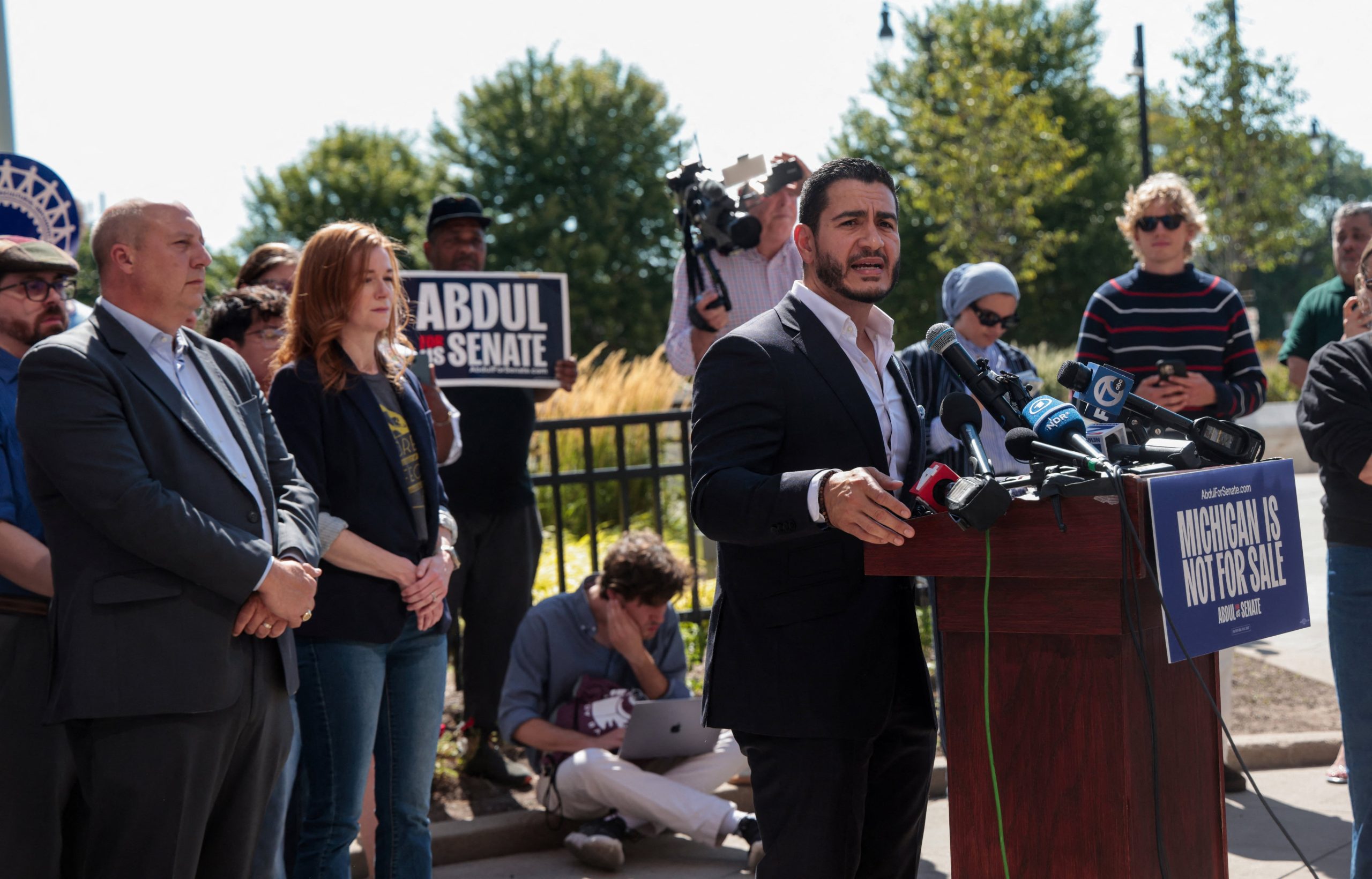
AIPAC has become a toxic word for many Americans. The acronym stands for the American Israel Public Affairs Committee, an organization founded in the 1950s to promote strong relations between the United States and Israel. But in recent years the organization has become a polarizing force in the United States, pouring millions into campaigns for pro-Israel candidates and seen by many citizens as synonymous with the shadowy influence of money in politics.
The latest politician to find that out is Representative Haley Stevens, whose bid last week to become the Democratic nominee for the U.S. Senate in Michigan ended in defeat. Stevens enjoyed the backing of her party’s establishment and the generous support of the pro-Israel lobby, which poured $30 million into her campaign, a record-breaking amount. But she ran up against the appeal of Abdul El-Sayed, the progressive candidate who built his success on the idea of ending the sway of special interests in electoral campaigns. “Get money out of politics, put money in your pocket, and pass Medicare for All” has become his rallying cry. And the first part of that message is aimed above all at one target: Israel’s political influence in Washington.
In an interview with The New Yorker shortly before the primary, El-Sayed acknowledged that the millions of dollars AIPAC spent to defeat him had allowed him to cast himself as a kind of David versus Goliath. “You gave me a gigantic platform. Thank you so much, AIPAC donors. I’m so grateful for you,” he said. If he wins the November 3 election, El-Sayed will become the first Muslim senator in U.S. history.
Three pillars under pressure
Aaron David Miller has spent half a century observing U.S.-Israel relations. He spent the first 30 years in government — advising six secretaries of state in various rounds of Arab-Israeli negotiations until 2003 — and the last 20 as an analyst. He says he has never seen a situation as fraught as the current one. “Over these decades, the relationship between the two countries has rested on three pillars: shared values, common interests and a strong bipartisan base of support in the United States. All of those elements are now under extreme pressure,” said the Carnegie Endowment for International Peace fellow by phone.
Given the complexity of the issue, Miller resists making a definitive conclusion about where the relationship between the — until now — close allies is headed. But he points to two factors that will set the tone: who will win the October 27 elections in Israel — Prime Minister Benjamin Netanyahu, he says, is opposed by most Americans — and ending the long-standing taboo surrounding the $3.8 billion in U.S. aid to Israel.
El-Sayed’s success is not an isolated case. Democrats most critical of Netanyahu have turned circumstance into an advantage, repeatedly highlighting AIPAC and the money spent to defeat them as proof of their independence, while drawing attention to their rivals’ ties to the pro-Israel lobby. It is a strategy that worked for congressional candidates backed by New York Mayor Zohran Mamdani. But it is no guaranteed formula for success: other Democrats running on similar platforms have failed. El-Sayed’s victory — by a razor-thin margin of just 15,000 votes — also highlights the deep divisions among Democrats over issues such as Israel.

Meanwhile, Republicans have already begun campaigning on the claim that El-Sayed is hostile to Israel and to Jews. They hope that message will help their candidate, Mike Rogers, win Michigan’s Senate race in November. The battleground state, which Trump carried in the 2024 presidential election, could prove crucial in determining control of the Senate. But Republicans are not monolithic in their support for Israel either. Many still recall Vice President J.D. Vance’s public rebuke of Netanyahu in June over what he saw as the Israeli leader’s obstruction of the peace process with Iran. “If I was in the cabinet of the Israeli government, I might not be attacking the only powerful ally that I have anywhere left in the entire world,” he said.
“El-Sayed’s victory suggests a Congress that is increasingly likely to treat the relationship with Israel as less exceptional, with aid leveling out to what other countries receive — an idea shared by both Democrats and Republicans,” says political strategist and Haaretz analyst Dahlia Scheindlin from Israel. “If a significant number of Democrats deeply critical of Israel enter Congress after the midterm elections, the United States will give much more limited support. There will be a reduction in arms exports and financial aid,” adds Scheindlin, who holds dual nationality.

From nonpartisan group to campaign financier
AIPAC’s spending on U.S. campaigns has grown as the two countries’ interests diverged. An organization that began as a nonpartisan platform lobbying Congress and sending lawmakers to Israel changed its role as it saw what it regarded as growing anti-Israel sentiment in some Democratic quarters. Key turning points included the 2015 nuclear agreement with Iran negotiated by the Obama administration and the rise of the Squad, a group of progressive lawmakers that included Alexandria Ocasio-Cortez and was viewed by AIPAC as overly sympathetic to the Palestinian cause.
In 2022, AIPAC created a vehicle to finance campaigns of candidates favorable to its interests, and its spending has risen steadily ever since. Four years ago, it spent $29 million; by 2026, that figure had climbed to $67 million, making it one of the biggest political spenders in the United States. According to an analysis by The New York Times, AIPAC funded 109 television and digital advertisements over the past four years, but only six explicitly mentioned Israel, a practice that has fueled criticism that it operates opaquely and without clearly disclosing its objectives.
I appreciate AIPAC proving it doesn’t belong in the Dem Party and especially our primaries.
From endorsing Jan 6th members to ensuring Congress remains in the hands of a 34-count felon, AIPAC is an org committed to undermining democracy at home and abroad.
See you in November. https://t.co/EKpNSaxcv3
— Alexandria Ocasio-Cortez (@AOC) August 5, 2026
Following El-Sayed’s victory, AIPAC issued a statement warning that it would do everything in its power to prevent the Democratic candidate, the son of Egyptian immigrants, from winning the general election. El-Sayed has openly described Netanyahu’s conduct in Gaza as genocide and has called for an end to unconditional U.S. support for Israel.
“I appreciate AIPAC proving it doesn’t belong in the Dem Party and especially our primaries,” Ocasio-Cortez replied on social media in response to the statement. “AIPAC is an org committed to undermining democracy at home and abroad. See you in November.”
Despite protests from Israel’s strongest supporters, it is clear that something is shifting in U.S. politics. Former vice president Kamala Harris, who has become increasingly open about her intention to seek the White House again in 2028, has endorsed El-Sayed ahead of the November election. The move is notable given that many analysts cited the Biden-Harris administration’s support for Israel as one of the factors that hurt her 2024 campaign and helped pave the way for Trump’s victory.
It is further evidence that traditional support for Israel is fracturing. And the upcoming midterm elections will be a crucial test of just how indissoluble the decades-old relationship between the two countries really is.
Sign up for our weekly newsletter to get more English-language news coverage from EL PAÍS USA Edition
Is Taking Parental Leave Mandatory If You’re Self-Employed In Spain?

Reale Insurance, Santa Ponsa: More Than 30 Years Protecting What Matters Most

The San Roque Club – Townhouses For Sale


-
easyJet2 weeks ago
First EasyJet passenger from UK refused entry to Gibraltar after new treaty
-

 New Developments2 weeks ago
Inside The Most LUXURIOUS Apartment Building In Spain!
-

 Uncategorized1 week ago
Lewis Hamilton hits gold with $10bn jackpot but British star snubs Monaco move: F1 News Recap
-
Latest2 weeks ago
Trump And Far Right Seize On Spanish Migration Crisis
-

 Latest2 weeks ago
Suspect In Murder Of Hungarian Woman In Benahavis Attempts To Slit His Own Throat As Guardia Civil Make Arrest
-
2 wheel case2 weeks ago
To push, pull or carry? Which luggage option is best for your posture and journey.
-
Airport Parking2 weeks ago
Elche closes second illegal airport parking site near Alicante-Elche Airport
-
Charity padel tournement2 weeks ago
Nueva Alcantara Club and children’s charity come together for a padel weekend with a purpose