Connect with us

%

‘We’ve Found Gold’: Belgian Builders Strike €9m Treasure Hidden Behind Cellar Wall

Published

on

‘we’ve-found-gold’:-belgian-builders-strike-e9m-treasure-hidden-behind-cellar-wall

Demolition crew unearths €9m gold hoard bricked into cellar wall in Belgium. Credit: Lokale Politie Dendermonde

An 18-year-old thought he had spotted a scatter of €1 coins while laying a drainage pipe, until a gold nugget rolled out beside them. What his crew had actually found, sealed inside a vault built into a cellar wall in Belgium, turned out to be a hoard worth an estimated €9 million. 

A gold nugget between the rubble

Workers from a local construction firm were carrying out groundworks on Tuesday August 11, laying a pipe for the sewerage system of a building on Van Langenhovestraat in Sint-Gillis-Dendermonde, East Flanders. When they removed a section of the foundations in the cellar, one of them spotted a scatter of coins lying in the rubble. “At first, I thought they were €1 coins,” said Kobe, an 18-year-old student on the crew. “But then we also saw a gold nugget lying there. That’s when we realised it was something bigger.” The crew’s first reaction was disbelief. “We certainly hadn’t expected to find gold,” Kobe said. 

Coins and bars kept turning up as the digging continued

Site manager Mario went to check what the commotion was about after workers shouted that they had found gold. “I went to have a look and picked up the gold,” he said. “We kept digging up more coins and bars. Only then did it really sink in what we’d found.”

The coins and ingots had been sealed inside a chest built into a hidden vault in the cellar wall, according to VRT. Mario said the discovery left “a strange feeling” after decades on building sites.

Why the gold went straight to the police

Although many people in their situation may have thought they’d just been made rich, keeping the find never seriously crossed the workers’ minds, both men said, mostly because of the sheer scale of it. “There are so many coins and bars, it would be almost impossible,” Mario said. “Besides, that would be theft.” Kobe agreed. “We did briefly consider keeping it. But it’s simply too much money. If it were a few thousand euros, it might be feasible. But nine million euros, you simply can’t keep that hidden.”

The find was reported to the site manager’s employer, then to the building’s owner and the police. The gold has since been moved to a secure location, said Hanne Ollevier of the East Flanders Public Prosecutor’s Office. “We’re keeping it under guard because it’s such a large sum,” she said. “We don’t want anyone getting ideas about coming to look for that money.”
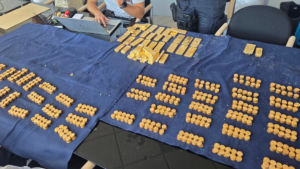
Gold bars and coins laid out after being recovered by Dendermonde police.
Gold bars and coins recovered from the hidden vault in Dendermonde.
Credit: Lokale Politie Dendermonde

How a homeless shelter could end up inheriting the fortune 

The building belongs to the Centrum Algemeen Welzijnswerk (CAW), a Flemish charity that provides social support services and is converting the property into a reception centre for homeless people. If the gold legally ends up in the charity’s hands, it will go towards funding shelters and social services, said CAW spokesperson Geert Hillaert. 

“We will obviously have to comply with all the relevant rules and legislation,” Hillaert said. “From a tax perspective, I imagine there are certain things that need to be taken into account too.” He added that the find could equally be linked to fraud carried out by a previous owner of the building.

Why the case could run for years

Ollevier said investigators must now establish how long the gold had been hidden, whether it is connected to any past criminal activity, and whether a legitimate owner can be traced. Hillaert expects any dispute to end up before a civil court, given the possibility of rival claims from descendants of a former owner, as well as a finder’s fee sought by both the charity and the construction company.

For now, the coins and bars remain in a police vault while the investigation continues. Kobe hopes there might be something in it for him and his colleagues. “After 33 years in the construction industry, this is the first time I’ve experienced anything like this,” Mario said. “I don’t think it will ever happen again.”


%

Major Change Hits Lidl Stores Across Spain As New Rules Take Effect

Published

on

major-change-hits-lidl-stores-across-spain-as-new-rules-take-effect

shoppers may find that some familiar products have different nutritional compositions. Photo credit: Marco Gallo/Shutterstock

Anyone popping into Lidl in Spain today could notice something different on the shelves, as the supermarket introduces a major change to part of its own-brand range. The change came into effect on Friday, August 14, and affects Lidl’s own-brand food aimed at younger consumers.

The supermarket says the products are being brought into line with new nutritional requirements, with the changes being introduced across its stores in 30 countries. The company says it wants to make it easier for shoppers to find products that meet its nutritional standards without having to scrutinise every label.

New nutritional requirements take effect

Lidl says its own-brand food products covered by the initiative must meet the nutritional criteria established by the World Health Organization (WHO), alongside the supermarket’s own requirements. That means shoppers may find that some familiar products have different nutritional compositions from previous versions. The changes affect products including pasta, fish fingers, cereals and corn snacks. 

The supermarket has linked the move to its broader aim of making healthier choices easier rather than expecting customers to work through nutritional information on every product before deciding what to put in their trolley. Lidl’s Stefan Haensel, responsible for Quality & Sustainability, said the company wanted to make choosing suitable products easier for families.

What will shoppers see on shelves?

The changes will not mean every Lidl product is being reformulated. The initiative applies to the supermarket’s own-brand range covered by its nutritional requirements. Some of the products will also feature Paw Patrol branding as part of a promotional collaboration linked to Paw Patrol: The Dino Movie. The campaign is expected to run for around ten weeks.

The branding is designed to make the products more appealing to younger shoppers, while the nutritional reformulation is intended to meet the standards Lidl has set for the range. For customers, the most noticeable difference will therefore be the products appearing on shelves rather than a change to the way Lidl stores operate. There is no indication that shoppers will need to change how they pay, use Lidl’s stores or access its usual services.

Lidl is changing the recipes

The supermarket’s move goes beyond simply putting new packaging on existing products. Lidl says the relevant own-brand products have been reformulated to meet its nutritional criteria. The company has presented the changes as part of its effort to improve the nutritional profile of the food it sells.

The approach is being applied across Lidl’s operations in 30 countries, making it a wider private-label policy rather than a change limited to Spain. For Spanish shoppers, however, the practical effect is straightforward: some products in the relevant section will gradually appear in their updated versions.

Why Lidl says it is making the change

Lidl’s stated aim is to remove some of the difficulty involved in choosing food with a more favourable nutritional profile. The supermarket says it is combining the WHO criteria with its own nutritional standards when developing the products covered by the policy.

The company has described the approach as a way of making the choice easier rather than relying entirely on customers to compare products themselves.That is also where Lidl’s “Queremos ponértelo más fácil” message comes in. The phrase, which translates as “We want to make it easier for you”, is being used to explain the reasoning behind the changes.

The change is already underway

Customers should not expect the entire relevant range to disappear overnight. The reformulated products are being introduced as part of the new requirements, meaning shoppers may encounter a mixture of existing and updated products while the transition takes place. The Paw Patrol promotion will also be temporary, with the collaboration expected to last approximately ten weeks.

The nutritional requirements, however, represent the more significant part of the announcement because they concern how Lidl develops its own-brand products. For shoppers in Spain, there is therefore no need to make any change at the checkout or adapt to a new Lidl store system.

The difference will be found on the shelves, where some of the supermarket’s own-brand products are being replaced by versions that Lidl says meet its updated nutritional requirements. And while the change is aimed at making food choices easier, the immediate question for shoppers will simply be whether their usual products look the same when they next visit Lidl.

Continue Reading

%

Andalucía Mosquito Alert As Doctors Expose The Truth About Citronella

Published

on

andalucia-mosquito-alert-as-doctors-expose-the-truth-about-citronella

Candles, plants and scented products are often used on terraces. Photo credit: Tetyana_Pidkaluyk/Shutterstock

Most of us have reached for a citronella candle, plant or spray when mosquitoes start becoming a nuisance. But people across Andalucía are now being warned not to mistake the familiar citrus scent for proper protection, with health centres displaying advice telling residents that citronella does not provide a reliable mosquito-repellent function.

The warning comes as Andalucía continues to deal with mosquitoes capable of transmitting diseases including West Nile virus, with cases already confirmed in people this summer and mosquito circulation detected in multiple municipalities.  The Junta is urging residents to use registered topical repellents instead of relying on products that may give them a false sense of protection.  The regional health authority has also produced dedicated 2026 posters and information materials on preventing mosquito bites, including specific guidance on authorised repellents. 

Citronella is not proper mosquito protection

The message being displayed in health centres is extremely important because citronella has become one of the most familiar ways of trying to keep mosquitoes away. Candles, plants and scented products are often used on terraces, balconies and around doors during the summer.

But the presence of citronella does not mean that someone sitting nearby has the same protection as they would get from an authorised repellent applied correctly to exposed skin. The Junta’s current guidance specifically recommends registered, topical mosquito repellents and provides lists of products authorised for use. It also advises covering as much skin as possible with light-coloured clothing. 

The warning comes as West Nile cases rise

This is not simply about avoiding an itchy bite. Andalucía has already recorded human cases of West Nile fever this season, including one death in Dos Hermanas. The Junta also confirmed six cases by July 28, all described as mild. They were identified in Palomares del Río, Villamanrique de la Condesa, La Puebla del Río, Coria del Río and Aznalcázar, all in the province of Sevilla. 

The same report said virus circulation had been detected in mosquitoes in 15 municipalities declared areas on alert, while viral circulation had also been detected in two municipalities where the capture sites were more than 1.5 kilometres from the urban centre. Mosquito densities were also increasing in several areas. 

Mosquito protection matters more in high-risk areas

The situation is being closely monitored because West Nile virus is transmitted through the bite of infected mosquitoes. Most infections do not cause symptoms, but some people develop illness and a small proportion can develop serious neurological complications.

The Junta has therefore been increasing surveillance across Andalucía rather than waiting for human cases to appear. More than 200 mosquito traps are being used to monitor circulation, with public health teams also carrying out checks in municipalities across the region.  That makes the advice being displayed in health centres particularly relevant to people living in or visiting areas where mosquito activity is high.

What should people use instead?

The advice is not to abandon every household measure used against mosquitoes. Screens, reducing standing water and using appropriate environmental insect-control products can all help reduce exposure. But anyone relying on protection for their own skin should use a registered topical repellent and follow its instructions.

The Junta maintains updated lists of authorised products, including repellents registered through the relevant Spanish and European systems.  People are also advised to wear clothing that covers the arms and legs where practical and to take extra care around dawn and dusk, when mosquito activity can be higher. Strongly scented perfumes and soaps should also be avoided because they can attract mosquitoes. 

Don’t let the smell create false confidence

A citronella candle burning on a terrace may make the area smell strongly of citrus, but that should not be confused with having protected your skin from mosquito bites. That distinction matters when the insects present are capable of carrying disease. Someone who assumes the citronella beside them is enough may spend an evening outdoors without using an appropriate repellent or covering exposed skin.

And Andalucía’s health authorities are already seeing why prevention matters. The region has recorded human West Nile cases this summer, while infected mosquitoes have been detected across several municipalities.  The message from the health campaign is therefore simple: don’t rely on citronella as your main defence against mosquito bites. Use a registered repellent, cover exposed skin and take steps to reduce mosquitoes around your home.

Continue Reading

%

Velez-Malaga’s €9.14m Budget Windfall

Published

on

velez-malaga’s-e9.14m-budget-windfall

Velez-Malaga town hall. Credit: AVM FB

Velez-Malaga Town Hall has finally wrapped up its 2025 accounts with a healthy positive balance of over €9 million. This surplus builds on last year’s solid figures and gives the council room to take on new financial commitments without squeezing residents.

Council covers full water tariff jump

One of the first moves will see the town hall fully absorb a 40 per cent rise in the wholesale water price charged by supplier Axaragua. Councillors confirm this extra cost will not appear on household bills. Residents across the different parts of the municipality can therefore keep budgeting as normal for an essential service that has faced repeated pressure in recent years.

The increase comes after more than a decade without any tariff review and includes pending inflation adjustments dating back to 2015. A temporary surcharge linked to bringing water from Malaga during the recent drought and problems at La Vinuela reservoir has been added on top.

Council resources from the surplus will cover the whole rise. Exact figures for the outlay remain unclear in the official statement, yet the decision ranks among the earliest uses of the leftover funds and shows a clear priority for protecting local pockets.

Axaragua’s price adjustment reflects both long-delayed contractual updates and the practical costs of securing supply when local reservoirs ran low. By stepping in completely, the town hall prevents any pass-on of that cost that would have hit families, self-employed people and businesses at a time when many already watch every euro.

Paying down bank debt next

A second major step involves amortising loans held with financial institutions. Extra cash in hand creates greater flexibility to cut outstanding obligations while still leaving capacity for new investment projects across the town. Reducing the debt burden frees up future budgets and lowers interest costs over time.

Local leaders describe the closed accounts as evidence of sound money management. Income now covers everyday services and generates enough spare capacity for extra commitments that benefit the whole area. Careful planning of public resources has produced this stronger position, allowing ordinary running costs to be met while still generating room for meaningful action on both water charges and longer-term liabilities.

Residents should notice no change in their water charges even as wholesale prices climb, and the council gains breathing space to chip away at its debt load. Further details on exact allocations for the water subsidy and the scale of debt repayments are expected once formal decisions are finalised in the coming weeks.

Continue Reading
Advertisement
Advertisement

Spanish Real Estate Agents

Tags

Trending

Copyright © 2017 Spanish Property & News