
Latest
What’s The Law On Ozempic For Weight Loss In Spain?


Ozempic has quickly become the world’s most popular off-label weight loss drug – but can people in Spain get their hands on it without a medical prescription and if they don’t have diabetes? Here’s what the law says.
Please sign up or log in to continue reading
More
Comments
See Also



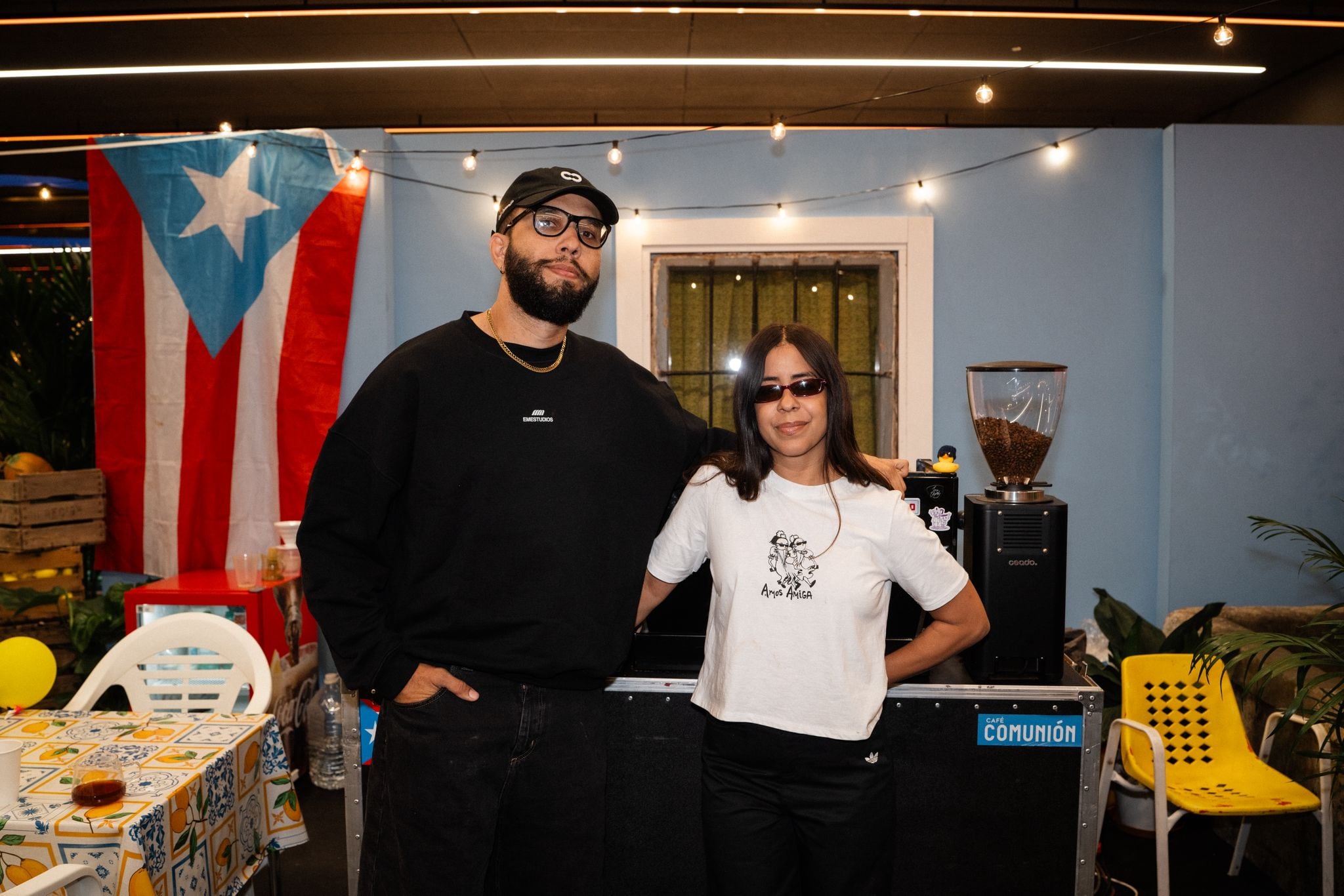
In September 2017, just as Abner Román and Karla Ly Quiñones were about to open the doors of Café Comunión in the Santurce neighborhood of San Juan, Puerto Rico, Hurricane Maria devastated the island.
“It took the entire front of our shop, we had structural damage and there was no electricity,” they remember. Instead of serving coffee from behind a counter, they took to the streets. “I would make it at home in the morning and walk across the street with a thermos, milk and sugar,” Abner recalls. They gave the coffee away for free, and also accepted donations, which they used to rebuild what the devastating storm had destroyed.
Who would have thought that seven years later Bad Bunny would stop in for a coffee at their shop after voting in Puerto Rico’s 2024 gubernatorial election? And that the singer would end up forming such a close relationship with Karla and Abner that he would offer them the chance to join his tour so he could keep drinking his favorite coffee while performing around the world.
“He came with his assistant, sat at the bar and we spent several hours talking about coffee and normal things, like NBA games,” they say. He came back the following week and kept coming back. Abner thinks this is because “they treat him like everyone else. Other customers have caught the vibe and no one asks him for photos. They greet him, yes, but I think that’s part of why he likes coming here.”
The truth is that before Benito Antonio Martínez Ocasio stopped by Café Comunión, several members of his team were already regulars. Through their frequent contact with people working in the music industry, Karla and Abner had toyed with the idea of offering their coffee services at concerts, but they never imagined they would do so on a tour of this scale, catering to all the backstage staff.
First they took part in Bad Bunny’s 30-show residency in Puerto Rico, held between July and September 2025. Then they were invited to join the DeBÍ TiRAR MáS FOToS world tour — and off they went, with their “coffee shop on wheels” and their six‑year‑old son in tow.
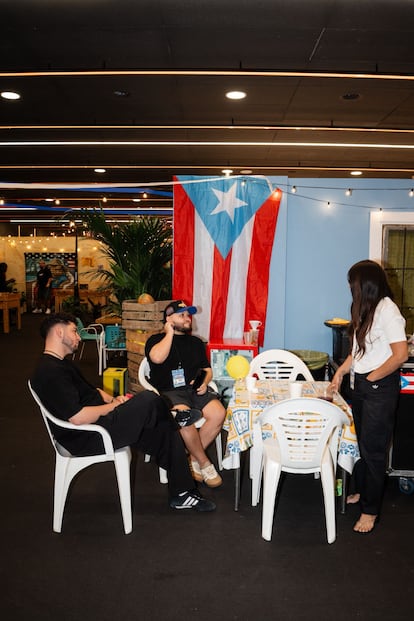
Over the past few months, they have been serving coffee backstage at Bad Bunny’s concerts in the Dominican Republic, Costa Rica, Mexico, Argentina, Brazil, Chile, Peru, Colombia, Australia — and now Spain. Each day, they cater to between 150 and 200 members of the artist’s crew, as well as the show’s guests. Abner admits he himself is still amazed by the situation.
“I had never heard of an artist taking baristas on tour. Concert venues offer catering services that include coffee, but here they wanted an experience — an area where colleagues could come to talk and disconnect,“ he says. ”Like going out for a coffee, but in the backstage area.”
Café Comunión’s distinctive blue cup has even made its way onto the stage on several occasions, with Bad Bunny raising it in front of the crowd.
Despite years of experience running their business, managing a mobile specialty coffee shop comes with its own challenges.
“Before we arrive at each city, we contact local suppliers and try to use that country’s coffee,” they explain. “We speak with roasters and producers, with espresso machine technicians (just in case), with milk distributors and sometimes with baristas in case we need someone to cover a shift.”
While they travel with the tour, their team keeps the two cafés they own in San Juan open (in addition to Santurce, they have another location in Río Piedras) and, in the downtime between shows, they make the most of the opportunity to meet other people in the industry. “We try to build connections in every country we visit.”
On June 4, during their stay in Madrid, they will be at Hola Coffee Roastery (Av. de Pedro Díez, 21Bis) preparing coffee and some of their signature drinks, a collaborative format they previously organized with cafés in Colombia, Mexico and Peru.
“The idea is to bring the Comunión experience to the country we’re in,” they say.
And what does that experience consist of? “We use the word ‘comunión’ in its secular sense. We want people who come to our coffee shop to feel welcomed and be able to disconnect in the company of others, creating a kind of communion between the barista and the rest of the customers.”
Two teachers who fell in love with coffee
Before opening Café Comunión, both Abner, 44, and Karla, 38, were teachers by profession — he taught English and she taught history. Owning a business had always been Abner’s dream, and this drink —which, according to him, “is consumed at all times in Puerto Rico” — had always caught his attention. So in 2008, he asked for a job at one of the cafés he used to frequent.
“Since teachers have the summer off, I asked if they would give me a chance to work those months,” he recalls. “I started washing dishes, then working at the cash register, and I really liked the coffee-shop atmosphere. Little by little, I learned to be a barista, and in 2013, I won a national latte art competition and then went to compete in Australia.”
There was no turning back. That prize confirmed he could make the leap from the classroom to the coffee bar, and he did. Karla joined shortly afterwards, focusing more on importers and the farms that grow the coffee.
“Although really we both do everything, because we’re a small business,” she says.
They gradually built a place for themselves in the coffee industry, and the next logical step was to open their own café. That’s how Comunión was born in 2017. Despite delays caused by Hurricane Maria, they managed to open before the end of the year, in December.
By then, Karla and Abner had been living in Santurce for some time, and he had worked for years in one of the neighborhood’s cafés, so they were already familiar faces in the area — something that helped them build a strong community around the business.
“After the hurricane, when neighbors saw us working hard to get things going, we connected even more. It was a moment when the community really came together, and we formed a very special bond,” Abner recalls.
They continued to take part in neighborhood activities and even opened their café space for community meetings. “We’re always ready to help however we can.”
Recently, Café Comunión was included on the list of the 100 best cafés in North America, Central America and the Caribbean. It ranked 44th, and was the only café from Puerto Rico to make it on the list.
“It made us feel very honoured; it was confirmation that we’re doing things right,” they say.
The couple has earned recognition from their own community in Puerto Rico, from the industry and now Bad Bunny — what will come next?
Sign up for our weekly newsletter to get more English-language news coverage from EL PAÍS USA Edition

The ceasefire that has never truly stopped the fighting between Israel and Hezbollah followed the same dynamic on Thursday after being extended in a new round of talks in Washington.
On Thursday morning, Israel’s military continued its attacks, and Israel’s defense minister, Israel Katz, has made it clear that bombing will go on and that troops will maintain their positions in Lebanon.
U.S. President Donald Trump himself acknowledged hours earlier that the ceasefire — launched in April — exists only on paper. Asked how he would define a ceasefire, he replied: “I’d say in that part of the world, ceasefire is when you’re shooting in a more moderate manner.”
In the first hours after the ceasefire was extended, Israel asserted its “freedom of action” in Lebanon, both in deeds and in words. On the ground, it wounded a family — a man, his wife and their daughter — in a drone strike on their car in southern Lebanon, according to the country’s national news agency. It has also issued a new “urgent warning to residents of southern Lebanon,” stating that it is continuing its attacks south of the Zahrani River (about 25 miles from the border) and that anyone there or traveling through the area “puts their life at risk.” In the same area, one Serbian peacekeeper has been killed and two Spanish personnel injured in an attack on the U.N. mission, UNIFIL, according to reports on Thursday.
In a statement, Katz stressed that the ceasefire is “conditioned on the prompt withdrawal of Hezbollah terrorists from all areas south of the Litani River and the creation of a demilitarized zone,” while his armed forces “will continue strikes and operations in the area for the time being,” and will keep occupying and destroying villages in areas they control (including Beaufort Castle) without allowing the population to return.
Katz emphasized that Israel retains freedom of action — “with U.S. support” — including the option to strike Beirut (after Trump forced Israeli Prime Minister Benjamin Netanyahu to back down on Tuesday) if Hezbollah attacks Israeli territory, and not only Israeli troops in Lebanon.

The new extension places the ball in Hezbollah’s court, according to a joint statement by the United States, Israel and Lebanon — whose government has declared Hezbollah’s armed activities illegal — released by the U.S. State Department. The text states that “the ceasefire is contingent on a complete cessation of Hizbollah fire and the evacuation of all Hizbollah operatives from the South Litani Sector.”
Hezbollah, for its part, rejects any “partial” ceasefire and demands a “genuine” full cessation of hostilities, including the withdrawal of Israeli troops from all Lebanese territory.
The main new element of the agreement is a plan to create “pilot zones” in Lebanon without Hezbollah presence, to be controlled by the Lebanese army. This could open the door to potential Israeli withdrawals, although it remains unclear how these would work or when they would begin. The two governments are due to meet again in two weeks with the aim of “reaching a comprehensive agreement,” the statement said.
The deal was reached during the fourth round of direct negotiations between Israel and Lebanon, held on Tuesday and Wednesday, and marked by insults that Trump directed at Netanyahu during one of their two phone calls, in which he forced the Israeli prime minister to back down from his plan to bomb Dahiyeh, the Shiite-majority suburbs of Beirut, after Tehran threatened to resume the war with the U.S.
Sign up for our weekly newsletter to get more English-language news coverage from EL PAÍS USA Edition

Max Verstappen F1 future hangs in the balance as three teams block 2027 rule changes

The San Roque Club – Townhouses For Sale

Barbón Acusa A Santos Cerdán De Haber Intentado “desestabilizar” Al PSOE De Asturias

Mexico’s Most Controversial Politician, Rubén Rocha, Goes To Ground As Cartel Questions Intensify
Insurance company Mapfre decides to pay out €14 million compensation for 2025 blackout
In The Final Stretch Of Colombia’s Presidential Campaign, Undecided Voters Are In High Demand


-
 ElPais2 weeks ago
Mexico’s Most Controversial Politician, Rubén Rocha, Goes To Ground As Cartel Questions Intensify
-
blackout April 20254 weeks ago
Insurance company Mapfre decides to pay out €14 million compensation for 2025 blackout
-
Abelardo de la Espriella1 week ago
In The Final Stretch Of Colombia’s Presidential Campaign, Undecided Voters Are In High Demand
-

 New Developments4 weeks ago
Inside The Most LUXURIOUS Apartment Building In Spain!
-
Costa Blanca South4 weeks ago
Alicante police chief to retire after 17 years of service
-

 New Developments4 weeks ago
🌅 Stunning Penthouse With Panoramic Sea & Mountain Views Benalmádena
-
Bonnie Tyler4 weeks ago
Bonnie Tyler placed in induced coma after emergency surgery in Portugal
-
aemet2 weeks ago
Spain heatwave 2026: When the next extreme temperatures could hit and which areas may suffer most
Join the conversation in our comments section below. Share your own views and experience and if you have a question or suggestion for our journalists then email us at news@thelocal.es.
Please keep comments civil, constructive and on topic – and make sure to read our terms of use before getting involved.
Please log in here to leave a comment.