
Motoring
Worried your credit score rules out car finance?


Ask people why they haven’t applied for car finance, and you’ll usually get the same answer. “I don’t think I’d get accepted.”
Not that they’ve been turned down. Not that the rates were too high. They just assume the answer will be no, so they never ask.
That assumption is expensive. It pushes people into buying whatever car they can scrape together in cash, or an older one that costs more to run, or whatever happens to be sitting on the forecourt that afternoon. And a lot of the time, the assumption is simply wrong.
We’re carloans 365, a UK used car finance broker. We started in 2018 because we think every driver deserves a fair decision, not a judgement based on one number. Here’s why that matters, and how to find out where you really stand.
Your credit score isn’t the full story
A credit score is useful, but it’s not the whole picture of you.
It doesn’t know the missed payment on your file was four years ago, when you lost your job. It doesn’t know you’re self-employed and your income is good but uneven. It doesn’t know whether you’ve paid your rent on time for ten years, or that you’ve recently moved to the UK and haven’t built up a credit history yet.
Lenders treat all of this very differently. Some are cautious and mostly automated. Others specialise in exactly the situations a basic score handles badly. Most drivers never find out which lender is which, because the process is confusing, the language is full of jargon, and applying feels like a risk.
We see the same three things over and over:
- People think a low score means no options. Usually it means fewer options, on different terms. That’s not the same as no.
- People accept a deal they don’t fully understand. If nobody explains what APR means, or how a longer term changes what you pay overall, how are you supposed to judge whether it’s any good?
- People don’t apply at all, because they’re worried about damaging their credit file by trying.
That last one is the easiest to fix, so let’s start there.
Common credit score myths, busted
A lot of what people believe about their credit score isn’t quite right, and it’s usually what’s keeping them from checking at all.
“Checking my eligibility will hurt my score.”
Not with a soft search. It’s only a full application, one you choose to go ahead with, that leaves a mark other lenders can see.
“A low score means I’ll get rejected.”
A low score usually means fewer lenders will say yes on standard terms, not that every lender will say no. Specialist lenders exist specifically for this.
“My score is basically permanent.”
It moves constantly. A missed payment years ago carries far less weight than what you’ve done in the last 12 months, and scores recover as your recent history improves.
“Being self-employed automatically counts against me.”
It changes how a lender assesses you, not whether they will. Lenders who understand irregular income look at the fuller picture rather than penalising it outright.
“If one lender turns me down, they all will.”
Lenders don’t share a single scoring system. They each weigh things differently, which is exactly why matching to the right one matters more than the score itself.
The pattern in all of these: the score is one input a lender uses, not a verdict. Treating it as a locked door is usually what stops people applying, not the actual number.
Three things any good car finance journey should give you
This applies whether you come to us or go somewhere else.
-
You should be able to check for free, with no risk to your credit file.
A soft-search eligibility check shows you what you could afford before you apply properly. A soft search doesn’t leave a mark other lenders can see, so it can’t affect your score. Ours takes about 60 seconds and only needs a few basic details. If a broker won’t tell you straight whether their check is a soft search, ask them again.
-
You should be matched to the right lender, not pushed towards the only one on offer.
We work with a panel of trusted UK lenders we’ve built up over years. That includes specialists in bad credit, no deposit and more complicated situations. Finding the lender that fits your circumstances is the job. It also means you’re not firing off applications all over the place and picking up hard searches on your file as you go. Nothing is guaranteed, because the lender still makes the final decision, but your chances are much better when someone is looking properly on your behalf.
-
You should know who the broker actually works for.
Hardly anyone thinks to ask this. We don’t work for lenders or dealerships. We work for drivers. It’s worth asking anyone you deal with the same question.
A bit about us
We started in 2018 as a small team with one goal: get every driver a fair deal.
Today we help thousands of drivers a year across the UK. We’re rated 4.6 out of 5 from more than 2,300+ verified reviews on TrustPilot, which tells us the approach works.
Four things we stick to:
- Plain English. No jargon, no surprises in the small print.
- You, not your score. We look at your whole situation, and so do the lenders we work with.
- Keep it simple. No pressure, no pointless steps.
- Do right by drivers. We only do well when you drive away happy.
One last thing
Don’t let a guess about your credit score decide what car you drive.
Find out where you actually stand with carloans 365 with a check that can’t hurt your file, then make your decision knowing the real numbers. That’s a much better place to be than guessing, and it takes about a minute.










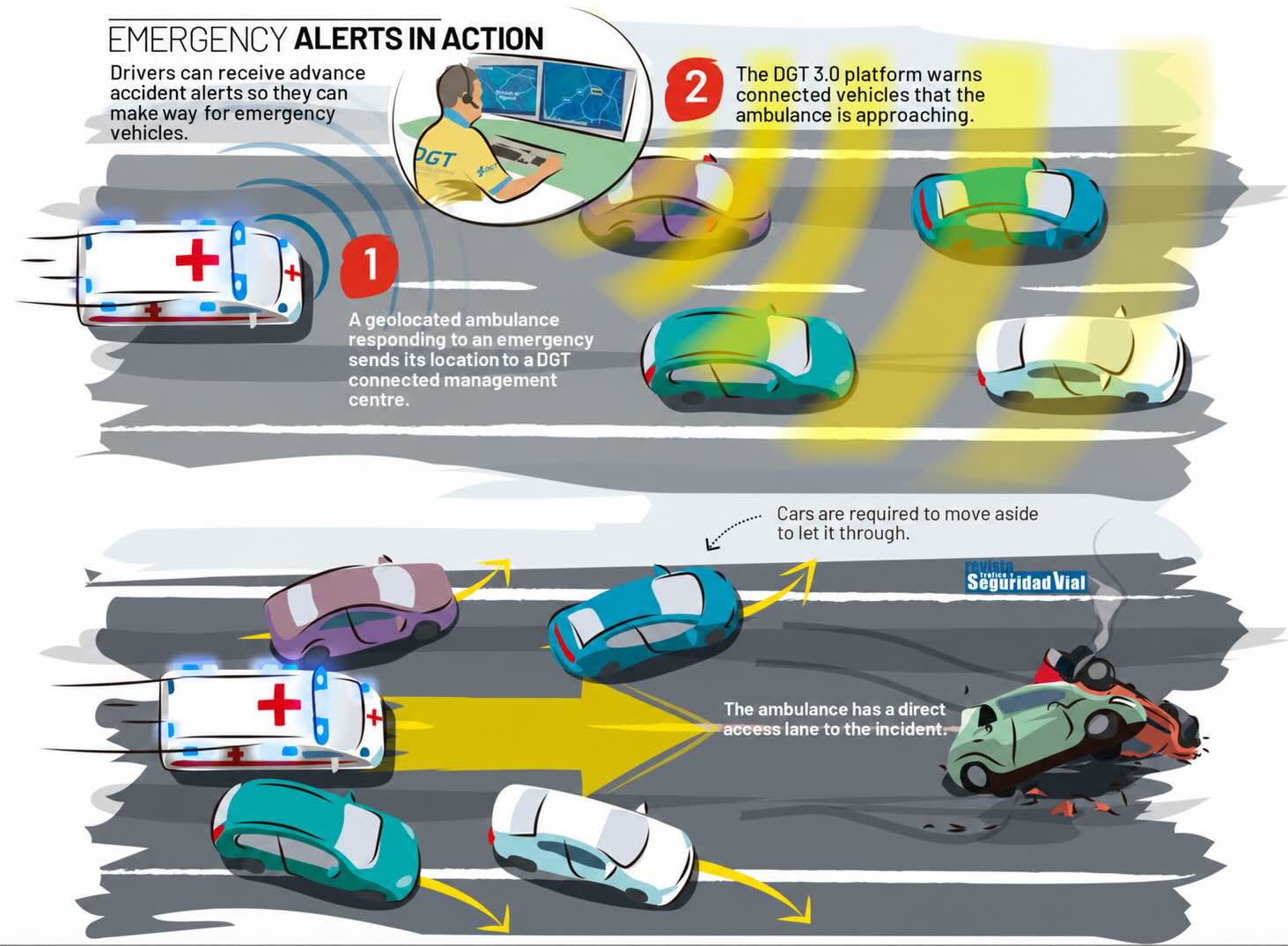
Ambulances face heavy motorway congestion as Spain prepares to require drivers to create an emergency corridor from October 1. Credit: DGT
A traffic jam on a Spanish motorway will soon mean more than slowing down and waiting. From October 1, drivers must create a clear route for ambulances, police, fire crews and other emergency vehicles whenever traffic is moving at walking pace or has stopped.
The new rule applies across Spain’s autopistas and autovías. It is designed to prevent emergency vehicles being trapped behind long queues after collisions, fires or medical incidents.
When do drivers have to form an emergency corridor?
The obligation starts when there is a traffic hold up and vehicles are either crawling at walking pace or stationary.
You do not have to wait until an ambulance is visible in the mirror. Once the queue forms, drivers should position their vehicles to leave the route open. Emergency vehicles can then get through immediately when they arrive.
The measure applies on motorways and dual carriageways, not ordinary single carriageway roads or town streets.
Where does the emergency corridor go on a two lane road?
On a motorway or dual carriageway with two lanes travelling in the same direction, the clear route must be created between the two lanes.
Drivers in the left lane should move as far left as safely possible. Drivers in the right lane should move as far right as safely possible.
The gap in the middle is for emergency services. It is not an extra lane for impatient drivers, motorcyclists or anyone trying to bypass the queue.
What happens when there are three or more lanes?
The rule changes slightly on larger motorways.
The emergency corridor must be formed between the far left lane and the lane immediately beside it. Drivers in the far left lane move as far left as possible, while vehicles in every other lane move as far right as possible.
This leaves a continuous route on the left side of the carriageway for ambulances, police, fire engines and rescue services.
What drivers should not do
Do not drive along the hard shoulder to escape the traffic. Do not follow an ambulance through the gap it has created. Do not block the corridor while trying to change lanes at the last moment.
Drivers should also avoid stopping so close to the vehicle in front that they cannot move aside. Leaving sensible space becomes particularly important in tunnels, on bridges and in heavy holiday traffic, where access for emergency services can be difficult.
Could you be fined?
The new emergency corridor requirement forms part of Spain’s updated General Traffic Regulations. Failing to follow lane use rules can be treated as a serious traffic offence, which normally carries a €200 fine.
The exact penalty will depend on the circumstances and enforcement decision. Where a driver obstructs an emergency vehicle or creates a genuine danger, the consequences may be more serious. Drivers should not rely on the corridor being merely a courtesy. From October 1, it is a legal obligation.
The rule is set out in Royal Decree 518 of 2026, published in the BOE, which updates Spain’s General Traffic Regulations.
For the wider list of traffic changes arriving this autumn, including new rules affecting cyclists, motorcyclists and scooters, read our guide to Spain’s road rule changes from October 1.

Category 5 Hurricane ‘Polo’ Moving Parallel To Mexico’s Pacific Coast

La Cuenta Atrás Para Echar A Maricarmen Ha Comenzado En La Calle Y Los Despachos

‘El Niño’ Alcanza Ya Niveles Récord Y Amenaza Con Cobrarse 450.000 Vidas Solo Por El Calor Extremo


-
Latest1 week ago
The Vocabulary You Need To Understand The Spanish Citizenship Process
-

 Argentina1 week ago
The Falklands: The Open Wound That Unites Argentines
-

 Energy efficiency & certificates2 weeks ago
94% Of Spanish Homes Are Energy Inefficient – Could Tighter Rules Be Coming?
-
Holiday rentals2 weeks ago
Ibiza council hits illegal tourist rental with €793,000 fine – but will the owner pay that much?
-

 Alex Saab1 week ago
Maduro Ally Alex Saab Pleads Guilty In US Money-Laundering Case
-
easyJet2 weeks ago
146 slide off easyJet flight after powerbank fire at Milan airport
-
Affordable homes Spain2 weeks ago
Costa Blanca renters may be missing out on Spain’s new affordable homes
-

 Uncategorized1 week ago
‘Lewis will never trust Charles again’ – F1 journalist issues shocking Ferrari statement – GPFans.com