
China
Young Chinese Seek Answers In Mao Zedong, Half A Century After His Death

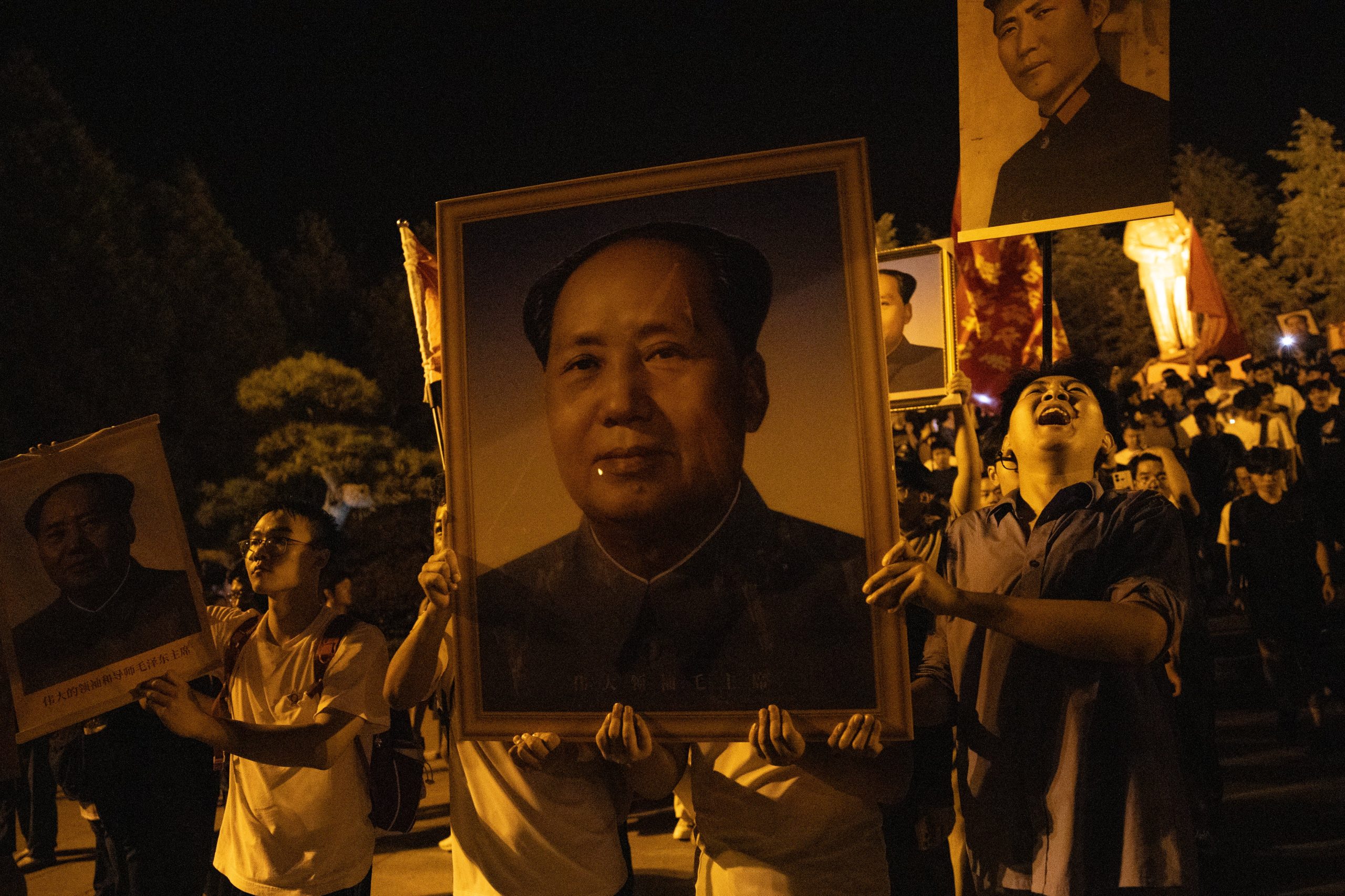
At the entrances to Tiananmen Square in Beijing, the capital of China, the crowd folds repeatedly between the barriers as people slowly move toward the security checkpoints. September 9 marks the 50th anniversary of the death of the founder of the People’s Republic, Mao Zedong, whose embalmed body lies in the imposing mausoleum that stands at the center of the vast plaza. There are no reservations left to visit the tomb for the entire week. “We came because our parents and grandparents dream of doing this, but they are old and haven’t had the chance to travel far,” Pan and Wang, two students aged 22 and 24 respectively, said the day before.
The two friends traveled from Dalian in the country’s northeast specifically for that purpose. After two and a half hours in line, they succeeded. “Chairman Mao lies peacefully. I was deeply moved. The atmosphere is very solemn,” Wang said. “Thanks to him we emerged from wars and poverty,” they said as they left the mausoleum.
Half a century after his death, the Great Helmsman sparks interest among many young Chinese born decades after he left this world. Some find in his writings a guide for coping with employment and personal uncertainty; others find a language to express their discontent with inequality. For some he represents China’s strength and rise. This renewed interest is aided by an official memory that praises Mao’s founding role while downplaying his responsibility for the darkest episodes of his rule.
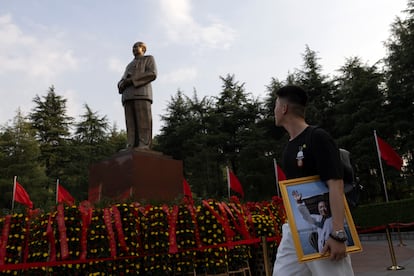
“Chairman Mao has been a beacon guiding me forward,” said Li, 24, an employee in the judicial system. He also traveled to Beijing to visit the mausoleum. “I couldn’t put into words what I felt,” this northern youth and grandson of a military man said. Li says that from graduation until he found work he went through what he describes as his own “odyssey.” During that time, reading the Selected Works of Mao Tse-Tung helped him cope better with problems. “Mao’s thinking is full of philosophical reflection; it teaches you to look at reality through its contradictions and how those contradictions transform,” he said.
Mao, who died in the early hours of September 9, 1976, at 82 and after nearly three decades of absolute power, is far from a figure confined to history books in today’s China. His portrait presides over Tiananmen Gate, from which he proclaimed the founding of the People’s Republic of China in 1949; his image still passes from hand to hand when cash is used; statues of him stand in front of many universities, factories, and public buildings. His ideas are taught from primary school through university and his thought is cited in the preamble to the Constitution and among the doctrines that guide the Communist Party of China (CPC). His iconography goes beyond official spaces: it is not unusual to find photographs of Mao in restaurants, homes, or taxis, sometimes as a political symbol and sometimes as a kind of protective amulet.
That physical and doctrinal omnipresence coexists with a public narrative that keeps the most devastating policies of his tenure in the shadows: the Great Leap Forward (1958–1962), the campaign of forced collectivization and rapid industrialization that led to a famine estimated to have killed between 30 million and 45 million people; and the Cultural Revolution (1966–1976), a decade of purges, persecution, and political violence that left nearly two million dead, tens of millions persecuted and caused massive destruction of the country’s cultural heritage.
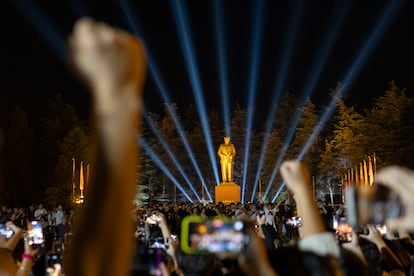
Pan, Wang and Li belong to a generation born and raised in a country Mao could hardly have imagined. The predominantly rural and impoverished China he left behind is today the world’s second-largest economy, its biggest exporter of goods, and an industrial, technological, space, and military power that competes with the United States for global influence. That transformation accelerated when, in the 1980s, Deng Xiaoping’s reforms moved the country away from much of Maoist economic policy. The young people now turning back to Mao are the children of a China built, to a large extent, by correcting many of his policies.
Yang Guobin, a professor of communication and sociology at the University of Pennsylvania and director of that university’s Center for Culture and Digital Society, wrote by email that for China’s Generation Z (born in the late 1990s and early 2000s), Mao’s texts are “fresh in style and penetrating in content.” “They read about perseverance and adaptability in guerrilla warfare and interpret it as advice for coping with the difficulties of the labor market or their personal lives,” Yang said. Social networks, he added, let users exchange impressions and pick what best fits their feelings and ideas. “There is a Mao for every occasion,” he summed up.
Wang Yiran, 25, joined a Maoist reading group as a teenager. “I thought it was very cool because it was a space to talk about politics,” she said by phone. But she was soon disappointed when she saw many members “spreading hate online.” She left and continued studying Marxism on her own. Wang is unemployed and lives with her parents. She believes that since the pandemic “there is more competition, inequality and uncertainty.” “Mao supporters keep their confidence, although times are different,” she said. “Mao is our teacher and a red sun that illuminates, but he is not God.”
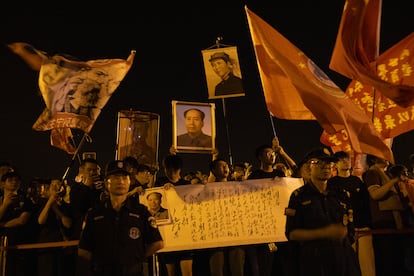
Despite that diversity of approaches, the role Mao officially occupies in China in 2026 leaves room for few nuances. The CPC set it in stone in 1981, during the reform and opening process, in a historic resolution that concluded his merits had been “far greater than his faults.” “Since what matters is the system, it was obviously not possible to criticize its creator too harshly,” Sinologist Sebastian Veg, a professor of intellectual history of contemporary China at the School for Advanced Studies in the Social Sciences (EHESS) in Paris, wrote by email.
That compromise allowed the CPC to do two things that might have seemed incompatible: abandon much of Mao’s economic model without renouncing the political legitimacy that derived from him. In 2021, China’s current president, Xi Jinping, reinforced the usefulness of that pact with the past and narrowed the scope for interpreting it. The CPC’s third historical resolution ratified the verdict on Mao, reduced mention of his errors to a few lines and incorporated him into an upward trajectory culminating with Xi’s era. In that reading, with Mao, China rose up; with Deng it grew wealthy; and with Xi it grows strong.
“We have corrected the mistakes of the past. We are not going to deny the achievements of a generation because of errors we have learned from,” Wang Yi, a professor at China’s National Academy of Governance, replied bluntly in July when asked directly about Mao’s legacy during a press conference organized by the Chinese Association for Public Diplomacy.
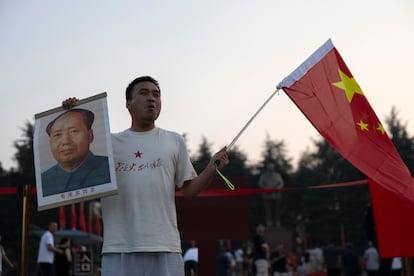
Beijing is thus trying to construct, in the words of Daniel Leese, a professor of Chinese history and politics at the University of Freiburg, “a seamless narrative that connects the past with the present, legitimizes the CPC’s historical mission, and discourages the population from asking critical questions,” he explained in a video call.
Leese, author of the essay Mao Cult, believes Xi — who has accumulated far more power than his predecessors Hu Jintao and Jiang Zemin — has drawn an essential lesson from Mao: “The figure of a central leader and a very strong ideological direction” allowed him “to maintain very tight control over both the Party and society.” Xi began a third term as head of state in 2023 after removing the two-term limit in 2018, and everything suggests that next year he will secure a fourth five-year term as general secretary of the CPC.
“It was 50 years ago… he really was a great leader,” two customers at a café called The Spark of Golden Street in Xicheng district, west of Tiananmen, murmured. They sipped their drinks while looking at the posters and Mao figurines decorating the small space. Revolutionary slogans are on display too. In a notebook, patrons write dedications or practice Mao’s calligraphy. The thirtysomething owner said it is “necessary” to have more businesses that reinforce a “properly Chinese” aesthetic. “Young people, may your light illuminate China,” reads an inscription on the terrace above a painting of a red star.
Sign up for our weekly newsletter to get more English-language news coverage from EL PAÍS USA Edition










What happens when a group of young people with outstanding résumés compete for the same job opportunity? That is the premise of An Exciting Offer (in Mandarin, 令人心动的offer), a sort of workplace version of The X Factor in which contestants vie for a single position. The show brings together university students and recent graduates trained at some of China’s most prestigious domestic and foreign institutions who, over the course of a month, work in internships under the guidance of experts while a panel of commentators in the studio assesses their successes, failures, and progress.
The format, inspired by the South Korean show Good People, lets viewers glimpse the insecurities of a generation raised to stand out and obsessed with proving it belongs. In its seventh season, broadcast last autumn, the competition moved to Dragon TV, part of the Shanghai Media Group (SMG), one of China’s major state audiovisual conglomerates.
That edition began with 10 aspiring television presenters: two were eliminated in the preliminary test and the remaining eight spent 30 days living and practicing their communication skills in the Shanghai network’s newsroom. Contestants were tasked with finding stories, locating sources, verifying information, writing scripts, conducting interviews, reporting from the street and performing live broadcasts. Across eight challenges, their experiences revealed to viewers the less visible side of a job that starts long before the red tally light goes on.
The tension is seasoned with every ingredient of a talent contest: suspenseful music, close-ups, trembling hands, tears, hugs, rivalries and on-camera confessions. Unlike other reality shows, the audience does not vote and there are no eliminations during the season. Each task gains contestants points and only those who reach 100 advance to the final interview, where the candidate who receives an offer to join Dragon TV is chosen.
Since its debut in 2019, the program had devoted four seasons to lawyers and one each to doctors and architects. But returning to law for two consecutive editions had made the format more predictable and the formula was beginning to show signs of fatigue.
To refresh it, the show’s producer, Tencent Video — one of China’s leading entertainment platforms — brought Dragon TV on as a co-producer in 2025, opening its doors and placing well-known faces in charge of training, such as veteran interviewer Chen Luyu. From the studio, former CCTV presenter Zhang Quanling and debate specialist Chen Ming provide the most substantive commentary, which also serves as short lessons in the craft, while comedians and internet personalities bring a fresher tone.
The move to a new sector proved a digital success: the seventh season led two of Weibo’s (China’s version of X) variety-show popularity rankings for 56 consecutive days and logged more than 1,200 appearances on that social network’s trending lists. The forum dedicated to the contest on Tencent Video also surpassed four million posts, the highest total for an entertainment program on the platform in all of 2025.

Part of that renewed interest lies in the figure of the presenter itself, at a moment when the boundaries of the profession have blurred, with hundreds of influencers speaking daily to audiences of millions and artificial intelligence writing scripts, voicing them, and even presenting news. An analysis in the Shanghai newspaper Wenhui Bao, reproduced by the state news agency Xinhua, presents this edition as a vindication of a profession whose survival can no longer be taken for granted.
Those hoping to fill that role on the show do not lack credentials. For example, Li Yujia graduated top of her class from the Communication University of China; Pang Zheng earned the same rank at the Shanghai Theatre Academy; Wang Yu studied at Cambridge; and Wang Yunlin had already worked as a presenter on Cantonese television. But those merits soon become another source of pressure. “Is that top rank that once brought me glory now my shackle?” Li asks in one episode. “You’re already excellent; don’t be so hard on yourself,” mentor Chen Chen tries to reassure her.
The real premise of the show becomes clear when the contestants — young people who are used to standing out — enter a setting where every mistake fuels comparisons and every compliment from a mentor increases the pressure. The mechanics echo the popular Chinese term neijuan (内卷), used to describe a spiral in which, faced with scarce opportunities, everyone is forced to work ever harder just to avoid falling behind. The result is a vicious cycle of demand that intensifies competition without producing real progress. In English, it could be compared to the idea of a “rat race.”
Anxiety and frustration
In fact, since its early seasons, some viewers have nicknamed the contest “An offer to make you feel bad,” overwhelmed by the contestants’ impressive list of degrees, awards, and experiences. One of the most talked-about moments of the last season was the elimination, before the internships even began, of a graduate from Tsinghua, China’s most prestigious university. Although, according to the network’s data, most of the audience consists of young people with higher education, there has been no shortage of calls on social media for a season “featuring ordinary people.”
The success of the format thus contains a paradox: why does a generation tired of competing spend its free time watching others fight over a job? Some internet users answer that the show reflects the anxiety and frustration they feel themselves, but at the same time it offers some consolation: on screen, at least, mistakes are explained and talent, discipline, and perseverance end up being recognized.
Sign up for our weekly newsletter to get more English-language news coverage from EL PAÍS USA Edition

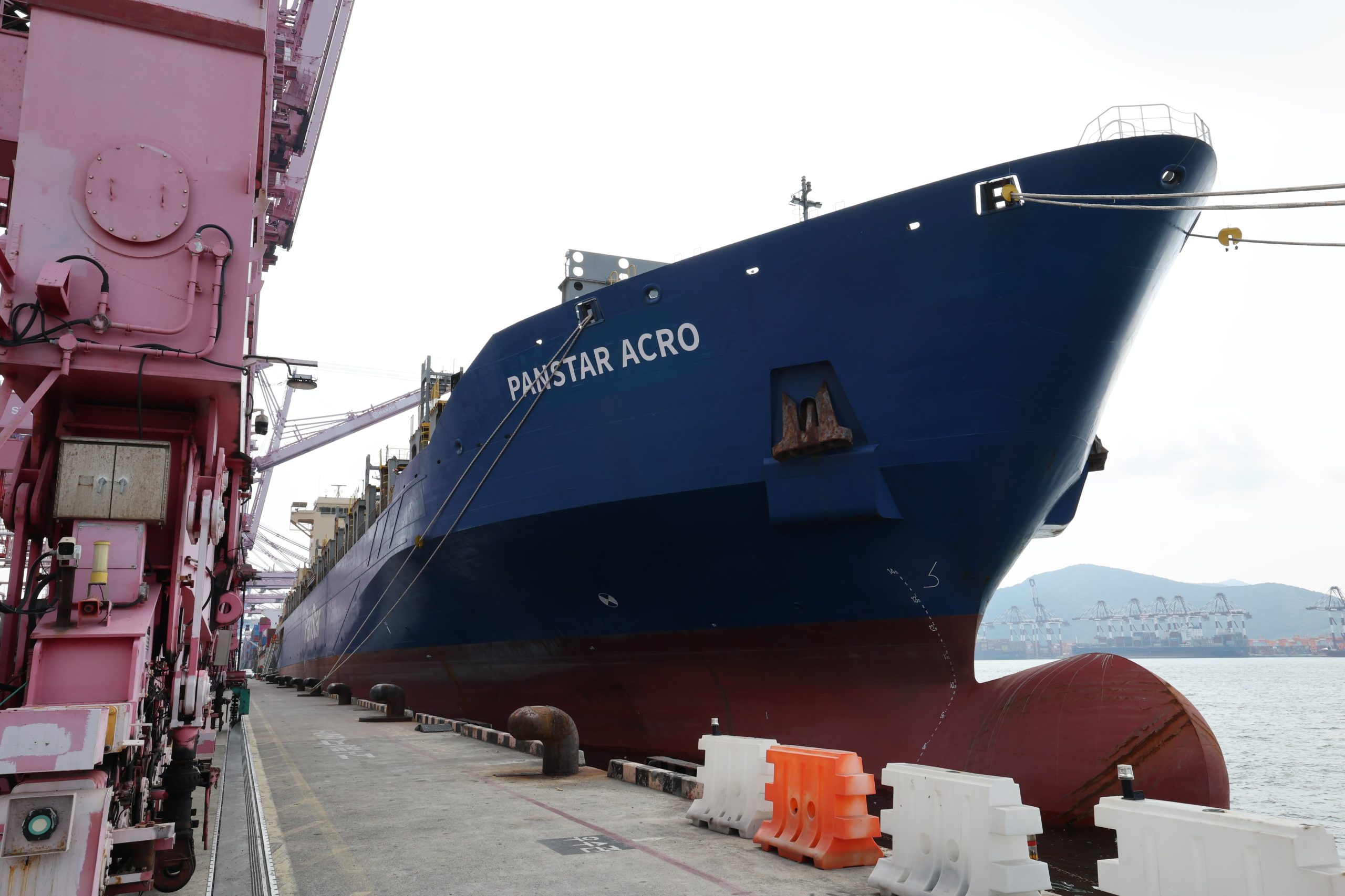
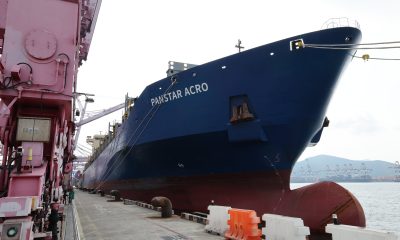
On August 26 and August 29, in the bustling port cities of Qingdao and Busan, located in China and South Korea respectively, two medium-sized cargo ships cast off. The Dubai Tower and the PanStar Acro headed for the British ports of Teesport and Felixstowe via the Arctic, before sailing to other destinations in Northern Europe.
This significant double move in the ever-frenetic world of maritime trade is redrawing the economic and geopolitical map. It shifts power and influence toward the Northern Hemisphere, at the expense of the Southern Hemisphere, and it grants yet another dangerous advantage to Vladimir Putin’s Russia.
Regular connections between Asia and Europe via the North Pole were unimaginable just a couple of decades ago. Even though global warming was already wreaking havoc back then, ice still covered the bulk of the Barents Sea. Today, however, the Chinese company Sea Legend intends for the new link between Asia and Europe to result in a weekly route. Its South Korean counterpart, meanwhile, is still in the testing phase.
The shipping sector estimates that navigability in the area will last around three or four months each year, from August to October (although there’s the possibility of an extension toward the end of that period). This means that a new route is now viable, one that drastically brings down shipping times when compared to the most-used alternative to connect Asia and Europe — the one that crosses the Suez Canal — and reduces them exponentially when compared to the route that crosses the Indian Ocean and rounds the Cape of Good Hope, at the southern tip of Africa.
“If the 20th century was the century of the Strait of Malacca, the 21st century will be the century of the Bering Strait,” predicts Arancha González Laya, dean of the Paris School of International Affairs at Sciences Po, in her recently published book, Solos en el Mundo (Alone in the World). “One of the greatest reconfigurations of global logistics has begun,” Spain’s former foreign minister adds.
With the Red Sea, the gateway to the Suez Canal, under constant Houthi pressure and the Strait of Hormuz doubly blocked by the U.S.-Israeli conflict with Iran, the situation could not be more favorable for the so-called Northern Sea Route. It shortens transit times by up to 40%, according to Kjell Stokvik, managing director of the Center for High North Logistics. And, he adds, this figure“will be reduced even further in the future, with transpolar routes.”
The Northern Sea Route allows for greater ship turnover. It reduces fuel consumption — which is crucial in times of scarcity — and it avoids the risk of armed attacks. Additionally, even though the premiums demanded by insurers are high, these have also grown significantly in Middle Eastern waters, which will level the playing field between the two routes.
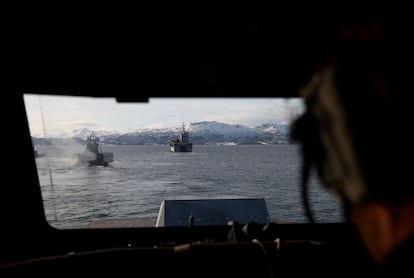
However, there are significant drawbacks to this new route. The first is the environmental damage: if this route is feasible today, it’s precisely because of the unchecked advance of ocean warming and the continuous melting of the Arctic Circle. Nowadays, icebreakers are only needed in the final stretch of the season, well into October. And, despite the ships’ lower fossil fuel consumption on a shorter journey, the opening of this new route could exacerbate pollution. It could also further damage the biodiversity in a unique region, one that’s a natural sanctuary of incalculable value.
“These cargo ships risk collisions with mammals and other species in an area that also depends heavily on fishing,” notes Javier Arnaut, a professor at the University of Greenland-Ilisimatusarfik.
Anjali V. Bhatt, a research fellow at the Peterson Institute for International Economics (PIIE), points to a second challenge: the control that Russia exerts over the route. If Iran (and now the U.S.) wants to seize control of the Strait of Hormuz, charging tolls at will, it’s Rosatom — the Kremlin-owned nuclear corporation — that issues navigation permits in the far north. Naturally, this generates larger and larger sums of money for the Russian government, at a time of pressing economic need in Moscow. The opposite is true in Egypt: if the Arctic route becomes established, it will represent a financial drain on the already-strained coffers of the North African country, which are heavily dependent on ships transiting through the Suez Canal.
“From Shanghai northward, any ship taking the Arctic route reaches Europe faster [than via the Suez Canal]. But there will always be a drawback: there are no points where ships can make intermediate stops,” explains Jordi Torrent, a consultant and secretary general of the MEDPorts Association. “From Asia to Algeciras [in Spain], ships can call at four or five ports [including Singapore, Dubai, Egypt, Malta]. In contrast, there’s nothing when you pass through the Arctic, and that’s a structural limitation.”
Spain has benefited from the diversions around the Cape of Good Hope, reinforcing its role as a gateway to Europe via the Strait of Gibraltar, one of the few remaining open shipping lanes. The cities of Valencia and Barcelona have seen their business boom, while Algeciras has established itself as a critical port on a global scale. The Arctic route could diminish this influence.
Although there’s still no regular service, a total of 103 transits (outbound or return journey) were recorded last year via the Arctic route. That’s six more than in 2024 and 60 more than in 2022, according to figures from the Center for High North Logistics, based in Kirkenes, Norway. Most of these vessels were Russian and Chinese. Those numbers, however, still pale in comparison to the more than 24,000 ships that passed through the Suez Canal in 2024, the last year before the war in the Middle East reached its peak.
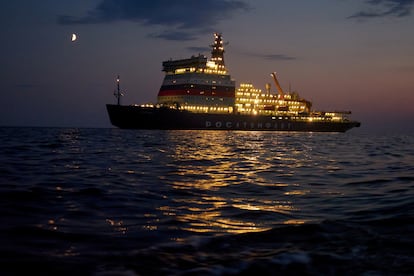
Neither North America nor Europe remains untouched by these commercial shifts (as well as military and energy-related ones) in an Arctic that has become one of the world’s hottest flashpoints in terms of clashes between global powers. The Trump administration has combined repeated annexation threats against Greenland with the announcement of a major purchase of Finnish-built icebreakers, bringing its fleet to over 50. Canada, not wanting to be left behind, has just announced the construction of six more of these vessels.
“The opening of these routes is generating anxiety in the U.S. to use the other Arctic route, the Northwest Passage, which Greenland has the rights to,” Arnaut explains. “It increases the value [of the island that’s under Danish sovereignty] for Trump and demonstrates that the gradual commercialization of the Arctic goes far beyond monetary value: it has strategic value.”
Meanwhile, in the next few weeks, the European Union is preparing to unveil the main points of its Arctic strategy for the coming years. It holds a strong hand: the continent has the advantage of geographical proximity, while Finland, Denmark and Sweden have historical hegemony in the area. But, as in so many other areas, many argue that it lacks ambition, that its instinctive caution risks holding it back at a time when the major powers, from Russia and the United States to China, are baring their teeth.
Summit in Lapland
Aware of the urgency, Helsinki (perhaps the EU capital with the most influence in a region where its future is at stake) has convened a high-level summit, to be held on September 13 and 14 in Rovaniemi, a town in Lapland, the northernmost region of Finland. “The Arctic region is an increasingly important part of Europe’s security environment. The European Union has direct interests in its stability, security and sustainable development,” said Finnish Prime Minister Petteri Orpo, while extending an invitation to several EU leaders.
“Europe’s challenge isn’t a lack of involvement. Rather, it’s about ensuring greater coordination and a clearer strategic direction,” Stokvik argues, from the Center for High North Logistics.
Michael Bravo, from the Scott Polar Research Institute at the University of Cambridge, also believes that the 27 member states can “benefit from these advances [in Arctic navigation].” The EU, he says, “has both the opportunity and the capacity to contribute constructively to shaping the region’s future, ensuring adequate environmental protection and economic stability.”
However, Alla Pozdnakova, from the Scandinavian Institute of Maritime Law at the University of Oslo, is more skeptical. “It’s fascinating to see China and South Korea’s plans, but I doubt these routes will have positive implications under the current circumstances, either for Arctic states or for the rest of Europe.”
On the contrary, she writes to EL PAÍS in an email, “Geopolitical tensions are likely to increase. And Arctic coastal countries, like Norway, will be exposed to greater risks of polluting accidents in the harsh conditions of Arctic waters. The ecological damage that a container ship accident can cause to the marine environment is enormous.”
Moscow’s leverage
“Russia not only uses natural gas to exert pressure on Europe, it can also use the Arctic as leverage: it can raise or lower the fees it charges shipping companies to transit the route, and it has the ability to shut it down whenever it chooses, much as Iran can with the Strait of Hormuz,” Vasco Sánchez Rodrigues, an associate professor at Cardiff University, warns by phone.
He also stresses the importance of the route as an outlet for Russian oil and gas exports, as well as a regular corridor for the movement of troops and military equipment to and from the Eurasian power.
In the words of Carlos Santana, director of IE University’s Advanced Supply Chain Management Programme in Madrid, the shift represents “a changing of the guard,” with a new lord and master of shipping routes. And it means more power for Moscow and Beijing. “For China,” he notes, “the Arctic isn’t just a potentially shorter route; it is, above all, a new strategic option.”
And for the Kremlin, concludes Torrent, the Arctic has been an obsession for four centuries. “Russia’s only maritime outlets were through the Black Sea, controlled by Turkey, and the Baltic. That is why access to the Arctic was one of Putin’s five priorities for this century. Thanks to climate change, that goal has now been achieved.”
Sign up for our weekly newsletter to get more English-language news coverage from EL PAÍS USA Edition
Asia
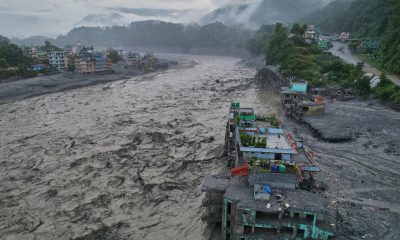
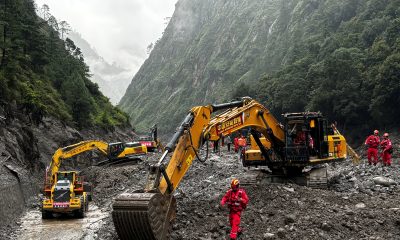
La Esperanza De Hallar Supervivientes Disminuye Una Semana Después De La Riada Del Himalaya: “La Recuperación Será Un Largo Maratón”

Gibraltar Gears Up To Celebrate First National Day Since Historic Post-Brexit Treaty Tore Down Border With Spain

Spain’s New ‘affordable’ Housing Portal Launches With Zero Flats In Andalucia Or Madrid
More than 40,000 treasures and classic cars heading to Torre Pacheco this September
France’s famous cheeses could taste different after drought forces farmers to change cows’ diets
Krakatoa exploded 143 years ago today: Noise heard 5,000km away that shaped Spain’s south-east

54 Hectares Destroyed In Barcelona Fire As Man Arrested Over Suspected Arson


-
Abondance2 weeks ago
France’s famous cheeses could taste different after drought forces farmers to change cows’ diets
-
History2 weeks ago
Krakatoa exploded 143 years ago today: Noise heard 5,000km away that shaped Spain’s south-east
-
 %2 weeks ago
54 Hectares Destroyed In Barcelona Fire As Man Arrested Over Suspected Arson
-
cocaine2 weeks ago
‘Blazing Saddles’: bizarre discovery sparks major police operation in Spain
-
botanical garden Orchidarium2 weeks ago
Wands out in Estepona: Costa del Sol town celebrates 25 years of Harry Potter on film
-
Airport malaria2 weeks ago
Mosquito stowaway kills two Frankfurt Airport workers in rare malaria outbreak
-
 Andalucia2 weeks ago
Spain’s Expat Havens: These Are The Towns Where Foreign Buyers Outnumber Spanish Ones – Sometimes By Two To One
-
Latest2 weeks ago
‘We Feel Abandoned’: Clashes In Spain’s Ceuta As Locals Grow Tired Of Migrant Crisis