
ElPais
Micah P. Hinson: ‘The United States Is Full Of Nationalists And Christian Fanatics Trying To Kick Everyone Out’

Micah P. Hinson, 44, has become a good neighbor in the Madrid district of Carabanchel. And, perhaps for him — a U.S. musician born in Tennessee and raised in Texas, who has traveled the world and survived more than one existential battle — that’s quite an achievement.
“I became capable of isolating myself a lot. And I thought that was just life,” he confesses, during a moment in his long conversation with EL PAÍS. The interview takes place in his apartment: a charming flat of no more than 750 square feet, it has large windows and walls adorned with his own illustrations, a skateboard, as well as hats that he likes to wear.
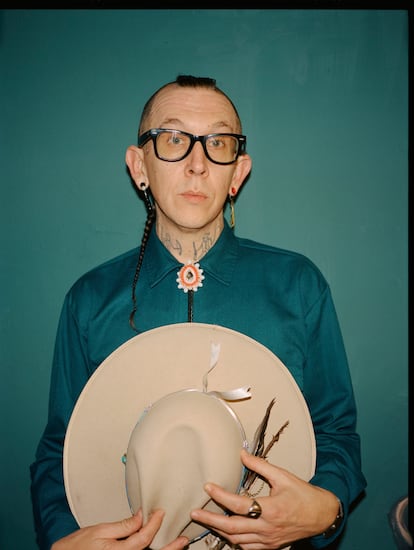
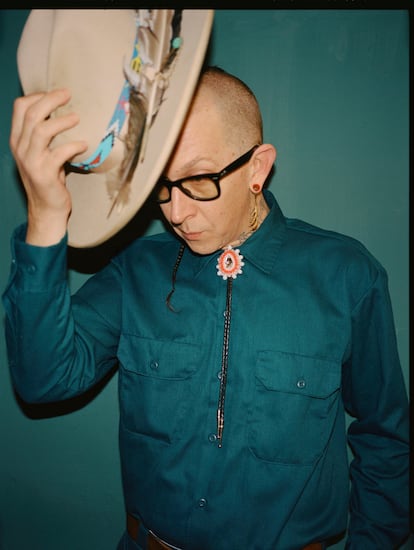
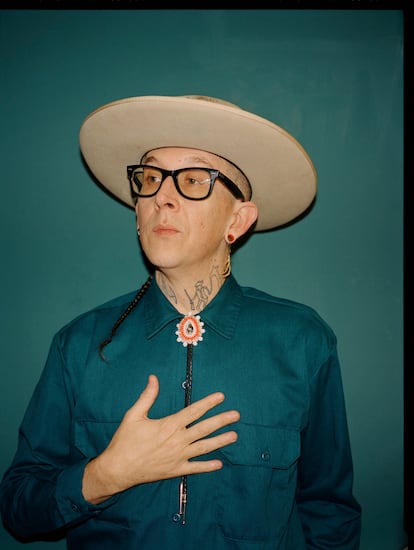
It’s a Wednesday afternoon. After answering the intercom with a simple “bajo” in Spanish (“coming down”), he appears on the landing without his hat, revealing a stiff, dark mohawk on his shaved head. He’s carrying a key to unlock the building’s front door. “Hello. Welcome to Carabanchel,” he says, in his playful Spanish, which is marked by an American accent. He shakes hands and gives a radiant smile. His horn-rimmed glasses and long feather earrings shimmer. “I came down the stairs, but I think it’s better to take the elevator to get to the third floor,” he adds, now in English.
The elevator is one of those old, tiny lifts, typical of the social housing in the upper part of Carabanchel, where this new resident of the district lives. “I really like this neighborhood,” he declares, before opening his front door. “I feel like I belong in Carabanchel.”
Lately, Carabanchel — the district whose icon has always been Rosendo, the urban Spanish rock legend — has become a haven for many artists who have revitalized the area’s cultural life. However, among so many artistic agitators, few are foreigners. And few — if any — have a story of rebirth as powerful as that of Micah P. Hinson, a sharpshooter of American songwriting. Without being a chart‑topper or a mainstream star, he became beloved in the first decade of the 21st century in Spanish music and indie circles, thanks to his emotive way of blending folk and rock.
His rebirth was partly due to a car accident he was involved in while traveling to Barcelona with the members of Tachenko, a Zaragoza-based band. The crash nearly cost them their lives. “We should have died in that accident. It was a miracle we survived. I suffered nerve damage in my arms. It took me eight months to be able to use them and play again. It was very tough,” he recalls.
He disappeared from the public eye. But in 2025, he returned with The Tomorrow Man, a remarkable orchestral album that has been cathartic for him. He admits that he almost quit music four or five years before releasing this album.
“I seriously considered it,” he sighs. “I felt like everything was going wrong, because I was drowning in every which way. I had signed with a British record label called Full Time Hobby, and they wouldn’t give me even a tiny bit of money up front so that I could record a handful of songs. It was exhausting because, on top of everything else, my head had been in a bad place for a long time. So, I started preparing to shut down this whole music thing. I thought I’d had a good 16-year career; I’d traveled the world and released some good albums I could be proud of. I just assumed the damn universe had a different plan for me.”
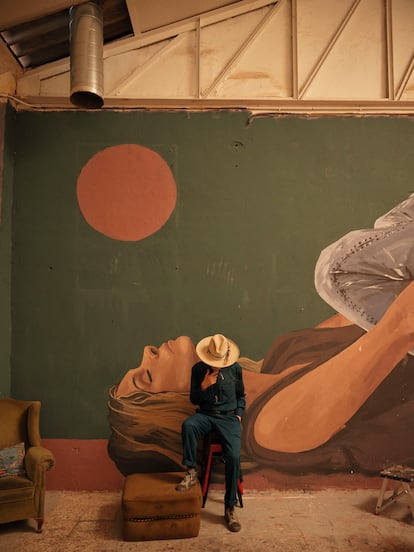
Today, however, Hinson proudly recounts how he ignored the supposed calls of the universe. Today, he is “content” — although not happy — in Carabanchel. “‘Happiness’ is a damn dangerous word, man… overall, I’m very content with how things are going. But of course, I can always be a better person.” Part of this contentment stems from his decision to stay in Madrid — where his Colombian partner lives — and, more specifically, in Carabanchel, a neighborhood that “isn’t Spanish.”
“The only Spaniards I see are elderly people in wheelchairs being pushed around by their Latina caregivers. As an immigrant, it feels right to be in a neighborhood like this. I love walking around and seeing people, all the beautiful human beings from Peru, Chile, Colombia, and Argentina. This seems to be a place where they’ve come to live their lives, just like me,” he explains. “I don’t have a car. So, if I want to go places, I have to use my legs or take the subway. I love it. In this neighborhood, if I want a pair of shoes, I go to the shoe store. If I need paint, I go to the paint store. In the United States, this doesn’t exist. We only have one place to go: the mall. A capitalist nightmare has become entrenched there. I don’t think it’s healthy for humanity.”
Breaking with that way of understanding a city isn’t the only thing this musician — who now seeks to be more human — has broken with. For his resurrection, Micah P. Hinson has had to break with much more. For example, with the “American way of life” — something that directly affected his family.
“I was unhappy, and a lot of it stemmed from wanting to follow the guidelines of the ‘American Dream’ structure,” he explains. “I had a house, a wife, kids, a job… all those things that make up the American Dream. But I didn’t have myself. I felt very miserable. I worked at a pizza place during the day and at a video store at night. I remember coming home — it had been a long time since I’d written a real song — and I felt like there was something inside me. And then, I started writing. I was still wearing my work clothes, which were dirty and covered in flour. My kids were in the living room doing whatever it was they were doing… and a song, Think of Me, came out.”
With its meticulous orchestral touch, Think of Me (2025) is a beautiful ballad in which Micah P. Hinson questions his place in the world. He sings the lyrics: “Wind will carry the rain that falls on me / Wish for me the words that I can’t find.”
Sitting on the sofa in his Carabanchel home, he recalls it this way: “The chords, the words… it all came so fast. I thought: ‘I can still write songs!’ I had a kind of cosmic shift in my existence. And it knocked me out for a few days. During that period, I decided that the past and the present would always be with me, but that it was time to focus on the future.” That future involved divorcing his wife and breaking up a family with four children.
On a living room table, the musician’s phone is charging. There’s also a small lamp, as well as a photograph of his four children. He gets up from the sofa and picks it up. He says their names and describes each of them. “I have a strange relationship with my children. We’re connected on a spiritual level, even though I only see them three times a year. I’m waiting to get their passports so they can visit more often.”
He lingers on the youngest, Lula. “She was conceived at a very inconvenient time. There are some people in this world who think that, if they have a problem in their relationship, a baby will solve everything. That’s crazy… [but] I did it.”
Hinson settles back into the sofa. The afternoon light is fading through the large window behind him. He lights another cigarette. He smokes fast, as fast as he talks, trying to keep pace with everything running through his mind.
“I ruined that whole damn family‑dream thing, man. I blew up, honestly. I changed, I crashed, I found the booster seat of my life and shot straight into the damn sky. And it was hard — because of my kids, and because there were so many chains. One of them was religion: my idea of Jesus Christ and God was tied to shame. I had to realize on my own that I didn’t need some invisible God telling me who I was supposed to be.”
His album is titled The Tomorrow Man (2025) because it refers precisely to the man he sought to be: a very different one. “I’ve had to create an almost alternate personality for myself, so to speak,” he confesses. And, if that’s the case, it’s because the past — and religion — always weighed heavily on his existence.
Micah was born in Memphis. As a child, he moved to Abilene, Texas, where his family was able to develop their strong religious convictions within a sect called the Church of Christ. “I thought we were like normal Christians. But as I grew up, I realized that we were just a bunch of damn fanatics,” he sighs. “In my home, I always viewed religion from the outside. People talked about prayer, reading the Bible, salvation — but I never wanted any of it. Everyone around me seemed to feel God’s love, but I didn’t.”
Being so different from his surroundings had its consequences: Micah didn’t fit into a mold that offered no alternatives: it was religion or the street. And he chose the streets. Before he was 20, he started using drugs after getting involved with an older widow, whom he refers to as “the Black Widow.” And he got into trouble: he spent time in jail, accused of drug use and forging prescriptions.
When he was released, his parents kicked him out of the house and he was forced into homelessness. Sometimes, he slept at friends’ houses; other times, in a motel. And that’s when he began writing his first songs. “Music is like a bubble in which we can do everything possible to silence — for a little while — the chaos and noise of being human. It makes people feel less alone,” he says.
The musician speaks while looking around his small living room. But when he fixes his attention on the journalist, a gleam of intensity shines through. His gaze is deep and warm, growing even warmer when — before answering any question — he apologizes in advance in case he ends up rambling. He doesn’t hold back with his words or with himself. He speaks from the heart and addresses all kinds of issues without hesitation: divorce, children, drugs, alcohol, prison, religious fanaticism, and depression. This last topic is complex because, according to his own life story, it’s something that he’s never been able to fully define. He believes that feeling so different from such a strict family has haunted him since childhood.
“All of this is interesting because my father — aside from being a spiritual advisor for the sect — is a psychologist by profession. I grew up with mental health being a constant topic of conversation in my home. Since I didn’t fit in, they took me to a counselor in my teens. And we talked about my depression. He asked me, ‘Hey, are you sad, or depressed?’ And I said, ‘Well, what’s the difference?’ And he said: ‘Sadness goes away. Depression makes a home around you. Sadness is like the wind.’ It was important for me to understand that, because I never wanted depression to be my home, but I’ve spent my whole life talking about it. And now, I want to think that what I’ve really lived with is a great sadness.”
Whether it be depression or great sadness, Micah P. Hinson has always struggled to be himself — the true self that comes out in his music. He has also fought against circumstance: his family, yes, but also his country.
“Sadness led me to a certain lifestyle. And that lifestyle led to some health problems over the years. Doctors in Texas prescribed me a drug called fentanyl, which is killing people in my country and turning everyone into fucking zombies. It’s a fucking miracle drug that makes you feel good, but I realized that I wasn’t eating or drinking anymore. And I looked like a fucking skeleton. It gets you addicted, and then, you’re done for.”
“I told the doctors it was time to stop the fentanyl,” he remembers. “They were very skeptical. They thought I shouldn’t. They kept saying, ‘Hey, this isn’t doing anything bad to you. You’re going to be fine.’ But I was adamant: ‘No, I’m quitting this drug, fuck it.’ And they tested me, found marijuana in my system and kicked me out of the clinic, claiming I was using illegal drugs. And I said, ‘Wait a minute, you’re giving me fentanyl. What are you talking about, assholes?’”
He pauses for a long time. “Man, I was a damn drug addict, tired of life, of the pressure from my family’s cult, of the doctors… I even contemplated suicide and all that grand, terrible stuff. But, luckily, I still had some humanity inside me that made me stop all that nonsense in my head.”
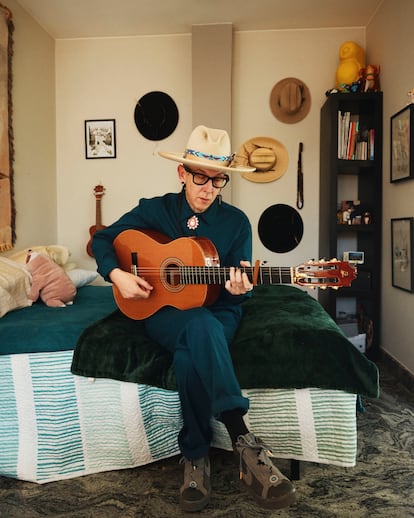
The musician — who offered water or tea when we entered his apartment — speaks over a glass of water. He no longer drinks alcohol (because he used to drink it down to the last drop). After going over his own problems, he delves into those of the country where he was born and raised. “In American society, talking about suicide is shameful. Nobody wants to stop and talk about it, because that might lead you to talk about its causes. About the system. About all those lives that endure so much every day. It’s better that they disappear quietly, or become zombies.”
“The real shame in my country,” he continues, “is that they repealed the right to abortion in many states […] And they want to prevent Native Americans from being recognized as citizens. The government of my country is making lists of Native Americans to separate them from the white people, who dominate the system. What the hell is that all about? I thought this issue had already been addressed 100 years ago… and now, we want to make distinctions. All these things are pressures on people who are already under pressure to survive in an ultra-capitalist system.”
Hinson has Native American ancestry on his grandmother’s side: he has Chickasaw blood. These Indigenous people are originally from present-day Mississippi and Alabama. “That lineage goes back through my grandmother to time immemorial, man. And if I sit here today looking like a white man, it’s because white men were sleeping with my grandmothers for 700 years. That’s the truth. Pure hypocrisy. There’s a real identity crisis. The government wants to erase the parts of our history it doesn’t like.”
Without pausing, he continues to string his thoughts together. “My country’s attitude is nothing new. It’s been like this since 1540, when the Spanish arrived with their attire and crosses of Christ. And then the English, Dutch, French and Italians forced religion on us even more forcefully. Nowadays, we live with a government that’s kidnapping Brown people from the damn streets to deport them.”
“I’m a little Brown and I speak some Spanish. I’m a threat to my government. Just like my gay friends and my trans friends. In Texas, I’ve got a problem. The mother of my kids knows it. My kids go to school in Texas, and they just passed a law requiring the Ten Commandments to be displayed and read in every classroom. I even have a problem with this interview because the Big Machine of the government can pick up my words, and I don’t think we’re living in the same free country we always thought we lived in. There’s a verse in the Bible that says when a foreigner enters your land, you treat them like your own brother. But they don’t read that part. They interpret the Bible however they want. And here we are, in my country, with all these damn nationalists and Christian fanatics trying to kick everyone out.”
Hinson gets up from the sofa again. He goes to his record collection and takes out Lux (2025), Rosalía’s latest album. He bought the vinyl a few days ago. “I spent 50 damn euros,” he says with a smile. ““I’ve been reading a lot about her. She was talking about the loneliness inside relationships, the emptiness in sex, all these human things tied to isolation and not being understood… It struck me because I’m talking about the same things on my new record. And hell, we both tried to fill that emptiness with orchestras.”
“I get that in the face of loneliness you might look for God, but I thought, ‘Is that the whole point?’ I’m a damn gringo and maybe she knows what this is about. Maybe all that loneliness Rosalía feels — as a woman and as a human being — has something to do with the teachings of that God.”
“I wish I were more famous so maybe I could meet her, sit in a room with her and talk about all this. Because human beings are spiritual, and maybe there’s no life after this one, or maybe, hopefully, we’re not alone — who knows. But we have consciousness, and we’re meant to connect with each other.”
The orange lights of the streetlamps glimmer behind Hinson, who remains seated on his sofa. His ashtray is overflowing. He reiterates that music is meant to end chaos. He says he learned this when he was young, from listening to Bob Dylan, Leonard Cohen and John Denver. “When Denver died, I felt like I had lost a family member. It was the music of my childhood, because it was the only music my parents tolerated. Although,” he adds, “the last artist who changed my life was Juan Gabriel; I discovered him on my trips to Mexico. He’s pure intensity.”
In the orange light, with his stiff mohawk and long feather earrings dangling from his hair, Micah P. Hinson bears an even stronger resemblance to a member of the Chickasaw tribe. “If I had to speak of a single fear, I would say I fear for the human soul,” he confesses. “I think the purpose of life is to share experiences, but we have fewer and fewer of them. With artificial intelligence, social media and the way the world is moving, we’re drifting away from that and from communicating love, which is something essential. But it’s very difficult to fight ignorance. I’m afraid we live in times that we don’t understand. And, instead of spending that time to opening a book, having a conversation, or writing something down, we’re putting all our energy into the void,” he reflects.
Hinson remains silent for a few seconds before continuing. “I also don’t think we need a god, or some damn fictional fairy tale, to tell me the truth about life. I think we need to be more aware, as a global society, of what we’re doing wrong. Yeah, man, it worries me a lot that the world is burning, and we’re only concerned with damn Instagram posts.”
As night falls, it’s time to say goodbye. Micah P. Hinson, the Carabanchel resident, stands up. And, just a few seconds later, he looks out of his living room window and exclaims: “Carabanchel! My neighborhood! I think I’ll go for a walk to get some dinner. Come back anytime.”
Sign up for our weekly newsletter to get more English-language news coverage from EL PAÍS USA Edition









Anemia
The Invisible Face Of Pregnancy And Postpartum: One In Every 16 Women Experiences Serious Depression



E

Luxury Villas For Sale, Estepona – ProjectL1

Hand Grenade Explosion In Malmo, Sweden

Stylish 3-Bedroom Apartment With Panoramic Sea Views – Benalmádena
Brussels warns Spain that migrants regularised under controversial scheme will be deported back to Spain if they try to move to other EU countries

Poland Disconnects Utilities At Russian Consulate That Moscow Refuses To Hand Over


-
 New Developments4 weeks ago
Stylish 3-Bedroom Apartment With Panoramic Sea Views – Benalmádena
-
eu response to spain migration policy3 weeks ago
Brussels warns Spain that migrants regularised under controversial scheme will be deported back to Spain if they try to move to other EU countries
-
 %4 weeks ago
Poland Disconnects Utilities At Russian Consulate That Moscow Refuses To Hand Over
-
Costa Calida3 weeks ago
Murcia unveils monument marking 175th anniversary of Burial of the Sardine
-
Costa del Sol3 weeks ago
Easter on the Costa del Sol: a time of renewal
-
Fish Counters Being Removed4 weeks ago
Mercadona removes fish counters: T9 format brings shift to pre-packaged seafood
-
DGT4 weeks ago
Spain dishes out record 6.1 million traffic fines, with Andalucia hit hardest
-

 Ataque contra Irán3 weeks ago
Última Hora De La Guerra De Estados Unidos E Israel Contra Irán, En Directo | EE UU Asegura Que Dos De Sus Buques Militares Han Cruzado Ormuz Para Desminar El Estrecho E Irán Lo Niega