
Donald Trump
The Promise Of $1,000 In Exchange For Becoming One Of Trump’s Deportees: ‘I Wanted To Get Out Of Detention, Not Out Of The US’

When Luis Andrés Monterroso López, 29, set foot on Guatemalan soil on December 19, 2025 — his first time back in three years — he was furious. Dressed in a gray jumpsuit and dark‑blue slippers, the standard uniform for migrants held in U.S. detention, he spoke to his mother on the phone while sitting outside the Guatemalan Air Force base where deportation flights land. “They don’t treat animals like this. I came back with my hands and feet shackled,” he told her, outraged.
In the plastic bag labeled with his name and identification number — the one he received at the Alvarado detention center in Texas — he carried two documents: his voluntary‑departure order and a sheet explaining how to claim a $1,000 payment. The sum was a kind of bonus that ICE officers promise to detainees with no criminal record if they agree to voluntary departure.
“We all signed just to get out of jail, not for the money — and as far as I know, no one ever manages to collect it. But I’ll try anyway,” Monterroso told this newspaper that day.
The instruction sheet said the money would be available five days later by logging into mail.cbp‑stipend.com with the username and password provided. A few days after returning to Quesada, in the department of Jutiapa, Monterroso followed the steps exactly and was redirected to Zoho, the platform the U.S. Department of Homeland Security supposedly uses to communicate with migrants who sign voluntary departure.
The account existed. So did the portal’s welcome messages. But there was no sign of the money. On January 24, Monterroso emailed the site’s support service asking how to claim the payment. No reply. He checked again on February 19. Still nothing.
Then, on March 19 — while this story was being prepared — he opened the account one last time. And there it was: an email from CBP Home with instructions to collect the money through Western Union. And it wasn’t $1,000 but $2,600, issued by Soterex Financial Services LLC, a Virginia‑based money‑transfer company. The message was dated February 25, 68 days after his deportation.
“It’s been an ordeal to get this money. With this delay, I had already lost hope,” Monterroso said.
And in fact, many never receive it.
“They tricked me”
Every week, about 1,180 people are deported from the United States to Guatemala, most of them from Alexandria, Louisiana. Many arrive carrying the voluntary‑departure form — and, sometimes only verbally, the promise of a cash payment.
“In jail, you don’t eat, you don’t sleep, you can’t wash. It’s horrible. To get out of there you’d sign anything, especially knowing almost no one wins their case,” says Eric, who was deported on March 21 after 18 years in the United States. “That’s why I agreed when the ICE officer pushed me to sign, offering me $3,000,” he adds. But at the Alabama detention center, he never received any instruction sheet. “They tricked me. How am I supposed to collect that money if they didn’t give me a login or a password?”
Others had the same experience. “They only asked for a phone number, but a week after being expelled we still haven’t received any message,” says Juan Gaspar from a village near Quetzaltenango.
Between 2025 and early 2026, 44 people have died in ICE custody — the highest number in decades, according to Detention Watch Network, a national coalition that wants to abolish the detention of migrants in the country.
“Some detainees are forced to sign voluntary release agreements to cover up cases of illegal detention that could be challenged,” explains Carlos Valenzuela, an immigration lawyer in the United States. “The money is presented as an incentive, but in practice it’s a mechanism of psychological pressure to get them to give up defending their case.”
Valenzuela says he has seen only one client actually receive the stipend. “The most frustrating thing is that once they sign the voluntary departure agreement, they can still be held for up to three months before being deported.”
Others report that ICE officers promise they will be able to return legally to the United States. “That’s the worst kind of deception,” the lawyer adds. Migrants who have spent more than a year in the country without legal status face a re‑entry ban of up to 10 years.

Deported or “self-deported”?
In March 2025, the Trump administration launched what it called “voluntary self‑deportation” through the CBP Home app, a program designed to encourage people to leave the country on their own. It allows non‑citizens without legal status to report to ICE, receive a ticket on a commercial flight, and access a stipend that now reaches $2,600, up from the initial $1,000.
“We haven’t assisted anyone who has applied to this program, and it’s unlikely that those of us who have lived in the U.S. for 10 or 20 years would approach the government, much less for such a small amount,” says Esmeralda Flores of Otros Dreams en Acción, which works with the returning migrant community. This Mexican organization also questions the use of the term “self-deportation.” “Deportation implies the presence of an immigration authority. No one can self-deport,” Flores argues, saying the label is meant to shift blame onto migrants.
At La Aurora Airport in Guatemala City, about 20 flights from the United States land every day. Some passengers return with multiple suitcases and a firm decision not to migrate again, but it’s hard to find anyone who says they came back through CBP Home. “No one sells themselves for $1,000,” says a taxi driver who works the airport.
Graciela, 19, confirms it: “My grandmother came back after seven years because she’s sick and tired of being in the U.S.. She paid for her own ticket and didn’t want this money from Trump. Besides, everyone says they don’t give it out.”
According to U.S. State Department data, nearly two million people have left the country through CBP Home since January 2025. But there is no public information on how many actually receive the stipend, nor whether the figure counts as “self‑deportation” cases that are, in reality, deportations.
“I don’t have a single client who, while free, has used CBP Home. And collecting the money is complicated,” Valenzuela adds.
According to Flores, from Otros Dreams en Acción, this is “part of the strategy of cruelty against migrants. By making the process difficult, they know that most people get discouraged and don’t get paid,” she concludes.

Less than a month’s wages
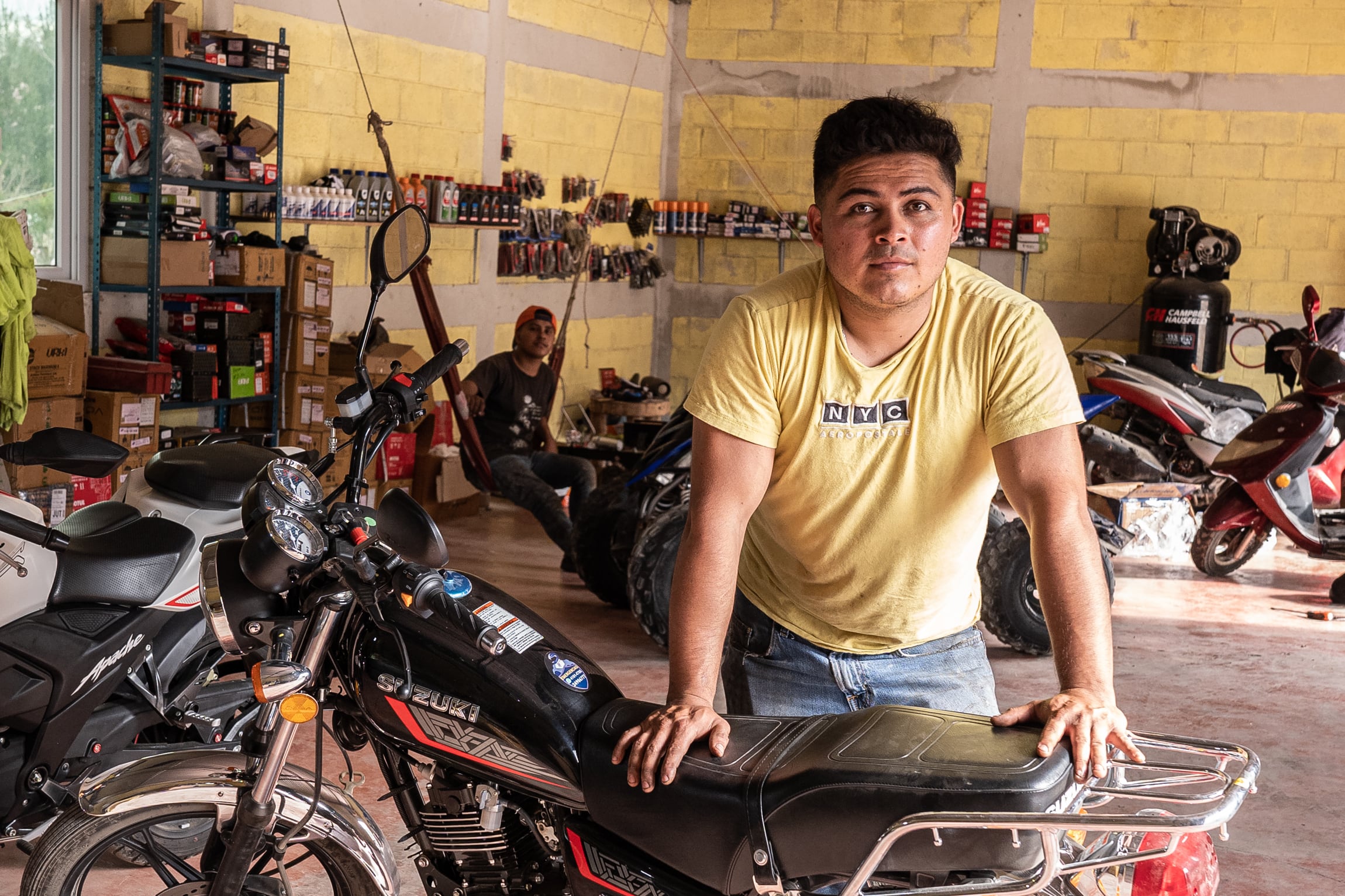
Four months after his deportation, Monterroso has opened a small mechanic’s shop in the village of Amatón, in Guatemala’s Jutiapa department. He set it up with his savings and the money from selling his van and belongings in the United States. He painted the façade yellow and hung a truck tire as a sign, painted with the words “24h Tire Repair.”
With the $2,600 stipend, he plans to buy a washing machine and fix up the corner of the shop where he is living for now, until he can save enough to build a home of his own. “In the U.S., I worked as a plumber and made $34 an hour. This $2,600 from ICE is less than a month’s wages there,” he says.

The economic contrast weighs on his mind, though he doesn’t entirely miss that life. “I’d get up at 4 a.m. to work and go back to a shared house at night. And the next day, the same thing. That’s the life of a migrant: you work, and that’s it,” he says.
Next to the workshop’s entrance is the white plastic bag with his name and the identification number that ICE gave him in December. Today it serves as a wastebasket. “The creativity of an entrepreneur,” he says, smiling.




















S

Passengers Face Alcohol Tests In Spain

Help Save Our Coastline: Eco Amigos Final Beach Clean Before Summer Season Starts
Brussels warns Spain that migrants regularised under controversial scheme will be deported back to Spain if they try to move to other EU countries
Murcia unveils monument marking 175th anniversary of Burial of the Sardine
Easter on the Costa del Sol: a time of renewal


-
eu response to spain migration policy3 weeks ago
Brussels warns Spain that migrants regularised under controversial scheme will be deported back to Spain if they try to move to other EU countries
-
Costa Calida3 weeks ago
Murcia unveils monument marking 175th anniversary of Burial of the Sardine
-
Costa del Sol3 weeks ago
Easter on the Costa del Sol: a time of renewal
-

 Caso Koldo3 weeks ago
Dinero En Efectivo Guardado En Casa Y La Devolución De Los Gastos Del PSOE: La Expareja De Koldo Protagoniza La Cuarta Jornada Por El ‘caso Mascarillas’
-

 Ataque contra Irán3 weeks ago
Última Hora De La Guerra De Estados Unidos E Israel Contra Irán, En Directo | EE UU Asegura Que Dos De Sus Buques Militares Han Cruzado Ormuz Para Desminar El Estrecho E Irán Lo Niega
-
Fish Counters Being Removed4 weeks ago
Mercadona removes fish counters: T9 format brings shift to pre-packaged seafood
-

 New Developments3 weeks ago
Inside The Most LUXURIOUS Apartment Building In Spain!
-
Costa del Sol3 weeks ago
A HUGE Costa del Sol police operation has busted members of the Lyons Clan, one of Scotland’s most notorious gangs, in a series of dramatic pre-dawn raids