
Cuba
Dying For The Revolution: Cuba Asks Its People To Sacrifice Themselves, But The Population Is ‘hungry And Disgruntled’

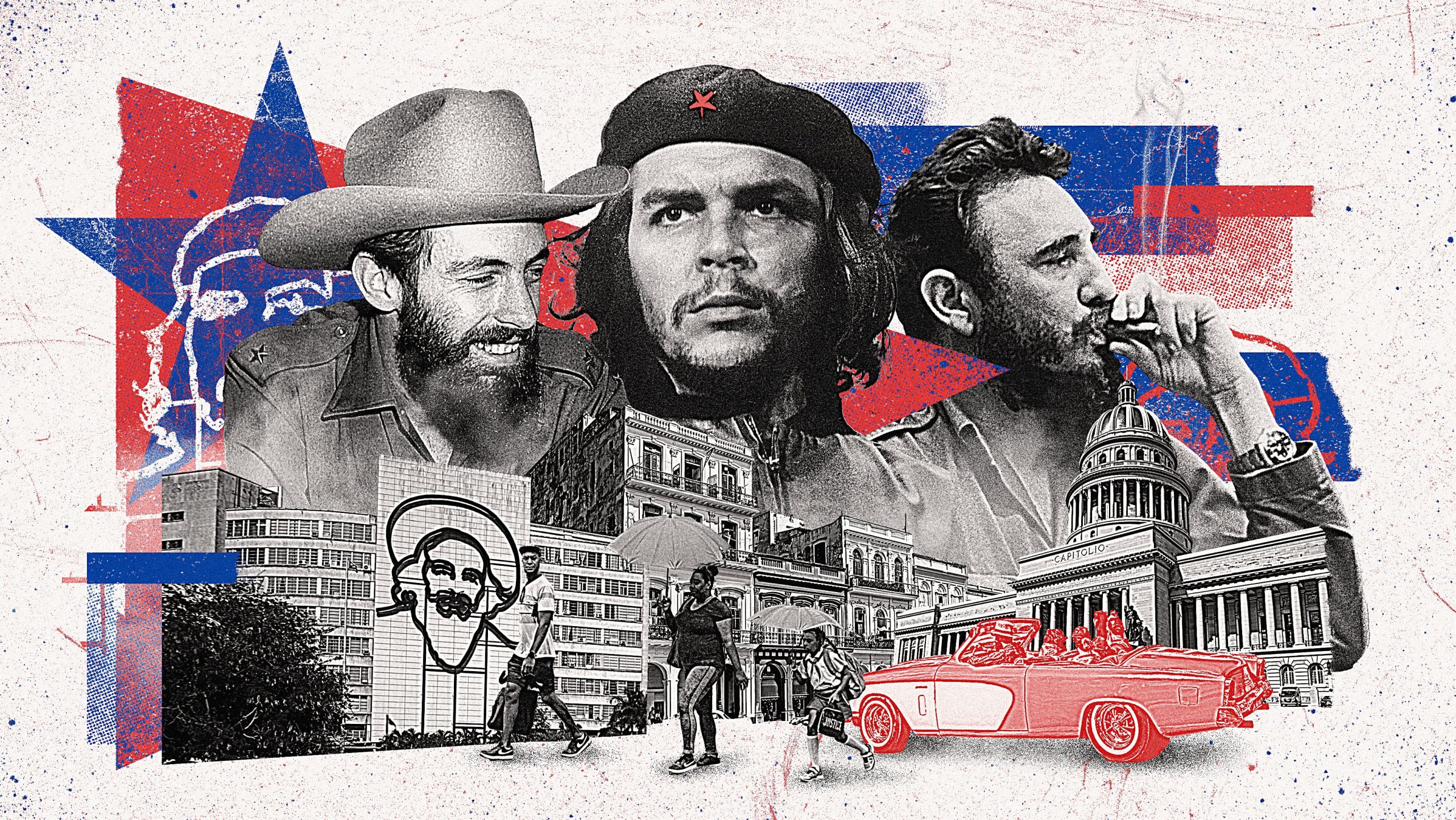
Dawn breaks in Havana. It’s May Day – Labor Day – and people begin gathering early at four strategic points in the city, in order to march with signs and banners to the José Martí Anti-Imperialist Platform. In the year 2000, Fidel Castro ordered that the public event venue be built across from the United States Embassy, in order for him to speak directly to the U.S. and demand the return of Elián González, the six-year-old boy whom Cuba turned into a political trophy in the eyes of Washington.
Today, it all seems so distant: Castro died a decade ago. And Elián, now 32, graduated as an industrial engineer and has a daughter. Certain things, however, remain unchanged: the enduring cold war with the Americans, and the warning to Cubans that, if they miss the annual parade, they could lose their meager monthly salary — even their job — or at least earn the disapproval of their boss.
Irma, an epidemiologist who asks that, as a precaution, her real name not be used by EL PAÍS, isn’t even worried about getting into trouble anymore. “I’m not going to the Platform,” she says over the phone from her workplace, the Institute of Immunology and Hematology in the Havana neighborhood of Vedado. “I can’t make that walk while I’m starving, no way; I have to save my energy.”
Some people got up before dawn and joined the throng heading toward the Malecón, the esplanade that stretches along the coast of Havana. José Luis Amador, a resident of the Palatino neighborhood, told the state press that the homeland was in danger and, therefore, the people had to “defend it.” A taxi driver from El Mónaco heard the urban singer Bebeshito’s music blasting near Carlos III Street, while some neighbors were finalizing preparations for the patriotic event.
In other parts of the capital, however, there was silence. People were staying home; it didn’t seem like the government had called for a major parade. “Most people aren’t in that May Day spirit,” the taxi driver says. “People are hungry, people are fed up. I was just at the hospital: I got my daughter’s tests, because I know how to get things done. With a little money for the doctors, the antibiotic appeared.”
The caravan of workers, numbering more than half-a-million Havana residents, according to official figures, carried Cuban and Palestinian flags, a banner that read “Ideas are our weapons,” a sign demanding the release of Nicolás Maduro from a New York City jail, as well as portraits of José Martí, Camilo Cienfuegos, Che Guevara and, of course, Fidel Castro. None of the images of Castro showed him in his later years (when he was a frail old man in his Adidas tracksuit), but rather as the young guerrilla fighter wearing an olive green uniform: strong, vibrant, capable of waging a sustained struggle against an empire. The imagery is a reminder that the revolutionary leader remains alive in the nation’s consciousness. An industrial worker grabbed the microphone and declared: “Fidel continues to call on us to resist and win.”

The Cuban leadership has no intention of letting the figure of its supreme leader die. Recently, they installed a screen in Havana that, through the use of artificial intelligence, invites Cubans to take a picture with Castro. “Hello, compatriots,” Fidel could be heard saying on May Day. People posed, and the deceased leader’s voice, still intact, said: “Until victory… one, two, three… forever!”
President Miguel Díaz-Canel, along with several attendees, had his picture taken with the Comandante. This was a gesture from the government, meant to remind the population about the man who brought them all to where they are today.
Emilio Basilides Alfonso, a professor of Philosophy at the University of Havana, vehemently believes that Castro is “more alive” than ever. “Fidel’s influence is as omnipresent as the misery that defines daily life on the island. And I’m not referring only to material hardship, which is already serious enough, but [also] to a deeper desolation: the distortion of the national character.” However, there’s a part of Castro that, according to the university professor, is fading with time. “Castro survives only in the minds of those who are ‘asleep’ — those who are afraid to admit that they were deceived — and in the minds of the ‘awakened,’ who know exactly where power resides. Outside that circle of nostalgia or cynicism, his figure fades into irrelevance.”
This is the fear that the leaders of the regime have today: that people will forget the man who, for decades, kept an ideology afloat despite the country’s collapse. This is especially concerning for them now, as there’s not only a crushing economic crisis, but also a notable leadership vacuum.
Marching at the head of the workers’ caravan on Friday, May 1, was Raúl Castro – Fidel’s brother and former first secretary of the Communist Party – escorted by his bodyguard and grandson, Raúl Guillermo Rodríguez Castro, known as “El Cangrejo” (“The Crab”) and the man who met with U.S. Secretary of State Marco Rubio to negotiate Cuba’s future.
Raúl hadn’t appeared in public since the announcement of the deaths of 32 Cuban soldiers who were killed in the attack on Venezuela back in January. At the age of 94, some say that he still pulls the strings of power in Cuba. To his left walked José Ramón Machado Ventura, a 95-year-old former member of the Politburo who once hinted that he wants to live to be 200; and to his right, Miguel Díaz-Canel, 66, who was born when the other two men were immersed in the 1959 Revolution. Amid the dialogues with Washington, the possibility of removing Díaz-Canel from power in Cuba was leaked, but the president has said that he won’t step aside. “I’m not afraid,” he asserted. “I’m willing to give my life for the Revolution.”
On May 1, as the Cuban people marched in Havana, President Donald Trump – speaking from Florida – announced new sanctions against the island. He promised to end the war in Iran in order to free up an aircraft carrier, send it to the Caribbean and take Cuba “almost immediately.” Díaz-Canel responded to the threat: “No aggressor, however powerful, will find surrendering Cubans,” he asserted. Rather, “they will encounter a people who are determined to defend sovereignty and independence in every inch of the national territory.”
At first glance, the march on May Day may seem like a repetition of previous years. But the Castroist regime knows that this is a unique event: not only are they celebrating Fidel Castro’s centennial, but they’re also reaching the 70th anniversary of the Revolution with a completely devastated economy, blackouts lasting more than 20 hours a day, a migration exodus of almost three million people in the last five years, widespread discontent that has led people to take to the streets, as well as real tension with the United States. Trump has promised “a new dawn for Cuba.”
Faced with this scenario, the Cuban government has called on the people to reaffirm their commitment to the homeland. On the Anti-Imperialist Platform, an improvisational poet recited a few décimas (10-line stanzas) in front of the parade attendees: “If the socotrocos (slang for “idiots”) enter the Cuban capital, they’ll find out that Havana is full of crazy people.” Some attendees applauded him.
Defending the homeland
Among all the posters in the parade, one stood out with a statistic: more than six million Cubans, according to the official registry, have taken part in the “Signature for the Homeland” movement, an initiative launched by the government a couple of weeks ago to commit Cubans to defending the achievements of the Revolution at any cost. This comes amidst the small cold war being waged in Cuba’s perpetual summer, with threats from Washington, an oil embargo having been in place for more than three months, drones flying over the island and U.S. Navy military exercises in Caribbean waters.

According to Díaz-Canel, the campaign is about more than just signing a petition. “It’s an act of unity in defense of national sovereignty,” he asserts. The petition also serves to support a declaration entitled “Girón is today and always,” referring to Playa Girón, a beach on the east bank of the Bay of Pigs. It makes it clear that Cuba is prepared to defend itself with arms, just as it did 65 years ago when a failed military landing by Cuban exiles took place.
The message put out by the campaign has been explicit: the Cuban Revolution “will never negotiate its principles.” It’s necessary to keep repeating this amidst a discontented population that has taken to the streets not only to demand food and electricity, but also freedom.
Katrin Hansing, a professor of anthropology at the City University of New York (CUNY), has spent the last three decades researching race, migration and inequality in Cuba. She has observed how, today, the official rhetoric resonates with very few Cubans. “The political, ideological, revolutionary aspect is barely felt. In Havana, you no longer see the slogans and posters on almost every block like you used to; the ones that are there are old. Most people are exhausted from the daily struggle [to survive], but also from politics, from the lies. There’s a collective weariness. The symbols, the codes… everything looks very old. Everything is very worn out.”
Even so, the anthropologist notes how the Cuban government still insists on continuing to speak to the people with the same language that it used 40 years ago. The people, however, have changed. The people are tired.
Some government delegates arrived at the door of Irma’s neighbor, asking her to sign her “Commitment to Cuba.” The 80-year-old woman came out of her house angrily: “I’m not going to sign,” she told them. “I’m diabetic and I don’t have milk for breakfast. Bread comes once a week. And I’m only surviving because of my daughter and grandson. Otherwise, I would have starved to death.”
Irma herself, like her co-workers at the Institute of Immunology and Hematology, was forced to sign the commitment book at her workplace. She did it. “If you don’t, you don’t get paid,” the woman explains. She earns about 5,000 Cuban pesos a month, equivalent to just under $10.00, and, when her workday ends, she has to go out and clean houses. “They want the world to believe that people sign voluntarily, [but] that’s not the case. It’s outrageous. This isn’t a country anymore; this is the end for Cubans.”
Maydelis Solanis is a resident of the city of Bayamo, in eastern Cuba. The government delegate from her neighborhood didn’t come to her door, “because she knows” what Solanis thinks of the system. But she did go to other homes to ask for signatures in defense of the homeland.
“People don’t want to sign; they say they have [no reason] to,” she shrugs. Yesterday, she heard a commotion. When she looked out the door, she saw that it was a neighbor arguing with the delegate. “He told her, ‘What am I going to sign [for]? The lack of electricity? The lack of food? The lack of medicine?’” Solano warned her children that they couldn’t sign any documents at school without her consent.

Yoel Acosta and his wife’s greatest fear is that the Cuban Army will conscript their 17-year-old son (he’s the minimum age for mandatory military service in Cuba). Their fear has grown, now that Díaz-Canel speaks about a “people’s war,” with Donald Trump not entirely ruling out the possibility of a military attack against Cuba. An officer from the Ministry of the Interior came to their home in Baracoa, a city in the province of Guantánamo, to have their son begin the required examinations for military service. “Neither I nor his mother agree [with this],” Acosta says. “We fear he’ll be recruited to participate in wars, or be sent out of the country as a mercenary, as they’ve already done with other young men. Now, with the tension between the United States and Cuba, we’re even more scared about his physical safety.”
According to Acosta, young men who do their military service are also being made to sign a pledge to “defend the country against aggression.” Otherwise, they’ll be “labeled as counterrevolutionaries and could be imprisoned,” he says. In Cuban hospitals, according to people interviewed by this newspaper, authorities are threatening staff with restrictions on their participation in medical missions abroad. While the government takes a considerable portion of their salaries, these missions provide some economic relief to healthcare professionals. Some workers in micro, small and medium-sized enterprises (MIPYMES) are also being forced to sign a written agreement with the state.
But on the island, Solano notes, people are preoccupied with whether or not Trump is coming. “You spend your life wondering what he’s going to do. Is he coming? Is he not coming? That’s what many Cubans are hoping for these days, because daily life is a burden and it becomes overwhelming,” she says. “It’s like trying to climb a mountain with a heavy backpack and never reaching the top.”
The creative resistance that nobody wants
On April 30, the day before the May Day march in Cuba, Díaz-Canel met with dozens of workers to tell them that it was essential to resort to “creative resistance,” a concept he’s been using since taking office as president of the country. Throughout his eight years in power, Cuba has never emerged from its deep crisis. In a conversation with Pablo Iglesias — a former left-wing Spanish politician who visited Havana this past March as part of a humanitarian flotilla — the president seemed almost proud of the creative resistance that Cubans have demonstrated during this crisis. He referred to a variety of actions: people gathering to watch telenovelas in front of the only working television in the neighborhood; electric trikes being converted into ambulances; or residents who set up communal kitchens and cook with charcoal.

“With the concept of creative resistance, you not only resist, but you develop,” the Cuban president explained to Iglesias. “It’s not about resisting with submission, but resisting with creativity.” He also said that he understands that “the people are suffering, that there are limitations, that there are shortages,” but emphasized that the “Cuban spirit of resilience, solidarity and joy hasn’t been lost.”
“This rhetoric stems from a political construct built from within the government, which tries to highlight certain convenient aspects amidst the profound structural crisis that Cuban society is experiencing,” notes sociologist Elaine Acosta González, a research associate at the Institute for Cuban Studies at Florida International University (FIU). The expert explains that, “by highlighting certain aspects of Cuban sociocultural identity, [the government] deliberately conceals the ineptitude of the leaders [with the] everyday survival strategies that citizens have had to develop to cope with the various impacts of the crisis.”
Some (those who can) continue to leave the island. Writer Jorge Fernández Era was accompanied by members of the state security apparatus until the very last moment when, a few weeks ago, he boarded a plane to Spain. It pains him to see how the thing that he dedicated his best years to has ended. “The Revolution stole my dreams,” the 63-year-old writer laments. “Nothing remains of the Revolution… and even less of socialism. [Cuba is now] a mixture of capitalism, feudalism and slavery, with a dash of primitive communism. The rest is crude propaganda.”
Fernández Era didn’t leave Cuba with relief, but with despair. He knows that something has been taken from him. “I’m leaving behind a country that I love… but [it] has ceased to be a country.”
Sign up for our weekly newsletter to get more English-language news coverage from EL PAÍS USA Edition









It all began on the shores of the English Channel. John Gillard remembers himself at just 11 years old, walking along the path that led away from the sea, through a sea of blue and white shirts, scarves, and flags, to the austere and venerable Goldstone Ground, in the heart of the town of Hove. In that century-old stadium, demolished in 1997 and now replaced by a shopping center, Brighton & Hove Albion, the legendary Seagulls, the pride of Sussex, the team of Gary Stevens and Gordon Smith, played their matches.
Gillard, a graduate in modern history, designer, writer, and creative writing workshop coordinator, was infected there by the football bug, a persistent affliction that, in subsequent years, has taken him all over the world. As he explains in the introduction to his book, The World Atlas of Football Stadiums (published in Spain by Cinco Tintas), professional obligations and sports tourism have taken Gillard from the floating pitch of Koh Panyee, in a Thai fishing village, to the futsal courts of the Rio de Janeiro favelas, the spectacular grandstand of Sydney’s Accor Stadium, and the new Santiago Bernabéu, with its unusual retractable pitch system.

The author concludes that no two stadiums are alike, that football is palpable in every one of these venues, and that each one “offers something unique and surprising,” related to its surroundings, its architecture, its tradition, or “the richness of its fans’ experience.” The book, to which writers Joseph O’Sullivan and Neel Shelat also contributed, includes descriptions and images of up to 1,000 iconic stadiums across five continents, including some as picturesque as La Bombonera in San Cristóbal, located on a tobacco plantation in the shadow of the Sierra del Rosario mountains in Cuba; the almost always packed Mobolaji Johnson Arena on Lagos Island in Nigeria; and the futuristic Glass House in Dunedin, New Zealand. With Gillard and his team as guides, readers travel a transoceanic route through Europe, Asia, Africa, and the Americas in 10 stops, from the most imposing and technologically advanced stadiums to the most peculiar, historic, and peripheral ones. In the words of the book’s author, “it is possible that a particular stadium may awaken your curiosity to the point that you decide to visit it, or even travel across an entire country jumping from one stadium to another, soaking up its culture along the way.”

Pier 5 (Brooklyn, New York)
The United States is one of the three host countries for this summer’s World Cup, with matches scheduled in historic venues like Seattle’s Lumen Field, Santa Clara’s Levi’s Stadium, and Miami Gardens’ Hard Rock Stadium. But the future of soccer — the kind that might allow the United States to emerge as a global power in the medium term — is slowly being forged in places like this: the public pitch on the Brooklyn piers, amid pleasure boats, the cries of seagulls, and the bustle of dockworkers, in the shadow of the Manhattan skyline. Aside from the school and corporate leagues held at Pier 5 between March and November, you can sign up on the Brooklyn Bridge Park website, pay an access fee that varies depending on availability, and simply play soccer.

León Stadium (Guanajuato, Mexico)
Colloquially known as Nou Camp, due to its obvious resemblance to FC Barcelona’s home, the stadium of the fourth most-populated city in Mexico, León de los Aldama, belongs to the Pachuca Group and has a capacity for more than 31,000 spectators. Here, the England national team was brought to its knees in an epic 1970 World Cup quarter-final against West Germany (as Gillard recalls, the English manager, Alf Ramsey, decided to substitute Bobby Charlton when they were winning 2-0 so that he would be fresh for the semi-final against Italy, and they ended up losing 2-3, after succumbing to an irresistible surge from Germany that dismantled them in just 20 minutes) and here, Club León — the Esperanzas de Guanajuato or Panzas Verdes — have celebrated 17 of their 19 national titles, including the surprising league title of 1992. It is not the Azteca Stadium nor the Olympic University Stadium of Mexico City, but it is one of the most beautiful and prestigious stadiums in North America.

Maracanã (Rio de Janeiro, Brazil)
Brazilian stadiums are in a league of their own, due to their colossal dimensions and the passion that fills their stands. There are colossi like the Mané Garrincha in Brasília, the Aderaldo Plácido Castelo in Fortaleza, the Morumbi in São Paulo, and the Mineirão in Belo Horizonte, all enormous, even though successive renovations have reduced their capacity. But the largest of them all, and the mecca of Brazilian football, is the Periodista Mario Filho stadium, better known as Maracanã after the populous neighborhood in which it is located. For Gillard, this stadium is exceptional because of its setting, nestled between the Atlantic beaches and the fertile hills of Rio, and because of the overwhelming proximity of Christ the Redeemer atop Corcovado Mountain, the 30-meter-high Art Deco statue that “watches over it like a guardian angel.” Also because it was, of course, the site of one of the most famous matches in football history: the 1950 World Cup final, in which Juan Alberto Schiaffino’s Uruguay were considered easy prey for the Brazilian constellation of stars, only to triumph with a goal that sent chills down the spines of 178,000 spectators. And because it is home to Rio’s two main teams, Flamengo and Fluminense, fierce rivals but, despite everything, brothers, united by a stadium that exudes sporting mystique from every pore.

Hennigsvaer Stadium (Norway)
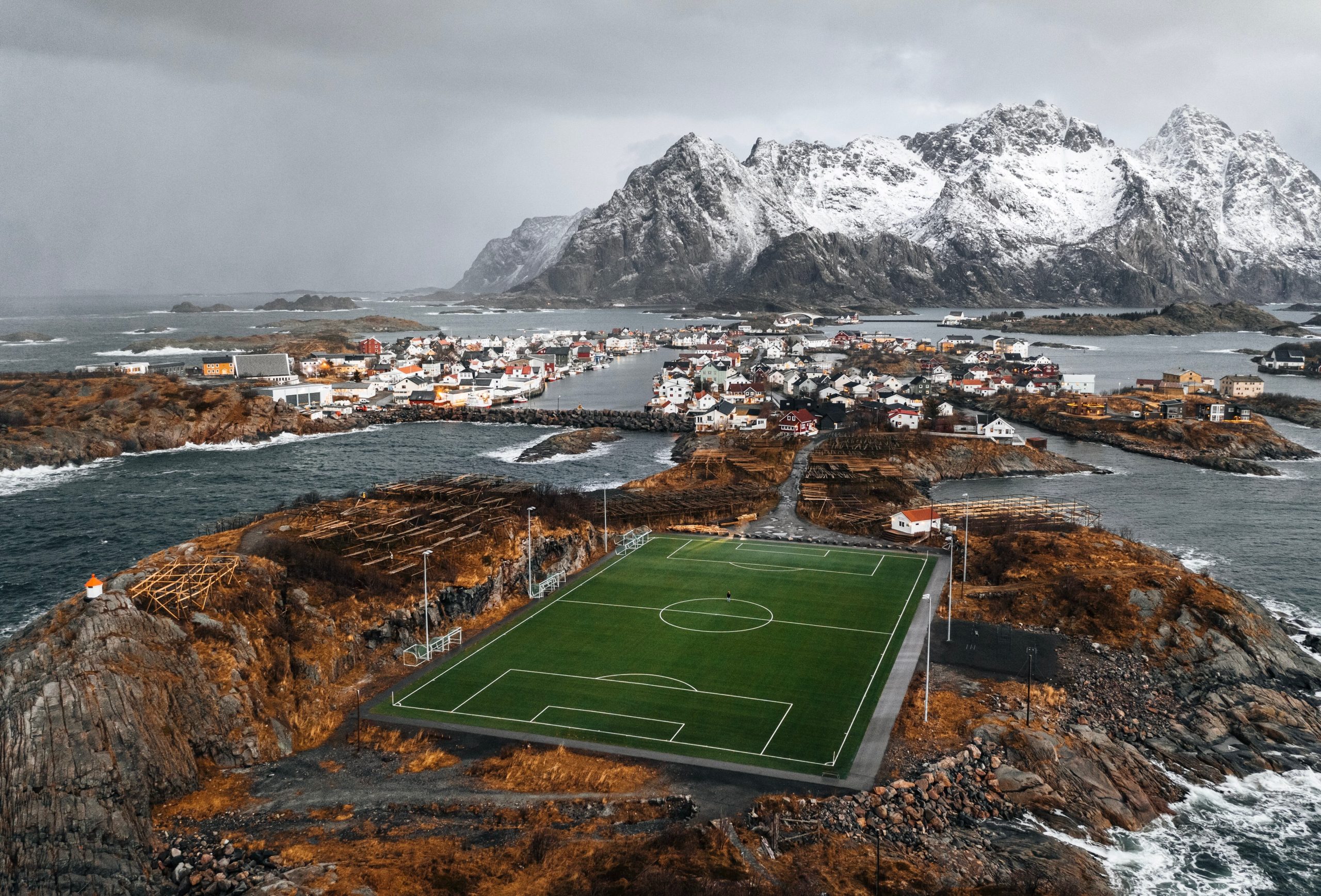
Another kind of soccer is possible. And it’s played, far from the multimillion-dollar spotlight of metropolitan soccer, in places like this pitch on the island of Hellandsoya, in the Lofoten archipelago, beyond the Arctic Circle. In this place of stark beauty, with white sand beaches where swimming is only possible for a couple of weeks a year, Gillard has featured what he considers one of the most beautiful stadiums in the world. To get there, as the British writer explains, you have to “cross bridges and tunnels, wait by the roadside for the infrequent local buses, and walk over bedrock.” Once you’ve completed the journey, upon arriving at a fishing port of about 400 inhabitants “that houses a contemporary art gallery where there used to be a caviar factory,” you can’t help but be amazed to see that someone has created something so beautiful on a rugged bed of petrified lava so that the locals can play soccer under the midnight sun or the Northern Lights.

Qeqertarsuaq (Greenland)
Also highly valued in the exotic category is this Greenlandic stadium surrounded by icebergs, right on the migration route of humpback whales, which frequently surface beyond the ice floes during matches. Despite its rugged appearance, it is a semi-professional pitch, where the Qeqertarsuaq team, G-44, one of the 16 that regularly compete in the Greenlandic Championship, plays its matches.

Stadio Diego Armando Maradona (Naples, Italy)
Fans of a certain age will remember that this multi-purpose stadium in Naples’ Fuorigrotta district was always called San Paolo, in honor of the apostle and one of the city’s main basilicas. But no saint can compete with the secular idolatry generated in Naples by the Argentinian Diego Armando Maradona, who established his headquarters in this stadium between 1984 and 1991, shifting the center of gravity of Italian soccer from the north to the south during those glorious years. Napoli fans continue to pay homage to the man who, for the first time in history, put the Campania club on par with Piedmontese, Lombard, and Roman teams. And they do so, above all, in this stadium famous for the roar and vibrant colors of its stands, starting with the legendary Curva B, which, match after match, boasts of erupting “like a bomb” the moment their team steps onto the pitch. It may not be the most beautiful stadium in Italy, but it is certainly among the most genuine and passionate, a coliseum animated, according to Gillard, by the tribal enthusiasm of “us versus them” so characteristic of a city that has often felt isolated from the rest of the nation, clinging to its own traditions and historical inertia. “It’s no wonder,” Gillard concludes, “that other fans know it as the cauldron of hatred.” Both the city of Naples and soccer have reasons that reason cannot comprehend.

Jean-Bouin and Parc des Princes (Paris, France)
Although the Vélodrome in Marseille and the Gérard Houllier in Lyon are, each in their own way, masterpieces of contemporary design, no snapshot of French soccer would be complete without starting with these twin stadiums on the outskirts of Paris. Separated by a four-lane avenue, the homes of the multi-billion-dollar PSG and the much more modest FC Versailles are an ode to neo-brutalist avant-garde, to the merciless power of soccer, and to the austere beauty of concrete behemoths. The Jean-Bouin opened in 1925 and has been renovated and expanded twice, most recently in 2011, when its striking Art Deco-inspired metal mesh was completed. Its illustrious neighbor has stood there since 1897 and consolidated its current appearance in 2016, when it was last remodeled, following expansions in the 1930s and 1960s and a complete reconstruction in 1972, led by architect Roger Taillibert.

Estadio Santiago Bernabéu (Madrid, Spain)
What does Gillard think of the new Bernabéu, the attempt to provide Madrid with a landmark building of international renown to rival the Sagrada Familia or the Taj Mahal? To begin with, he says that from afar it looks more like a spaceship than the sardine can its detractors perceive it to be. Once inside, according to the author, it’s an imposing “cathedral of football” that forces players leaving the tunnel to tilt their heads back to appreciate the intimidating grandeur of the stadium they’re in. A behemoth with a capacity of 83,000 spectators, a retractable roof equipped with weather sensors, that retractable pitch everyone’s talking about, and a 360-degree video scoreboard. For Gillard, it’s “a stage worthy of the most successful club in football history.” The author also praises examples of excellence in Spanish sports architecture such as the new San Mamés, the pilot version of the future Nou Camp, and the Metropolitano, which he describes as “one of the most modern stadiums in Europe.”

Sükrü Saracoglu Stadium (Istanbul, Turkey)
The authors of the World Atlas of Football Stadiums are captivated by the richness and diversity of Turkish soccer. In particular, they admire the fertile and fierce rivalry between the three major teams (Besiktas, Galatasaray, and Fenerbahçe) of Istanbul, that megalopolis of 15 million inhabitants that lives and breathes soccer and consumes it with unbridled passion. Of the three local stadiums, Fenerbahçe’s home ground is perhaps the most striking, due to its location between the city’s busiest thoroughfare and the shores of the Sea of Marmara. Inaugurated in 1908 and with a capacity of over 47,000 spectators, this stadium was last renovated in 2006 and today presents an appearance somewhere between the melancholic grandeur of its origins and the understated efficiency of contemporary sports architecture.

DHL Stadium (Cape Town, South Africa)
There are plenty of reasons to enjoy sports tourism in sub-Saharan Africa. You can choose from stadiums in Tanzania, Senegal, Nigeria, or Ethiopia, and in all of them you’ll find boundless passion, striking settings, and local color. But the continent’s greatest stadiums are in South Africa, which hosted the World Cup in 2010. There you’ll find the FNB Stadium in Nasrec, Johannesburg, the astonishing bowl covered in turned wood (as Gillard describes it) where Andrés Iniesta scored a goal for the ages. And 745 miles away, at the other end of the country, is the DHL Stadium in Cape Town, home to Ajax Cape Town, the younger sibling of Ajax Amsterdam and the pride of the Parow suburb. The stadium in the former colonial city sits at the foot of the bucolic Signal Hill and on the shores of the South Atlantic, with the rugged Table Mountain looming over the north stand. Gillard points out that, alongside the new venue, inaugurated in 2009 and with a capacity for 55,000 spectators, the previous version of the stadium, dating from 1897, is preserved: “It is a strange image, seeing the old and the new resting next to each other.”
Sign up for our weekly newsletter to get more English-language news coverage from EL PAÍS USA Edition

In Miami, it’s essential to stay alert for tropical storm and hurricane warnings. Torrential rains and high winds are compounded by rising sea levels due to global warming caused by climate change. South Florida’s porous limestone foundations act like a sponge. As sea levels rise, groundwater rises to the surface. To prevent Miami from becoming Atlantis, the only option is to raise it above the water, a project underway in Sunset Harbour and other residential areas — see the MB Rising Above cell phone app for details. This strategic plan is part of the Southeast Florida Regional Climate Change Compact.
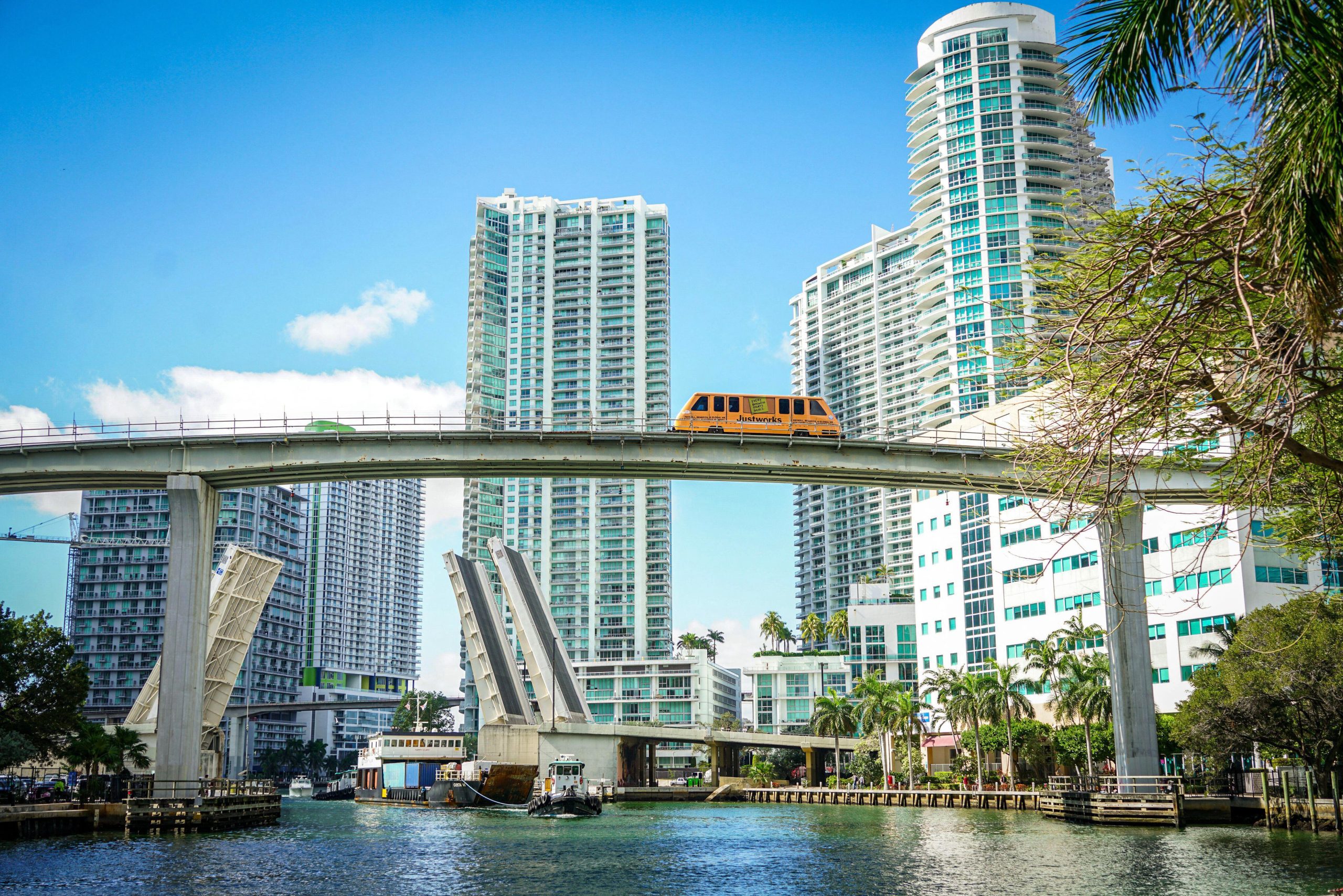
In addition to this elevation, a mass transit system has been implemented to reduce greenhouse gas emissions, one of the causes of global warming. Miami’s shallow subsoil means that the main highways and the Metromover—a free, driverless monorail consisting of two cars—run above street level. Next to one of its elevated stations, Park West, is the CitizenM Miami World Center, a so-called smart and sustainable hotel where a very high percentage of its electricity comes from renewable energy sources and where plastic bottles have been replaced with water fountains for guests to refill their own bottles.
In the centrally located neighborhood of Brickell, and below the monorail, stretches the long and narrow Underline Park with a series of rest areas, calisthenics equipment, playgrounds, and unique installations, such as ping-pong tables designed to collect and reuse rainwater. Embracing this same sustainable spirit is Brickell City Centre, a shopping mall beneath a sculptural and intelligent roof that harnesses sunlight and rainwater to illuminate its three interconnected four-story buildings and partially power their air conditioning systems, respectively. In Miami, it’s not outlandish to walk around in sandals with a scarf wrapped around your neck.

Along the streets, in addition to the many cars, you’ll also find a type of vehicle called a trolley. It’s a kind of wheeled tram that operates free of charge in different parts of the city, such as Wynwood. This neighborhood, once filled with warehouses, has become a vibrant artistic and cultural hub. From the comfort of a Segway, a practical and fun mode of transportation, you can begin to question the true nature of everything you see. The neighborhood is decorated with large, colorful murals and dotted with restaurants where the milk isn’t dairy and the pizzas aren’t topped with cheese, as is the case with the conscious, vegan-friendly, and healthy Love Life Café.

Without the train, Miami would not exist
In the realm of less polluting modes of transportation, Miami Central Station comes into play. A station with the look and feel of a charming hotel lobby, it’s the hub for Brightline trains departing from and connecting to other Florida cities, such as Orlando, Fort Lauderdale, and Boca Raton. If Miami is what it is today, it’s partly thanks to the train. A severe freeze in 1895 and the purchase of several plots of land—the land that would become Miami—by Julia Tuttle (known as the “mother of Miami”) convinced Henry Flagler to extend the railroad to the southeastern coast of the Florida peninsula. Developers and visionaries quickly recognized the area’s potential as a sun and beach tourist destination and didn’t hesitate to dredge Biscayne Bay, creating new islands and replenishing the mangrove coastline.

What is known as Miami is a county and a city located in the southeast of the Florida peninsula. Between this peninsula, Miami Island, where the eastern Atlantic beaches are found, and the Virginia and Biscayne Keys, lies the Intracoastal Waterway, spanned by bridges and highways that run over the water. South of this amphibious urban network, at the tip of the peninsula, are the Everglades. This is a protected wetland, preserved and cared for by the Miccosukee people. Another group of Native Americans, the Tequesta, settled earlier in Biscayne Bay, around the mouth of the Miami River, the current urban center of the city.
In the 16th century, Spanish conquistadors colonized Florida, a peninsula they ceded to the United States in the 19th century. From then on, bridges and roads began to be built connecting the mainland city with the island across the bay, where a city was built and christened with a name that has become a brand: Miami Beach. To the south, in what is known as South Beach, along Ocean Drive and Collins Avenue, a small group of hoteliers began constructing small accommodations in the 1930s: Beacon, Victor, Breakwater, Avlon, and the Sea Isle Hotel, among others. The latter is located in the middle of the island and is now the Palms Hotel & Spa, a luxury wellness resort for all ages “inspired by nature” and committed to minimizing its environmental impact and raising ecological awareness among locals and guests, who are encouraged to clean their section of the beach each morning alongside the hotel’s Green Team.

This architectural ensemble of white and pastel-hued hotels gives life to what is known as South Beach’s Art Deco Historic District. At 1001 Ocean Drive is the Art Deco Welcome Center, which organizes tours with stops at the most attractive and unique buildings designed in this style, as well as Mediterranean-looking ones. Some of these hotels were converted into makeshift barracks between 1942 and 1945, when half a million members of the U.S. Army Air Corps were stationed in this sunny location for training maneuvers before departing for the various fronts of World War II. After the war, many soldiers settled in Miami Beach and the surrounding area.

Something similar happened with the Cubans who went into exile in 1959, when Fidel Castro took power in Cuba. So many Cubans settled in one area that it became known as Little Havana. Today, Cubans live scattered throughout the city, as do the hundreds of thousands of other Latin Americans who have settled in a city and on an island where Spanish is widely spoken and where almost everyone talks about escaping and hope when asked why they are there.

A complicated relationship with water
Miami is a place almost no one is originally from, yet many aspire to be. It’s also an island surrounded and traversed by water. Mansions with docks line the canals, while South Beach’s beachfront is dominated by skyscrapers of apartments and hotels. These hotels deploy their army of lounge chairs and umbrellas on the sand to the rhythm of Latin music hits. This is no place for saxophones or pianos. Miami seems to forbid boredom, stillness, and silence. It’s an extravagant city where ostentation makes sense and is even hypnotic and photogenic. It is an ornate, sometimes obscenely so, landscape that evokes the world of Miami Vice and Scarface, though this image bears no resemblance to the current one. From a place of corruption and crime, it has transformed into a city of environmental awareness and efforts to mitigate the effects of climate change both on the mainland and on the island. This is the approach being implemented in the Sunset Harbour neighborhood of Miami Beach, one of the lowest-lying areas, which is being raised to cope with rising sea levels. Walking through this area, you can see stormwater pumping stations, which, in addition to providing power and speed, collect, filter, and discharge the cleanest possible water into the bay, and seawalls, which reduce erosion and provide protection against flooding.
In Miami, water is a source of both pleasure and tragedy. It’s also a source of inspiration. The renovated Miami Beach Convention Center is a massive, translucent, wave-shaped structure, built on the premise of resilience and with a commitment to environmental responsibility and sustainable practices in all the events held there. That same water serves as the larder for restaurants like Stiltsville Fish Bar in Sunset Harbour, where fish and seafood are paired with sauces and presented in ways that might surprise more traditional palates, such as their lobster burger.

Fishing and paddling are popular activities at Oleta River State Park. This river estuary, once home to the Tequesta people, offers calm waters lined with mangroves for kayaking. With luck, you might even spot dolphins and manatees. For alligator sightings, head to the Everglades at the tip of the Florida peninsula. This vibrant, restless tip of the peninsula is a place of water where the few remaining members of the Miccosukee tribe, guardians of this swampy land, enjoy showing it off on airboats powered by large fans at the back. This tour, Tigertail Airboat Tours, takes visitors over waterways flanked by lush vegetation and frequented by various birds.

Despite the noise of the speedboat, one can concentrate and take in the aquatic landscape they’re entering. A symphony orchestra where the wind stirs the reeds and sets the water running under the sun, while Jean Sarmiento, from the Love the Everglades movement, tells visitors what this place means to its ancestral and current inhabitants, for whom water is sacred. Although, in Miami’s case, water is also a problem. It’s the price to pay for being a sunny peninsular and island city built where it was.
Sign up for our weekly newsletter to get more English-language news coverage from EL PAÍS USA Edition


How To Get A Tourist Rental Licence In Andalusia (Spain) – Step-By-Step Guide 2025

Max Verstappen Nurburgring LIVE: NLS5 Schedule, start times and free live streams
Warning for drivers in Spain as week-long clamp down on speeding is underway


-
 New Developments3 weeks ago
How To Get A Tourist Rental Licence In Andalusia (Spain) – Step-By-Step Guide 2025
-
 Uncategorized3 weeks ago
Max Verstappen Nurburgring LIVE: NLS5 Schedule, start times and free live streams
-
Andalucia4 weeks ago
Warning for drivers in Spain as week-long clamp down on speeding is underway
-

 Competiciones2 weeks ago
E
-
Asia4 weeks ago
Al Menos Cuatro Muertos, Tres De Ellos Niños, En Un Tiroteo En Un Colegio Del Sur De Turquía
-
cabin crew4 weeks ago
Spain’s Supreme Court rules EasyJet must reveal cabin crew identities
-

 Uncategorized4 weeks ago
Lando Norris unleashes F1 2026 criticism after Nurburgring test
-

 Uncategorized4 weeks ago
Lewis Hamilton admits being