
Cuba
E
Published
2 weeks agoon
Please enable JS and disable any ad blocker
You may like
-
‘El Cangrejo’, Raúl Castro’s ‘favorite’ Grandson In Talks With The United States
-
A Cuba On The Brink Of Collapse Peers Into The Vertigo Of Change Imposed From The United States
-
How Trump Is Inadvertently Driving US Support For The Catholic Church
-
Reyna Grande, Author: ‘Trying To Find The Joy Is An Act Of Resistance’
-
E
-
The Seven Trackers Who Traveled To Mexico To Search For Dozens Of Missing Migrants
CIA
‘El Cangrejo’, Raúl Castro’s ‘favorite’ Grandson In Talks With The United States
Published
1 day agoon
May 16, 2026
There is a man who whispers in Raúl Castro’s ear. He speaks to him during the May Day parade in Havana or puts his arm in the way if a woman tries to take the former president’s hand—as though she needs reassurance that he is still alive. When Castro delivered speeches in Revolution Square—always less fiery than his brother Fidel’s—this man stood behind him, steadfast in the scorching tropical heat. When Raúl received Pope Francis in the Cuban capital, the same man was there, watching his every move. Those who know him say he is Castro’s “darling.” They also say he has an extra finger due to a congenital condition, and that his inner circle has given him a nickname: El Cangrejo—The Crab. His name is Raúl Guillermo Rodríguez Castro; he is Raúl’s grandson and his bodyguard. For months now, however, he seems to be guarding something far larger: not just his grandfather’s back, but the fate of his country.
Rodríguez Castro has become the bodyguard not only of Castro but also of the negotiations between Cuba and the United States. El Cangrejo has been present at the talks that have been taking place since the start of the year—talks Cuba initially denied were happening. El Cangrejo traveled to the Caribbean Community (CARICOM) summit to meet with advisers to Secretary of State Marco Rubio. When President Miguel Díaz-Canel acknowledged for the first time in March that they were negotiating with the Trump administration, El Cangrejo was there. El Cangrejo was spotted in a solemn position at the farewell ceremony for the Cuban military personnel killed during the operation that captured Nicolás Maduro. El Cangrejo took part in the visit of U.S. officials to Havana on April 10, during which Cuba was presented with an ultimatum to release political prisoners—one it failed to meet. And this past Thursday, when the head of the CIA landed on the island to “seriously address economic and security issues,” El Cangrejo could not be absent.
Even so, almost no Cuban today can explain what role Rodríguez Castro plays at the moment of greatest tension in decades between Washington and Havana. People barely know how he speaks, what his voice sounds like, or what he thinks or believes. “El Cangrejo matters because he is family, not because he has any individual political capital of his own, beyond being a trusted member of a family clan,” says Cuban intellectual Alina Bárbara López.
Once, in 2017, a young man was spotted on a platform at Varadero beach, sweating, singing, and dancing to the reggaeton beat of the popular duo Gente de Zona. He would have gone unnoticed were it not for what was written on his shirt: he was wearing a New York Yankees jersey with the words “El Cangrejo” emblazoned across it in large letters. Other extravagances from those years also drew attention: yacht trips, lobster fishing, VIP parties, flights on private planes.
Yet people still know very little about Rodríguez Castro beyond what he and his family have chosen to reveal. Juan Almeida García, son of the late Cuban Vice President Juan Almeida Bosque, who grew up in Raúl’s household as a child, says that El Cangrejo is without question “his favorite grandson.” Being the firstborn grandson, combined with the insecurities he carried from being born with a sixth finger, led Castro to be fiercely overprotective. “Raúl Castro has always been very attached to him, and the boy grew up with a rather exaggerated degree of protection from his grandfather,” says Almeida, who was present on the day of his birth—March 24, 1984.

Now 41, Rodríguez Castro is the son of Raul’s daughter Deborah and the late General Luis Alberto Rodríguez López-Calleja, the man who built the GAESA military and economic conglomerate and who died suddenly in 2022. Rodríguez López-Calleja was a figure who was widely considered a potential future leader of Cuba. He studied at the Los Camilitos military academy, graduated with a degree in Accounting and Finance from the University of Havana, and in 2016 was appointed lieutenant colonel in the Ministry of the Interior and head of Castro’s Personal Security Directorate.
Although Castro made him his bodyguard, in reality, “the grandfather is the one who takes care of the grandson and not the grandson who takes care of the grandfather,” says Almeida, who assures that El Cangrejo cultivated a “quite egocentric” personality.
For a long time, people couldn’t guess who the young man who was always seen guarding Raúl was. Today, he is invisible to no one. Maidelys Solano, who is currently desperate because of the power outage in her Bayamo neighborhood, has heard a lot of talk lately about El Cangrejo. “People know who he is, and many say he’s the one who’s going to lead the transition in Cuba; that’s what everyone’s saying. But I think he has to go too, because he’s also benefited from all this,” she says.
Amidst negotiations that escalate and de-escalate each month, where Havana denies details that Washington asserts and where secrecy keeps Cubans on edge, many questions arise surrounding the figure of El Cangrejo: What is the role of someone who holds no institutional or political office, at least not publicly? Or why is he a constant presence in the dialogues with Washington, in which, for example, Díaz-Canel has never been seen, nor has his uncle, Alejandro Castro Espín?
For Cuban historian and writer Enrique del Risco, several possibilities exist: “The most obvious is that El Cangrejo is a frontman for Alejandro Castro Espín, until a few years ago Raúl’s clearest successor,” he maintains. Espín, Castro’s only son, mediated during the talks with the Barack Obama administration that led to the reestablishment of diplomatic relations, but disappeared from public view after the so-called Havana Syndrome affair.
The other possibility del Risco sees is that El Cangrejo “is being groomed as the true successor to the dynasty, and despite never having held any government position, they want to present him to society as a new figure of power.” “His presence in the dialogues would be justified by the need to invest him with an authority he hasn’t acquired until now as a member of the Castro regime. The fact that no one within the regime dares to question the decision to make him a representative of the Cuban government without ever having been part of it gives us an idea of the absolute lack of judgment of a regime that a family runs as if it were their own private business,” the historian asserts.
The hidden power in Cuba
The CIA arrived in Havana with a mission: to personally convey President Trump’s message that the United States is willing to seriously address economic and security issues, but only if Cuba makes fundamental changes, an agency official told Fox News, adding that El Cangrejo had participated in the meeting.
Although it has been confirmed that Castro’s grandson is part of the negotiation process, the image released by the CIA focuses on Ramón Romero Curbelo, the head of intelligence services in Cuba, a face that Cubans barely recognize or wouldn’t imagine could be the one calling the shots in the country. The image has brought to the forefront of public debate a question that remains unanswerable: Who really runs the island today, or is the power structure even identifiable?
The intellectual Alina Bárbara Rodríguez, who has directly faced repression, claims to have noticed what she calls “a formal and an informal power” on the island. The former is occupied by President Miguel Díaz-Canel, along with Prime Minister Manuel Marrero, and others who hold positions in the government or the Communist Party. The latter power is unnameable. “It’s that hidden, deep, informal state; it’s difficult to know because it’s not designed for us to know. But it’s clear that there’s a very close relationship between them, one that involves family, patronage, and a technocratic military structure. And Curbelo’s figure is fundamental to that apparatus. That’s why none of the people connected to the formal state are present at the most important meetings,” Rodríguez maintains.
Beyond the statement from the Communist Party of Cuba, which insists that the meeting with the CIA made it clear that Cuba does not represent a threat to U.S. national security, the encounter with the agency’s director, John Ratcliffe, leaves several implicit messages. “First, it confirms that there is an effort on the part of the U.S. government to produce some kind of change in Cuba, beyond what previous administrations have done,” asserts historian and political scientist Armando Chaguaceda. “Whether that change translates into an economic shift, a step toward capitalism, with a political realignment in favor of the U.S. without democratization—which is not the goal for which we Cubans have fought—remains to be seen.”
CIA
A Cuba On The Brink Of Collapse Peers Into The Vertigo Of Change Imposed From The United States
Published
1 day agoon
May 16, 2026
Time accelerated in Cuba this Thursday to the rhythm of sensational news and images—among them, the CIA director in Havana, something unseen in seven decades of Castroism. The day ended with reasonable certainty that change is approaching on an island on the verge of collapse: change imposed from Washington, after more than four months of economic and political pressure from the Trump administration to hasten the end of the regime. So this Friday, both Washington and Cuba woke up watching out for the next milestones on an uncertain timeline, with the U.S. president and his strongman, Secretary of State Marco Rubio, aboard Air Force One on their way back from China.
First came the formalization of Washington’s offer of 100 million dollars to “provide direct assistance to the Cuban people” through the Catholic Church. An offer that Cuba’s leaders initially rejected before accepting it, acknowledging that the mission undertaken with the military intervention in Venezuela in January—cutting off the island’s fuel supply—is producing its final effects.
Then came the release of political prisoner Sissi Abascal Zamora, who immediately traveled into exile. Shortly after, confirmation that CIA Director John Ratcliffe was in Havana, evidenced by a series of photographs that forced one to look twice, arrived. Last was the leak to U.S. media that a federal prosecutor from southern Florida—home to an exile community that lives in anxious anticipation of any sign of Castroism’s end—was preparing an uncertain legal gambit: indicting 94-year-old Raúl Castro for the 1996 shootdown of two small planes belonging to Hermanos de Rescate, a humanitarian organization based in Miami. Four people were killed in that attack. The potential legal move would represent a new pressure measure in what appears to be Washington’s strategy toward Havana—similar to the one employed against Venezuela, or even Iran.
In the rhetorical escalation from Trump and his administration, the “takeover” of the island is treated as a foregone conclusion. But with events moving this fast, it is no longer so clear that it will arrive, as the Republican promised, once the Middle East crisis has been resolved. The war against Iran remains mired in a stalemate of rejected peace proposals and the collapse of global energy trade caused by the closure of the Strait of Hormuz in the Persian Gulf.
The U.S. president has been absorbed this week by Taiwan and his meeting with Chinese President Xi Jinping, and the reporters traveling with him on Air Force One did not ask him about Cuba—depriving the world of another serving of his contradictory messages.
The CIA director, who arrived with a warning to Havana to refrain from intelligence cooperation with China and Russia, is the highest-ranking member of the U.S. government to set foot on the island since Trump’s campaign began. His presence marks a step forward in Washington’s pressure strategy, and its timing did not appear to be left to chance: it came one day after Vicente de la O Levy, Cuba’s Minister of Energy and Mines, announced that oil supplies for domestic consumption and power plants had run out—including the million barrels of Russian-origin oil that Washington had allowed through in April.
“We have absolutely no fuel, absolutely no diesel. In Havana, blackouts today exceed 20 or 22 hours a day,” said the minister, who chose to skip the part where his compatriots—perennially on the edge of the abyss, always pushed a little further—protested by banging pots in streets blocked by piles of accumulated garbage they set on fire, beside useless gas stations. “This dramatic deterioration has a single cause,” Cuban President Miguel Díaz-Canel wrote on X: “The genocidal energy blockade to which the United States subjects our country.”

The Trump administration’s decision to send Ratcliffe to sit across the negotiating table from Cuba’s Interior Minister, Lázaro Álvarez Casas, and the island’s intelligence chief, General Ramón Romero Curbelo—a meeting the CIA conveniently made public—did not only stir doubts about who is really in charge in Cuba. It also fed the enigma surrounding a figure who has risen to prominence as Washington tightens its stranglehold on the island: Raúl Guillermo Rodríguez Castro, known as El Cangrejo, The Crab, the grandson and bodyguard of Raúl Castro.
In a pre-recorded interview with NBC aired Thursday night, Marco Rubio—himself a son of the exile community—insisted that Cuba’s prosperity is a matter of “national interest” for the United States. “We don’t want a failed state 150 kilometers from our shores,” he warned. Rubio has also repeatedly said that Washington could settle for sweeping economic reforms, leaving the more drastic changes to Cuba’s political structure for a later date—or, to put it plainly, replicating the Venezuelan model and applying it to the island that for years was Chavismo’s main pillar of support.
The parallels, however, and the prospects of exporting that model, are not absolute. Castroism is not Chavismo. And the degree of direct U.S. government involvement is not identical either. Rubio, the son of Cuban immigrants, has on several occasions expressed doubts about the regime’s competence: he tends to argue that it is the ineptitude of Cuba’s leaders, not the embargo or other U.S. pressure measures, that has ruined the island’s economy.
Rubio repeated that idea again this week, in an interview with Fox News, where he expressed skepticism about the possibility of “changing Cuba’s trajectory while those people remain in charge.”
To those arguments, the CIA added another on Thursday—equally well-worn—in the statement that followed the Havana meeting: Cuba, the text charged, is a “haven for U.S. adversaries,” in a barely veiled reference to Russia and China.
The Cuban Communist Party described the meeting with the CIA director—a senior official they had already received in Havana in secret during the Obama years—as “part of efforts to address the current situation.” The Interior Ministry, which oversees the island’s vast apparatus of espionage and repression, spoke of “developing bilateral cooperation” and defended its “unequivocal condemnation of terrorism in all its forms and manifestations.”
With those words, the regime added euphemism to the repertoire of contradictory positions its officials have wielded in recent months while absorbing Washington’s pressure. The messaging has swung between willingness to cooperate with Washington and warnings that “any external aggressor” would meet “impregnable resistance”—while Trump floats the idea of sending a powerful aircraft carrier to finish the job. Meanwhile, and despite pressure from U.S. negotiators, the mass release of political prisoners has yet to materialize.
In February, it emerged that Rubio had been in contact with El Cangrejo, and that the latter had traveled to the capital of Saint Kitts and Nevis, on the sidelines of the Caribbean Community (CARICOM) summit, to meet with the Secretary of State’s advisers. In March, President Díaz-Canel—whose own role in this process is also in question—acknowledged for the first time that they were negotiating with the Trump administration. Then came the first visit by a U.S. delegation to Havana on April 10th.
Thursday’s visit—for which Ratcliffe arrived aboard a Boeing C-40B Clipper from Andrews Air Force Base, used for official travel by the U.S. president and other senior officials due to its proximity to Washington—was the second since Trump’s pressure campaign began. What comes next—whether only economic change is applied, a comprehensive political reform is undertaken, a supervised transitional state along Venezuelan lines emerges, or simply more of the same continues—remains unknown in a Cuba on the brink of collapse, where this week, time sped up.
Chiapas
The Seven Trackers Who Traveled To Mexico To Search For Dozens Of Missing Migrants
Published
3 days agoon
May 14, 2026The heat presses down near the ocean’s edge. Hours pass, and the patrols look for shade, officials fan themselves, reporters lean back — but they keep going. They walk, they ask, they insist, they jot things down: a name, a date, another place they’ve never heard of. They work even with the life jackets from the boat ride still on; they don’t take them off, in case there isn’t enough time. They’ve spent 16 months searching, and this is the first time they’ve been able to do it while standing on the same ground their missing loved ones — their children, a grandson, a brother — once stood on; seeing the mangroves, the palm‑thatch roofs, the lagoon brushing up against the Pacific, all of it they are certain — certain — their loved ones also saw.
On December 21, 2024, the trail of 40 migrants vanished in San José El Hueyate, in the Mexican state of Chiapas. They boarded a boat bound for Juchitán de Zaragoza, Oaxaca, also in Mexico. They were never heard from again. The families didn’t know — couldn’t have known — that another group of at least 20 people had disappeared in the same place and along the same route just two months earlier, on October 21, 2024. And another group, 23 migrants, also vanished from a nearby port on their way to the same destination on September 5, 2024. They, the searchers, are seven; they, the missing, are 83. There may be more — they don’t know, they cannot know.
On December 21, 2024, 40 migrants vanished in San José El Hueyate, Chiapas, Mexico. They boarded a boat bound for Juchitán de Zaragoza, Oaxaca, also in Mexico. They were never heard from again. Their families didn’t know — they couldn’t know — but another group, of at least 20 people, had disappeared in the same place and on the same route just two months earlier, on October 21, 2024. And yet another group, with 23 migrants, also disappeared from a nearby port on September 5, 2024, heading for the same destination. Seven relatives are here to search for them; 83 are missing. There could be more; they don’t know, they can’t know.
Alicia Santos, Isis Pérez, Elizabeth Guevara, Margarita Bravo and Lázara Fernández have come from Cuba. Óscar Hernández, from Honduras, and José Quindil, from Ecuador. After 16 months, the government has granted them a visa to enter the country so they can “search.”
Search: put up posters with faces, ask questions, ask again, learn names they had never heard before. The permit — and this matters — is not to investigate. That, they are told, is something the Chiapas state Attorney’s Office must do. It is the office that holds the case file and that, in more than a year, has not traced the phones of the missing, nor those of their smugglers, nor those of the last people who saw them. The office hasn’t summoned anyone, and it has no line of investigation, much less any suspects.


“We wish the Attorney General’s Office had done more before we arrived,” says Margarita Bravo.
“We gave them enough information to search, and they didn’t,” adds Isis Pérez.
“The fact that we have to be here to look for our children means the authorities haven’t done their job,” remarks Alicia Santos.
These seven — taxi drivers, accountants, biologists, retirees, homemakers, government workers — boarded a plane for the first time, left their home countries for the first time, and landed in a country about which the only thing they knew was that it had swallowed their families.
The lack of answers from the Mexican Attorney General’s Office (FGR) — which took nearly a year just to give them a case number — has shaken the families, though it comes as no surprise in a country with more than 130,000 missing people, where families are left to search for their loved ones without any state support.
This week, the Inter-American Commission on Human Rights (IACHR) underscored something the U.N. has been warning about repeatedly: in Mexico, disappearance is “widespread,” “indiscriminate,” a humanitarian crisis that can affect anyone and that state agents allow or participate in. The government of Claudia Sheinbaum insists that addressing this crisis is now a “national priority,” but the last time — this past Monday — officials dared to say it out loud, a mother who has spent 21 years looking for her daughter shouted: “What hope can any victim in this country have?” Silence.
The detectives
Alicia Santos is tall, a leader, an owl‑eyed observer: she is searching for her son, Jorge Lozada, 24.
Isis Pérez hugs hard, investigates hard, remembers hard: she is searching for her daughter, Elianis Morejón, 18.
Elizabeth Guevara prefers to speak little in public and to pray on her knees; she is firm when she says she never feels fear: she is searching for her daughter, Lorena Rosabal, 28.
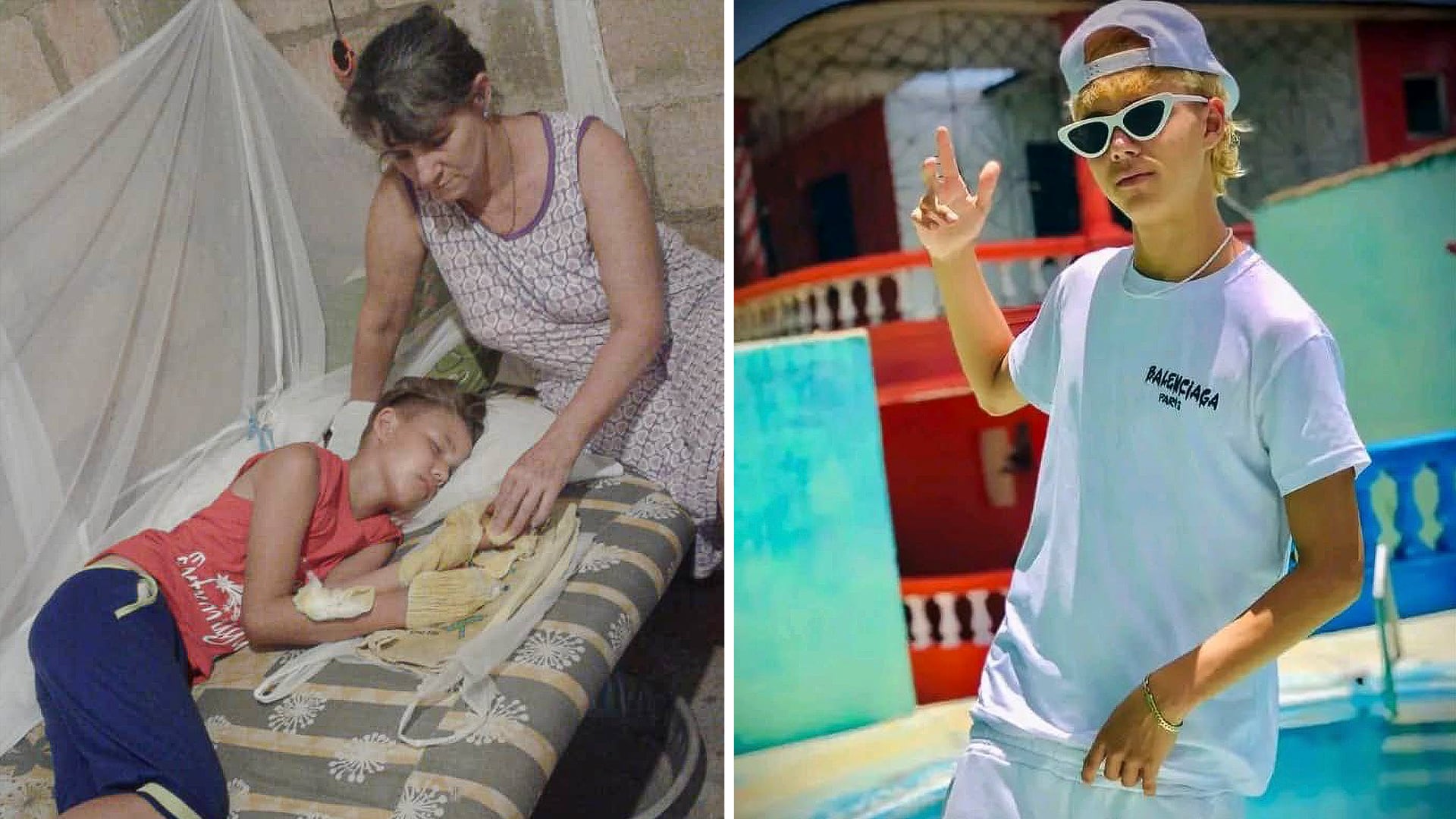
Margarita Bravo smiles even when she cries, the mother‑figure among the mothers: she is searching for her daughter, Meiling Álvarez, 40, and for her grandson, Samei Reyes, 14. That teenager with the shy smile is also being searched for by his other grandmother, Lázara Fernández. These are the Cuban searchers.
There is also Óscar Hernández, with his dark little notebook, his gentle smile, his wariness: he is searching for his younger brother, Ricardo Hernández, a 33‑year‑old Honduran.
And completing the group is José Quindil, who has been wiping away tears ever since he arrived from Cotopaxi, Ecuador, to find his son, Jefferson Quindil, 21.
Graciela Ramos, mother of Dairanis Tan, a 33‑year‑old Cuban, could not join the brigade, nor could the families of Hondurans Karla Hernández, 29, and Olvin Marin Maldonado, 61, who also disappeared on the same journey. So the seven detectives ask about them, too.

The families began filing missing persons reports — each on their own — in January 2025. They didn’t know one another, nor did they know the names of the people who had traveled with their children, because Mexican authorities dismissed each of their individual reports with ease. The Cuban mothers found one another through social‑media posts, and one phone call led to another.
They eventually reached the Foundation for Justice, the organization that accompanied them more than a year ago to file a complaint before the FGR. The federal agency declared itself not competent and sent the case file back to the Chiapas Attorney General’s Office, even though there were — and still are — signs of organized‑crime involvement.
The case was published in EL PAÍS in June 2025, and from that story, like a domino effect, the September and October disappearances were linked to it. Only a few months ago, Chiapas prosecutor Jorge Llaven acknowledged after a press conference that all the cases were “related” and that San José El Hueyate was home to “a network for smuggling undocumented migrants”: “As there must undoubtedly also be complicity from authorities.”
Two of the three disappearances already have U.N. Urgent Actions, which require the Mexican state to begin an immediate search. It was in that context that the 2026 Tejiendo Redes (Weaving Networks) Brigade was organized with the Regional Network of Migrant Families to bring the detectives to Mexico.
A crossroads
The town’s name is unusual. Even some locals get confused. San José El Hueyate belongs to the municipality of Mazatán; some call it the Barra de San José, and the owner of a restaurant insists people also call it La Encrucijada — The Crossroads. “Do you know what that means?” he asks. Then he explains that here, dozens of tiny islands, dirt paths, and waterways intersect and split apart, that a lot goes through here, that many people have passed through here. But he doesn’t recognize any of the photos of the missing. Another shop owner says bluntly that those who don’t turn up either drowned or were taken. She has a missing brother, just like another neighbor, just like a migration officer. People in town have never dared to hang the faces of the missing on these wooden walls. They are poor, afraid, and they have their reasons. On that, the detectives agree.
San José El Hueyate has been a drug‑trafficking corridor for decades; in the 1980s, small planes loaded with cocaine landed here, and for years, migrants have been hidden in safe houses because of the area’s isolation. No one is used to an operation like the one accompanying the seven detectives, and children stare wide‑eyed at the convoy made up of the National Guard, the Army, Municipal Police, State Police, the Migrant Prosecutor’s Office, the National Search Commission, the State Search Commission, the Executive Commission for Victim Assistance, Civil Protection, the Mazatán government, activists and a handful of journalists. It is an unusual deployment — at times promising, at others ineffective.


The sand is damp, and under the palm‑thatched shelter sit several dozen motorbikes and a handful of neighbors who had been calm until the entire brigade arrived. The families ask carefully, insist patiently. “If at any point you remember something, you can call this number — it’s all anonymous.” “Look, let me show you another photo.” “No, they didn’t disappear at night; it was 9 a.m., broad daylight — someone must have seen them.” “I can’t rest until I know where my son is.” “Have boat guides gone missing here?”
They receive timid answers, a few attentive eyes, and replies that reveal more than they say: “Why do you want to know that?”
“There’s a truth hidden in San José El Hueyate — everything we need to find our relatives is there,” says Óscar Hernández. “That’s what the prosecutor’s office needs to do.”
In 10 days, they have traveled through Mexico City, Tuxtla Gutiérrez, Tonalá, Paredón, Tapachula, Mazatán and San José El Hueyate; they have visited migrant detention centers, shelters, hospitals, prisons, churches, markets, government buildings; they have met with the National Migration Institute and the prosecutor’s office; they have held press conferences; they have given their samples to the Argentine Forensic Anthropology Team; they have left the border covered with the faces of Jorge, Elianis, Lorena, Meiling, Samei, Ricardo, Jefferson, Dairanis, Karla and Olvin; they have shown those faces to more than 1,000 inmates who filed past one by one under the sun to look at their photos; they have heard possible leads and many refusals; at times they wish they could go home and be far from here, and at times they don’t want to leave until they can do so with their families.
“As a son, it’s incredibly frustrating. What am I going to tell my parents when I get back?” Óscar Hernández asks sadly.
At the same time, they acknowledge the progress, the leads, a glimmer of hope once again.
“I think if we stayed here for a month, we could find them,” Alicia Santos muses aloud.
“What we want now is for our case file to be sent to the Attorney General’s Office so they can search the entire country,” says Isis Pérez.
They all hoped to return to their countries with something — with someone — but they know that this has been, after all, just the first attempt.
Sign up for our weekly newsletter to get more English-language news coverage from EL PAÍS USA Edition
E
Viral Restaurant Incident: Diners Walk Out Without Paying And Leave Note Explaining Why
Conor McGregor Returns To UFC Vs Max Holloway
Tags
Trending
-
Competiciones2 weeks agoE
-
Costa del Sol3 weeks ago
Why home care is the new gold standard for living well in Spain
-
Bullfighter injured3 weeks ago
Second serious injury in Spain’s La Maestranza bullring reignites controversy
-
Uncategorized4 weeks agoMartin Brundle tells all on how his famous F1 Grid Walk began
-
%3 weeks agoGibraltar Sees Surge In Residency Applications After Border Agreement
-
%3 weeks agoPortugal Confirms High-Speed Rail Link
-
Costa del Sol3 weeks ago
Nube floats into Estepona
-
Animal protection law3 weeks ago
Spain moves to redefine legal pets as draft law raises wider welfare concerns