
Boris Yeltsin
Russia Imposes The Memory Of Stalinism’s Executioners Over That Of Its Victims

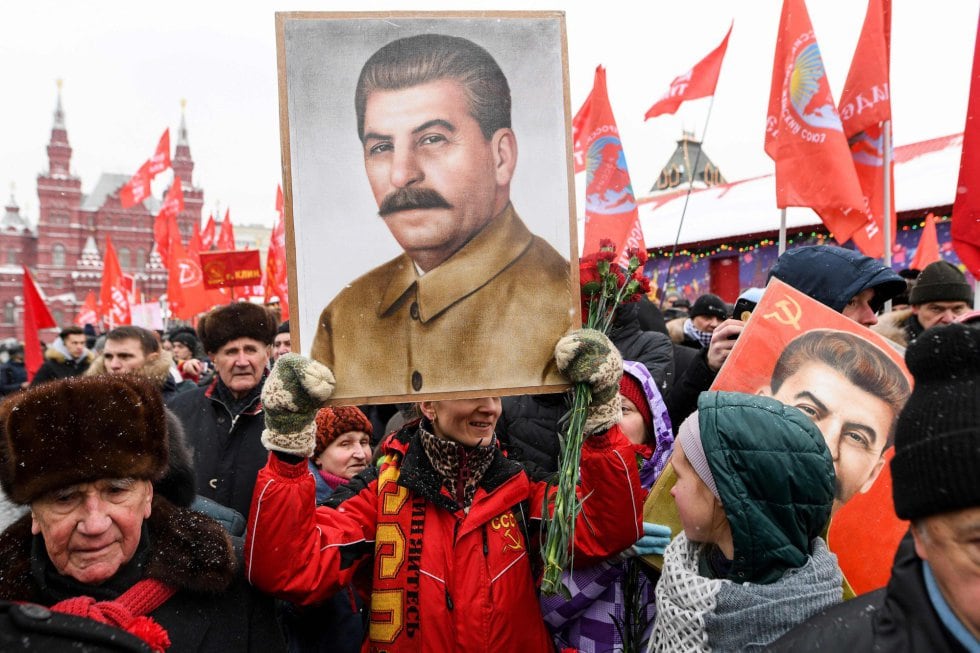
Systematically, Vladimir Putin suppresses and destroys the memory of Stalinist terror and replaces it with an artificial construction of myths, distortions, and selective silences about the past. The manipulation — used to justify the war against Ukraine — has intensified as the conflict drags on.
Russian propaganda equates the aggression against Ukraine with defending the USSR from German invaders in the Great Patriotic War (the term Russia uses for the Soviet Union’s participation in World War II from 1941). The profound difference between the two conflicts does not matter.
Properly processed by the Kremlin, the Russian invasion is portrayed as a response to alleged aggressive intentions by NATO, supposedly lurking behind Ukraine. Ukrainian patriots and defenders are thus turned into “terrorists,” “extremists,” and “Nazis.”
In this context, it is significant that the Russian authorities have declared Memorial — the Nobel Peace Prize–winning organization that, since its founding in 1989, had dedicated itself to remembering Stalinist repression and defending human rights —an “extremist organization.”
The banning of Memorial and the transformation of its founders and members into “criminals” is a qualitative step not only toward erasing memory but also toward monopolizing the interpretation of history and turning complex realities into controlled dogma.
Stalin is again presented according to the most orthodox Soviet canons, in which that leader had the personally decisive role in the victory over Nazism. This view minimizes or erases the mass repressions, the purges that weakened the Red Army, the nature of the German–Soviet pact and the character and objectives of cooperation between the USSR and the Western allies.
Historian Sergei Ehrlich, director of the project Istoricheskaia Expertisa, which is dedicated to historical hoaxes in the post-Soviet space, distinguishes two parallel processes: on the one hand “Stalin’s crimes,” and on the other “the desire to exalt that leader as the organizer of the victory.” “To whitewash Stalin’s figure you have to forget the repression and its victims and also the German–Soviet pact,” he says.
“The rhetoric of Russian leaders, not only Putin, is built on a formula according to which the current war against Ukraine is a continuation of the Great Patriotic War against the Nazis,” the historian says. For a long time, he adds, Putin avoided praising Stalin, partly because he understood that many peoples of the Caucasus, deported during World War II, regarded him as “a devil, guilty of an unforgivable tragedy.”
The historian noted a change in Putin’s public rhetoric in 2025 when he told parliamentary leaders: “One cannot forget the personal role of Josef Stalin in the Victory in the Great Patriotic War; one must try to depoliticize him.” After admitting “problems related to the repression,” Putin then said: “It is not fair to forget the role that this particular person [Stalin] played in the victory of the Soviet people.”
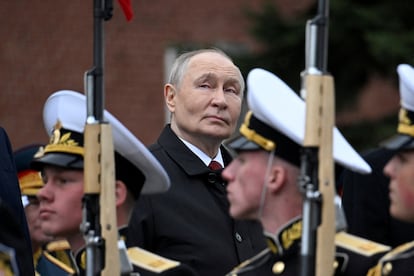
The tendency to subordinate the memory of repression to the memory of the victorious strongman — “a symbol of the fight against neo-Nazism,” according to Ehrlich — manifests itself in the proliferation of monuments to Stalin, which is setting records in Russia. In the autumn of 2023 there were 110 such monuments, 95 of them erected during Putin’s era, according to a study by the publication Mozhem Obyasnit. At the same time, symbols of Stalinist repression are being removed across Russia.
As president, Putin has resorted to different conceptions at different moments. In 2017 he inaugurated in Moscow “The Wall of Sorrow,” a sculptural composition dedicated to the victims of political repression. Accompanied by the widow of the writer Alexandr Solzhenitsyn and relatives of other repressed people, Putin said: “It is essential to understand and remember this tragic period of our history, when whole strata, whole nations, were subjected to a brutal persecution [that] spared neither talent nor merit to the motherland […]; anyone could be charged with invented and utterly absurd offenses. Millions of people were declared ‘enemies of the people,’ were shot or mutilated, and suffered the torments of prisons, concentration camps, and exile.” “This horrible past cannot be removed from the national memory and much less be justified by anything,” he concluded.
The memory of those repressed and the memory of the repressors coexist to this day in Russia. The Federal Security Service (FSB), successor to the Soviet KGB and NKVD, was neither purged nor ideologically modernized when the USSR disintegrated.
The ideological heirs of the KGB and the NKVD govern Russia and have established their monopoly over politics and history, and in both realms dissent can be punished with prison. Punishments for spreading conclusions that differ from the official account of World War II history, coupled with the closure of archives and the inclusion of independent or critical historians on lists of “foreign agents” or “undesirables,” hinder and impede research.
This is not a matter of convictions but of power and control. Ehrlich considers it “pure cynicism” that “the memory of World War II is being used as fuel for the war in Ukraine and veterans are being used as a political weapon.”
By outlawing Memorial, Russia closes a cycle that began during perestroika, when Soviet leader Mikhail Gorbachev allowed that organization — where the memories of many social sectors converged — to be legalized as a civic organization, apparently at the request of Elena Bonner, the widow of scientist and Nobel Peace Prize laureate Andrei Sakharov. It was in 1990, in Gorbachev’s era, that the Solovki stone commemorating Stalinist repression was placed near the KGB headquarters in Moscow.
Under Boris Yeltsin (1991–1999), Memorial continued to develop and obtained premises in the Russian capital (now closed), although as early as the 1990s the organization clashed with the authorities, recalls historian Irina Shcherbakova, a co-founder of Memorial who now lives in exile. The sources of disagreement included the confrontation between the executive branch and the legislature in 1993 (which ended with the shelling of parliament) and the denunciations of abuses committed by the military and security forces during the first Chechen war (1994–1996).

The paradox of the Russian state today is that, while the authorities continue to work on the “rehabilitation” of victims of Stalinist repression, they are also engaged in a process of “de-rehabilitation,” and both processes take place outside society, controlled by prosecutors, judges, and institutions that are heirs of the executioners.
With Putin — who tried to join the state security organs when he was still a child — the memory of those who carried out Stalinist policy has displaced the memory of the victims. The many Russians who now support the official narrative prompt reflection on the distorted logic, the confusion and the power of clichés portraying Russia as a fortress besieged by all.
Sign up for our weekly newsletter to get more English-language news coverage from EL PAÍS USA Edition






E
Drivers are being warned about a simple car park trick that starts with a piece of paper
Pirate-themed Chiringuito Royal Beach Pirata serves beachfront treasures

Mexico’s Most Controversial Politician, Rubén Rocha, Goes To Ground As Cartel Questions Intensify
Insurance company Mapfre decides to pay out €14 million compensation for 2025 blackout

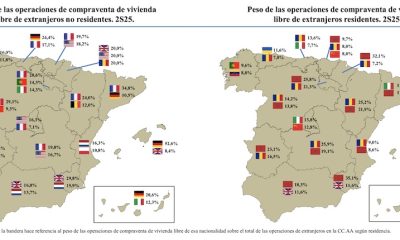
Who Bought Where In The Second Half Of 2025?


-
 ElPais1 week ago
Mexico’s Most Controversial Politician, Rubén Rocha, Goes To Ground As Cartel Questions Intensify
-
blackout April 20253 weeks ago
Insurance company Mapfre decides to pay out €14 million compensation for 2025 blackout
-
 Foreign demand3 weeks ago
Who Bought Where In The Second Half Of 2025?
-

 New Developments3 weeks ago
Inside The Most LUXURIOUS Apartment Building In Spain!
-
Costa Blanca South3 weeks ago
Alicante police chief to retire after 17 years of service
-

 New Developments3 weeks ago
🌅 Stunning Penthouse With Panoramic Sea & Mountain Views Benalmádena
-
biggest ever cocaine bust4 weeks ago
Spain’s biggest-ever cocaine bust – massive Atlantic seizure stuns authorities
-
Costa del Sol3 weeks ago
Starlite Marbella 2026 offers over 1,000 summer jobs: Apply before positions fill fast