Connect with us

%

Bulldozers Demolish Iconic BereBere Chiringuito In Torre Del Mar

Published

on

bulldozers-demolish-iconic-berebere-chiringuito-in-torre-del-mar

BereBere chiringuito removed from Torre del Mar beach. Credit: José María Alba FB

José María Alba expressed deep sadness as excavators reduced his chiringuito beach bar to rubble early on Tuesday, June 16. An 18-year-old establishment in Torre del Mar had been happily serving meals and gatherings beside the sea in the Axarquia area of Malaga. Alba shared footage showing the demolition and voiced his sense of abandonment by the local Tenencia de Alcadia.

Owner blames local officials for lack of backing

Alba claimed national coastal authorities had agreed in principle to a relocation nearby. He stated the local government body had failed to support this move, resulting in the enforced demolition after permits expired. His business had offered lunches, snacks and parties on the beach for nearly two decades.

Council defends action by reciting national coastal legislation

Spain’s Ley de Costas places the entire shoreline public domain under national control and not local councils’. Concessions require competitive bidding and technical approval from the national Demarcacion de Costas office. Local bodies hold no authority for direct awards on this land. Torre del Mar officials said the chiringuito enjoyed an exceptional extension lasting 18 years. They stressed that backing businesses must respect the rules and legal security. Coastal decisions on public land belong to central authorities in Madrid.

Job losses lead to accusations of favouritism

Dozens of workers now face unemployment. Some 54 staff worked in summer, while 30 held year-round posts. Social media posts from supporters accused local leaders of favouring connected entrepreneurs over established employers. Messages suggested residents would remember the events of this in the May 2027 elections. Council statements have not ruled out legal steps to correct inaccurate claims.

Venue built reputation for quality dining and recovery

Chiringuito BereBere earned praise for food that combined traditional beach dishes with refined cooking, admired by top Andalusian chefs. Its location aided Torre del Mar’s appeal to diners seeking quality seaside meals. Owners and staff overcame a 2018 fryer fire that damaged the premises. Rapid repairs let the business reopen shortly after.

%

Ceiling Collapse In Benalmadena Restaurant

Published

on

ceiling-collapse-in-benalmadena-restaurant

The owners of Sopranos Restaurant in Benalmadena woke to a shock alarm alert before discovering part of their restaurant ceiling had collapsed into a dining area leaving a trail of mess and chaos. Tony and Emma of Sopranos had already had a testing week in the business and the ceiling failure was an unwelcome end to an already difficult week.

The incident happened in the early hours of Monday, June 15, when owner Emma received a notification from the restaurant’s alarm system at approximately 6.55am indicating movement in the rear dining room.

After checking the venue’s security cameras, she could see movement but was unable to determine what had happened. It was only when the restaurant was opened later that morning that the cause became clear.

“When we lifted the shutter, you could see all the plaster on the floor,” she said. Fortunately, no one was injured in the collapse.

Alarm alert leads to discovery of ceiling collapse

According to Emma, the damage appears to have been caused by an ageing ceiling structure in the rear dining area.

“It is a very old technique of putting a ceiling up which looks like it has given way,” she explained.

The affected section was quickly cleaned and cordoned off to ensure customer safety, while access to the restaurant’s toilets was maintained. Emma praised helpers Marcia and Liam for assisting with the clean-up operation, allowing the business to continue trading despite the disruption.

“It was a shock, but at least no one was injured,” she said.
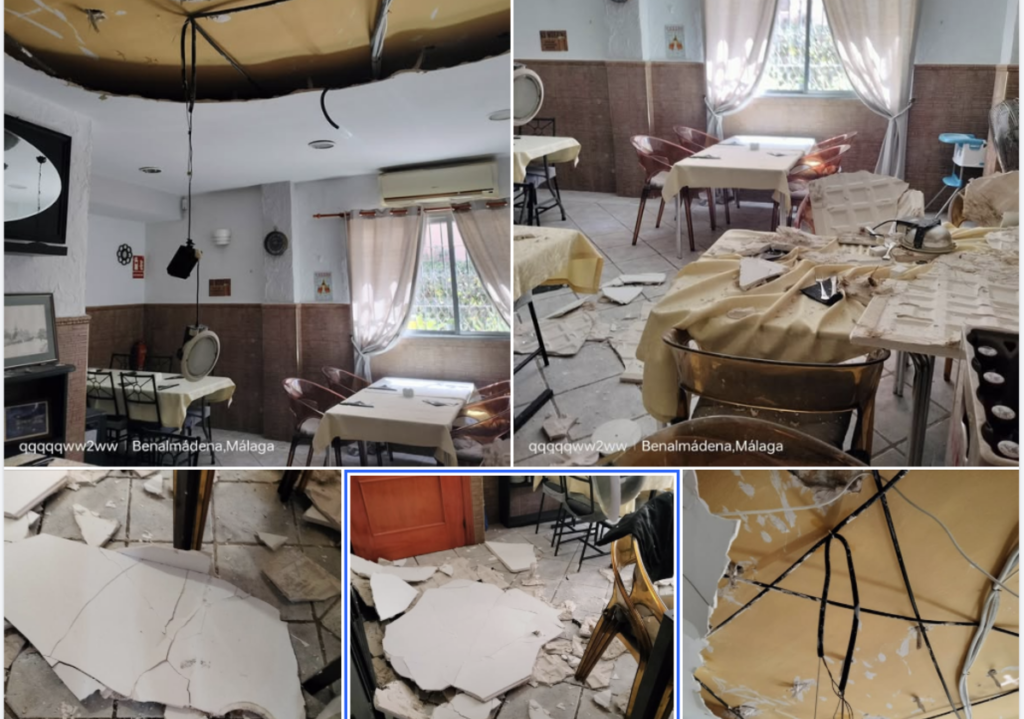
Sopranos restaurant ceiling collapse
The ceiling failure
Credit:Sopranos/FB

Benalmadena restaurant faces series of technical problems

The ceiling collapse was the latest setback in what has been a particularly challenging week for the restaurant. Earlier in the week, Sopranos lost power after an electrical fault developed, requiring repairs before normal service could resume.

The problems continued when the restaurant’s main kitchen chiller broke down on Friday night, forcing staff to temporarily rely on alternative refrigeration while repairs were arranged.

“We have had such a bad week,” Emma said.

The good news for the business was that the chiller was successfully repaired, allowing kitchen operations to return to normal.

Landlord steps in after insurance setback

Following the ceiling collapse, the restaurant contacted its insurance company but was informed that the damage was not covered because it was considered general wear and tear.

However, Emma said the landlord immediately became involved and has been absolutely fantastic with his support and response to the situation. With repairs now being organised, the restaurant remains open while work continues.

Customers rally around local Costa del Sol business

News of the difficult week saw an outpouring of support on social media, with customers leaving numerous messages of encouragement on the restaurant’s Facebook page.

Emma said the response from regular customers had helped lift spirits after several days of unexpected challenges.

“Thanks for all the messages of support. It has meant a lot,” she posted on social media.

“We’ve got very good customers,” Emma added.

Despite dealing with electrical issues, refrigeration problems and now a ceiling collapse, the hardworking team at Sopranos Restaurant has continued serving customers and is hoping for a far less eventful week ahead.

Continue Reading

%

200,000 Visitors Expected At Motril’s 20th International Air Festival

Published

on

200,000-visitors-expected-at-motril’s-20th-international-air-festival

Costa Tropical skies roar once more. Credit: Motril festival aereo FB

Motril council has announced the 20th year of the International Air Festival on Sunday, June 20 with the event taking place along the local coastline and organisers expecting over 200,000 visitors for the full day of jaw-dropping aviation wonder.

Programme details for the milestone year

Mayor Luisa Garcia Chamorro presented the plans and said the festival roots among residents and tourists and called it Spain’s best aeronautical festival. She recalled its 2005 start with three helicopters and 500 spectators, now a key summer date for Motril and Costa Tropical. Organisers have described a balanced programme ranging from gliders to combat jets with helicopters prominent as tribute to the first event. This gathering will do wonders for the local economy and tourism across the Costa Tropical.

Featured international military and rescue aircraft

New elements include the Sikorsky MH-60R Romeo helicopter from the US Navy making its first appearance in Motril. This Rota-based aircraft ranks among the world’s most sophisticated naval helicopters. German air force Demo Team from Ala 51 flies Tornado jets in a rare display in Spain. German helicopters join US Navy, Maritime Rescue, INFOCA, Guardia Civil and National Police units.

Extensive safety measures and access information

Deputy mayor Jose Peña outlined the security plans with Local Police, Guardia Civil, National Police and fire services for thousands of visitors. Extra parking includes a new zone with nearly 500 spaces. Visitors should arrive early preferring public transport to avoid congestion. Attendees should arrive two hours early via Avenida Nuestra Senora de la Cabeza, Rambla de las Brujas or the Playa Granada road. Parking is expected, as in other years, to be slow moving entering the official parking. Not to worry though, as best views are expected to be from the beach. Still, those looking for a day of wonder watching the skies should arrive as early as possible to nab the best parking spots.

Drone flights are banned all day over restricted airspace risking serious penalties for violations. This year confirms the Motril’s airshow status as a top Spanish aviation event and key Andalucian summer draw.

Continue Reading

%

Only Five Foreign Residents Approved For Healthcare In Madrid Sparks Questions

Published

on

only-five-foreign-residents-approved-for-healthcare-in-madrid-sparks-questions

Opposition figures have requested further clarification on the total number of applications submitted. Photo credit: GenadiyGM/Shutterstock

A new set of figures has sparked debate in Madrid over access to public healthcare for foreign residents without legal status. In 2025, just five applications were approved under the Community of Madrid’s DASE system, according to Cadena SER Madrid. The figures relate to the DASE system (Documento de Asistencia Sanitaria para Extranjeros), a regional scheme that allows foreign residents without legal residency to access Spain’s public healthcare system if they meet specific requirements, including a minimum period of residence and registration in the municipality.

Out of an estimated 57,000 foreign arrivals to the region during the same year, only ten applications were examined, with five ultimately approved and five rejected. The figures have prompted political criticism from opposition groups, who have questioned the level of access provided under the system and called for greater transparency on how applications are processed.

What the DASE system is designed to do

The DASE document is issued by the Community of Madrid and provides access to publicly funded healthcare for foreign residents who do not hold legal residency status in Spain. It is intended to ensure access to basic medical services within the regional health system for individuals who would otherwise not qualify for standard public healthcare coverage.

According to regional guidelines, applicants must generally demonstrate at least 90 days of residence in Spain, be registered (empadronado) in the Community of Madrid for a minimum period, and not hold legal residency status or alternative entitlement to public healthcare. The document is typically valid for two years once granted and allows access to healthcare services under the regional public system.

Strict eligibility requirements limit applications

Eligibility conditions for the scheme are structured around residence and administrative status. Applicants must show proof of continuous residence in Spain for a defined minimum period, alongside proof of municipal registration. In addition, individuals must not already have legal residency or alternative healthcare coverage through another system.

These requirements are designed to regulate access for people in irregular administrative situations, while ensuring coordination with existing national and regional healthcare entitlements. However, the low number of applications processed in 2025 has drawn attention to how frequently the scheme is being used in practice.

Political reaction and calls for greater transparency

The data released on application outcomes has led to criticism from opposition representatives in the Madrid Assembly. Concerns have been raised about the gap between the number of foreign residents arriving in the region and the very small number of DASE applications that were reviewed during the year.

Opposition figures have requested further clarification on the total number of applications submitted, as well as the criteria applied during assessment, arguing that the available figures do not provide a complete picture of access to the system. Some political voices have also highlighted broader concerns about access to essential public services for migrants in irregular administrative situations.

Why this system applies only to Madrid

The DASE scheme is a regional mechanism operated by the Community of Madrid, meaning it only applies within this autonomous community and is not part of a nationwide programme. Spain’s healthcare system is decentralised, with each autonomous community responsible for managing healthcare access within its territory. While national legislation sets the general framework, regional governments define how access is implemented in practice.

As a result, other regions in Spain may apply different rules or operate alternative systems for healthcare access depending on their own policies and administrative criteria. This means the figures reported in Madrid reflect a regional policy outcome rather than a national trend.

Could this affect the rest of Spain?

At present, there is no indication that the DASE system or its application results are being replicated at national level. The figures are specific to Madrid’s administrative framework and do not represent a change in Spain’s overall healthcare policy. However, the situation is likely to contribute to wider debate across Spain about how autonomous communities manage healthcare access for foreign residents without legal status.

Because healthcare powers are devolved, any potential change outside Madrid would depend on decisions made by individual regional governments rather than national legislation.

What this means for residents in Spain

This development does not affect legal residents in Spain, who continue to access public healthcare under the standard national system through social security registration or established residency-based entitlements.

The figures relate specifically to foreign nationals in an irregular administrative situation in the Community of Madrid, who may apply for healthcare access under the regional DASE scheme if they meet strict local requirements. The data therefore reflects a very limited subgroup rather than the general resident population.

For most residents in Spain, both Spanish citizens and legally resident foreigners, there is no change in healthcare access or entitlement as a result of these figures. The wider relevance lies in administrative and policy terms. Because healthcare is managed at regional level, the Madrid data highlights differences in how autonomous communities structure access pathways for non-regularised migrants. Any broader impact beyond Madrid would depend on future decisions by individual regional governments, rather than a national change in rules.

In practical terms, the situation is therefore regional and procedural, not a nationwide change affecting residents’ rights or access to healthcare services.

Wider view of healthcare access in Spain

Healthcare access for foreign residents in Spain is governed through a combination of national legislation and regional administration. While national rules define overall entitlement frameworks, each autonomous community is responsible for implementation. This creates variation in how access is managed across different regions.

The Madrid data therefore forms part of a broader regionalised system rather than a uniform national policy, reinforcing the role of local governments in determining healthcare access conditions.

Limited uptake raises questions over accessibility

The small number of approved applications in 2025 has raised questions about how accessible the system is for eligible individuals. While the scheme is formally available to qualifying foreign residents, the data suggests that relatively few applications are being submitted or progressing through the approval process.

This has led to renewed scrutiny of administrative procedures and eligibility requirements, particularly in relation to how effectively the system reaches those it is intended to cover. At present, official figures indicate that only a fraction of potential applicants are engaging with the process or successfully obtaining access under the scheme.

Ongoing debate over healthcare inclusion

The figures have contributed to a broader debate in Madrid over healthcare inclusion and access for foreign residents without legal status. While the DASE system is designed to provide a structured pathway into the public healthcare system, the low number of approvals has intensified discussion around whether current administrative requirements may be limiting uptake in practice.

As political debate continues, calls for further data and greater transparency around application processing remain central to discussions over healthcare access at regional level in Madrid.

Continue Reading

Trending

Copyright © 2017 Spanish Property & News