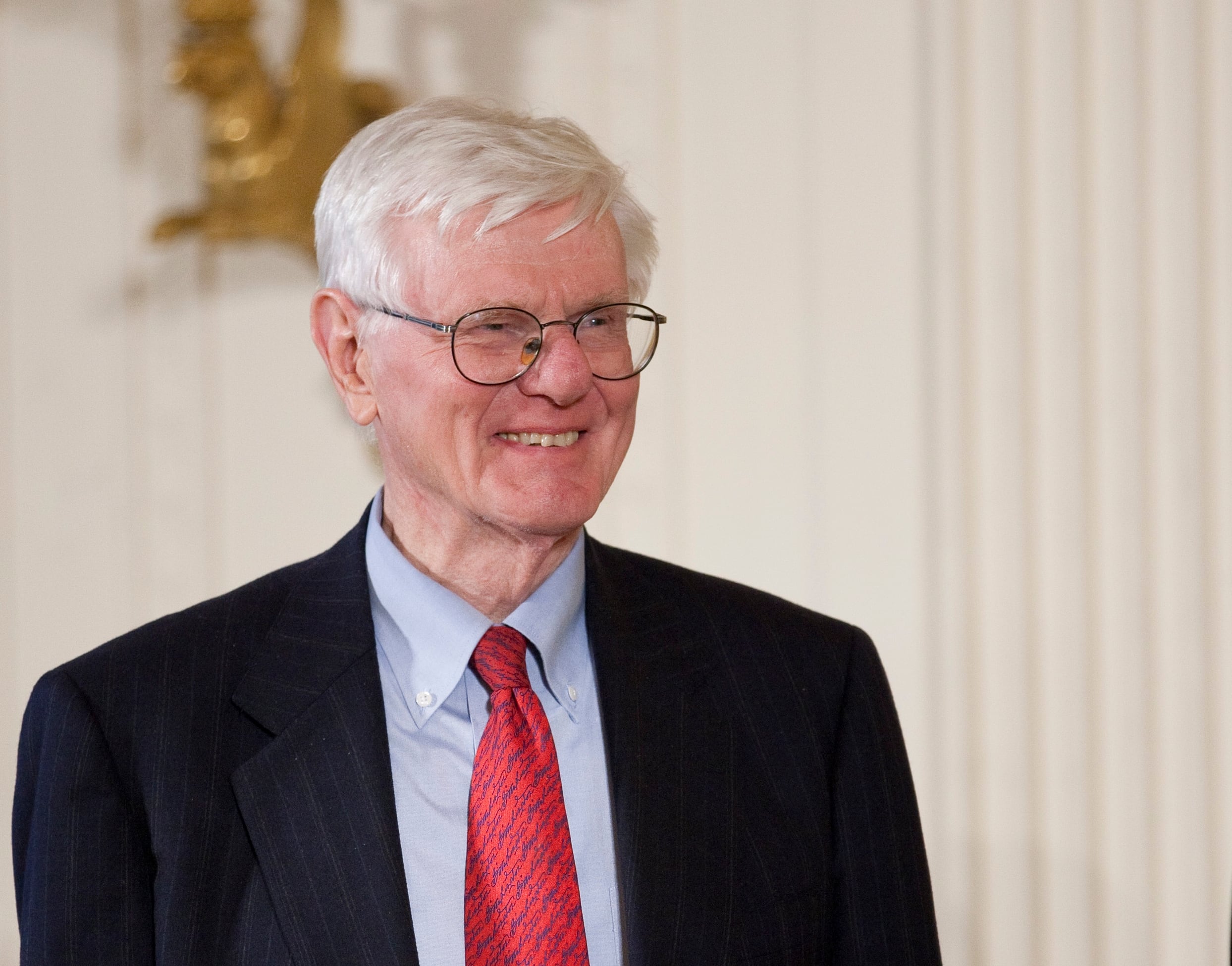
He spent sixty years explaining how the United States became a democracy, and he died weeks before it turned 250. Gordon S. Wood, the most influential historian of the American Revolution, was born in Concord, Massachusetts, in 1933, and killed by a car in Rhode Island on June 7, at ninety-two. He was revered by many, resisted by others, ignored by no one. He even reached the movies: Matt Damon’s character skewers a pompous Harvard graduate student whose idea of sounding clever is to name-drop Wood. After all, his name carries the weight of a long and prestigious career spent explaining to his countrymen how the first sparks of 1776 helped to develop American democracy.
In his last year he fought an important battle over the meaning of American citizenship. In a Wall Street Journal essay, he answered a rising claim that ancestry confers a deeper title to the country, that the children of immigrants belong less than the heirs of the Mayflower. The United States, he argued, is exceptional because it has no ethnos beneath the state but an incredible multiethnic diversity bonded not by blood but by the words of the Declaration of Independence. Thus, Wood rebuked a resurgent nativism and ethnic nationalism now trying, legally and culturally, to redraw the line of belonging against immigrants and their children.
In a way, Wood died defending the American dream his life embodied. The son of a working-class family, he was the first in his family to attend college, graduating from Tufts in 1955. He served in the Air Force from 1955 to 1958 before entering Harvard University as a graduate student, earned his Ph.D. there in 1964, and in 1969 joined the faculty of Brown University, where he would teach for nearly four decades. In an interview I conducted at Uppsala University, he told me that his family background deeply influenced his scholarship. In his work, ordinary people occupy the heart of the American Revolution, their concerns with money and getting ahead constantly overriding the designs of the elites.
Because Wood became the leading interpreter of republicanism, it is often forgotten that his analysis ran on two levels, the ideological and the sociological: republican ideas lived in the words of the elite, while democracy transpired in the social world beneath them. It was on that lower level that Wood placed the force of change. For him, the commercially minded, individualistic people who labored with their hands made the United States a modern democracy, thus shattering the elite republican dreams.
Wood’s first book, The Creation of the American Republic (1969), which earned the Bancroft Prize, already held the seed of The Radicalism of the American Revolution (1992), which won the Pulitzer Prize. Writing in an ironic prose that made him so often misread, Wood showed that the Constitution was an aristocratic attempt to tame a rising pluralistic society keen on pursuing its diverse private interests. In Empire of Liberty (2009), his volume in the Oxford History of the United States, Wood carried the story from the Constitution’s adoption to 1815. Its subject is the unintended transformations the American Revolution set loose. It shows how the democratic and commercial energies of ordinary Americans remade the nation’s politics, religion, and culture in ways the revolutionary leaders had never sought. Overall, Wood rescued the American Revolution from a postwar interpretation that had reduced it to a constitutional quarrel over rights drained of social roots. In doing so, he left every generation of students and scholars after him to confront how revolutionary the American Revolution was.
Irony was the signature of Wood’s work. It let him honor the revolutionary elite as genuine idealists while showing how the material interests of ordinary people propelled American democracy. The same irony shaped his view of history: in The Purpose of the Past (2008) he called history conservative, valuable because it shows how little power historical actors have over the outcomes of their own actions, and he exposed the many ironies and errors of historians who sought to draw universal lessons from the past.
Wood’s ideas were always thought-provoking, and his prose was at once persuasive and down to earth. In lectures, in interviews, and in ordinary conversations, he could be almost hypnotic. The subtlety with which he connected events, marshaled details, retrieved the perfect quote, and reconciled seemingly contradictory ideas was mesmerizing. Wood’s admirers crossed party lines. Newt Gingrich named The Radicalism of the American Revolution an essential book, an endorsement Wood drily called the “kiss of death,” and in 2011 President Obama awarded him the National Humanities Medal. Once, when I pushed him about his political influences, he named Daniel Patrick Moynihan, a politician who, he said, could develop non-ideological, practical policies by working across party lines
Wood claimed to follow the scholarship, not an agenda, yet at the end the present pulled him in. In 2019 he and four other historians signed an open letter disputing the New York Times 1619 Project’s claim that slavery drove the colonists to independence. However, his criticism was used by Republicans to ban the project from schools, a censorship he loathed. He called the whole affair a disaster.
It was a fate worthy of his own irony. For sixty years he had preached detachment, the historian standing apart from the quarrels of his day. At the end of his life, love of country drew him into current affairs. He often tried to show how history mocks the intentions of those who make it. It did not spare him. His optimism survived it anyway. Shortly before his death, talking about the crisis of American democracy in a podcast from the American Enterprise Institute, he said that its future lay not with the law professors at Harvard University but with the country’s mechanics and electricians, the ordinary people who had always made it and would remake it again. It was a fitting last word from a Harvard man who never forgot his origins.























 Canada2 weeks ago