
Columnists
Marbella Moments: Is it really worth going the distance?


August adventures. Credit: Nicole King.
It seems like every year we’re taken by surprise by the heat, the humidity and the traffic and yet every year we face the same situations.
Marbella is 27km long and the reality is that many of us tend to stay in our own areas. We have so much on offer right on our doorstep that it has to be a fairly special reason to go to the other side of the city, particularly in August.
I did make it from San Pedro to Elviria one evening because I really wanted to catch up with friends and family in that area, but it was a 45-minute drive and a miracle I found parking.
I finally found a space, only to come up against a guard dog on duty protecting the area when I came back! I quickly opened the car, jumped into the passenger seat and climbed over. Such adventures!
And I can’t believe I’ve made appointments in August when I know how unlikely it is to find a parking space, not even in the many car parks.
This year, the cherry on top has to be that my new car’s air conditioning isn’t working, which means I have the added joy of almost melting before I get to my destination. Of course, being August, no one is fixing it and I thought I’d manage anyway. Not the case.
I was on my way to Fuengirola earlier this week for a three o’clock meeting, but gave up halfway and went back home for fear of having a heat stroke.
Apparently, I’m not alone in driving around without air conditioning for one reason or another. I’ve now aborted missions three times.
Sometimes you really just have to ask yourself: is it really worth going the distance?



By Carlos Baos (Lawyer) • Published: 12 Aug 2026 • 16:26 • 2 minutes read
Claim dismissed on appeal. Credit. PaeGAG / Shutterstock
A recent case handled by our firm illustrates a situation that is more common than many property owners realise. Two neighbouring plots in Benissa had been separated by a wall since the 70s, when a single property was divided into two. Decades later, the owners of one plot became convinced that their land was smaller than it should have been, and that the missing surface area was, in fact, sitting inside their neighbour’s property.
So, they brought a claim before the courts seeking the recovery of less than 50 square meters against our client, who had purchased his property years earlier and had always used the land exactly as delimited by the existing wall, disputed the claim. The case was heard by the Court of Denia, which ruled in our favour. The claimant appealed to the Provincial Court of Alicante, which has now confirmed the original decision. You can read the complete judgment by visiting our website: www.white-baos.com
What makes this case a useful illustration is not the outcome itself, but the reasoning behind it. Under Spanish law, recovering land from a neighbour requires considerably more than a suspicion that a boundary is misplaced. Even where a registered surface area does not match what a survey shows on the ground, the claimant must identify, with precision, exactly where the missing land is located.
In this case, the disputed plot bordered three other properties besides our client’s. Yet the possibility that the shortfall originated elsewhere, rather than from our client’s land specifically, was never examined. Nor was the historical registry record of the original, undivided property produced, which would have helped establish where the boundary had originally been intended to run.
Cases like this tend to arise from properties divided many years ago, when land surveys were considerably less precise than current technology allows. What the courts require nowadays is a complete, verifiable picture, ruling out every alternative explanation before any land can change hands.
For property owners on either side of a boundary dispute, the lesson is a practical one: claims of this kind demand thorough preparation and precise evidence from the outset. At White & Baos Lawyers, we have direct experience handling this type of dispute on both sides, representing claimants and defendants alike. If you are facing a similar situation, we would be glad to review your case. Reach out to us today.
You may be interested in the following services and articles:
Carlos Baos (Lawyer)
White & Baos.
Tel: +34 966 426 185
E-mail: info@white-baos.com
White & Baos 2026 – All Rights Reserved.
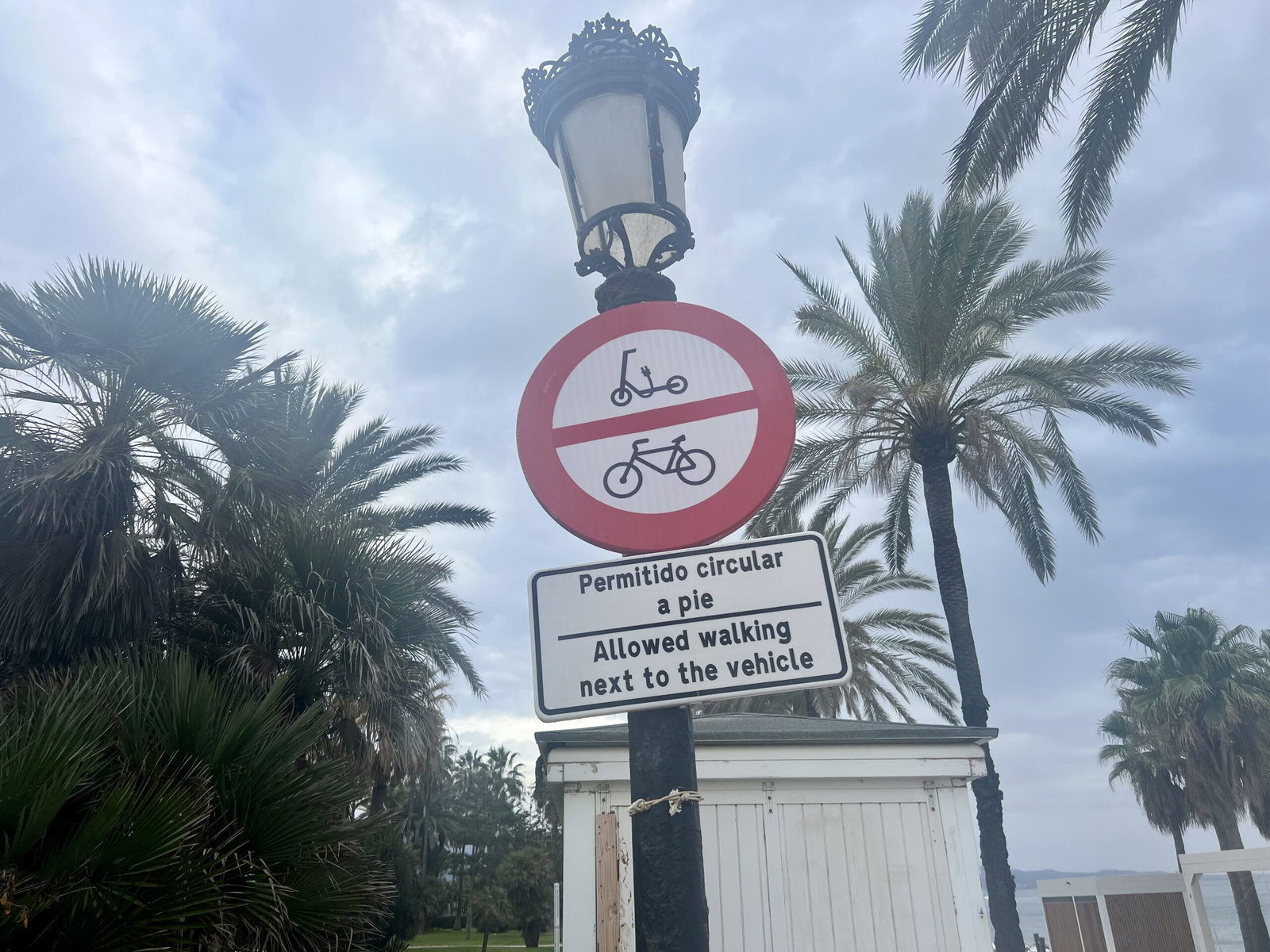
New signs on the Paseo Maritimo. Credit: Nicole King
Marbella’s Paseo Marítimo now nearly covers the entire 27 kilometres of our city and is one of the highlights of living here. However in summer as it also becomes incredibly busy, we need to be aware of the rules and abide by them.
Firstly it is worth remembering that a Paseo Marítimo literally means a seaside “promenade”, a place designed for walking. Nowadays it’s a melange of pedestrians, children playing, dogs, runners, cyclists and electric scooters all sharing the promenade, alongside restaurant terraces and waiters regularly crossing the walkway.
To optimise our safety the rules for bicycles and personal mobility vehicles now vary according to the section of the Paseo, and signs that previously restricted cycling at certain times have been replaced in some areas by signs telling cyclists and scooter users to dismount and walk alongside their vehicle.
There is a good reason behind the change. In August last year, Marbella Town Hall temporarily stopped bicycles and scooters being ridden on a number of paved sections after reporting an increase in incidents between pedestrians, bicycles and personal mobility vehicles during July. The measure was specifically introduced to prevent further accidents and protect pedestrians during periods of particularly high footfall.
Where cycling is permitted, pedestrians still always have priority, the maximum speed is 10 kilometres per hour, users must keep right and zig-zagging and reckless riding is prohibited. On a crowded promenade, someone stepping unexpectedly into their path, children or dogs changing direction, sudden braking or evasive manoeuvres lead to very nasty accidents.
So please don’t assume yesterday’s rules apply everywhere today. Watch the signs, watch your back, slow down and remember that on the Paseo, pedestrians first.

Rolling Stones tribute brings legendary rock hits to Orihuela Costa this August
Alicante records more than 38,000 blood donations as summer drive boosts supplies

Max Verstappen Red Bull contract


-

 Uncategorized2 weeks ago
Lewis Hamilton hits gold with $10bn jackpot but British star snubs Monaco move: F1 News Recap
-

 Uncategorized2 weeks ago
Racing star was destined for F1, now he
-
Latest2 weeks ago
EU Tells Meta, TikTok To Boost Monitoring, Fact-Checking
-
Altea1 week ago
Fireworks disaster at Costa Blanca spectacular leaves 27 injured in Altea
-
Mallorca2 weeks ago
Palma mayor fights to keep TUI water bus project afloat
-

 Andalucia2 weeks ago
Courageous Costa Del Sol Father Seeking To Raise Funds For Specialised Treatment In Germany As He Battles Brain Cancer
-

 Bogotá1 week ago
Última Hora Del Terremoto En Colombia, En Directo | Al Menos 132 Muertos Y 570 Heridos Por El Seísmo De Magnitud 7,4
-
European News1 week ago
Portugal moves to stop pets being left behind in wildfires and floods