
America
Coalition Sues Trump Administration Over Limits On Foreign Student Visa Stays


Donald Trump’s immigration policy is once again facing the courts, this time over a measure affecting students, researchers, exchange visitors and foreign journalists. A coalition of unions, universities and education organizations has sued the administration in an effort to block new restrictions that, beginning September 15, will establish time limits on how long people can legally remain in the United States under certain types of visas.
The lawsuit was filed Tuesday in federal court in Massachusetts and challenges a regulation by the Department of Homeland Security (DHS) that replaces the system known as “duration of status,” which had been in place for decades. Under that system, international students with F-1 visas could remain in the country as long as they were making adequate progress in their academic programs, without being subject to a fixed maximum period.
The new regulations establish that students and exchange visitors with F and J visas, respectively, may be admitted for the duration of their program, but for no more than four years. Those who need more time will have to apply for an extension of stay.
The measure does not mean that all students must complete their degrees within four years. However, the plaintiffs argue that the requirement to apply for an extension introduces additional uncertainty for those enrolled in longer programs, particularly graduate and doctoral students.
“Students will lose opportunities, schools will lose talent, and the public will lose billions of dollars of economic contributions supported by one of the United States’ top exports: education,” the groups said in their lawsuit.
What will change for foreign students?
In addition to the four-year limit, the regulation imposes new restrictions on some students who want to change programs or institutions and limits certain opportunities to begin new courses of study.
The plaintiffs argue that these provisions could force students who have already invested years and significant amounts of money in their education to depend on discretionary extensions to complete their studies.
The issue is particularly relevant for doctoral programs and other courses of study that can take more than four years. The plaintiffs argue that the new system could turn a process that previously depended primarily on academic progress into one subject to periodic reviews by immigration authorities.
The regulation is not limited to universities. Foreign journalists with I visas will also face shorter admission periods. For most of them, the period of stay will be limited to 240 days. For journalists holding passports from the People’s Republic of China — with the exception of those holding Hong Kong or Macau passports — the limit will generally be 90 days. They may apply for extensions, although those will also be subject to limits.
The DHS argues that the new restrictions will allow it to exercise greater oversight over foreigners remaining in the United States under these visas.
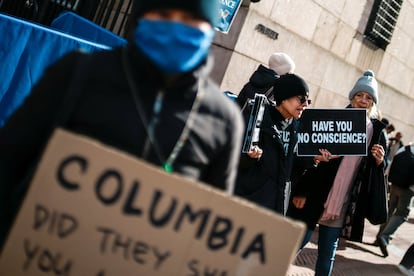
The agency says the defined admission periods will allow officials to conduct periodic assessments to determine whether visa holders continue to comply with the terms of their status and to detect potential abuse or fraud. A DHS spokesperson defended the policy as a way to ensure that student visas are used by people who genuinely intend to study in the United States.
The administration has also said that the previous system allowed some foreigners to remain in the country for long periods with active visas.
However, the groups suing the government argue that using potential cases of fraud to justify a change affecting millions of students and other foreign visitors imposes a disproportionate burden on universities and applicants.
A new signal for foreign talent
The dispute comes at a time when the United States is beginning to face questions about its traditional role as a preferred destination for international students, researchers and professionals. For decades, its universities, labor market and opportunities for social mobility turned the country into a magnet for international talent. But, as EL PAÍS has documented, that perception has deteriorated during the Trump administration, amid tougher immigration policies and greater uncertainty for those seeking to study or work in the country.
The shift also coincides with efforts by other developed countries to attract highly skilled researchers and workers. Canada, Germany and the United Kingdom have introduced measures to facilitate the arrival of foreign talent, while the United States is tightening some of the mechanisms that for decades helped its universities and companies recruit it.
The data point to a change in the preferences of some professionals. According to the employment platform Handshake, the share of full-time job postings offering visa sponsorship fell to 2.3% in 2026, roughly one-fifth of the 2023 level. International student enrollment also fell by nearly 20% at the beginning of the last academic year.
The plaintiffs argue that imposing new limits and additional procedures could have consequences that go beyond the students themselves. In their lawsuit, they say the possibility of losing legal status while pursuing their studies could discourage foreigners from choosing U.S. universities.
For educational institutions, the risk is not limited to losing students. International students are an important source of revenue for universities and contribute to research and other sectors of the economy.
Immigration uncertainty is precisely one of the factors leading some foreign students and professionals to reconsider whether the United States is still the best place to build a long-term career. For those who come to the country intending to study and later enter the workforce, having a predictable immigration pathway can be just as important as the quality of a university or the professional opportunities.
The lawsuit asks a judge to block the rule from taking effect and to invalidate it before September 15.
Sign up fo rour weekly newsletter to get more English-language news coverage from EL PAÍS USA Edition










America
Estados Unidos Amplía Su Campaña Contra El Tribunal Penal Internacional Y Sanciona A Su Presidenta


Raphinha Sobrevive A La Canícula Y El Barcelona Se Lleva El Gamper

700 Flee As Suspected Arson Wildfire Spreads From Cáceres Into Salamanca

La Clase De Kang-In Lee Y Baena Rompe A Un Buen Málaga Y Da El Primer Triunfo Al Atlético


-

 Uncategorized2 weeks ago
Racing star was destined for F1, now he
-
Latest2 weeks ago
EU Tells Meta, TikTok To Boost Monitoring, Fact-Checking
-
Altea2 weeks ago
Fireworks disaster at Costa Blanca spectacular leaves 27 injured in Altea
-
 Andalucia2 weeks ago
Courageous Costa Del Sol Father Seeking To Raise Funds For Specialised Treatment In Germany As He Battles Brain Cancer
-
Mallorca2 weeks ago
Palma mayor fights to keep TUI water bus project afloat
-

 Bogotá1 week ago
Última Hora Del Terremoto En Colombia, En Directo | Al Menos 132 Muertos Y 570 Heridos Por El Seísmo De Magnitud 7,4
-

 New Developments2 weeks ago
Stylish 3-Bedroom Apartment With Panoramic Sea Views – Benalmádena
-
Caravaca de la Cruz2 weeks ago
Murcia firefighters battle massive forest blaze in Moratalla, Murcia as wildfires strike three towns