
ElPais
A Traveling Circus For The Horror Of Gaza

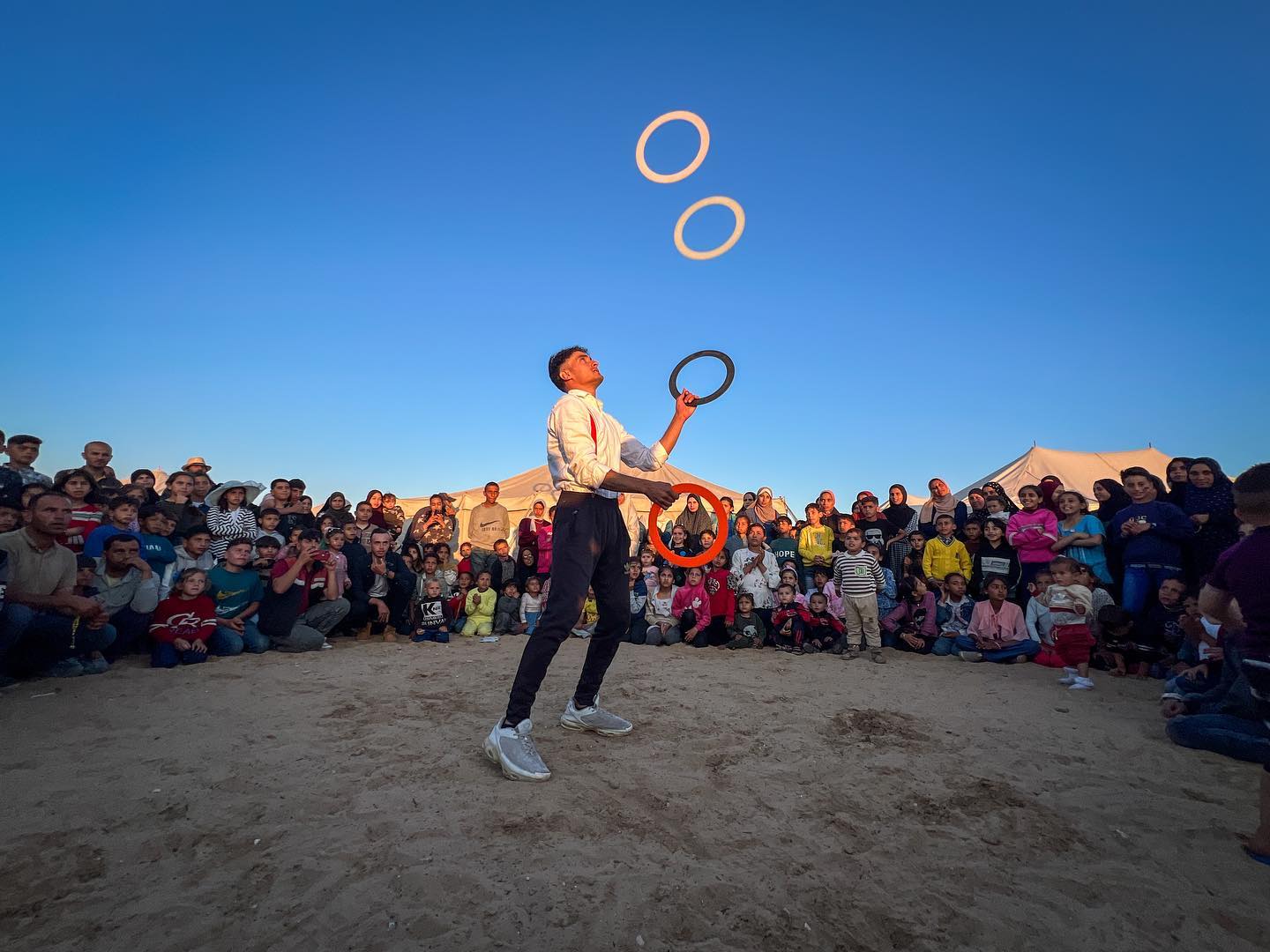
In 2018, after spending his adolescence in an Israeli-blockaded Gaza watching videos online about circus activities abroad, Muhammad Jader decided to bring what he had learned to his community. After waiting a decade to painstakingly acquire the necessary equipment, he and nine other Palestinians opened the Free Gaza Circus.
The aim was to “spread circus culture” among children and young people through workshops and courses based on what they had learned on social media. In a “modest space” they set up in the Jabalia refugee camp in northern Gaza, they began teaching those skills, he recalls today, eight years and much suffering later. The project, which he founded with his brother Yusef, grew steadily until it reached 480 students at a time when leaving Gaza was already difficult.
In October 2023, Hamas launched its surprise attack and Israel began bombing the enclave, killing hundreds of people a day and ordering the displacement of more than half of Gaza’s then 2.3 million residents from the north, where Jabalia is located, to the south. “We didn’t know where to go or what to do. We left all the equipment behind in the middle of the bombardments. For a month, we were simply traumatized,” he remembers.
As Benjamin Netanyahu’s government turned life in Gaza into a mix of attacks, repeated displacement, hunger and destruction, teaching circus tricks would have seemed like an ill-timed luxury. Jader, displaced from his native north to the southernmost city of Rafah, realized that the circus could no longer be about skills. It had to become a tool for mental health and survival.
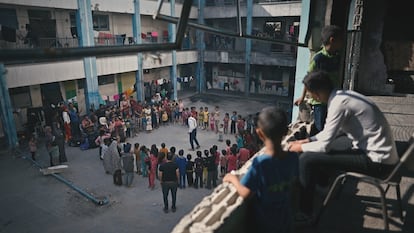
“We sat down and decided we had to use our energy to start giving our people hope. To make them feel safe for a while and break the routine of tension and bombardment. Until October 7, 2023 [when the bombings began], our goal was training and teaching. When the war started, it became about providing emotional and social support through activities in the displacement camps. About distracting children and young people from the bombing and destruction around them,” he says during a patchy phone call. Many Gazans rely on mobile signals from neighboring Egypt or Israel, or use international SIM cards, because Israel has barred journalists from freely entering Gaza for nearly three years.
A loudspeaker and scraps of fabric
The first thing they did was buy a small loudspeaker. Then they set about searching through the rubble for scraps of fabric and colorful clothing, which they stitched into their own clown costumes.
The circus shifted its focus to free outdoor performances aimed at bringing smiles amid adversity, using little more than red noses, juggling balls and stilts made from salvaged pieces of wood.
The systematic destruction of buildings left most Gazans living in tents. During the summer, this new version of the circus would wait for the fierce daytime heat to subside before gathering crowds of all ages eager for a brief escape from the daily routine of queuing for food and drinking water from humanitarian and charitable organizations, or from hours spent scavenging wood or even plastic among the rubble to use as fuel for cooking.
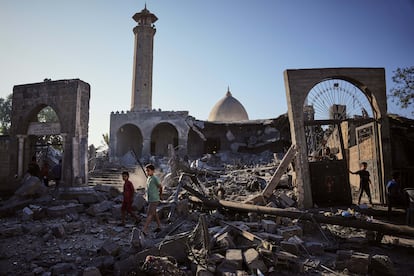
“Older people came too, and it was very moving to see that we were putting smiles on adults’ faces as well,” recalls Jader, now 27. “They had no work, they were sitting around with nothing to do, and afterward they would tell us how happy they were and asked us to keep coming.”
“When the army withdrew from Khan Younis, we went there to perform and saw more smiles on the faces of elderly people than on those of children,” he continues. “That convinced me even more that the circus is very important in this situation.”
Created as a permanent educational initiative, the circus was thus forced to reinvent itself as a traveling troupe focused on psychosocial support. According to UNICEF, virtually all of Gaza’s 1.1 million children require mental health and psychosocial support services. Even before the invasion, Gaza had only one psychiatrist for every 100,000 inhabitants.

In the spring of 2025, Israel intensified its use of hunger as a weapon of war by preventing any food from entering Gaza. The result was famine for more than a million people, with dozens of emaciated children dying from starvation.
The circus decided to stop. “Children wake up and go to bed hungry […] We cannot offer psychological support to people who have not been able to eat anything. Even we, as performers, are exhausted from hunger and worn down by this situation,” they said in a statement.
That October, U.S. President Donald Trump imposed a ceasefire on Netanyahu in Gaza, and the circus resumed its activities. Israel continues to carry out airstrikes, with 1,320 people killed during the 10 months of the ceasefire, controls 60% of Gaza, prevents reconstruction in the devastated territory and still restricts the entry of aid. But the attacks are far less intense, the constant displacement has become a thing of the past, and there is considerably more food available in the markets.
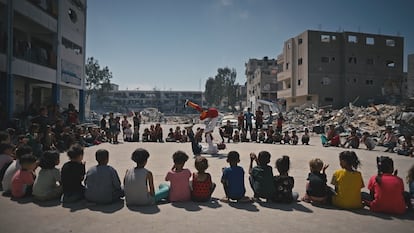
Since this was the closest thing to stability they could hope for in the short term, they resumed training in May. Not in Jabalia, where the center that once housed their activities now lies in ruins, but in Deir al-Balah, the new home of hundreds of thousands of displaced people. And not with the full team. Of the 10 partners who founded the circus, three have been killed during the Israeli invasion. Only four of the survivors have managed to reunite and restart training and educational activities in a tent provided by the Palestinian philanthropic foundation Tamer, in collaboration with UNICEF.
Last January, they took advantage of the ceasefire to return to the original site and search for equipment among the rubble. “We only recovered simple things,” like carabiners or mats, “but it gave us hope,” Jader recalls. The most expensive and hardest-to-get items remain buried there, like the bicycle or the unicycle and the rigging needed to hang aerial silks. “Outside Gaza, they’re easy to find, but for us, getting them in the first place was like finding treasure,” he says.
That is why the circus focuses on teaching floor acrobatics and clowning, which require fewer resources. And in a Gaza where few people speak of the future with any sense of hope, the project survives largely through personal commitment. “We don’t have projects, nor a clear plan, nor steady support, nor an operating budget,” Jader admits.
For now, though, he is worried about something more immediate: the nearly 190 children enrolled in the activities. “I think,” he says, “I have a problem with the size of the tent.”
Sign up for our weekly newsletter to get more English-language news coverage from EL PAÍS USA Edition










brad pitt
Why Middle-Aged Men Are Buying Coffee Machines Instead Of Convertibles: ‘These Aren’t Indulgences, They’re Experiences’



The midlife crisis has no proven biological basis and, in fact, some experts suggest it may be the one major crisis millennials manage to avoid. While getting older may be a universal experience, a full-blown existential crisis requires a fairly privileged starting point: a degree of financial, personal and family stability that allows people to devote time and resources to questioning their lives and, of course, reinventing them.
In the 1960s, psychoanalyst Elliott Jaques argued that, as we approach 40, we begin to confront our own mortality more consciously, a realization that can be accompanied by a profound sense of unease. For decades, that anxiety found expression, particularly among men and according to their means, in a series of recognizable gestures. At one end was the businessman who left his wife, started a relationship with a younger woman and bought a sports car; at the other, the forty-something who simply got a tattoo or dyed his hair platinum blond. These are different ways of dramatizing a break with one’s previous life and convincing oneself that there is still time to start over.
But things are changing. The new sports car is a high-end espresso machine. One social media user asks: “1980–1996 friends… how’s that midlife coffee crisis going?” Another says: “Having a coffee cabinet is the best kind of mid-life crisis. Because middle age is about brewing coffee in different ways yourself.”
Let’s not forget that Brad Pitt, David Beckham and George Clooney are among the stars who have become the new faces of coffee, including coffee pods. The fact that these products are promoted by middle-aged men suggests that some people are navigating their midlife crisis through caffeine rather than horsepower.
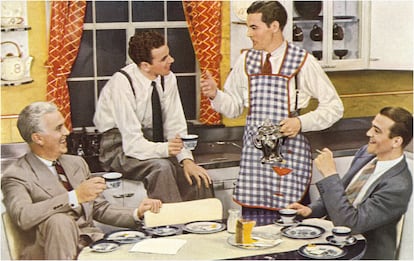
Of course, there is already a name for this phenomenon. Writing in Robb Report about the “obsessive, intensive and expensive” ways in which men indulge their passion for coffee, Mark Ellwood coins the term MAMIC, Middle-Aged Man Into Coffee. He also references the MAMIL, Middle-Aged Man in Lycra, the Lycra-clad middle-aged man who throws himself wholeheartedly into cycling.
“The car has become too obvious, a victim, so to speak, of its own clichéd status,” writes Max Scharnigg in the German newspaper Süddeutsche Zeitung. “In general, the car as a symbol of success now works only up to a point, whether it’s a Porsche or a Mercedes G-Class. Quite simply, it no longer says much about a man’s actual status when any youngster can show up driving an AMG with an enormous engine.”
The journalist reflects on how the affluent middle classes in Western countries now prefer subtler ways of displaying status. The symbols men use to assert themselves, both to themselves and to their peers, are no longer primarily meant to signal wealth or professional success. Instead, they signal expertise. Scharnigg concludes: “For several years now, there has been a curious category of objects that comes into its own in middle age: things that require specialist knowledge or reflect a personal passion. The new equation of social distinction in midlife could therefore be summed up as: time plus sacrifice equals status.”
Marcos Apud, a psychologist and expert in neuro-longevity, explains that men between the ages of 40 and 50 grew up watching their fathers accumulate possessions as status symbols, only to realize at some point that those things did not make them happier or healthier. “Middle age no longer asks, ‘What do I have?’ but ‘How do I feel?’ The expensive bicycle, the pizza oven, the specialty coffee machine… these are not indulgences; they are investments in personal experience, in rituals, in the quality of everyday life. Status has become internal. And, from a biological perspective, that makes perfect sense: by the time you reach 40, your body starts sending clear signals. If you don’t listen to them, you’ll pay the price,” he says.
“There is a genuine element of maturity to it,” he adds. “Today’s middle-aged man has more information than ever about what is good for his body and mind, and he is beginning to act accordingly. Going to the gym for health reasons, eating better, protecting personal time… that’s not vanity; it’s biological intelligence. Now, it would be naïve to deny that identity also plays a role. Appearance matters. But the difference from previous generations is that today that image is built from the inside out: first I take care of myself, and then it shows. Not the other way around,” he adds.
“A certain level of status gives people access to the financial resources that make a particular lifestyle possible,” says Antoni Bolinches, author of El síndrome de las supermujeres (The Superwoman Syndrome). “As men lose youth and gain maturity and status, they come to realize that happiness is possible at any stage of life, so long as they do not try to achieve it in the same way.”
According to the psychologist, the difference is also shaped by the social expectations placed on men and women. “Women receive the message that they must not age, which leads them to resist the passage of time and try to preserve their youth. Men, by contrast, grow up in a culture that presents aging as an opportunity to gain maturity and experience, allowing them to view getting older in a more positive light,” he says.
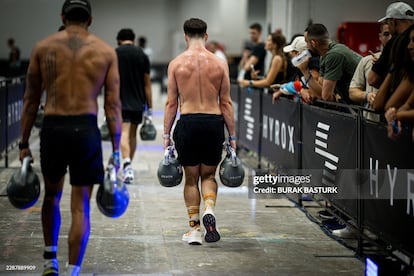
Chris Rovzar argues in Bloomberg that today’s middle-aged men face growing pressure to prolong their years of sexual attractiveness: “Americans have become obsessed with longevity, extending not just our lifespan but also our ‘healthspan’ — how long we live healthfully and happily. As a result, what middle age looks like has shifted too, thanks to everything from skincare to surgery. If we feel young and healthy on the inside, why wouldn’t we want to look that way on the outside? Now we’re all about extending our ‘hotspan.’”
Running, endless cycling sessions and, of course, Hyrox (something of a new-generation CrossFit), have become the new face of the midlife crisis, alongside cosmetic enhancements. “Hyrox over 4’s new dad life! The midlife crisis is now voluntary suffering running round in circles,” Hyrox coach Charlie Hendrie jokes on social media. “Still showing up. Still puttin in the work. No excuses.”
The problem arises when enthusiasm borders on obsession. Rafael San Román, author of ¿Qué le cuento a mi psicólogo? (What Do I Tell My Psychologist?), warns against taking self-care too far. “We often think that by doing a certain kind of exercise or eating in a certain way we’re looking after our health when, in reality, we’re not only gaining nothing from it but actually putting more pressure on ourselves. Many men in their forties and fifties may be trying to put their foot on the accelerator to preserve something that can’t be preserved, or to achieve for the first time something they’ve never had.”
The urge is understandable. “Perhaps we feel that the last trains are leaving the station when it comes to physical attractiveness, sexual appeal or certain life experiences. But instead of approaching it in a healthy, integrated and mature way, we try to compensate, in an unbalanced fashion, for shortcomings we perceive in earlier years. We become obsessed with last chances and lost youth. That’s when everything starts to unravel,” he warns.
“What women often seem able to do, namely confront a life crisis by drawing, at least initially, on their own resources, through self-reflection or by seeking therapy covered by health insurance, appears to be more difficult for men,” Scharnigg writes. “They need to make a considerable investment, perhaps to convince themselves they are really taking change seriously. Naturally, one doesn’t carry a pizza oven or an espresso machine under one’s arm, so they don’t work exactly as status symbols. They do work, however, as discreet badges for those in the know. ”
He continues: “What used to be that lakeside house on Lake Como, casually slipped into conversation, can now be an apparently offhand reference to the La Marzocco GS3 coffee machine you have at home: a kind of code recognizable only to fellow initiates.” The machine in question costs around €8,000 ($9,200). In this case, it is an exceedingly expensive example of an “if you know, you know” purchase, an inside joke for connoisseurs.
Perhaps the difference lies in how each generation experiences its midlife crisis. The previous one longed to recapture lost youth through conspicuous symbols of success and pleasure, while the current generation tries to turn consumption into expertise and use it to build a new version of itself. Because even when the money is spent on expensive pizza ovens or coffee machines, the purchase alone is not enough; what matters is mastering details such as roast profiles or bean varieties. In the past, people bought themselves a new life. Today, they acquire the tools to shape one. The goal is no longer to escape, but to become the kind of man who can better appreciate what he already has.
And however irritating some may find it to listen to a middle-aged man explain every step of his quest for the perfect cappuccino, that will always be more appealing, and certainly less ridiculous, than watching someone rev the engine of a sports car despite knowing that speed limits leave little room for showing off.
Sign up for our weekly newsletter to get more English-language news coverage from EL PAÍS USA Edition
Abelardo de la Espriella
Doris Salcedo, The Artist Who Melted The FARC’s Weapons: ‘Goya Strips War Of Its Heroic Character’

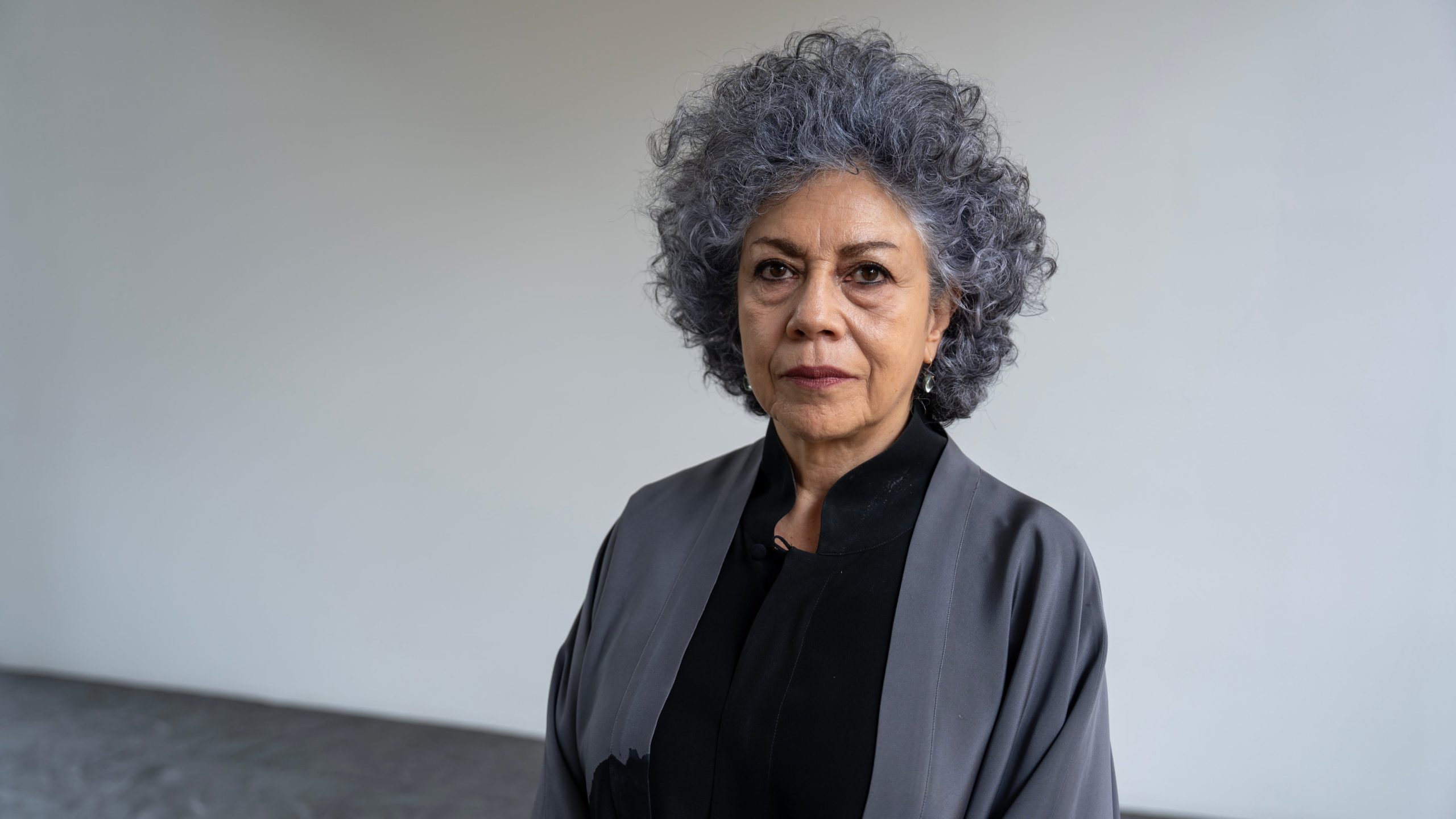
Colombia continues to suffer the horrors of its many forms of violence. Nearly 10 years after the peace agreement with Colombia’s Revolutionary Armed Forces (FARC), the country is entering a new political chapter, with a new government that has closed the door on any further attempts at dialogue.
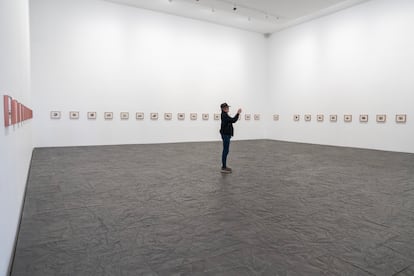
Against that backdrop, The Disasters of War, Francisco de Goya’s series of prints depicting the victims of conflict, will go on display from September 5 at Fragmentos, the counter-monument in Bogotá’s historic center. This important space of art and memory was built from the melted-down rifles of the now-defunct FARC and was conceived by Doris Salcedo, one of the most acclaimed Latin American visual artists in the world.
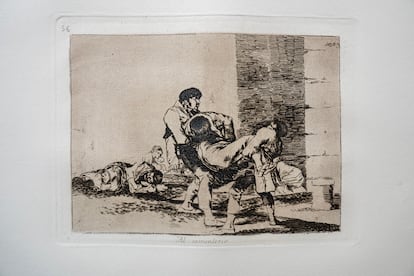
The exhibition brings together the complete series of 80 prints, produced between 1810 and 1820, in which Goya depicts the most devastating consequences of Napoleon’s invasion of Spain and the Peninsular War. The prints will be accompanied through January 17 of next year by seven poems from authors from different countries. Three collective actions focused on memory and remembrance will also take place over the coming months.
“Goya gives us a profound lesson about what war is. First, he strips it of any heroic character; second, he completely removes its nationalist dimension. He simply shows that war is pure brutality, that it is ignorance, and that all it brings is death,” Salcedo explains.
“He shows us rape, forced displacement, extrajudicial executions, torture, impalement, famine,” says the renowned Colombian artist. “He also shows the return of ignorance, because the Inquisition comes back; the violence that religion inflicts on ordinary people. We see all of these elements reflected absolutely in Colombia today,” she adds, speaking of the enduring relevance of The Disasters of War.
In her view, many of those scenes directly evoke the horrors of Colombia’s own armed conflict, including massacres such as El Salado, carried out by paramilitaries in 2000.
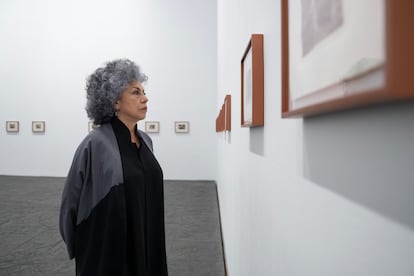
“Fragmentos represents a possibility for Colombians: the possibility of ending conflicts without killing one another, without bloodshed, without firing a single bullet. It represents the possibility of agreement, of dialogue, of talking things through, of understanding each other as rational human beings,” Salcedo reflects. “What we wanted to do by juxtaposing Fragmentos with this extraordinary work by Goya was to show Colombians the choices before us. We can either continue down the path of war, ignorance, religion, class divisions, everything that Goya shows us, or we can choose to build a social pact that leads us toward a peaceful and livable life in community for everyone.”
The exhibition arrives at a delicate moment. Abelardo de la Espriella has not yet completed his first month as Colombia’s president, but he is already promising a return to tough-on-crime security policies, ruling out any peace negotiations and sharply criticizing the institutions created under the accord with the FARC. He has also announced raids against undocumented migrants, spoken of “gutting” the left, though he later softened those remarks, and has repeatedly promoted a “cultural battle” that encompasses, among many other fronts, the Culture Ministry itself.
With its enormous symbolic weight, Fragmentos is itself a product of the peace agreement signed at the end of 2016. The Goya exhibition reaffirms the mission for which it was conceived: a space dedicated to the victims of the many forms of violence that have scarred Colombia. It was built from the melted metal of 37 tons of weapons surrendered by former FARC combatants. Its floor is made up of 1,300 metal plates hammered into shape by women who suffered sexual violence during the armed conflict. Housed in a colonial-era building just steps from the Casa de Nariño, the presidential palace, it was also envisioned as a museum that, for each year of the conflict and over a span of more than half a century, would host exhibitions by Colombian and international artists.
Salcedo has long been deeply committed to the peace accord, as well as to the Truth Commission, which delivered its final report in 2022. On more than one occasion, she has transformed Bogotá’s Plaza de Bolívar, the country’s political heart, which is only a few blocks from Fragmentos. There she installed Quebrantos, an intervention denouncing Colombian society’s growing indifference to the murder of social leaders. The square was also the site of Sumando ausencias, a vast white shroud stitched together with seven miles of thread by 10,000 people, giving voice to victims amid public calls to salvage the peace accord after the plebiscite in which the original agreement was narrowly rejected. Through her work, Salcedo has insisted time and again that Colombians are not condemned to yet another cycle of violence.
With a long list of international awards to her name, ranging from Spain’s Velázquez Prize to the Nasher Prize in the United States and the Nomura Award in Japan, Salcedo has achieved worldwide acclaim. Her work includes Shibboleth, the monumental crack that split the floor of London’s Tate Modern, exhibitions at New York’s MoMA and Paris’s Centre Pompidou, and Palimpsesto at Madrid’s Crystal Palace, a tribute to migrants who died at sea.
What also stands out in The Disasters of War, Salcedo notes, is the sheer number of images depicting migrants and forced displacement. Colombia is the principal destination for migrants fleeing neighboring Venezuela, and one of the poems accompanying the prints is Home by Warsan Shire. “You have to understand / that no one puts their children in a boat / unless the water is safer than the land,” it reads.
“These cultural battles are clearly driving us toward violence,” Salcedo laments. “I invite people to look carefully at the exhibition and reflect on each of these images, in which Goya shows us how distressing the return of the Inquisition was for him, which also investigated him personally, and how terrible it was for Spain. Let us hope that artists in Colombia do not meet the same fate. Let’s leave that in the past. Let us trust that there will be openness and an understanding that culture is about knowledge and an open-minded view of what a society is.”
Sign up for our weekly newsletter to get more English-language news coverage from EL PAÍS USA Edition

Mexico-Style Cartel Wars Rock The Netherlands After Cocaine Shipment Linked To Drug Lord Bolle Jos Is ‘stolen In Spain’

A Traveling Circus For The Horror Of Gaza

Experts Warn Of Longer Airport Queues As Major Change To The EU’s Controversial EES System Begins Next Week


-

 Uncategorized2 weeks ago
How Kimi Antonelli saved Red Bull as Max Verstappen signs blockbuster F1 deal
-
Latest2 weeks ago
Six EU Countries Urge Windfall Tax On Energy Firms
-
bullfighting2 weeks ago
Ronda’s September Feria returns with bulls back in the ring after two years away
-
 Andalucia2 weeks ago
How Max Beach Grew Into A Costa Del Sol Landmark And Helped Transform The Riviera Area Of Mijas In Just Seven Years
-

 Antonio Hidalgo1 week ago
El Deportivo Agua La Fiesta Del Málaga En Su Debut Liguero En Casa
-
Costa del Sol1 week ago
Mijas police step up rubbish patrols as residents complain about dumped waste
-
asylum seekers2 weeks ago
Europe splits over migrant returns as Spain refuses Italy transfers
-

 Uncategorized2 weeks ago
Ferrari F1 star Charles Leclerc teases major family event: