Connect with us

%

Marbella Puts Tsunami Plan To Test On El Faro Beach

Published

on

marbella-puts-tsunami-plan-to-test-on-el-faro-beach

Earthquake proof emergency services. Credit: Ayto

Marbella Town Hall sent out 40 emergency staff onto El Faro beach for a live drill built around a fictitious quake that could send a wave towards the Costa del Sol. Local Police, National Police, firefighters, Civil Protection, beach lifeguards and Salvamento Maritimo all took part, with drones, quads, boats, jet skis and ambulances on the sand and in the water.

Citizen Safety councillor Jose Eduardo Diaz stood with Beaches councillor Diego Lopez and said planning still matters if neighbours and holidaymakers are to stay safe when something real happens. He added that crews got to watch protocols, radio traffic and arrival times while people were actually on the beach.

How the mock 112 emergency call played out

Civil Protection explained that the job was simple: see whether every service that would turn out for a seismic and tsunami job can work as one unit. Crews practised pulling about 20 people from the sea to the shore and moving them to higher ground, then treating and shifting one injured person on the sand.

A dummy 112 alert started the clock and opened an advanced command post. Staff then cleared the beach up to Paseo Maritimo Duque de Ahumada, which sits on higher ground, using the marked routes already written into the municipal playbooks.

Plans signed off in March now get a real run

This run-through used Marbella’s local tsunami plan and its local seismic plan, both cleared in March by Andalucia’s standing Civil Protection commission. Those documents set out evacuation routes and safe zones after council approval earlier this year.

A joint debrief followed, looking at timings, radios and who talks to whom, so gaps can be closed before anyone needs this for real. Beach rescue kit already used on the 27-kilometre shoreline, from jet skis to patrol quads, was folded into the same picture.

UNESCO still rates a Mediterranean wave of at least a metre as highly likely within the next 30 years, and a nearby Alboran Sea quake could leave little more than 20 minutes before water hits the Costa del Sol. Official council notes on the exercise sit on Marbella’s citizen safety pages. Spain’s National Geographic Institute and 112 Andalucia remain the first ports of call if the next alert is not a drill.

%

Couple Who Had Never Sailed Before Plan World Circumnavigation In All-Electric Sailboat

Published

on

couple-who-had-never-sailed-before-plan-world-circumnavigation-in-all-electric-sailboat

Dan and Kika ready to take out Uma. Credit: Given

After a decade of preparation, Dan and Kika Deckert are preparing to take their 36-foot sailing boat Uma on a round-the-world trip, with departure planned for November 2026.

Their target is to complete a circumnavigation within 12 months without fossil fuels for propulsion, onboard power or cooking. Sailing will provide Uma’s movement, while solar panels, batteries and regeneration under sail will power life at sea.

Route plans will take Uma south-west out of the Mediterranean and across the Atlantic before heading around Cape Horn. Travel will then continue through the South Pacific, Australia and the Indian Ocean, around the Cape of Good Hope and back across the Atlantic.

An electric boat built through experience

Uma, far from Gibraltar.
Credit: Given

Uma is a 1972 Pearson 36 that Dan and Kika bought after graduating as architects. Neither had sailing experience, but they spent the following 12 years learning at sea, rebuilding the boat and documenting their adventures.

More than 30,000 nautical miles and 30 countries later, Uma has become a long-running test bed for electric sailing. Their first system used a second-hand forklift motor and batteries before they moved to Oceanvolt electric propulsion.

Svalbard also features in Uma’s story. In 2021, the boat reached the High Arctic without a diesel engine after Dan and Kika crossed the North Atlantic.

No diesel, generator or cooking gas

Uma 3.0 uses twin Oceanvolt electric propulsion, 3kW of solar generation, 50kWh of battery storage and up to 1kW of regeneration under sail.

Hydrogeneration allows the boat to turn movement through the water into electricity while sailing, helping recharge its batteries during longer passages. Oceanvolt says the amount generated depends on factors including boat speed.

Dan and Kika say every essential system, including navigation, communications, cooking and water production, must work within the energy available from solar power and regeneration.

“We never set out to become experts. We simply kept asking better questions and learning what the next step required,” they say.

Could Uma make history?

Previous attempts at fossil-fuel-free ocean voyages have not followed the same rules, according to the press kit. Some carried backup fuel or generators, while others did not complete the voyage.

Success would give Uma a claim to becoming the first all-electric cruising sailboat to complete a circumnavigation under the couple’s stated conditions.

Adventure is only part of the project. Dan and Kika want to show what long-term life aboard an electric cruising boat can look like.

Readers can also follow the voyage through Sailing Uma’s website, YouTube and social media, with future live tracking planned.

Continue Reading

%

Home Prices In Competa, Frigiliana & Nerja Jump 30%

Published

on

home-prices-in-competa,-frigiliana-&-nerja-jump-30%

Burriana in Nerja. Credit: Charlesy – Shutterstock

Northern Europeans keep clicking through Idealista ads in three Axarquia towns, and asking if prices have moved with them. Competa, Frigiliana and Nerja now are among Spain’s most-watched spots for foreign house hunters, and square-metre costs have climbed more than 30 per cent since October 2021.

Two sorts of visitors still split the Costa del Sol. Some come for a few nights out. Others, often older buyers from Britain, the Netherlands, Sweden and Germany, want a place of their own and a milder winter than Bristol, Amsterdam or Oslo. That second group has built small colonies in the eastern hills and on the Nerja coast. Spanish is optional. Sun is not.

Where overseas clicks already beat Spanish ones

Idealista’s late-August readout put Competa, Malaga Province’s most international and cosmopolitan village, at the top of Malaga’s list. Foreigners accounted for 61 per cent of views of homes for sale there, mainly British, Dutch and German browsers. Frigiliana followed at 57 per cent, with Brits, Dutch and Swedes leading. Nerja came in at 56 per cent, this time with Swedes first, then British and Dutch house hunters.

Search traffic is not a completed sale. Local agents still say it matches what they see: northern Europeans touring village houses and sea-view flats before they book a viewing.

How far prices have moved since 2021

Competa went from €1,467 per square metre in October 2021 to €1,949 in August 2026, a 32 per cent rise. Frigiliana climbed from €2,388 to €3,248, up 36 per cent. Nerja posted the steepest jump, from €2,866 to €3,952, a 38 per cent increase.

Buying a home in Malaga province is dearer almost everywhere than five years ago. Those three towns still lag the provincial jump of about 75 per cent. Malaga itself is a mixed market: Marbella and Benahavis mansions above €8,000 per square metre sit at one end, and modest inland cottages near €1,000 at the other.

Competa, Frigiliana and Nerja sit in the middle, pulled by both Spanish and overseas demand. Nothing in the latest Idealista numbers suggests that climb is about to ease.

Continue Reading

%

Crane Needed To Flip World’s Biggest Spanish Omelette

Published

on

crane-needed-to-flip-world’s-biggest-spanish-omelette

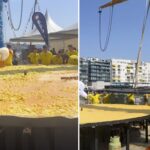
World’s biggest Spanish tortilla. Credit: Sanxenxo ayto

Crowds packed Sanxenxo in Galicia on Saturday to watch a family-run egg company cook what organisers called the world’s biggest Spanish omelette. Family company El Huevo de la Abuela (O Ovo da Avoa) used 17,000 eggs, 1,700 kilos of potatoes, 300 kilos of onion, 300 litres of oil and 30 kilos of salt.

Six-metre pan and 72 pairs of hands

Town hall social posts said thousands turned out for the cook-off, tied to the local onion fair and Santa Rosalia festivities. Seventy-two people worked a six-metre-diameter pan. Portions came with onion and without, a nod to Spain’s never-ending kitchen argument over how a proper tortilla de patatas should taste. Fans of that debate will recognise the split from earlier Euro Weekly News coverage of national surveys on onion versus no onion.

75-tonne crane for the flip

Sanxenxo council called the flip the day’s most nail-biting moment. So easily could they have ended up with the world’s biggest pan of scrambled eggs.bCrews needed a 75-tonne crane to turn the giant omelette. Officials described it as a high-precision job that went off without a hitch. Cooking finished around 14.15, then queues formed for 10,000 portions at just €3 each. Proceeds go to charity.

Council thanks went to the Melide-based family firm, sponsors, volunteers and everyone who turned up. “Sanxenxo made history,” the town hall said.

Onion fair backdrop and a Galician food tradition

This was no one-off stunt. The same company staged a similar giant omelette in Melide last year. Sanxenxo’s version sat inside the Feira da Cebola, putting the town’s own onions front and centre. Galicia already draws food lovers for octopus, percebes and hearty home cooking; a monster tortilla fits that pattern of big, communal plates that raise cash as well as eyebrows.

Readers who like oversized Spanish dishes can look back at Euro Weekly News pieces on giant paella fundraisers and huge rice cook-offs in other regions. Marbella’s well-reviewed tortilla bars and Galicia travel features give more flavour of the same food culture. Official details on the egg producer sit at elhuevodelaabuela.com. Broader context on Spanish omelette records and earlier attempts is available from contemporary Spanish press reports on the Melide and Vitoria cook-offs.

Portions sold out to a mix of locals and visitors. Charity takings were the point, not a stamped Guinness certificate on the day. For a coastal Galician town better known for beaches and summer crowds, a six-metre omelette flipped by crane made for an unusual Saturday in early September.

Continue Reading

Trending

Copyright © 2017 Spanish Property & News