
ElPais
Why Chess Still Fascinates Us: The Game That Teaches Us To Think In An Age That Thinks Less And Less

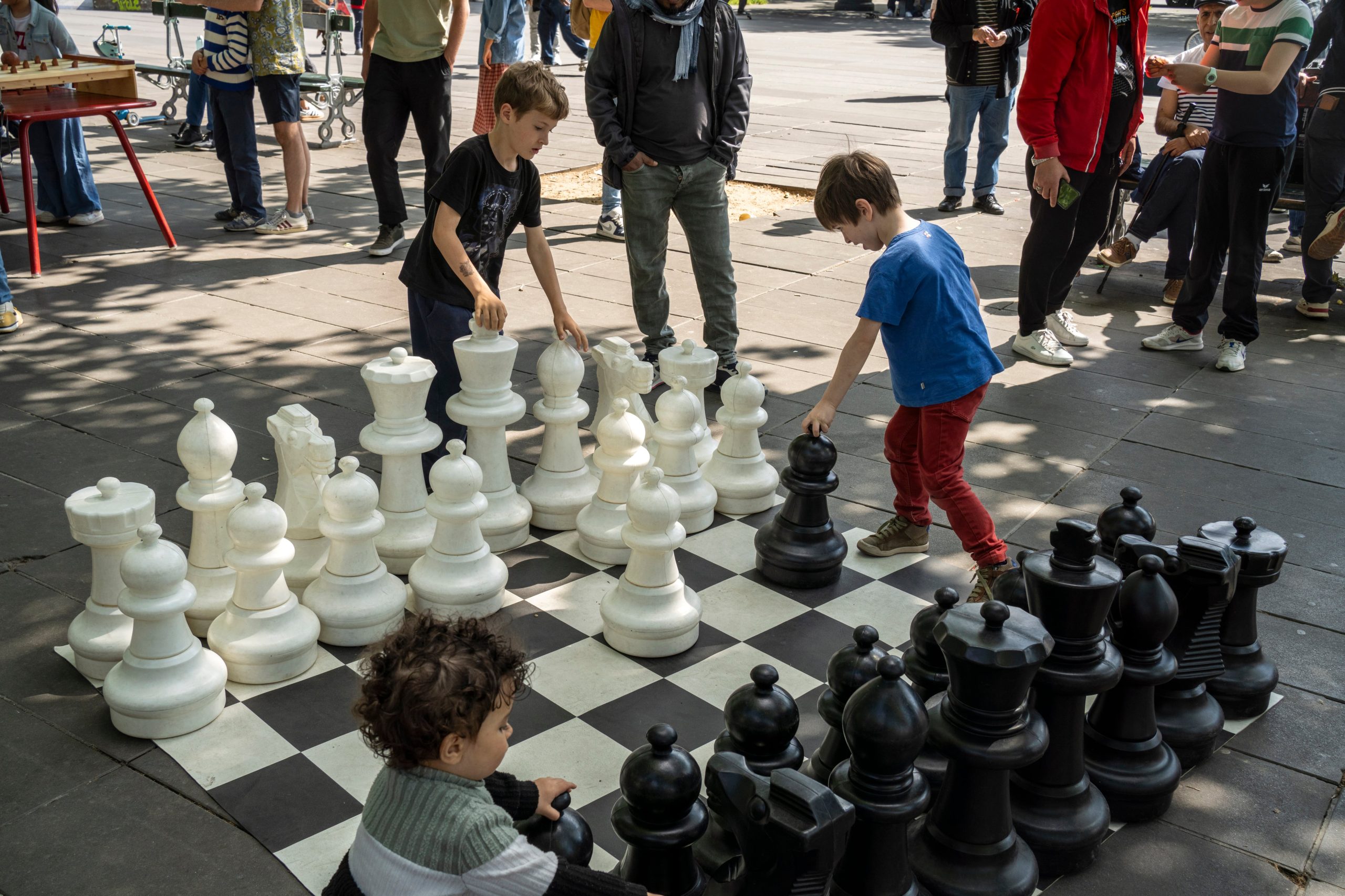
There are strong indications that people are thinking less and less, and that many now consider a 30-second video too long. But there is also evidence that more people are playing chess than ever before, using it as an educational tool and a form of mental exercise (an approach supported by a growing body of research).
Among its devotees are high-profile figures such as Spanish Prime Minister Pedro Sánchez, tennis player Carlos Alcaraz, comedian David Broncano and soccer players Erling Haaland and Unai Simón. It serves as a source of inspiration in professional sport, for figures such as Pep Guardiola and Ernesto Valverde, and in the arts, for creators ranging from Arturo Pérez-Reverte to Humphrey Bogart, Stanley Kubrick and Miloš Forman. And at least tens of millions of people play it online every month. Why does chess continue to captivate people 15 centuries after the beginning of its documented history?
“There’s something hypnotic about it.” Or: “It’s like a magnet.” “There’s something magical here.” “I don’t know how to play, but the atmosphere is captivating.” These were some of the remarks heard on May 2 at Matadero Madrid, the cultural venue that hosted EL PAÍS’s 50th-anniversary festival. Chess holds a unique place at the newspaper: it is the only column that has appeared every single day for 50 years. Spanish-Iranian woman grandmaster Sara Khadem took on 20 opponents in a simultaneous exhibition after an interview with this reporter. Afterward, only soft background music could be heard, yet many spectators stayed there for more than two hours.
Iran, then known as Persia, served as the bridge between sixth-century India and the court of Baghdad in the seventh century, allowing the Arabs to bring chess to al-Andalus in the eighth and quickly spread it across the Iberian Peninsula, as recently highlighted in an exhibition at Valladolid’s National Sculpture Museum exploring the cultural and artistic journey of chess through history. King Alfonso X of Castile, known as “the Wise,” made it clear in his remarkable Book of Chess, Dice and Tables (1283) that the game was played by Muslims, Jews and Christians alike, by men, women and children.
Nearly two centuries later, around 1475 and probably in Valencia, the queen became the most powerful piece on the board. Spaniards then exported the modern version of chess to the Americas and much of Europe, while cleric Ruy López, sponsored by Philip II of Spain, came to be recognized as the game’s first unofficial champion in the mid-16th century.
Almost five centuries later, the strongest chess player is no longer human. It calculates millions of moves per second and can run on a cellphone. Yet chess as a sport is still as meaningful as ever because beauty in chess is often born from imperfection: one player makes a mistake, the other punishes it brilliantly, and together they create a work of art, much like the 570 masterpieces featured in this newspaper’s El Rincón de los Inmortales (Immortals Corner) video series, published every Monday.
Over-the-board tournaments continue to grow. The International Chess Federation (FIDE) has 203 member federations, more than any international sports body except those governing soccer, athletics and basketball. But online chess is expanding even faster. Chess.com reports more than 250 million user accounts. Counting only those who play at least once a month, and adding other major platforms such as Lichess and Play Chess, the total reaches tens of millions.
The boom was turbocharged by the pandemic and the global success of The Queen’s Gambit. Netflix has since added two more chess-themed series: Queen of Chess, about Judit Polgár, the only woman ever to rank among the world’s top 10 players, and Chess Mates, about Magnus Carlsen’s unproven cheating allegations against Hans Niemann. Far from being a passing fad, the game’s popularity continues to grow month after month, as does the list of celebrities drawn to it.
The first reason is simple: anyone who falls in love with chess is unlikely ever to be bored again. The number of possible chess games (a 1 followed by 123 zeros) exceeds the estimated number of atoms in the known universe (a 1 followed by 80 zeros). Chess also intersects with an extraordinary range of fields: education, artificial intelligence, mathematics, teaching, psychology, psychiatry, neuroscience, film, literature and international politics. Few human activities can boast more than 1,500 years of documented history, making chess a gold mine for journalists and storytellers. Those 15 centuries have produced hundreds of characters worthy of novels and films.
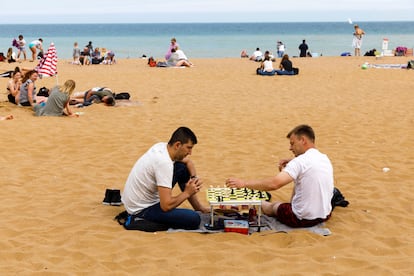
Consider a few examples of the extraordinary range of subjects that fall within what might be called chess culture. The game has played a significant role in the development of artificial intelligence, from Alan Turing’s pioneering work in 1947 to Demis Hassabis’s Nobel Prize in Chemistry in 2024. It was banned by the Spanish Inquisition, by the Chinese government during the final years of Mao Zedong’s rule, by Ayatollah Khomeini in Iran and, today, by the Taliban in Afghanistan. Globally, there is roughly one female player for every 10 male players. Alongside music and mathematics, it is one of the fields most closely associated with child prodigies. There is also strong scientific evidence that chess develops both cognitive and emotional intelligence and helps slow age-related cognitive decline, potentially delaying the onset of Alzheimer’s disease.
Former world champion Garry Kasparov, now living in exile in New York, ranks high on Vladimir Putin’s list of enemies. His great rival, Anatoly Karpov, a lawmaker for Putin’s party, was found unconscious on a dark street shortly after publicly opposing the invasion of Ukraine.
Nearly 1,300 years after chess formed part of the education of Andalusian nobles, Spain is at the forefront of efforts to introduce the game as an educational tool, thanks above all to a rare unanimous resolution passed by Congress on Feb. 11, 2015. The country also leads in the social and therapeutic uses of chess, particularly in the Spanish region of Extremadura, where it is used in programs addressing cognitive aging, prison rehabilitation, addiction recovery, ADHD, autism spectrum disorder and Down syndrome, among others. And since the enormous success of the 1987 Kasparov-Karpov World Championship match in Seville, whose final game drew 13 million television viewers in Spain, the country has also hosted more international chess tournaments than any other, with several hundred held each year.
It is an encouraging picture, one that contrasts sharply with the culture of intellectual laziness fostered by the misuse of social media and, more recently, ChatGPT and similar tools. Millions of people now simply copy, paste and submit material with little original thought when asked by a boss or teacher to complete a task, raising questions about whether Homo sapiens will continue to deserve its name.
Goethe, one of history’s greatest men of letters, set a high bar when he said: “Chess is the touchstone of the intellect.” Yet an Indian proverb reminds us that mastery is not required to enjoy the game: “Chess is a sea where a gnat may drink from and an elephant may bathe in.” Perhaps the German master Siegbert Tarrasch, one of the world’s best players a century ago, captured its essence best: “Chess, like love and music, has the power to make men happy.”
Sign up for our weekly newsletter to get more English-language news coverage from EL PAÍS USA Edition




Donald Trump wants to meet with him again. Vladimir Putin needs him to sustain his war in Ukraine. And Xi Jinping chose a visit to Pyongyang as his first, and so far only, foreign trip of 2026. Kim Jong-un, the supreme leader of secretive North Korea, has managed to make the United States, Russia and China compete for his attention. Despite leading a nuclear-armed regime long subjected to international sanctions and presiding over a tiny economy, Kim appears to have found a formula for exerting influence over Washington, Moscow and Beijing: offering each of them something different, and something none wants left in the hands of the others.
“Kim has deliberately sought to increase North Korea’s strategic value to several major powers, rather than return to the kind of dependence and isolation it faced years ago,” Rachel Minyoung Lee, senior researcher in the Korea program at the U.S. think tank Stimson, explains by email.
The outcome is less the result of a grand strategy than of a series of opportunities skillfully exploited. Kim could not have foreseen Russia’s invasion of Ukraine or that ties with Moscow would evolve into a military alliance, Lee notes. But he has proved “adept” at turning the needs of others into strategic leverage, she argues.
The latest opportunity emerged last Monday, just hours before U.S. and South Korean forces began their main joint summer military exercises. Trump unexpectedly ordered the Pentagon to “substantially” reduce U.S. participation, citing the high cost of the drills and his dissatisfaction with Seoul’s level of support during the war with Iran.
Trump justified the decision in a post on Truth Social, where he also emphasized that the exercises make North Korea uncomfortable, despite the fact that, he said, the country had been “unthreatening and respectful” since his return to the White House. The Ulchi Freedom Shield exercises ended on Friday, six days ahead of schedule. There is no precedent for military drills of this scale being cut short at Washington’s request once they have already begun.
For Pyongyang, which sees the exercises as rehearsals for an invasion, the reduction amounts to a concession secured before negotiations have even begun, Ramón Pacheco Pardo, professor of international relations at King’s College London, says by phone.
A pivotal player
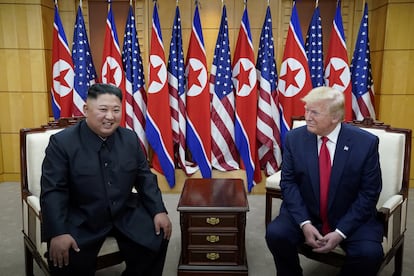
Trump is turning his attention back to Pyongyang at a time of mounting domestic pressure and frustration over his inability to achieve the results he had hoped for in the Middle East. The images of his three meetings with Kim between 2018 and 2019, the only meetings ever held between a sitting U.S. president and a North Korean leader, made headlines around the world. Although the process ultimately ended without an agreement, the Republican still portrays it as one of the major achievements of his first term. In recent days, he has highlighted his “great relationship” with Kim and said he is considering another meeting, perhaps in the fall, when he travels to Shenzhen, China, for the Asia-Pacific Economic Cooperation (APEC) leaders’ summit.
Seven years after their last handshake, however, that photo opportunity comes at a higher price. Kim Yo-jong, the North Korean leader’s sister and one of his closest aides, has denied that the two sides are engaged in negotiations, though she has left the door ajar to dialogue if Washington changes its policy toward Pyongyang. The personal relationship between her brother and the U.S. president, she noted, “remains excellent.”
Still, Jenny Town, director of the publication 38 North, stresses in a phone interview that Pyongyang should not be underestimated. “North Korea has options,” Town says, noting that cooperation with Russia is designed to outlast the war and that North Korea has recently expanded ties with other countries at odds with the West. Relations with China, meanwhile, have entered what Chinese and North Korean state media in June described as a “new historic stage.”
Although sanctions continue to weigh on the country and China’s economic support remains indispensable, there is “no longer any urgency” for Pyongyang to sit down and talk with the United States, Town stresses. That gives Kim room to wait, raise his demands and decide when it suits him to turn back toward Washington. “He believes he is a key player in reshaping the world order” and “on equal footing with his partners,” Town says.
The war in Ukraine has made clear that this ambition extends far beyond rhetoric. North Korea has become a crucial supplier for Russia’s war of attrition in a conflict that has now stretched into its fifth year. The U.K.-based Open Source Centre estimates that, since mid-2023, Pyongyang has shipped between eight million and 11 million artillery shells and rockets, while Ukrainian intelligence believes North Korean supplies have at times accounted for nearly half of the ammunition used by Russian artillery on the front lines.
Weapons have been accompanied by manpower. Since 2024, some 15,000 North Korean troops have fought in Russia’s Kursk region. Kyiv estimates that around 8,500 North Korean personnel are currently deployed in Russia, including engineers, sappers and drone operators. “North Korea can now present itself as a country that contributes to the security of another major power,” Lee notes.
It is a significant reversal of roles: a state long treated as a problem to be contained by others is now providing ammunition and troops to a permanent member of the U.N. Security Council. The relationship has continued to deepen since Putin and Kim signed a strategic partnership treaty in 2024 committing the two countries to assist one another in the event of an attack.
China steps up its diplomacy
The exchange has also reduced Pyongyang’s isolation. In return for its military support, North Korea has obtained revenue, oil, economic cooperation, combat experience for its troops and, possibly, military technology transfers. Russia has also helped weaken one of the main instruments of pressure on North Korea: despite U.N. sanctions, it openly imports North Korean weapons and, in 2024, vetoed the renewal of the panel of experts responsible for monitoring those sanctions. The sanctions remain in force, but they have lost their main independent oversight mechanism.
The burgeoning Russia-North Korea partnership has also altered the balance with Beijing. A European diplomat based in the Chinese capital argues that North Korea’s involvement in Ukraine has forced China’s leadership to reassess its calculations. Although China remains by far North Korea’s main economic partner and traditional ally, the existence of a Russian alternative has reduced Beijing’s ability to impose conditions. That added room for maneuver has unsettled Chinese policymakers, who in recent months have accelerated high-level diplomatic engagement with Pyongyang.
Kim returned to China in September 2025 after six years without meeting Xi, and stood alongside the Chinese leader and Putin during the grand military parade in Tiananmen Square marking the 80th anniversary of Japan’s surrender in the Second Sino-Japanese War (1937-1945) and the end of World War II.
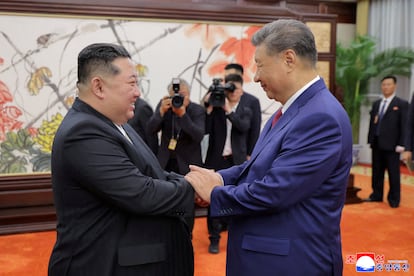
Xi traveled to Pyongyang in June for the first time since 2019, in what remains his only foreign trip this year. For China, keeping North Korea within its orbit means preserving a partner against the U.S. military presence on the Korean Peninsula, preventing instability along its border and ensuring a central role in any crisis that could upset the regional balance. During his visit, Xi reaffirmed a friendship “forged in blood” and a bond of comradeship and mutual trust that, he said, has withstood both the passage of time and a changing international landscape.
The official accounts of the meeting also contained a notable omission. There was no mention of denuclearization, which for years had been one of Beijing’s stated objectives on the Korean Peninsula. Although China has not formally abandoned that goal, it has avoided raising it publicly in the face of an emboldened Kim, who insists that North Korea’s nuclear arsenal is not up for negotiation.
“Kim is trying to make North Korea impossible for the United States to ignore,” Lee says. The researcher argues that Kim’s nuclear arsenal is no longer merely a guarantee of the regime’s survival. It has also become a source of power, autonomy and international status. “He wants to be treated as a normal actor,” Town says, “and to engage with the international community on his own terms.”
And Trump, with his appetite for attention and recognition, may be particularly receptive to that ambition. While previous administrations maintained the complete denuclearization of North Korea as their objective, the U.S. president has gone so far as to refer to the country as a “nuclear power.” That does not amount to formally recognizing North Korea as a nuclear-armed state, his administration still officially calls for denuclearization, but it breaks with the caution of previous governments and raises the possibility that any future negotiations may not begin with demands for the dismantling of Pyongyang’s arsenal.
Pacheco Pardo believes the U.S. president has made it quite clear that his priority is to deal directly with Kim and secure an outcome “he can sell as a victory.”
For now, Kim does not appear to be in any hurry. But a future opening from Washington, and above all any easing of sanctions, would help him continue to diversify North Korea’s international relationships. “North Korea does not want to depend on anyone,” explains Pacheco Pardo.
Having strengthened its ties with Russia and repaired its relationship with China, Pyongyang can afford to wait and assess what it might be able to extract from Trump.
Sign up for our weekly newsletter to get more English-language news coverage from EL PAÍS USA Edition
Argentina
Maradona Death Trial Upended By Bizarre Error: Experts Analyzed His Father’s Clinical Records


Andalucia
Andalusia’s Rivers Are Being Destroyed By Tourism: ‘You Don’t See Anything, It’s All Dead’

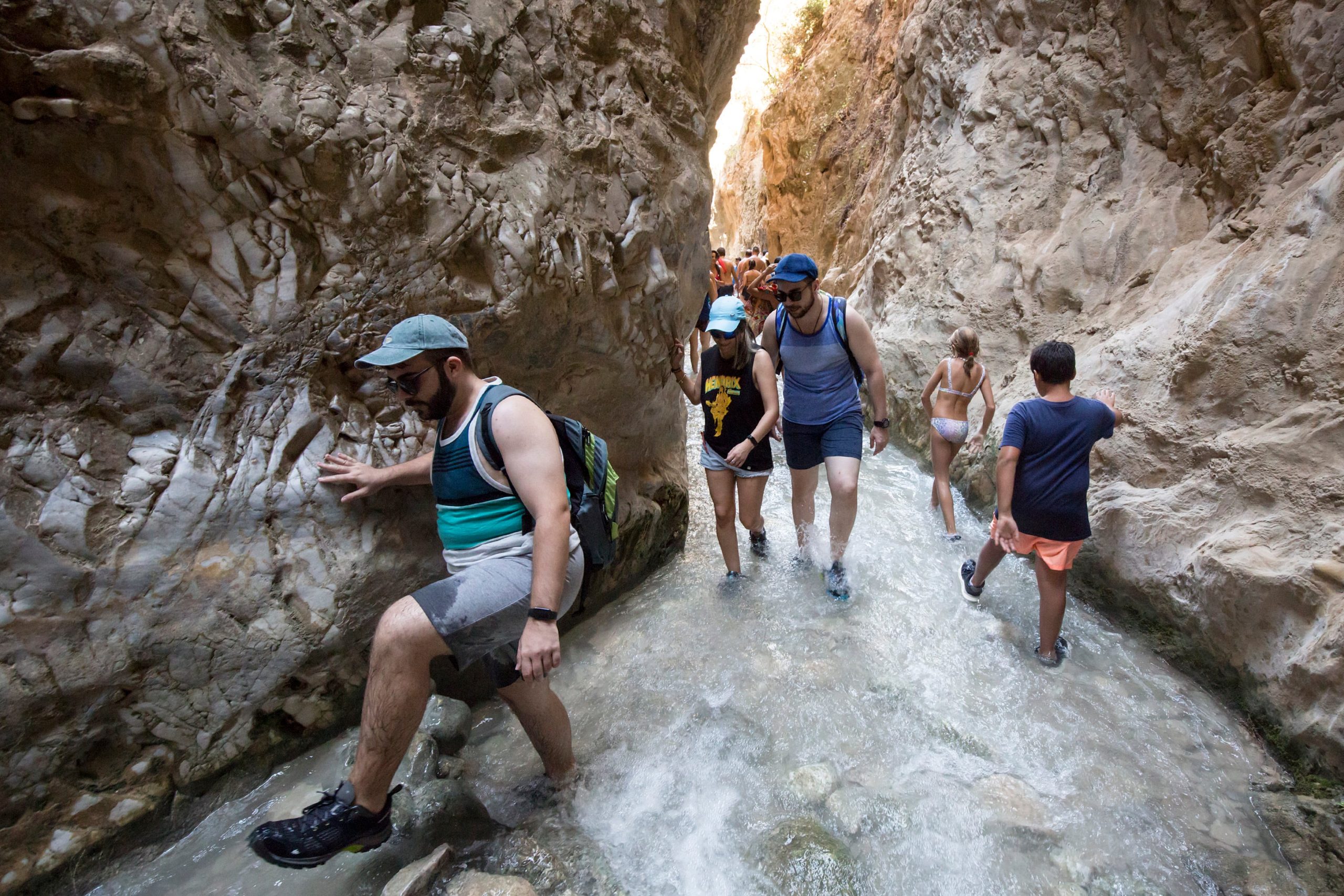
Refreshing, clear, clean water. Narrow gorges, waterfalls and pools amid dense vegetation. The Chíllar River, in Nerja (Málaga province, population 22,187), offers almost everything a summer visitor could want, including easy parking and little technical difficulty. That is why up to 3,000 people a day trampled through it. It became a fairground. For that reason Nerja Town Hall banned entry in August 2023 and, although visiting is still not permitted, the regional government of Andalusia is already planning to reopen it, with some limits. Two companies are bidding to manage the area amid widespread criticism over the major impact renewed human presence will have on biodiversity. “Tourist activity destroys its life,” sums up Rafael Yus, spokesperson for the NGO Ecologists in Action, who warns that the same risk threatens many other rivers across the region because of tourism pressure.
Today the area around the Chíllar is calm. The crowds are gone, but some people still access the route due to lack of awareness and scarce enforcement, which is shared between Nerja’s local police force and the handful of national park rangers — 18 officers for a protected area of 40,600 hectares. Beyond the ecological issues, the authorities decided to close access after warnings from the Environment Prosecutor’s Office and the Wildfire Prevention Plan, which flagged the risk to people in case of a fire. Among other issues, the only escape route would be via the river, making it impossible to know if someone had become trapped by the flames. Since then, the authorities’ idea has been to reduce river capacity through private management. Two companies, Travelnatura and Sando, have already put in bids and envisage a maximum of 500 visitors a day, although the regional government’s original proposal was almost half that: 300. The first bid offers tickets at €10 ($11.70) and the second at €4.90. Both promise constant channel maintenance and emergency protocols. During the last major cleanup, in 2017, 450 kilos of waste and thousands of pairs of shoes hanging from local wiring were removed.
The process to decide which company will get the contract is expected to be long, between one and two years. Those who know the area hope that time will be used to reconsider the project for a river designated a Fluvial Natural Reserve. “Trampling the riverbed and banks, because there is no other place to walk, kills everything. And nothing would happen if it stayed closed longer: since 2023 no one has protested,” says Yus, who stresses that Ecologists in Action has submitted objections to the reopening, arguing for protection based on the existing biodiversity sanctuary. “It is one of the few streams in the area that has water year-round and its ecosystem is very interesting. It should have the highest protection,” confirms Andrés Vicente Pérez Latorre, associate professor in the Department of Botany and Plant Physiology at the University of Málaga, who believes allowing 500 people a day “is destructive.” “Perhaps five visitors a day with naturalist roles, never tourists, should be allowed,” he recommends.
Baltasar Cabezudo is also a botanist who has worked across Andalusia. He knows the territory well and says the Chíllar’s surroundings are “singular.” He thinks the management options proposed are “a scam” with no purpose other than tourism exploitation. “There are about 50 species that are very fragile to trampling, pollution, and people’s urine, because it should be remembered that there are no toilets there,” he warns.
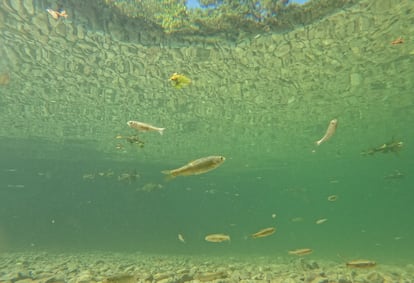
“There used to be herons in the upper course, lots of fish, crayfish, dragonflies… Now you put an underwater camera in and you don’t see larvae, you don’t see anything, it’s all dead,” says a source well-versed in the matter who prefers not to give their name for fear of reprisals. “They killed the Chíllar River and they won’t stop: the same will happen to many others that have become fashionable now,” they add.
From the Río Verde to the Cebollón
They are, indeed, not small in number. It is easy to find hundreds of Instagram posts about pools, ponds, and rivers set in postcard paradises across Andalusia. And behind those images come thousands of people, as happens at Río Verde, near Otívar (Granada), at the eastern end of the Sierras de Tejeda, Almijara and Alhama Natural Park. The huge number of visitors in recent years has forced the Andalusian government to limit access to 100 vehicles a day. Regulation is enforced by the Sociedad Cooperativa de Cázulas, owner of the land crossed by the track that leads to the riverbed. It charges €5 per person and €5 per car. In summer it fills almost daily on weekdays; on Saturdays and Sundays the limit is reached before 11.00 a.m. The route is usually taken along the river bank, but beyond the turquoise pools many visitors also walk inside the channel — like canyoning groups led by active tourism companies — affecting the ecosystem. Injuries are also common. Civil Guard figures for Granada this summer recorded the rescue of up to 12 people who could not continue the route due to injuries.
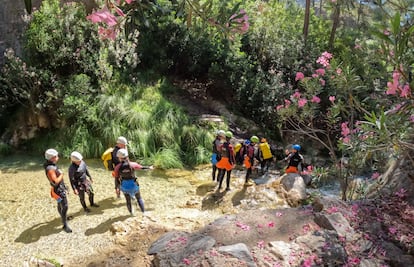
In the same province, the Dúrcal River is also suffering, as Ecologists in Action likewise denounced. “No natural area can withstand these mass visits for such a prolonged time,” the organization stressed in a strong statement then, which also pointed to species and habitat loss in the Castril and Lanjarón rivers in the Sierra Nevada. Further south, near Fornes, walking inside the channel of the Cebollón River is already prohibited, although the bank can be traversed and swimming is allowed at the dam waterfall, according to the Andalusian authority. There are also restrictions at others such as Río de la Miel, Majaceite and Bocaleones (all in Cádiz). At the latter, in the heart of the Sierra de Grazalema Natural Park, ecologists also lament more than 50 people a day — the quota imposed by the administration — and music, shouting, or dogs that turn the spot “into a theme park.” Despite all these complaints, there is no specific plan from the regional government for managing these rivers.
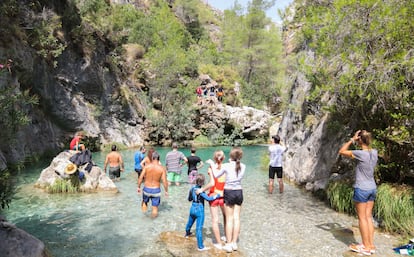
Back in Málaga, the situation is similar at rivers such as Patalamara (Cómpeta), Cástor and Padrón (Estepona), Higuerón (Frigiliana) or the pool at the Cueva del Gato (Benaoján), where families bring inflatable mattresses and leave lots of trash. Also the Genal, where dams are built without permits to create pools that affect wildlife. More serious is the situation of the Guadalmina (Benahavís), just a step from Marbella and saturated all summer. Further inland, in the Sierra de las Nieves National Park, the Turón River also offers a trail with several pools, which the regional government has banned vehicle access to, so now they can only be reached on foot. “It is a filter that has greatly improved the situation,” says Helios Muñoz, biologist and technician for the regional municipal association.
“No choice but to regulate”
Even so, the problems persist. “There are families with children who catch fish in containers, there are unleashed dogs, there are people who leave trash everywhere. When I go I am fighting with visitors all the time and, because of that, I’ve decided not to return until after the summer,” says Mariló Narváez, mayor of El Burgo (population 1,761). She also criticizes those who choose to walk in the channel itself, because of the damage it causes the ecosystem. “In the end we ask for nothing more than awareness. You can come for a swim, spend the day, but always respecting the surroundings,” she says, warning that more and more people are choosing to go upstream beyond the dams, something no one used to do. The practice puts the upper Turón at risk; it has been declared a Fluvial Natural Reserve due to limited human intervention, which favors the presence of endemic fish such as the Málaga chub, as well as crayfish and otters. A national park project has driven the installation of two cameras to monitor capacity, which may help improve management.
“There are many of us and Andalusia gets a lot of tourism. We all want to enjoy nature, which can absorb disturbances but also has its limits. There is no choice but to regulate; it is essential,” says Antonio Herrera, manager of environmental consultancy Mediodes and member of the board of the Nueva Cultura del Agua Foundation. “The effects on river ecosystems of so many people are enormous. From trash to sunscreens and many other pollutants. You just have to regulate and also raise awareness, educate, explain clearly why those measures are taken,” Herrera urges the administrations. He proposes initiatives such as prior — free — permits that the regional government requires for routes like the pinsapar in Grazalema or the Río Bailón trail, in the Sierras Subbéticas Natural Park, which serve precisely to control visitor numbers.
Sign up for our weekly newsletter to get more English-language news coverage from EL PAÍS USA Edition

Can’t Afford To Buy? Four In 10 Spaniards Now Considering Building Their Own Home To Escape Soaring Housing Costs

Why Chess Still Fascinates Us: The Game That Teaches Us To Think In An Age That Thinks Less And Less

Spain’s Great Housing Paradox: Sales Are Falling But Prices Keep Rising – So Is The Property Boom Finally Starting To Turn?

Attaoui Saca Un Bronce En 800m De La Casi Nada

Última Hora Del Terremoto En Colombia, En Directo | Al Menos 132 Muertos Y 570 Heridos Por El Seísmo De Magnitud 7,4
Flames force Spanish troops to evacuate 1,000-year-old kings’ bones from burning monastery


-
 800 metros lisos2 weeks ago
Attaoui Saca Un Bronce En 800m De La Casi Nada
-
 Bogotá2 weeks ago
Última Hora Del Terremoto En Colombia, En Directo | Al Menos 132 Muertos Y 570 Heridos Por El Seísmo De Magnitud 7,4
-
aragon wildfire1 week ago
Flames force Spanish troops to evacuate 1,000-year-old kings’ bones from burning monastery
-
Mallorca2 weeks ago
Qatar Royal Family’s £300m ‘Palace in the Sky’ lands in Mallorca ahead of historic eclipse
-
Latest2 weeks ago
EU Curbs On ‘forever Chemicals’ In Food Packaging Kick In
-
Benalmadena pueblo2 weeks ago
Five days that turn Benalmadena pueblo into a giant street party and everyone’s invited
-

 Cupón ONCE2 weeks ago
Cupón Diario De La ONCE: Comprobar Sorteo Del Lunes 10 De Agosto
-

 ElPais2 weeks ago
The Total Eclipse In Spain, In Pictures