Connect with us

%

American Fined After 9kg Mercadona Meat Haul Found In Airport Luggage

Published

on

american-fined-after-9kg-mercadona-meat-haul-found-in-airport-luggage

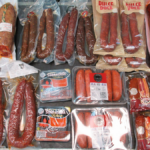
The almost nine kilograms of chorizo, cured pork and venison sausage seized at Seattle-Tacoma International Airport. Credit: @OFOEAC / X

Nearly nine kilograms of chorizo, cured pork and venison sausage may seem like the perfect souvenir to take back home from a Mercadona in Spain, but customs officers in the US did not agree. The haul cost the traveller a 500-dollar fine, his confiscated meat and, on his second offence, his Global Entry fast-track pass for good. 

Chorizo, lomo and venison sausage filled his suitcase

US Customs and Border Protection (CBP) said the traveller, a member of the Global Entry trusted-traveller scheme, arrived at Seattle-Tacoma International Airport carrying 8.44kg of pork and 0.4kg of venison sausage tucked into his luggage, almost nine kilograms of meat in total.

The haul included chorizo, salpicão, cured pork loin, fuet and linguiça, a mix of cured meats that are staples from Spain and Portugal. According to reports, most of it had been bought at a Mercadona supermarket during a trip to Spain.

None of it was declared on arrival

CBP said the traveller did not declare any of the meat, despite the forms and signage at US airports asking passengers to list any food, plant or animal products before they reach the border. Agriculture specialists who searched the luggage found the sausages and cured pork undeclared and confiscated the lot.

The agency said its officers enforce US Department of Agriculture quarantine rules designed to keep pests and diseases, including African swine fever, out of the country’s farms. Spain reported its own outbreak of the disease in wild boar near Barcelona in November 2025, prompting several countries, including the UK, to briefly halt some Spanish pork imports.

A second offence that cost him for good

This was not the traveller’s first brush with US customs over undeclared food. CBP said it was his second such offence, and that this time the consequences were more severe: the agency confirmed his Global Entry membership had been permanently revoked.

He was also fined 500 dollars (around €431). CBP said fines for bringing in undeclared agricultural products can run as high as 1,000 dollars (about €861), and repeat offenders lose the fast-track privileges Global Entry is built around, including skipping the queues at immigration and customs.

What it means for travellers flying out of Spain

Global Entry lets pre-approved travellers use automated kiosks to clear US customs and immigration more quickly, a perk especially popular with frequent flyers between Spain and the US. Losing it means going back to the ordinary queue every time, however many times someone has used the fast lane before.

For anyone flying to the US with Spanish jamón, chorizo or other cured meats in their case, the message from CBP is to always declare it. Officers can allow some shelf-stable, fully cured products through once they are declared and inspected, but undeclared meat is confiscated on the spot, and a second offence can be far costlier than the shopping itself.

Meat rules have tightened closer to home too. The UK now applies its own post-Brexit checks on meat and dairy brought in from Spain and the rest of the EU, though nothing quite as strict as the US approach. Whichever border travellers are crossing with a suitcase of Spanish produce, the safest option to not lose the Mercadona delicacies is to declare what’s in the bag.

%

Lidl Puts Cabless, Driverless Lorry On German Roads As Spain Watches

Published

on

lidl-puts-cabless,-driverless-lorry-on-german-roads-as-spain-watches

There is no driver or safety operator sitting inside the vehicle. Photo credit:Shamatha Pictures / Shutterstock.com

If you shop at Lidl in Spain, there is a good chance you have never given much thought to how the products on those shelves actually get there. Behind every supermarket is a huge delivery operation, with lorries constantly moving goods between warehouses and stores. But Lidl has just started testing something in Germany that could eventually change the way some of those journeys are made.

Even though the experiment is taking place elsewhere, it involves a major change to the way Lidl moves its products, and the results could be worth watching for anyone who regularly shops at the supermarket.

Lidl is testing a very different kind of delivery

The German trial involves a cabless electric truck that drives itself, operating on public roads between Lidl’s distribution centre in Edermünde, near Kassel, and a nearby store. There is no driver or safety operator sitting inside the vehicle and the truck operates at SAE Level 4, allowing it to drive autonomously within the conditions covered by its official approval. This is not a closed-course demonstration, the vehicle is literally carrying Lidl’s goods as part of an actual delivery operation.

It can transport 15 Euro pallets and make up to three trips each day. During the four-month project, Lidl expects more than 3,000 pallets to be transported using the vehicle. The German Federal Motor Transport Authority, known as the KBA, has authorised the operation. According to Lidl and Einride, this is the first permit of its kind in Germany for a cabless Level 4 autonomous truck operating on public roads.

Could Spain eventually see the same thing?

Whilst there is currently no announcement that Lidl is bringing these trucks here. The German project is a trial designed to establish how autonomous freight works in a real retail environment. Lidl is using the route to gather practical experience before considering how the technology could be developed further and which countries will benefit from it.

Another reason the trial is also worth watching in Spain, is because Lidl has a large network of supermarkets and distribution centres. Any decision to expand autonomous deliveries in the future would depend on the technology, the results of trials such as this one and the regulatory framework in each country. For now the, Spanish Lidl customers won’t suddenly find a driverless lorry arriving at their local store,

Lidl wants to take the trial further

The current journey is relatively simple, taking goods from the distribution centre to a nearby shop. The next stage could be more complicated. Lidl and Einride plan to develop the route towards a so called multi-stop “milkrun” model, in which one autonomous vehicle can serve several locations during a single operation.

Lidl also says further deployments involving companies within the Schwarz Group are being discussed. That would move the technology beyond a single delivery route and towards a much larger logistics operation.

Who is Einride?

Einride is a Swedish transport company that specialises in electric and autonomous freight. For Einride, the Lidl project represents an important step because the technology is being used for commercial deliveries on public roads rather than simply demonstrated in controlled conditions.

For Lidl on the other hand, the project provides a chance to see whether autonomous electric transport can become a practical part of its supply chain. There is still a long way to go before anything similar appears on Spanish roads, but Lidl has now put the technology into a real supermarket delivery operation, and what happens in Germany could help determine whether this remains a small experiment or becomes something much bigger.

Continue Reading

%

King Felipe VI To Visit Ceuta And Melilla As Spain Prepares For Historic Royal Trip

Published

on

king-felipe-vi-to-visit-ceuta-and-melilla-as-spain-prepares-for-historic-royal-trip

The King has remained closely informed about developments. Photo credit: Marco Iacobucci Epp/Shutterstock

After everything that has happened in Ceuta over the past few months, there is a strong feeling that King Felipe VI should come and see the situation for himself. His arrival would be a powerful show of support for the city, particularly after the extraordinary events of July, and residents are now waiting to find out when it will actually happen.

The King and Queen Letizia are expected to visit both Ceuta and Melilla, but despite the announcement that the trip would take place in the coming weeks, there is still no confirmed date. The latest reports suggest that the date should be fixed before October 12, Spain’s National Day.

A visit that means more than a royal engagement

The planned journey was already being considered before the events of July, so the visit itself is not a new response to the crisis. What has changed is the significance of Felipe VI actually arriving in Ceuta. The King has remained closely informed about developments. He has spoken several times with Ceuta’s president, Juan Jesús Vivas, and received him at the Marivent Palace to discuss the situation directly.

For Ceuta, having the King visit in person would allow him to see the reality on the ground and meet people who have been dealing with the consequences of the events of recent months. Vivas has said that Felipe VI committed to visiting the city, while Prime Minister Pedro Sánchez subsequently confirmed that the King and Queen would travel to Ceuta and Melilla, the only thing missing now is the date.

Why the date is still uncertain

Morocco’s elections on September 23 are one factor being taken into account when planning the trip. Reports indicate that the preference is for the royal visit to take place after the elections. That leaves only a few weeks before October 12, when Spain celebrates its National Day.

There is also an unresolved question over whether Sánchez will accompany the King. According to reports on September 17, Moncloa had not yet made a final decision, with the possibility of another minister travelling with Felipe VI instead. The final itinerary has also not been announced. One possibility is for Felipe VI and Letizia to visit both cities on the same day, although that remains subject to confirmation.

Felipe VI has already spoken about Ceuta

Although the King has yet to visit, he has made several public references to the city since the summer. In his first major speech after the break, Felipe VI described Ceuta as an “example of civic spirit”, while praising the emergency services, public servants and volunteers who worked during the difficult situation. He has also met Defence Minister Margarita Robles and senior military commanders to receive information about the situation in Ceuta.

The forthcoming visit will also be historic for another reason. Felipe VI has never officially visited Ceuta or Melilla since becoming King in 2014. The last reigning Spanish monarch to visit both cities was Juan Carlos I, who travelled there with Queen Sofía in 2006. For now, Ceuta and Melilla are left waiting for the announcement that will turn months of expectation into a date in the diary. The latest indication is that the date for the royal visit should be fixed before October 12. Exactly when Felipe VI and Letizia will arrive, however, remains unknown.

Continue Reading

%

Electric Scooter Filmed At 100 Km/h On A-7

Published

on

electric-scooter-filmed-at-100-km/h-on-a-7

Scooter going at over 100 kph. Credit: FsQ

A bizarre electric scooter sighting on the A-7 near Marbella has prompted the latest round of the increasingly familiar question: where are Marbella police?

Video circulating on social media appears to show a man riding an electric scooter on the busy motorway towards Malaga, without a helmet and travelling at an extraordinary speed.

The footage, shared by Fuengirolasequeja, shows the scooter moving through traffic while the driver recording the incident displays his car’s speedometer at around 100 km/h.

That does not independently prove that the scooter itself was travelling at exactly 100 km/h. However, the footage gives a clear indication of the extraordinary speed at which the rider was keeping up with traffic.

Blatant flaunting of basic laws

More importantly, the journey itself appears to break some very basic Spanish traffic rules.

According to Spain’s DGT, electric scooters classed as personal mobility vehicles (VMPs) have a maximum design speed of 25 km/h and are prohibited from using motorways, autovias and other roads between towns.

New national regulations approved this year will also make helmets compulsory for scooter users from October 1, 2026, with failing to wear one treated as a serious offence carrying a €200 fine.

Marbella already has its own VMP regulations, with the town hall warning that infringements can result in fines ranging from €200 to €1,000.

Another in long line of law breaking

The remarkable footage is not even the first time such behaviour has been reported on the Marbella section of the A-7. In June 2022, another video showed an electric scooter overtaking a vehicle travelling at almost 100 km/h on an autovia in Marbella. At the time, Spanish media reported that the scooter appeared to be travelling at an illegal speed and raised questions about whether such a vehicle could even be classified as a VMP.

Now the latest footage is circulating again, leaving social media users asking the obvious question: where are Marbella police?

Continue Reading
Advertisement
Advertisement

Spanish Real Estate Agents

Tags

Trending

Copyright © 2017 Spanish Property & News