
Aldi
Christmas food bill worries drive Spanish households to start shopping weeks early

Christmas remains a big occasion for getting people around the table. Photo credit: Filtown Films/Shutterstock
Nobody wants the Christmas food shop to land as one enormous bill just before the big day. Across Spain, households are spreading the cost by buying festive food weeks in advance, hoping to find better prices and avoid having to pay for everything at once.
A new survey found that 71 per cent of households buy at least some of their Christmas food a week or more before the celebrations. Almost half of those planning ahead say they do it to find cheaper prices, while others want to make sure they get the products they need and avoid leaving the whole job until the last minute.
Saving money starts before the supermarket
The figures come from the eighth annual ALDI report on food shopping for Christmas celebrations in Spain, based on a survey of 1,300 people. It found that 48 per cent of respondents who shop early do so to secure lower prices. Availability is another major consideration, with 51 per cent wanting to find the products they are looking for, while 50 per cent say planning ahead helps them organise shopping and meals.
Buying early does not mean every item can go into the cupboard weeks in advance. Fresh food still has to be bought nearer the time, but products with a longer shelf life can be picked up gradually, rather than adding everything to one expensive supermarket trip. The survey also found that 82 per cent plan their Christmas menus at least a week ahead.
Price is weighing more heavily on Christmas choices
The pressure on household budgets is clear in the spending figures. Nearly six in ten households (57 per cent) expect to spend more than €300 on food and drink for Christmas, while 41 per cent say food and drink will be their biggest festive expense. Price is becoming harder to ignore. Six in ten consumers (61 per cent) say it will have more influence on what they buy this Christmas than it did last year.
That is feeding into a wider effort to make the budget stretch: 90 per cent of households say they use at least one way of saving money when buying Christmas food. The most common tactic is looking out for special offers and promotions, used by 62 per cent of shoppers. Almost half (47 per cent) plan menus in advance, helping them decide what they need before they shop and reducing the risk of buying more than they will use.
Supermarkets take the biggest share of the Christmas shop
The regular supermarket is the preferred place to buy Christmas food for 51 per cent of households. Its appeal is not just convenience. Among those choosing where to shop, 56 per cent point to value for money, while 43 per cent value the ease of shopping there and 40 per cent cite the range of products available.
Own-brand products are also firmly established on the festive table. The report says 81 per cent of households expect to serve at least some supermarket own-brand food at Christmas. For 60 per cent of shoppers, these products already account for half or more of their Christmas food basket.
That does not mean shoppers are giving up on special treats. Two-thirds (66 per cent) say they like including gourmet products in their Christmas menus, while 70 per cent plan to serve regional specialities. Fish and seafood will feature in the menus of half of households.
The cost of feeding a full house
Christmas remains a big occasion for getting people around the table. The report found that 92 per cent of households celebrate Christmas Eve with family or friends, while 90 per cent get together for New Year’s Eve. In 68 per cent of homes, the festive gathering involves between five and 12 people. That helps explain why food can take such a large bite out of the Christmas budget.
Even a modest menu becomes a substantial shop when several people are eating, particularly if households want to keep familiar dishes and special ingredients on the table. The figures suggest that families are not necessarily cutting Christmas back, but are trying to control when and how they spend.
Shopping earlier, watching promotions, planning menus and mixing own-brand products with a few more expensive items are all ways of managing the bill without abandoning the meals that make the celebrations feel special. The survey records shoppers’ reasons for buying early; it does not show that every product is cheaper weeks ahead. Comparing prices and checking offers remain important if the aim is to save.








Shopping and eating local produce has become a priority for many people, a fresh vegetable that hasn’t travelled across the world to get to your plate is far less preferable to something grown and harvested just on your doorstep. One customer has now challenged the well known supermarket over an apparent labelling discrepancy in Spain, raising questions about food origins and shoppers’ right to know where their fresh produce comes from.
Mandarins from thousands of miles away
Aldi is facing questions after a shopper reportedly discovered that mandarins displayed as Spanish at one of its Spanish supermarkets were delivered in boxes identifying South Africa as their country of origin. The complaint concerns an Aldi store in Oropesa del Mar, in Castellon province, and was reported by Spanish publication Merca2 on November 3, 2026.
According to the report, the customer shared an image on X, formerly Twitter, showing the delivery-box label along with the supermarket’s fruit display. The shopper claimed that the store was advertising the mandarins as Spanish, despite the packaging stating that they came from South Africa. The apparent contradiction prompted the customer to challenge Aldi publicly and demand that the information be corrected.
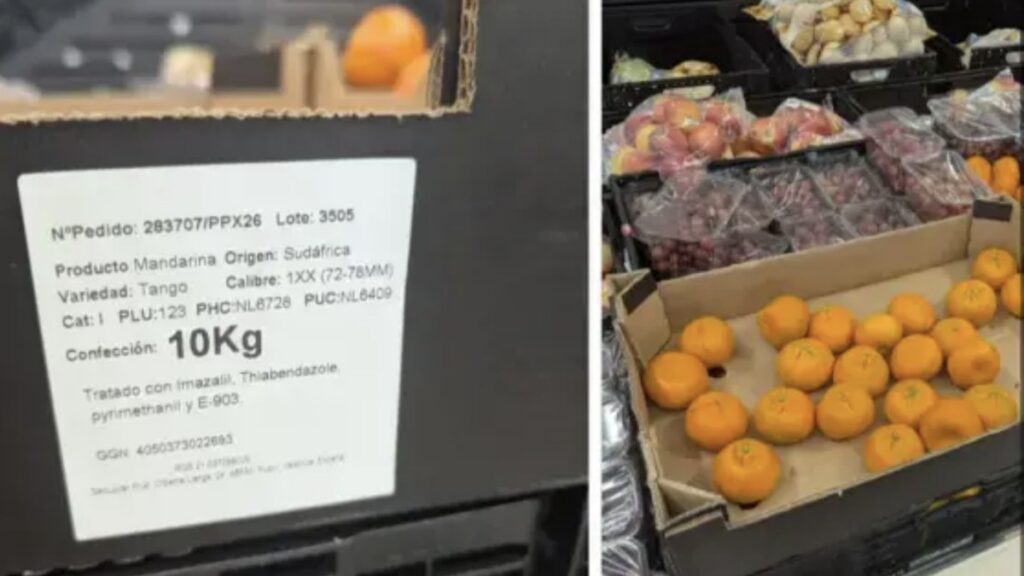
Credit: RRSS/XTwitter
What did Aldi say about the mandarin complaint?
Merca2 reports that Aldi asked the customer to provide further details so that the matter could be investigated internally. No outcome has been reported, and is still unclear whether the discrepancy resulted from an incorrect shelf label, a stock change or another administrative mistake. There is also no evidence that Aldi deliberately misled shoppers, but it raises a question of do we really always know where our food comes from.
What do EU rules say about fruit origins?
Supermarkets in Spain must provide customers with accurate information about the origins of fresh fruit and vegetables.
Under EU Delegated Regulation 2023/2429, which applies to fruit marketing standards, country-of-origin information must be clearly displayed and must not mislead consumers. Article 7 requires retailers to show this information prominently and legibly next to the produce. If mandarins grown in South Africa are presented as Spanish, this could breach the applicable consumer information rules..
Why the origin matters to shoppers
Spain has a long-established citrus industry, particularly in Valencia, Andalucia and Murcia, where oranges and mandarins are important agricultural products. Imported citrus is perfectly legitimate, and South African mandarins are regularly sold in European supermarkets. The important issue is that customers should be told accurately where their fruit was grown.
For shoppers who prefer to support Spanish farmers and local producers, clear labelling makes it easier to choose home-grown produce. British residents living in Spain may also find it useful to check the country-of-origin information on supermarket shelf labels rather than relying on the fruit variety or packaging. A mandarin variety such as Tango does not necessarily indicate where it was grown.
Shoppers should be able to trust the information provided by their supermarket and be able to confidently source produce grown close to home.

Última Hora De La Actualidad Política, En Directo | Marlaska Ordena Una Investigación Sobre Las Cargas Policiales En Las Manifestaciones Por La Vivienda Y Pide Que No Se Use Gas Lacrimógeno

Spain Faces Wave Of Bomb Scares As Madrid And Guadarrama Trigger Major Security Operations
Spain rocked by strike violence as police clash with protesters and businesses are targeted
Viral video in Spain sparks fury over drivers who ‘have no idea how to drive’
Spain’s pet owners face fines of up to €200,000 for animal welfare offences
Halloween lunch sells out as 51 join Marbella get-together


-
DGT4 weeks ago
Viral video in Spain sparks fury over drivers who ‘have no idea how to drive’
-
Keeping cats and dogs outside4 weeks ago
Spain’s pet owners face fines of up to €200,000 for animal welfare offences
-
Age Concern Marbella - San Pedro2 weeks ago
Halloween lunch sells out as 51 join Marbella get-together
-
Consumer Rights Spain4 weeks ago
EU offers extra year of warranty on phones, but Spain faces delays
-
Council tax (IBI)4 weeks ago
Barcelona plans 150% property tax increase on tourist flats ahead of 2028 ban
-
airports4 weeks ago
Travelling between Spain and Italy? The extra border checks could soon end
-

 %4 weeks ago
Santa Pola Museo Del Mar
-

 New Developments2 weeks ago
How To Get A Tourist Rental Licence In Andalusia (Spain) – Step-By-Step Guide 2025