
%
Aldi Mandarin South African Fruit Label


Shopping and eating local produce has become a priority for many people, a fresh vegetable that hasn’t travelled across the world to get to your plate is far less preferable to something grown and harvested just on your doorstep. One customer has now challenged the well known supermarket over an apparent labelling discrepancy in Spain, raising questions about food origins and shoppers’ right to know where their fresh produce comes from.
Mandarins from thousands of miles away
Aldi is facing questions after a shopper reportedly discovered that mandarins displayed as Spanish at one of its Spanish supermarkets were delivered in boxes identifying South Africa as their country of origin. The complaint concerns an Aldi store in Oropesa del Mar, in Castellon province, and was reported by Spanish publication Merca2 on November 3, 2026.
According to the report, the customer shared an image on X, formerly Twitter, showing the delivery-box label along with the supermarket’s fruit display. The shopper claimed that the store was advertising the mandarins as Spanish, despite the packaging stating that they came from South Africa. The apparent contradiction prompted the customer to challenge Aldi publicly and demand that the information be corrected.
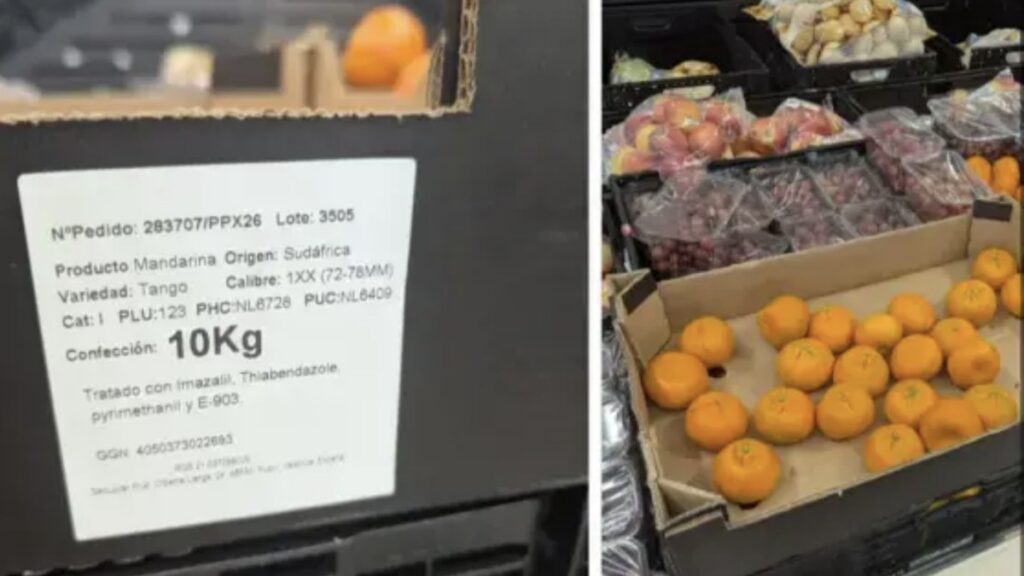
Credit: RRSS/XTwitter
What did Aldi say about the mandarin complaint?
Merca2 reports that Aldi asked the customer to provide further details so that the matter could be investigated internally. No outcome has been reported, and is still unclear whether the discrepancy resulted from an incorrect shelf label, a stock change or another administrative mistake. There is also no evidence that Aldi deliberately misled shoppers, but it raises a question of do we really always know where our food comes from.
What do EU rules say about fruit origins?
Supermarkets in Spain must provide customers with accurate information about the origins of fresh fruit and vegetables.
Under EU Delegated Regulation 2023/2429, which applies to fruit marketing standards, country-of-origin information must be clearly displayed and must not mislead consumers. Article 7 requires retailers to show this information prominently and legibly next to the produce. If mandarins grown in South Africa are presented as Spanish, this could breach the applicable consumer information rules..
Why the origin matters to shoppers
Spain has a long-established citrus industry, particularly in Valencia, Andalucia and Murcia, where oranges and mandarins are important agricultural products. Imported citrus is perfectly legitimate, and South African mandarins are regularly sold in European supermarkets. The important issue is that customers should be told accurately where their fruit was grown.
For shoppers who prefer to support Spanish farmers and local producers, clear labelling makes it easier to choose home-grown produce. British residents living in Spain may also find it useful to check the country-of-origin information on supermarket shelf labels rather than relying on the fruit variety or packaging. A mandarin variety such as Tango does not necessarily indicate where it was grown.
Shoppers should be able to trust the information provided by their supermarket and be able to confidently source produce grown close to home.






%
Brits In Spain With Old UK Workplace Pensions Left Guessing As Britain Rewrites How Pensions Pay Out





Financial advisors worldwide are concerned about the growing ‘gap’ they observe in their industry between financial planning and asset management. Many say that it’s a struggle for them to align the financial plan of a client with their investment portfolio.
One financial advisor described it as: “two halves of a bridge built from opposite banks that don’t meet in the middle: each side may be well engineered, but without coordination, the client can’t get across.”
Few people in the finance sector deny that this gap exists. They offer several differing reasons to explain it, however. Some blame chaotic markets, others say it’s due to a tug-of-war between clients wanting personalisation and financial firms wanting to grow rapidly.
Peter Dougherty believes this gap has a different cause: the limitations of modern portfolio theory. He thinks the problem begins with the one-dimensional assumption that ‘volatility’ equals ‘risk’ in an investment portfolio. As Dougherty explains: “if over three years two stocks have each earned 7%, portfolio theory tells us that the stock whose annual returns have been 9%, -1%, and 14% is ‘riskier’ than the stock that returned 8%, 6% and 7% over the three-year period. They each earned 7%. Yet, because the standard deviation of the first stock’s returns (6.24) is higher than second’s (.816), which means its returns vary more, buying the first stock is viewed as subjecting the investor to more ‘risk’ than buying the second stock.”
But Dougherty doesn’t believe this ‘volatility’ (variance in price) equals risk. Instead, he says that “not having what you need when you need it is the risk. Volatility is an important characteristic, but it is not risk. To most clients, ‘risk’ is the chance of not reaching their goals, like running out of money in retirement. That chasm between the textbook definition and the client’s definition is the reason financial planning and investing need to be designed together.”
So, four years ago, when Peter Dougherty arrived in Spain as a financial planner, he deliberately went to work for the only Spanish firm that brought financial planning and investments into alignment: Bissan Wealth Management. His aim was to help Americans in Spain with their financial plans and investments. To enhance his abilities, Dougherty earned a master’s degree in Spanish taxation from Universidad Nebrija and became Spain’s only U.S./Spanish dual-accredited financial planner: receiving the European Financial Planner certification in Spain and the CERTIFIED FINANCIAL PLANNER® credential in the U.S.
Now, four years later, he recognises that it’s often wiser for Americans to leave their investments in the U.S. rather than transfer financial assets to Spain. He recently arrived at this ‘aha moment’ — ‘when the penny dropped’ — as he was adjusting a wobbly table at a neighbourhood café. Dougherty placed a napkin under one leg and a different leg started rocking because the floor itself was uneven. That’s the moment it dawned on him that the real problem for Americans in Spain, like a rug that doesn’t fit the room, is that U.S. investment rules are incompatible with the Spanish financial ecosystem.
That’s the reason Dougherty left his job at Bissan and founded USpain Financial Consultancy, where he provides independent financial advice and planning to English-speaking expats in Spain. He still believes that financial planning and investing need to be designed together rather than handled by separate people or processes. But he also realises that Americans in Spain seldom need assistance with Spanish wealth management. That explains why USpain Financial blends cross-border financial planning for expats in Spain that works well even if their investment portfolio is predominantly in the U.S.
To draw a parallel between what his new firm is doing and technology, Dougherty jokes: “How do you know a computer is European? It has a five-week vacation policy, but it has an operating system, installed software, and a processor that are from California.”
Peter Dougherty, CFP®, CRPC®, EFP (Spain), is a financial planner at USpain Financial Consultancy, where he specialises in advising Americans living in the country. He is the author of two financial planning books, one in English: “The Dougherty Code: Secrets of Financial Planning in Spain Revealed” and the other in Spanish: “La Hoja de Ruta Fiscal y Financiera para los españoles en EE.UU.”
For more information: https://www.financial-planning-in-spain.com

This article is for informational purposes only and does not constitute financial, tax or investment advice. Tax and investment rules differ for US citizens resident in Spain and depend on individual circumstances. Always seek independent regulated advice before making financial decisions, and check that any adviser is authorised to advise you in your jurisdiction

Brits In Spain With Old UK Workplace Pensions Left Guessing As Britain Rewrites How Pensions Pay Out

Aldi Mandarin South African Fruit Label

EXCLUSIVE: Marbella Butt-Lift King’s Plastic Surgery Clinic Is Refusing Patient Refunds Totalling Nearly €100,000 After His Brutal Murder
Viral video in Spain sparks fury over drivers who ‘have no idea how to drive’

Un Ataque De Los Hutíes Contra El Aeropuerto De Riad Causa Al Menos 12 Muertos Y Más De 300 Heridos

Spanish House Prices Rise 9pc But Market Growth Stalls In H1 2026


-
DGT3 weeks ago
Viral video in Spain sparks fury over drivers who ‘have no idea how to drive’
-
 Arabia Saudí4 weeks ago
Un Ataque De Los Hutíes Contra El Aeropuerto De Riad Causa Al Menos 12 Muertos Y Más De 300 Heridos
-
 House prices4 weeks ago
Spanish House Prices Rise 9pc But Market Growth Stalls In H1 2026
-

 America4 weeks ago
Un Tirador Mata A Ocho Personas En Una Vivienda En Pensilvania
-
Costa Blanca North4 weeks ago
Jávea opens historic lighthouse to the public with a new whale-watching viewpoint
-

 America4 weeks ago
Trump Llega A Un Acuerdo Con Putin Para Que Rusia Libere Miles De Barriles De Diésel En Los Mercados Mundiales
-
Automated supermarket3 weeks ago
Spain’s 24-hour shop with no tills expands to Barcelona Airport
-

 Uncategorized3 weeks ago
Williams F1 driver caught up in four-car pit lane pileup