
Argentina
Argentina Forces Oil Companies To Choose Between Vaca Muerta And The Falklands


Vaca Muerta, the Patagonian shale formation that currently produces more than 600,000 barrels of oil a day, is not only Argentina’s crown jewel of energy production. It has also become the tool President Javier Milei is using in Argentina’s long-running sovereignty dispute with the United Kingdom over the Falkland Islands, known in Argentina as the Malvinas.
As the Sea Lion offshore oil project, approved by the islands’ British-backed government and designed to extract crude from the waters surrounding the archipelago, moves closer to production, the Argentine president has issued a warning: any company involved in the venture will be barred from operating in Argentina. In practice, that would mean giving up access to Vaca Muerta, one of the world’s largest unconventional oil and gas reserves and a basin believed to hold enough resources for decades of production.
“Those who operate on our islands behind the Argentine government’s back will have to choose between an illegal gamble in disputed territory and a profitable, secure operation in a sovereign country with clear rules and predictability. You can’t do both,” Milei said last Thursday in a speech broadcast nationwide.
In that address, he announced an expansion of sanctions already established under a 2011 law targeting companies operating in the Falkland Islands without Argentina’s authorization. The measures would apply not only to those firms but also to their shareholders, employees and suppliers. Argentina has claimed sovereignty over the islands, which have been administered by the United Kingdom since 1833 and were the subject of a brief war between the two countries in 1982.
“Choosing between Vaca Muerta and Sea Lion is like choosing between [Argentine soccer star Lionel] Messi and a youth player,” says Juan José Carbajales, a former Argentine deputy secretary for hydrocarbons and current director of the Gas and Oil Institute at the University of Buenos Aires. “Vaca Muerta is a proven resource; it works. You know there’s oil, and you just have to invest and extract it. The other is a high-risk bet and, even if everything goes right, Vaca Muerta is an entire basin, while Sea Lion is just a single field.”
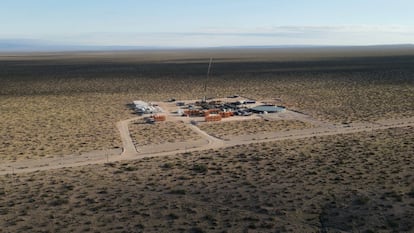
The Sea Lion field was discovered in 2010 and lies about 220 kilometers (137 miles) north of the Falkland Islands. The project is being developed by Israel’s Navitas Petroleum and Britain’s Rockhopper Exploration, which secured final investment approval for the first phase of development on Dec. 10, 2025.
Vaca Muerta is estimated to hold around 30.17 billion barrels of technically recoverable resources, while Sea Lion’s recoverable reserves are put at roughly 314 million barrels, about 1% of that amount. Vaca Muerta currently produces more than 600,000 barrels of oil a day, a figure expected to rise to around 1.5 million barrels per day by 2032. Sea Lion, by comparison, is projected to produce 55,000 barrels a day in its initial phase, with output potentially reaching 200,000 barrels a day once the project is fully developed.
There is also a significant gap in costs. Offshore drilling is far more expensive than onshore operations. While drilling a well in Vaca Muerta costs roughly $10 million, a deepwater well can cost as much as $200 million, according to Carbajales.
“Sea Lion is the size of one of the 40 projects that make up Vaca Muerta,” said Daniel Dreizzen, a former Argentine energy planning secretary and director of consultancy Aleph Energy.
Even so, Sea Lion is not a particularly small project by global standards and, above all, it represents a promise. If production goes ahead and proves profitable, investor interest in exploring neighboring blocks is likely to surge. That is why the Argentine government sees it as crucial to derail the project at this early stage.
Although the companies involved have said Milei’s statements will not alter their timetable, which calls for drilling to begin in 2027, the Argentine president’s change of stance adds political risk to an already complex venture. The Final Investment Decision (FID) was taken in December 2025, at a time when Milei had not yet signaled opposition to the project.
The president, who has repeatedly described himself as an admirer of Margaret Thatcher, Britain’s prime minister during the 1982 Falklands War, had even suggested in the past that the islands’ residents had a right to self-determination, a position he now rejects outright.
The shift in rhetoric has led both political opponents and many Argentines to view the announcements as politically opportunistic. Critics accuse Milei of embracing an issue that resonates deeply with the public at a time when his popularity is declining and he is preparing a bid for re-election.
In his speech, Milei argued that the prospect of exploiting oil reserves beneath the waters around the islands would give “an incentive for the British government to deepen its occupation” of the Falklands. While the islands were long viewed by London primarily as a strategic and military burden, the discovery and potential development of hydrocarbon resources could now turn them into a valuable economic asset.
The day after Milei’s nationally televised address, oilfield-services companies Schlumberger (SLB), Halliburton and Baker Hughes issued statements announcing that they would not participate in hydrocarbon projects in the Falklands or the surrounding maritime areas.
The position taken by those companies is significant. The global oil-services market is highly concentrated, and together the three firms account for more than 52% of the publicly traded oil-services market worldwide. While smaller competitors exist, the decision by these three industry giants to stay away from Falklands projects adds another layer of difficulty to an area that is already remote, technically challenging and costly to operate in, making it harder to secure contractors with the necessary expertise at competitive prices.

In recent days, the Argentine government has announced that it has begun proceedings to sanction 45 companies and individuals linked to hydrocarbon activities in the disputed Falkland Islands. It also plans to file a criminal complaint against the Israeli oil company Navitas Petroleum and several of its subsidiaries, as well as against Canada-based JHI Associates Inc. and its shareholder Eco (Atlantic) Oil & Gas Ltd., for holding licenses granted by the United Kingdom to carry out oil exploration and production activities in the North Falkland Basin.
Argentina has invoked the sanctions established under Law 26,659 on previous occasions. Although the legal framework for penalizing such activities has existed since 2011, it has gained weight over time as Vaca Muerta has evolved from a promising prospect into a world-class oil and gas basin.
“Today, Argentina not only has the luxury of wielding a stick in negotiations, it also has a carrot to offer. It can offer investors a place they can develop with relatively low risk, backed by a legal framework such as the Incentive Regime for Large Investments,” says Carbajales, referring to a scheme promoted by Milei that offers major investors tax, customs and foreign-exchange incentives, along with regulatory stability for 30 years. “Today, foreign investors are being offered everything.”
Sign up for our weekly newsletter to get more English-language news coverage from EL PAÍS USA Edition





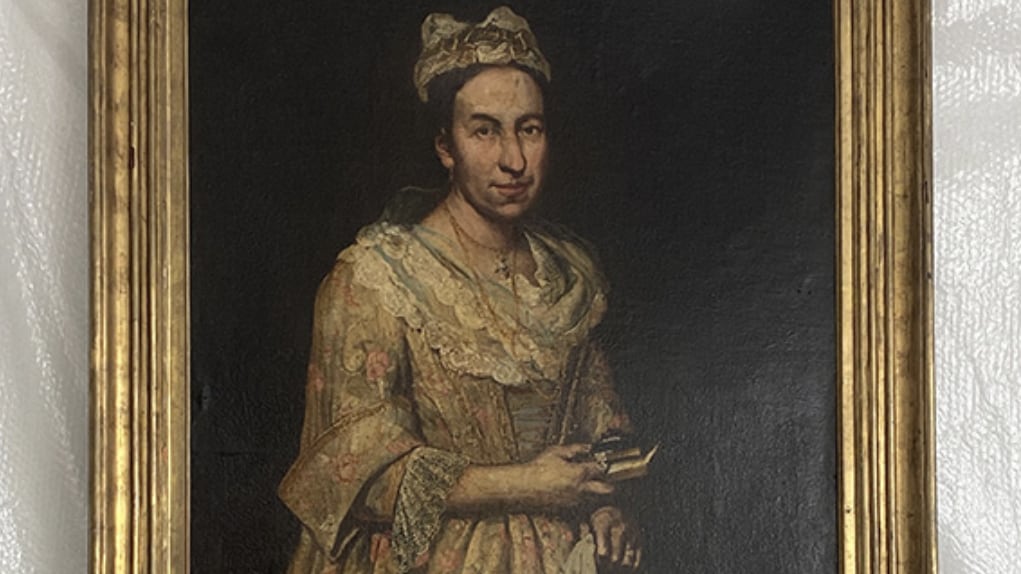
After almost 90 years, a painting stolen by the Nazis in the Netherlands will be returned to the heirs of the victims. Argentine courts ordered the restitution of the Portrait of a Lady to the family of Jewish gallery owner Jacques Goudstikker (1897–1940). The work, painted in the 18th century by Italian artist Giacomo Ceruti (1698–1767), had been missing since World War II and was found last year in the city of Mar del Plata, about 250 miles from Buenos Aires. It hung in the home of one of the daughters of Friedrich Kadgien, who was known as the Nazi regime’s “finance wizard.” Kadgien, a prominent associate of war criminal Hermann Göring, later moved to South America, where he lived out his life without ever facing justice.
In the case heard by the federal courts in Mar del Plata, Patricia Kadgien and her husband, Juan Carlos Cortegoso, were charged with possessing and concealing artwork stolen in the context of a genocide. After initially claiming to be the lawful owners of an inherited painting, the couple ultimately accepted an agreement reached between prosecutors and their defense attorneys to avoid a trial. As part of the deal, they irrevocably waived any rights or claims to the artwork.
The painting will now be returned to Marei von Saher, Goudstikker’s daughter-in-law, who, together with her daughters Charlene and Chantal von Saher, has devoted years to tracking down and recovering works looted by the Nazis. Through her lawyers, Von Saher, the heir of the art dealer who died in 1940 while fleeing the Nazis, said she would not accept “86 years of plunder,” but added that she was seeking neither revenge nor compensation, only the return of the painting that once belonged to her father-in-law.
According to her legal representatives, the family’s intention is for Portrait of a Lady to be exhibited on loan at a museum in Buenos Aires before it is returned, in order to raise awareness of the Nazi regime’s systematic looting of artwork. For now, the painting remains in the custody of Argentina’s Supreme Court in Buenos Aires.
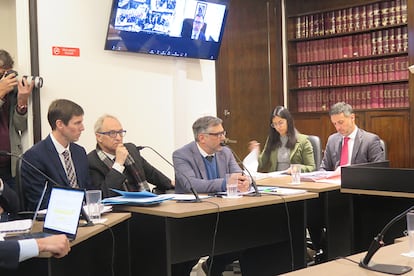
The painting’s return was finalized on Friday during a hearing presided over by Federal Judge Santiago Inchausti, with representatives of the Attorney General’s Office, Von Saher’s legal team, the defendants and their attorneys in attendance. During the proceedings, prosecutor Carlos Martínez said the resolution amounted to “a form of historical reparation for the victims.” As part of the agreement, the defendants must donate 4.8 million pesos (about $3,200), which will go to a charitable foundation supporting a maternal and children’s hospital in the district.
The discovery of the painting
Portrait of a Lady is an oil-on-canvas measuring 119.5 centimeters high by 89 centimeters wide. Its trail had gone cold in Amsterdam after Adolf Hitler’s regime looted the art gallery of Jacques Goudstikker, whose collection contained more than 1,100 works. In Goudstikker’s records, the painting was attributed to Giuseppe Ghislandi (1655-1743), but an expert examination carried out by Argentina’s National Academy of Fine Arts confirmed what several specialists had suspected over the years: the work was actually painted by Giacomo Ceruti, known as Il Pitocchetto. The painting is now estimated to be worth around €250,000 ($290,000).
The artwork’s rediscovery was the result of a chance development during a journalistic investigation into Nazi official Friedrich Gustav Kadgien (1907-1978). In August 2025, as part of coverage marking the 80th anniversary of the end of World War II, the Dutch newspaper Algemeen Dagblad sent correspondent Peter Schouten to Mar del Plata to try to contact Kadgien’s daughters.
Schouten was unable to reach anyone at the house, but he noticed a for-sale sign outside the property. Later, while browsing the real estate firm’s website, he found the listing. Among the photographs showing the interior of the home, he spotted the long-lost painting hanging prominently in the living room. Kadgien’s daughter and her husband were detained for 72 hours before surrendering the artwork to authorities.
“He is a snake of the lowest sort,” a U.S. intelligence report from 1945 said of Kadgien. A member of the SS, Kadgien had served as a financial expert for the Nazi regime since 1938. He played a key role in foreign-currency operations and in the plunder of territories occupied by Germany during the war. One of his responsibilities was extorting Jewish merchants in Amsterdam to help finance the Nazi war machine. After the Allied victory, he fled first to Switzerland, then to Brazil and ultimately, like many other war criminals, to Argentina, where he reinvented himself as a businessman.
Contemporary intelligence reports indicate that Kadgien escaped with diamonds and numerous works of art. For at least one of those works — the portrait of an Italian countess named Colleoni — something resembling justice has finally been served.
Sign up for our weekly newsletter to get more English-language news coverage from EL PAÍS USA Edition


Última Hora De La Entrada De Inmigrantes A Ceuta, En Directo | Page Advierte Que La Crisis De Ceuta Puede Convertirse En La “segunda Gran Mentira De La Democracia”

La Fiscalía Alerta De Una “alarmante Espiral Que No Para De Crecer” En Los Delitos Sexuales Cometidos Por Menores
UK Air Traffic Control Glitch Hits Spain’s Airports As 229 Flights Cancelled

54 Hectares Destroyed In Barcelona Fire As Man Arrested Over Suspected Arson
France’s famous cheeses could taste different after drought forces farmers to change cows’ diets
Krakatoa exploded 143 years ago today: Noise heard 5,000km away that shaped Spain’s south-east


-
 %2 weeks ago
54 Hectares Destroyed In Barcelona Fire As Man Arrested Over Suspected Arson
-
Abondance2 weeks ago
France’s famous cheeses could taste different after drought forces farmers to change cows’ diets
-
History2 weeks ago
Krakatoa exploded 143 years ago today: Noise heard 5,000km away that shaped Spain’s south-east
-
cocaine2 weeks ago
‘Blazing Saddles’: bizarre discovery sparks major police operation in Spain
-
 Andalucia2 weeks ago
Spain’s Expat Havens: These Are The Towns Where Foreign Buyers Outnumber Spanish Ones – Sometimes By Two To One
-
botanical garden Orchidarium2 weeks ago
Wands out in Estepona: Costa del Sol town celebrates 25 years of Harry Potter on film
-
Costa Blanca North2 weeks ago
Everything you need to know about the final weekend of Benidorm Pride
-

 New Developments2 weeks ago
Inside The Most LUXURIOUS Apartment Building In Spain!