Connect with us

%

Britons Over 55 Offered New Route To Gibraltar Residency As Government Changes Rules

Published

on

britons-over-55-offered-new-route-to-gibraltar-residency-as-government-changes-rules

The government is now proposing a separate route specifically for people over 55. Photo credit: Kirk Fisher/Shutterstock

British retirees and financially independent people aged over 55’s could soon have another way to make Gibraltar their home after the government announced plans to change its new residency rules. The proposal would reopen a route for older applicants who can support themselves financially but do not necessarily qualify through employment or business activity. 

Under the planned arrangements, they would need private medical insurance, make a financial contribution to Gibraltar’s healthcare system and spend at least six months a year living there. The government expects to publish the amendments by the end of October, following consultation with relevant stakeholders. Until the changes are published, however, the final eligibility requirements remain unclear. 

Why Gibraltar is changing its residency rules

The announcement follows a major change to Gibraltar’s residency framework in July, when new regulations introduced stricter requirements for people seeking permission to live on the Rock. The rules placed greater emphasis on economic contribution, including employment and business activity, while normally limiting new residency applications to people aged 55 or younger. 

The government’s stated aim was to ensure new residents contribute to the local economy and do not place undue pressure on housing and public services. However, the changes attracted criticism because they made it harder for financially independent older people to relocate without taking up employment or qualifying through an alternative category.

The government is now proposing a separate route specifically for people over 55 who have sufficient financial means to live in Gibraltar. For British pensioners who had considered retiring on the Rock, the announcement offers a potential alternative to the arrangements introduced in July. It does not, however, mean that applications under the new route are already open. 

What will applicants need?

The proposed route will come with three stated conditions, applicants must hold private medical insurance, make a financial contribution to Gibraltar’s healthcare system and spend at least six months of each year living on the Rock. The residence requirement means the route is intended for people who genuinely want to make Gibraltar their home, rather than those seeking residency while spending most of their time elsewhere.

The government has not yet published the full eligibility criteria, including any minimum income or financial thresholds. The amount applicants will have to contribute towards healthcare has also not been specified in the announcement. Anyone considering a move should therefore wait for the amended regulations before making financial commitments or assuming they will qualify.

Health, Care and Business Minister Gemma Arias-Vasquez announced the proposal at the GibLink London event on Tuesday, October 20, held as part of Gibraltar Day in London. She said the new route would allow people who had been considering Gibraltar as a place to spend the next stage of their lives to make that move, while contributing to the territory from the outset. 

New business think tank to shape Gibraltar’s future

The residency announcement was made alongside plans for a new business think tank intended to help determine Gibraltar’s long-term economic direction. Led by Peter Montegriffo KC, the group will report directly to Arias-Vasquez and bring together experienced figures from Gibraltar’s business community to examine opportunities for future growth. The initiative comes as Gibraltar adjusts to the new arrangements following the treaty with the European Union and the removal of the physical frontier barriers on July 15.

Speaking at the London event, Arias-Vasquez said Gibraltar had spent years responding to events outside its control, including Brexit, the pandemic and lengthy treaty negotiations. She argued that the territory could now take a more active role in deciding its economic future. The think tank is expected to explore where Gibraltar’s economy should focus its efforts in the years ahead. Its detailed membership, work programme and timetable for recommendations have not yet been announced. 

When will the new route be available?

The next step is publication of the amended residency regulations, which the government expects before the end of October. Those rules should establish the precise conditions for applicants, including the financial requirements and the contribution towards healthcare.

For older Britons who had ruled out Gibraltar following the July changes, the proposal could put the territory back on their list of retirement destinations. But until the final regulations are published, the announcement remains a plan rather than an available residency option.

%

Spain’s New Menopause Sick Leave Rules

Published

on

spain’s-new-menopause-sick-leave-rules

Spain introduces new sick leave protections for menopause-related conditions from December 1 Credit : Miljan Zivkovic, Shutterstock

Women working in Spain who suffer from certain debilitating menopause-related conditions will soon be entitled to enhanced sick leave protection, with payments starting from the day after they stop working and no minimum contribution period required. The changes form part of a new Social Security reform published on Wednesday, October 21, and will take effect on December 1, 2026.

The measure is intended to support women whose menopause-related health conditions prevent them from carrying out their jobs. Unlike ordinary sick leave for common illnesses, which generally requires a minimum contribution history and does not provide statutory payments for the first three days, the new arrangement offers financial protection from the beginning of a medically certified absence.

However, the reform does not introduce automatic paid leave for every woman experiencing menopause. Eligibility depends on a qualifying medical condition, an inability to work and the relevant Social Security requirements.

The change is included in Royal Decree-law 31/2026, published in Spain’s Official State Gazette, alongside other measures expanding protection for families and workers.

Who qualifies for Spain’s new menopause-related sick leave?

The new provision recognises a specific category of temporary incapacity, known in Spanish as incapacidad temporal, for women affected by a medically recognised, limiting condition associated with a secondary menopausal disorder.

Under the legislation, the condition must be sufficiently serious to prevent the woman from performing her work, and she must be receiving medical care through Spain’s public health service.

The legislation refers specifically to a qualifying condition identified through the appropriate medical coding. This distinction matters because menopause itself is a natural stage of life and does not automatically establish an entitlement to sick leave.Women experiencing symptoms that interfere with their work will therefore need a medical assessment to determine whether their condition meets the requirements for the new category.

The measure is designed to address circumstances in which menopause-related health problems have a substantial impact on a woman’s ability to continue working. The reform comes as women in Spain continue to face difficulties accessing some menopause treatments, following shortages of several hormone replacement therapies.

The legislation also introduces a separate special sick leave category for women whose injuries resulting from gender-based violence prevent them from working. Both changes form part of a wider reform of Spain’s temporary incapacity system.

According to the Spanish government’s announcement on October 20, the aim is to provide more appropriate protection in circumstances where existing sick leave arrangements may not adequately reflect particular health and social situations.

How much will workers receive during sick leave?

One of the most significant changes concerns when payments begin.

Under the ordinary rules for sick leave caused by a common illness, statutory benefits generally begin on the fourth day of absence. Sick leave has become an increasingly significant issue for Spain’s Social Security system, with its financial cost and impact on employers attracting growing attention.  Workers must normally have contributed to Social Security for at least 180 days during the preceding five years to qualify.

For the new special category covering qualifying menopause-related conditions, no minimum contribution period will be required.

The employer will pay the worker’s full salary for the first day of medically certified absence. From the following day, the statutory temporary incapacity benefit will become payable through the responsible Social Security managing or collaborating body.

The amount will be calculated using the worker’s base reguladora, or regulatory base, which is determined according to the applicable Social Security contribution rules.

The government has confirmed the following payment rates:

  • 60 per cent of the regulatory base until the twentieth day of sick leave.
  • 75 per cent of the regulatory base from the twenty-first day onwards.

These percentages do not necessarily correspond to the same proportion of a worker’s usual take-home pay, because the regulatory base is calculated using contribution information rather than simply the net salary received each month.

For someone with a regulatory base of €1,500 per month, a simplified illustration would be €900 per month at the 60 per cent rate or €1,125 per month at the 75 per cent rate. Actual payments would depend on the duration of the absence, the relevant daily calculation and individual circumstances.

The new arrangement does not mean workers will automatically receive their full salary throughout the absence. Any additional payments would depend on applicable employment agreements or other relevant provisions.

The main improvement is that qualifying workers will no longer have to wait until the fourth day for statutory sick leave payments, nor meet the usual minimum contribution requirement for common illness.

When do the new rules take effect in Spain?

Although Royal Decree-law 31/2026 was published in the Official State Gazette on October 21, the new special temporary incapacity provisions will apply from December 1, 2026 and until the relevant provisions take effect, existing temporary incapacity rules continue to govern cases according to the circumstances involved.

The reform was approved by Spain’s Council of Ministers on Tuesday, October 20. As a decree-law, it is also subject to the parliamentary validation process required under Spanish law.

The government has presented the changes as part of a broader package intended to strengthen Social Security protection, including additional measures concerning family benefits, survivors’ pensions and support for people caring for seriously ill children.

For women who may be affected, the practical starting point is a medical assessment. A qualifying diagnosis and medically certified inability to work will be essential to determining whether the new special category applies.

Workers should also distinguish between the medical justification for taking sick leave and the financial conditions governing the benefit. The reform improves the latter for eligible cases, but it does not remove the need to establish that a medical condition prevents the person from working.

The new rules mark a change in how Spain’s Social Security system recognises certain menopause-related health conditions. From December 1, eligible women will have access to statutory payments from the day after their absence begins, without the usual minimum contribution period required for ordinary sick leave.

Continue Reading

%

Mallorca’s Thrilling Triathlon

Published

on

mallorca’s-thrilling-triathlon

More than 2,000 athletes and thousands of spectators descended on Peguera over the weekend as Challenge Peguera-Mallorca delivered a thrilling day of international triathlon, close finishes and a festival atmosphere along the Calvià coastline.

The 12th edition of the event took place on Saturday, October 17, with elite athletes, amateur competitors, relay teams and families helping transform the popular resort into a sporting hub. From the first swimmers entering the Mediterranean to the final runners crossing the finish line, the event showcased Mallorca as a destination for sport and autumn tourism.

Dramatic finishes crown international champions

The men’s professional race produced a remarkable finish, with Slovenia’s Matevž Nunar claiming his first professional victory after overtaking Germany’s Alexander Kull in the final kilometre.

Nunar crossed the line in three hours, 42 minutes and 38 seconds, just 21 seconds ahead of Kull, who finished in 3:42:59. Britain’s Jack Hutchens secured third place in 3:43:12, narrowly beating Belgium’s Michiel Stockman by a single second.

The women’s competition was equally compelling, as Switzerland’s Cathia Schär successfully defended her title despite suffering stomach problems during the early stages of the run.

Schär finished in 4:10:13, ahead of Germany’s Caroline Pohle in 4:11:48, while fellow German athlete Laura Jansen took third in 4:13:17.

The middle-distance challenge tested competitors across a 1.9-kilometre swim, a 90-kilometre cycle and a 21.1-kilometre run, demanding endurance, tactical judgement and determination right to the finish.

Peguera turns out to cheer on the athletes

Away from the elite battle, the atmosphere across Peguera was a major part of the weekend’s success.

Residents, holidaymakers and triathlon fans lined the course to encourage competitors along the cycling and running routes, with the finish area at Torà beach providing a focal point for celebrations.

The event extended beyond Saturday’s headline race, with four days of activities from October 15 to 18. The programme included relay competitions, Challenge Women, inclusive sporting activities and children’s events, ensuring that the occasion appealed to more than experienced triathletes.

The weekend concluded on Sunday with the Junior Aquathlon, giving younger participants an opportunity to experience the excitement of competitive sport.

Organisers also benefited from the contribution of more than 650 volunteers, alongside local sports clubs, police, civil protection teams and municipal services. Their involvement helped deliver an event that brings the community together as well as attracting international competitors.

A boost for Mallorca’s autumn tourism

Challenge Peguera-Mallorca has become an important fixture in the island’s sporting calendar, helping demonstrate that Mallorca’s tourism appeal extends well beyond the traditional summer season.

According to Calvià Town Hall, more than 85 per cent of participants in the event come from outside the Balearic Islands. Athletes travelling to compete, often accompanied by family and friends, bring additional visitors to Peguera during October.

That international audience creates opportunities for hotels, restaurants, cafés, shops and other local businesses, with competitors and supporters able to combine the sporting weekend with time enjoying the resort and its surroundings.

The event also promotes Calvià internationally, showcasing its coastline, mild autumn climate and facilities for outdoor activities at a time when many Mediterranean destinations are winding down for the season.

The race is organised by Calvià Town Hall and the Calvià 365 Foundation, working with Spanish and Balearic triathlon federations and supported by tourism bodies, local hotel associations and private sponsors.

With packed participation across the programme, thousands of visitors and a dramatic finish to the professional races, this year’s Challenge Peguera-Mallorca once again demonstrated how major sporting events can combine elite competition with community spirit and tourism opportunities.

For Peguera, it was more than a race: it was a weekend that put the resort firmly in the international sporting spotlight.

Continue Reading

%

Palma De Mallorca History & Travel Guide | Mallorca

Published

on

palma-de-mallorca-history-&-travel-guide-|-mallorca

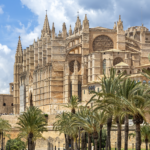
Palma de Mallorca. Credit: Markus Mainka/Shutterstock.

Palma, capital of the Balearic Islands and sun-drenched star of Mallorca’s southwestern coast, has hosted more power struggles than an over-the-top splashy Shakespearean subplot.

First embraced by the Romans in 123 BCE, it was later looted by Vandals, rebranded by Byzantines and in the 8th century fell to the Arabs: until James I of Aragon swept in, sword aloft, in 1229. Palma’s destiny flip-flopped until the royal marriage of Ferdinand and Isabella in 1469 finally settled it under the Spanish crown (probably inspiring countless soap operas!).

Palma’s old town flaunts history like a peacock in a cathedral. Started in 1230 but finished only a few centuries before Brexit, its Gothic cathedral dominates the skyline. Nearby are Bellver Castle, Almudaina Palace and more architectural gems than you can shake selfie sticks at.

The modern city unfurls along the sea like an elegant sun lounger: seven miles of promenades, cafés and luxury hotels. Additionally, it turns out everything from embroidery to olive wood trinkets – perfect for suitcases or impulse purchases after too much sangria. Oops!

Palma is both island idyll and cultural cocktail with its lively university scene, art museums, excellent transport links to Barcelona and Valencia and impressive history.

So, wherever in Spain you’re reading this GREAT newspaper, put on your walking shoes and get exploring!

Thanks for emails to my website below. Delighted you also enjoy my novels – invited for inclusion in the prestigious Book Riot’s 2026 Read Harder Challenge!

Nora Johnson’s 15 critically acclaimed psychological suspense crime thrillers, including the latest ‘The Girl in Red’ (www.nora-johnson.net), all available online at Amazon etc. Profits to Cudeca cancer charity. 

Continue Reading

Trending

Copyright © 2017 Spanish Property & News