Connect with us

%

Palma De Mallorca History & Travel Guide | Mallorca

Published

on

palma-de-mallorca-history-&-travel-guide-|-mallorca

Palma de Mallorca. Credit: Markus Mainka/Shutterstock.

Palma, capital of the Balearic Islands and sun-drenched star of Mallorca’s southwestern coast, has hosted more power struggles than an over-the-top splashy Shakespearean subplot.

First embraced by the Romans in 123 BCE, it was later looted by Vandals, rebranded by Byzantines and in the 8th century fell to the Arabs: until James I of Aragon swept in, sword aloft, in 1229. Palma’s destiny flip-flopped until the royal marriage of Ferdinand and Isabella in 1469 finally settled it under the Spanish crown (probably inspiring countless soap operas!).

Palma’s old town flaunts history like a peacock in a cathedral. Started in 1230 but finished only a few centuries before Brexit, its Gothic cathedral dominates the skyline. Nearby are Bellver Castle, Almudaina Palace and more architectural gems than you can shake selfie sticks at.

The modern city unfurls along the sea like an elegant sun lounger: seven miles of promenades, cafés and luxury hotels. Additionally, it turns out everything from embroidery to olive wood trinkets – perfect for suitcases or impulse purchases after too much sangria. Oops!

Palma is both island idyll and cultural cocktail with its lively university scene, art museums, excellent transport links to Barcelona and Valencia and impressive history.

So, wherever in Spain you’re reading this GREAT newspaper, put on your walking shoes and get exploring!

Thanks for emails to my website below. Delighted you also enjoy my novels – invited for inclusion in the prestigious Book Riot’s 2026 Read Harder Challenge!

Nora Johnson’s 15 critically acclaimed psychological suspense crime thrillers, including the latest ‘The Girl in Red’ (www.nora-johnson.net), all available online at Amazon etc. Profits to Cudeca cancer charity. 

%

Mallorca’s Thrilling Triathlon

Published

on

mallorca’s-thrilling-triathlon

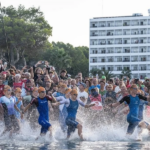
More than 2,000 athletes and thousands of spectators descended on Peguera over the weekend as Challenge Peguera-Mallorca delivered a thrilling day of international triathlon, close finishes and a festival atmosphere along the Calvià coastline.

The 12th edition of the event took place on Saturday, October 17, with elite athletes, amateur competitors, relay teams and families helping transform the popular resort into a sporting hub. From the first swimmers entering the Mediterranean to the final runners crossing the finish line, the event showcased Mallorca as a destination for sport and autumn tourism.

Dramatic finishes crown international champions

The men’s professional race produced a remarkable finish, with Slovenia’s Matevž Nunar claiming his first professional victory after overtaking Germany’s Alexander Kull in the final kilometre.

Nunar crossed the line in three hours, 42 minutes and 38 seconds, just 21 seconds ahead of Kull, who finished in 3:42:59. Britain’s Jack Hutchens secured third place in 3:43:12, narrowly beating Belgium’s Michiel Stockman by a single second.

The women’s competition was equally compelling, as Switzerland’s Cathia Schär successfully defended her title despite suffering stomach problems during the early stages of the run.

Schär finished in 4:10:13, ahead of Germany’s Caroline Pohle in 4:11:48, while fellow German athlete Laura Jansen took third in 4:13:17.

The middle-distance challenge tested competitors across a 1.9-kilometre swim, a 90-kilometre cycle and a 21.1-kilometre run, demanding endurance, tactical judgement and determination right to the finish.

Peguera turns out to cheer on the athletes

Away from the elite battle, the atmosphere across Peguera was a major part of the weekend’s success.

Residents, holidaymakers and triathlon fans lined the course to encourage competitors along the cycling and running routes, with the finish area at Torà beach providing a focal point for celebrations.

The event extended beyond Saturday’s headline race, with four days of activities from October 15 to 18. The programme included relay competitions, Challenge Women, inclusive sporting activities and children’s events, ensuring that the occasion appealed to more than experienced triathletes.

The weekend concluded on Sunday with the Junior Aquathlon, giving younger participants an opportunity to experience the excitement of competitive sport.

Organisers also benefited from the contribution of more than 650 volunteers, alongside local sports clubs, police, civil protection teams and municipal services. Their involvement helped deliver an event that brings the community together as well as attracting international competitors.

A boost for Mallorca’s autumn tourism

Challenge Peguera-Mallorca has become an important fixture in the island’s sporting calendar, helping demonstrate that Mallorca’s tourism appeal extends well beyond the traditional summer season.

According to Calvià Town Hall, more than 85 per cent of participants in the event come from outside the Balearic Islands. Athletes travelling to compete, often accompanied by family and friends, bring additional visitors to Peguera during October.

That international audience creates opportunities for hotels, restaurants, cafés, shops and other local businesses, with competitors and supporters able to combine the sporting weekend with time enjoying the resort and its surroundings.

The event also promotes Calvià internationally, showcasing its coastline, mild autumn climate and facilities for outdoor activities at a time when many Mediterranean destinations are winding down for the season.

The race is organised by Calvià Town Hall and the Calvià 365 Foundation, working with Spanish and Balearic triathlon federations and supported by tourism bodies, local hotel associations and private sponsors.

With packed participation across the programme, thousands of visitors and a dramatic finish to the professional races, this year’s Challenge Peguera-Mallorca once again demonstrated how major sporting events can combine elite competition with community spirit and tourism opportunities.

For Peguera, it was more than a race: it was a weekend that put the resort firmly in the international sporting spotlight.

Continue Reading

%

Spain Raises Child Maintenance Aid To €300

Published

on

spain-raises-child-maintenance-aid-to-e300

Spain raises unpaid child maintenance support to €300 a month for eligible families. Credit : Lordn, Shutterstock

Children in Spain whose parent fails to pay court-ordered maintenance could receive up to €300 a month from the state under new rules approved by the Government. The maximum advance has risen from €100, and support can continue until the child turns 18 if the maintenance obligation is still in force.

The change is part of a wider package of social protection measures approved by Spain’s Council of Ministers on Tuesday, October 20. It is designed to provide greater financial security for children whose parents fail to meet their legal obligations following a separation, divorce or other court proceedings.

According to an official announcement by Spain’s Ministry of Inclusion, Social Security and Migration, the government has approved an increase in the maximum monthly advance available through the Fondo de Garantía del Pago de Alimentos, or Child Maintenance Guarantee Fund.

The reform does not mean that every single parent in Spain will automatically receive €300. The payments are intended for eligible families where court-ordered child maintenance has not been paid, and the amount depends on the maintenance awarded and the applicable conditions.

Who can receive up to €300 in child maintenance support in Spain?

Spain’s Child Maintenance Guarantee Fund provides financial advances to protect children when a parent fails to pay maintenance ordered by a court.

The scheme applies to qualifying cases involving divorce, separation, marriage annulment and legal proceedings concerning parentage or child maintenance.

Previously, the maximum payment was €100 per month for each eligible child. Under the reform approved on October 20, that ceiling increases to €300.

This is a maximum rather than a fixed entitlement. For example, if a court has ordered a parent to pay €200 a month in maintenance, the fund would not automatically provide €300. The amount of the court order remains relevant when determining the advance.

Families must also meet eligibility requirements, including financial conditions. Eligibility also depends on household income, meaning that not every family affected by unpaid maintenance will qualify for financial support.

The fund is particularly important for parents who have primary responsibility for their children but cannot rely on maintenance payments arriving regularly.

However, it is not the same as a general child benefit or a payment available to every separated parent. Applicants need to demonstrate that the maintenance obligation exists and that the required payments have not been made.

The advances are provided by the state, rather than representing an increase in the amount that a court has ordered the non-paying parent to contribute.

How long can families receive the payments under the new rules?

The second major change concerns the duration of support.

Until now, advances from the fund were limited to a maximum of 18 months, whether those months were consecutive or spread over a longer period.

The government has approved the removal of that limit. Under the approved reform, advances can continue until the maintenance obligation ends, but no later than the beneficiary’s 18th birthday.

This could make a substantial difference for families dealing with prolonged non-payment, rather than a temporary interruption in financial support.

Families considering a first application should nevertheless check the official requirements, including income limits, documentation and evidence of unpaid maintenance.

The reform was approved by the Council of Ministers on October 20. Its practical application depends on the legal text and its entry into force, so families should not assume that the higher amount is already available for payment.

The announcement forms part of a broader reform of Spain’s social protection system. Other measures include changes to support for parents caring for seriously ill children, protections for women affected by certain incapacitating health conditions, and expanded access to survivor benefits.

The government has also approved changes affecting unmarried couples with children who may qualify for a widow’s or widower’s pension. Euro Weekly News has separately reported on how unmarried parents previously refused Spain’s widow’s pension could benefit from the changes.

For parents in Spain facing unpaid child maintenance, however, the immediate significance of the latest announcement is the combination of a higher monthly ceiling and a potentially much longer period of financial support.

Instead of being restricted to €100 a month for a maximum of 18 months, eligible families could receive advances of up to €300 per child each month while the qualifying maintenance obligation continues, within the new age limit.

Continue Reading

%

Could AI Decide You’re Bad At Your Job? Spain’s Rules On Workplace Monitoring

Published

on

could-ai-decide-you’re-bad-at-your-job?-spain’s-rules-on-workplace-monitoring

employee representatives have the right to receive information about the parameters. Photo credit: Zamrznuti tonovi/Shutterstock

Spanish supermarket workers could face growing scrutiny as artificial intelligence finds its way into the workplace, raising questions about who is watching employees, how their performance is judged and whether a computer should help decide if someone deserves a disciplinary warning.

The issue has already surfaced in Australia, where a supermarket cashier with 30 years of experience reportedly received a final written warning after an AI monitoring system flagged errors on just 0.18 per cent of the products she scanned, around one mistake in every 533 items.  The case was raised by the Shop, Distributive and Allied Employees Association, an Australian retail workers’ union. For workers in Spain, the case raises a pressing question: could an employer use technology to monitor performance and take disciplinary action here, too?

What Spanish law says about AI monitoring workers

Employers in Spain already have the right to monitor whether staff are fulfilling their work obligations. But that power is not unlimited. Article 20.3 of the Workers’ Statute allows companies to introduce surveillance and control measures, provided they respect employees’ dignity and the legal limits governing their use. Spain’s data protection legislation also requires workers to be informed about workplace video surveillance and certain other monitoring measures. 

The rules become especially important when monitoring involves algorithms or AI systems that assess employees’ performance or influence decisions about their working conditions. Under Article 64.4.d of the Workers’ Statute, employee representatives have the right to receive information about the parameters, rules and instructions behind algorithms or AI systems that affect decisions about working conditions, access to employment or the continuation of employment, including profiling.  In other words, employers cannot simply treat the way these systems work as a secret when the technology affects workers’ rights.

Can a computer decide to discipline an employee?

Spanish workers also have protections against certain decisions made solely by automated systems. The Spanish Data Protection Agency (AEPD) explains that people generally have the right not to be subject to a decision based exclusively on automated processing when it produces legal effects or similarly significant consequences for them. This can include profiling that assesses a person’s performance at work. There are exceptions, including where automated processing is necessary for a contract or authorised by law. 

However, where the contractual or consent exceptions apply, safeguards must include the right to obtain human intervention, explain one’s position and challenge the decision. A system may flag a scanning error, but that does not automatically establish why it happened or whether a formal warning is justified. A human manager can consider the circumstances, including whether a mistake was caused by a faulty barcode, a product that would not scan properly or an issue beyond the employee’s control. An automated score may not tell the whole story.

AI surveillance is already a workplace concern

The debate extends beyond supermarket checkouts. Algorithms can influence shift allocation, task distribution, performance assessments and promotion decisions, while digital monitoring can track employees’ activity.  A report from Spain’s Observatory of Digital Rights sets out workers’ protections around privacy, monitoring tools and automated decision-making. 

It also stresses that workers’ representatives should be informed about relevant systems, including the data used and how the systems operate. The European Union’s AI Act also classifies many AI systems used for employment decisions, worker management and performance monitoring as high-risk, reflecting their potential impact on people’s livelihoods and fundamental rights. 

Could AI cost Spanish workers their jobs?

For Spanish employees, the concern is not whether businesses should be allowed to use technology to improve efficiency. It is whether workers can understand how they are being assessed and challenge decisions that could affect their jobs. The Australian cashier’s case offers a warning of what can happen when a performance figure becomes the focus of a disciplinary process. 

In Spain, existing employment and data protection rules provide safeguards, but workers’ ability to exercise those rights depends on transparency about the systems being used. For anyone whose job is increasingly measured by software, the key question is whether a computer is simply flagging a problem, or influencing a decision that could cost them their livelihood.

Continue Reading

Trending

Copyright © 2017 Spanish Property & News