
Almeria
Cabo de Gata cracks down as almost 100 camper vans fined for illegal beach parking


Camper vans are facing tougher parking rules along Spain’s protected coastlines. Credit: Voyagerix / Shutterstock
One vehicle wasn’t simply parked in the wrong place, it had been turned into a makeshift campsite, and it is far from the only one caught out this summer.
Almost 100 denuncias across Almería’s best-known beaches
Officers from the Junta de Andalucía’s Agentes de Medio Ambiente (environmental protection agents), working alongside Níjar’s Local Police, have issued 98 denuncias (formal citations) so far this year to camper vans, caravans and motorhomes parked overnight in the Cabo de Gata-Níjar Natural Park.
The fines have been concentrated at some of the park’s most popular spots, including El Playazo, Isleta del Moro, Playa de los Genoveses and Playa de Mónsul, as well as along the wider protected coastline.
Why one case went beyond ordinary bad parking
The rule being enforced bans habitable vehicles and tents from stopping overnight, between sunset and sunrise, in areas not set aside for camping inside the natural park. Officers said one vehicle had gone further than simply parking badly: it had chairs and other camping equipment set up outside it, turning a parking offence into an unauthorised campsite.
Previous enforcement seasons in the park have seen fines of up to around €601 under Andalucian protected-space law, though amounts for this year’s citations have not been published. Officials described the fines as a last resort, saying teams usually warn campers and ask them to move on first. Some vehicles have also been towed by municipal trucks, with parking areas temporarily closed off. It is the park’s seventh consecutive year of special summer patrols, which last year recorded 268 violations and removed 22,400 kilograms of rubbish from the coastline.
The same clampdown is spreading along Spain’s coast
Cabo de Gata is far from the only area facing the issues. A national instruction from the DGT (Spain’s traffic authority), in force since March 2026, tried to settle years of confusion by ruling that parking is not the same as camping. A motorhome resting on its wheels in an ordinary space is legal, but putting out awnings, tables or stabiliser legs turns it into camping, which stays banned outside designated sites, and beaches remain strictly off-limits under Spain’s 1988 Coastal Law regardless.
Other tourist hotspots have gone further still. Ibiza has issued fines of up to €30,000 for unauthorised motorhome parking on rustic land this year, while on the Costa del Sol, camper van owners were warned of €200 fines after a parking overhaul at Fuengirola’s former Feria grounds, and Vélez-Málaga council is still weighing options for Torre del Mar’s long-running motorhome parking problem.

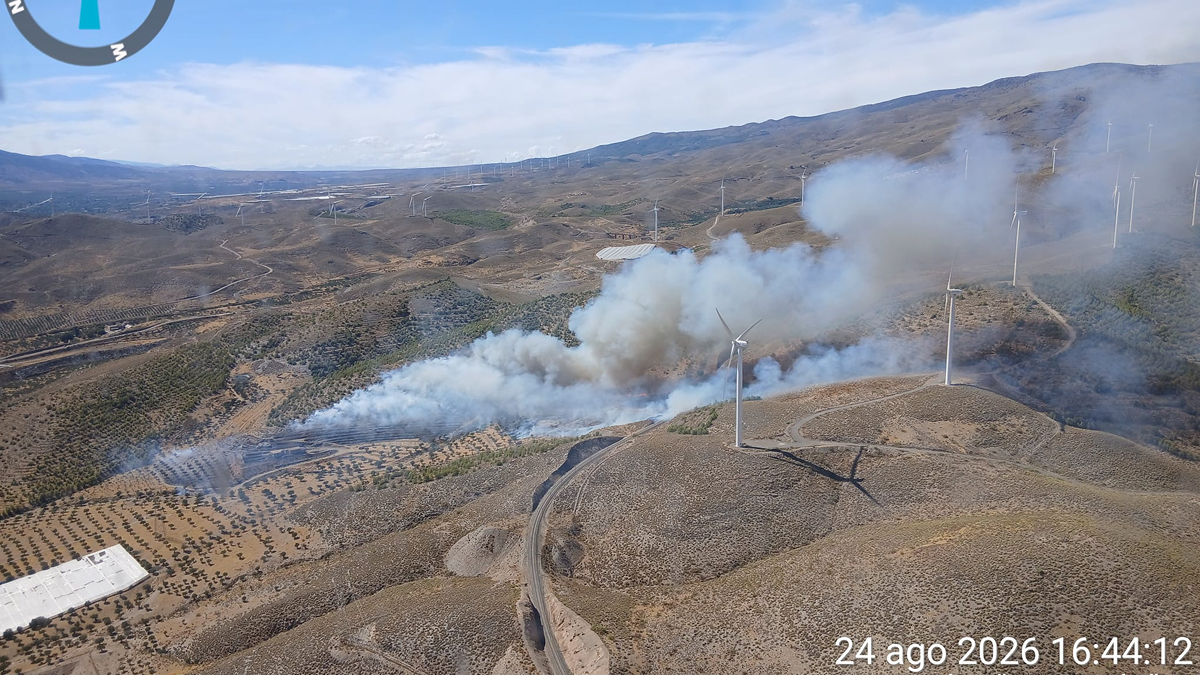
Smoke billows over the hills above Las Tres Villas as Almería’s wildfire spread on Monday evening. Credit: Plan INFOCA / X
Families who spent the night away from home in Las Tres Villas were finally able to return on Tuesday afternoon. The wildfire that forced them out and halted trains through Almería has now been declared stabilised, though firefighters say full control is still some way off.
Level 1 emergency downgraded as fire declared stabilised
The Junta de Andalucía declared the Las Tres Villas wildfire stabilised at 2pm on Tuesday, almost 22 hours after it broke out, and downgraded the region’s response from a Level 1 emergency to a lower “pre-emergency” footing. Antonio Sanz Cabello, the regional Presidency and Interior minister who activated the original emergency, said stabilised meant the fire was “evolving favourably” even though it remained short of being fully controlled. Crews were continuing to consolidate the fire’s perimeter and check for hot spots that could reignite.
Fire broke out near a wind farm and spread towards Nacimiento
The blaze took hold at around 4pm on Monday August 24 in the Doña María area of Las Tres Villas, a small municipality of about 547 people in inland Almería, close to a wind farm. Flames quickly gained ground and pushed towards the neighbouring municipality of Nacimiento before firefighters began to gain the upper hand overnight.
Eight confined, nine evacuated, all now back home
Seventeen residents had been affected as a precaution while the fire advanced. Eight people were confined to their homes in the hamlets of Gilma and Los Sanchos and nine more moved away from scattered settlements altogether. With the fire stabilised, all were able to return home or rejoin family on Tuesday afternoon, and the road linking Las Piletas, Gilma and Los Sanchos reopened to traffic.
Rail services on the Almería-Linares-Baeza line, suspended on Monday evening after flames reached the tracks near Abla-Abrucena and Doña María-Ocaña, had already resumed by 9am on Tuesday.
Nearly 100 firefighters and seven helicopters tackled the blaze
At the height of the operation, close to 100 ground and aerial resources were mobilised, including seven helicopters, four water and retardant aircraft, 66 forest firefighters and four reinforcement brigades, working from an advanced command post at Las Tres Villas’ ITV testing centre.
By the time the fire was stabilised on Tuesday afternoon, the operation had scaled back to 84 EMA-INFOCA personnel, five fire engines, a medical unit for forest fires and two cargo aircraft, alongside more than 40 Guardia Civil officers who had helped secure the area throughout.
What ‘stabilised’ means, and what happens next
In Spain’s official wildfire classification, “stabilised” is a distinct stage short of “controlled” and, eventually, “extinguished” – it means firefighters have stopped the fire’s active fronts from advancing, without yet having the blaze fully boxed in. The burnt area is put at more than 300 hectares, though Plan INFOCA said a definitive figure would only follow full extinction.
The fire comes during one of Spain’s worst wildfire summers on record, with more than 260,000 hectares burned nationally so far this year, including the deadly blaze near Los Gallardos, also in Almería province, which caused a total of 14 deaths in July. Crews at Las Tres Villas said their focus now was on preventing any flare-up before the fire can be declared fully under control.
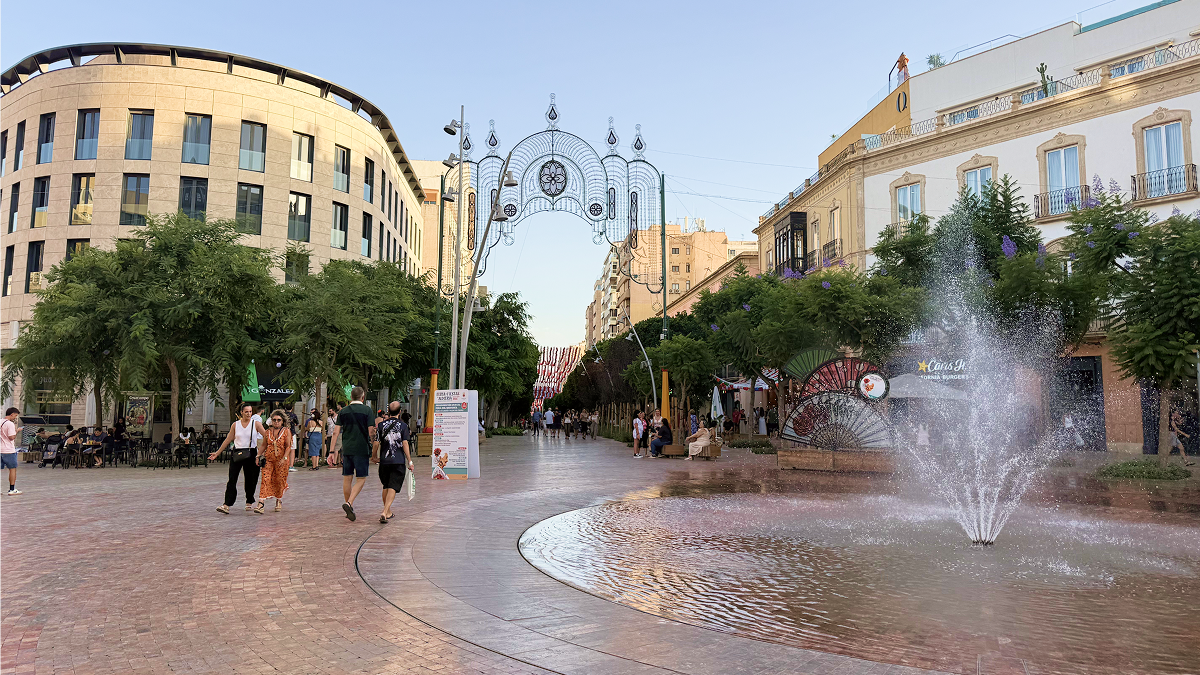
Puerta de Purchena, where the newly pedestrian Paseo now leads straight into the Feria. Credit: Euro Weekly News
For more than a year Almería’s main promenade has been a building site. Now, largely car-free after an €11.2 million transformation, the Paseo de Almería returns as the centre of the city’s Feria for the first time since the works began, backed by new bus routes and one of its biggest security operations yet.
The pedestrianised Paseo returns as the Feria’s stage for the first time
Almería City Council has spent €11.2 million rebuilding Paseo de Almería as a largely car-free public space under its ‘Ciudad de Plazas’ project, removing 9,700 square metres of asphalt, planting more than 320 trees and reserving just 3,600 square metres of restricted lane for residents, public transport and emergency vehicles. The works began in January 2025 and left the promenade unable to host the Feria’s usual activities while they were under way.
This year, for the first time since the transformation began, the council has restored what mayor María del Mar Vázquez called the Paseo’s historic role as a festival hub, with a miniature fair entrance at Puerta de Purchena, seven ambigú stalls (food and drink stands) spread across five plazas and a photocall area. For the nine days of the fair, between Friday August 21 and Saturday August 29, even that restricted resident and public transport lane is closed completely between Puerta de Purchena and the junction with Calle Lachambre and Calle Rueda López, with just two crossing points left open for people needing to reach the other side, according to the council’s full mobility guide.
The fairground goes car-free every night
From 6pm to 6am each day between August 21 and 29, the Recinto Ferial (fairground) is closed to general traffic altogether. Only public transport and residents with a permit can enter, through checkpoints at the Camino de la Goleta roundabout and Avenida Vega de Acá, or a new checkpoint at the junction of Árbol de la Seda and Camino de la Goleta.
One-off closures apply on top of that. The Dianas Floreadas parades on August 22, 23, 26 and 29 bring progressive traffic stops from 11am, a historical re-enactment through the centre closes streets on August 23, and the Batalla de Flores parade shuts Avenida Federico García Lorca and central streets including the Rambla from mid-afternoon on August 24.
Eight new bus routes link the city for €1.30 a ride
The city council has added eight special lines, labelled F1 to F8, connecting neighbourhoods including La Salle, Calle Granada, Pescadería, Piedras Redondas, El Alquián, Retamar, Torrecárdenas and Cruz Roja directly to the fairground. They run from 8pm to 7am, starting an hour earlier on August 26, 28 and 29, with a flat fare of €1.30 across the whole special network.
Traffic councillor María del Mar García Lorca said the reinforced service was designed to give residents ‘comfortable and accessible’ travel to and from the fair. Twenty-six vehicles have been assigned to the special routes alone, with the wider network running up to 60 buses at peak times.
More than 300 police officers a day, plus drones and a new mounted unit
Security for this year’s fair involves more than 300 officers and staff a day, drawn from the Policía Local, Policía Nacional, Guardia Civil, Bomberos de Almería (the fire service), Protección Civil and private security firms, alongside medical teams.
New this year is an aerial drone system giving live video coverage of the fairground and surrounding streets, and a mounted police unit joining patrols for the first time. Rapid-intervention and canine units are also deployed, alongside breathalyser checks on drivers and food safety inspections across the site’s stalls.
Mayor María del Mar Vázquez asked residents to ‘enjoy the fair with responsibility, civility and confidence’ in the measures put in place to keep it safe.
David Bisbal returned home for the fair’s biggest anniversary
Almería-born singer David Bisbal gave the traditional sermón (a ceremonial address in the Virgin’s honour) at the Virgen del Mar sanctuary on Friday August 21 at 7:30pm, as the city marked 75 years since she was granted her canonical coronation. He also gave a spectacular performance while closing the final night at Cooltural Fest, the city’s biggest music festival of the year, that brought more than 60 acts to Almería this year, including Lori Meyers, Ana Torroja, Hombres G and Rigoberta Bandini.
Behind a newly built 22.5-metre illuminated entrance gate, the fair runs to 21 casetas (marquees), three bullfights and a closing procession honouring the Virgen del Mar on August 30, when Almería’s newest public space will complete its very first Feria.
Almeria
David Bisbal’s incredible Almería homecoming turns Cooltural Fest into ‘one enormous chorus’

David Bisbal performs during his headline set at Cooltural Fest in Almería. Credit: Juan Marin Escoriza
David Bisbal turned his own hometown audience into one enormous chorus as he closed Cooltural Fest on its final night. The singer was one of the main attractions at a festival that one audience member says keeps getting better: bigger, louder and, in their words, more inclusive than anywhere else they’ve been.
Bisbal closes the festival with a tribute-filled homecoming set
David Bisbal closed this year’s four-day Cooltural Fest, one of the headline events of Almería’s summer feria calendar, on Sunday August 23 at the Recinto Ferial in his home city. The festival ran from Thursday August 20, and Bisbal shared Sunday’s bill with Vera GRV and Nixon, though the closing slot was always his.
The show, which began around 11.15pm, was later described as “apoteósico”, all-out spectacular, built around hits including “Ave María“, “Bulería” and “Lloraré las penas“, alongside tributes to Camilo Sesto and Julio Iglesias. Bisbal returned to the phrase “mi Almería” (my Almería) throughout, and by the closing numbers the fairground had reportedly become an enormous chorus, with thousands singing every line back at him.
It capped a busy few days for the singer in his home province. Two days earlier, on Friday August 21, Bisbal addressed the Virgen del Mar procession at the saint’s sanctuary, an appearance presented by his partner Rosanna Zanetti. The Cooltural Fest set was billed as his only Almería concert this summer, and arrives ahead of his new album, Eternos, due for release on Thursday October 2.
‘Everyone danced and sang every song’ on the closing night
For Paula Jiménez, 31, who attended all three days of the festival, the Bisbal set lived up to the billing. “On Sunday the most anticipated concert was obviously Bisbal, everyone danced and sang every single song,” she said.
Bisbal was not the only highlight of the weekend, though. On Friday, Paula said the crowd’s most enthusiastic reaction came for “Malibu” by underground artist Rusowski. “The crowd danced to it with so much energy, it was great fun,” she said. Saturday brought a surprise in Ultraligera, a band she hadn’t come across before. “Their stage show and the quality of the set really surprised me,” she added.
Bigger crowds, yet no queues this year
Cooltural Fest’s attendance has grown year on year, and Paula said this year’s crowd was noticeably bigger than the last edition. The site layout had changed too, with the entrance and the toilets moved to different spots around the grounds. “The toilets are now closer to the entrance, which was appreciated, and there are more near the Cupra stage,” she said. Despite the extra numbers, she affirmed that the reorganised layout meant no long waits for food or the toilets across the weekend. “The toilets especially weren’t overwhelmed like I’ve seen at other festivals,” she said.
One of Europe’s most inclusive festivals
The festival’s growth has come alongside a long-running employment and accessibility programme run with the Fundación Music For All, which has placed more than 50 people with disabilities in festival roles each year, including bar work, cleaning, access control and backstage support.
“We’re proud that each year there continue to be advances in this area,” said Crash Music director Diego Ferrón, whose company organises Cooltural Fest. Provincial equality representative Lorena Nieto has called it “the most relevant inclusive cultural project in the province.” On-site measures this year included sign language interpreters, subtitled performances and sensory-friendly spaces, part of more than 50 accessibility services built into the festival. Paula Jiménez said the improvements were visible on the ground.
“What makes it so inclusive is how well they manage the spaces so they work for people with different needs, as well as subtitling the songs during concerts and including sign language interpreters,” she said. “I’ve seen more people with functional diversity here than at any other festival.”
Next year’s 2027 edition marks the festival’s 10 year anniversary, and after this year’s line-up being a little askew from their usual style of heavily indie based acts, the anniversary edition could promise a spectacular return to its roots with some huge national and international names on the bill.
Costa del Sol expat Steve: older neighbours need the same kindness we showed family this summer
Istan painter Salvador Calvo brings 40 years of colour to Marbella this September
Stunning play opens Fuengirola theatre season with McDonagh’s dark classic
Make a small donation at Miramar shopping centre and transform a child’s first day back at school

How To Get A Tourist Rental Licence In Andalusia (Spain) – Step-By-Step Guide 2025

How Kimi Antonelli saved Red Bull as Max Verstappen signs blockbuster F1 deal


-
back to school2 weeks ago
Make a small donation at Miramar shopping centre and transform a child’s first day back at school
-
 New Developments2 weeks ago
How To Get A Tourist Rental Licence In Andalusia (Spain) – Step-By-Step Guide 2025
-
 Uncategorized2 weeks ago
How Kimi Antonelli saved Red Bull as Max Verstappen signs blockbuster F1 deal
-

 BCE2 weeks ago
Los Precios De La Energía En Europa Volvieron A Escalar Por Encima Del 10% En Julio
-
Alicant2 weeks ago
British pub giant bans loud phone videos and calls, should bars in Spain follow?
-
bullfighting1 week ago
Ronda’s September Feria returns with bulls back in the ring after two years away
-
airports in Spain2 weeks ago
British families flying between UK and Spain given fresh EES warning for under-12s
-

 benefits ban2 weeks ago
EXPLAINER: Which Benefits Could Brits Living In Spain Lose Access To Under Reform’s EU Welfare Ban – And Would It Include Pensions?