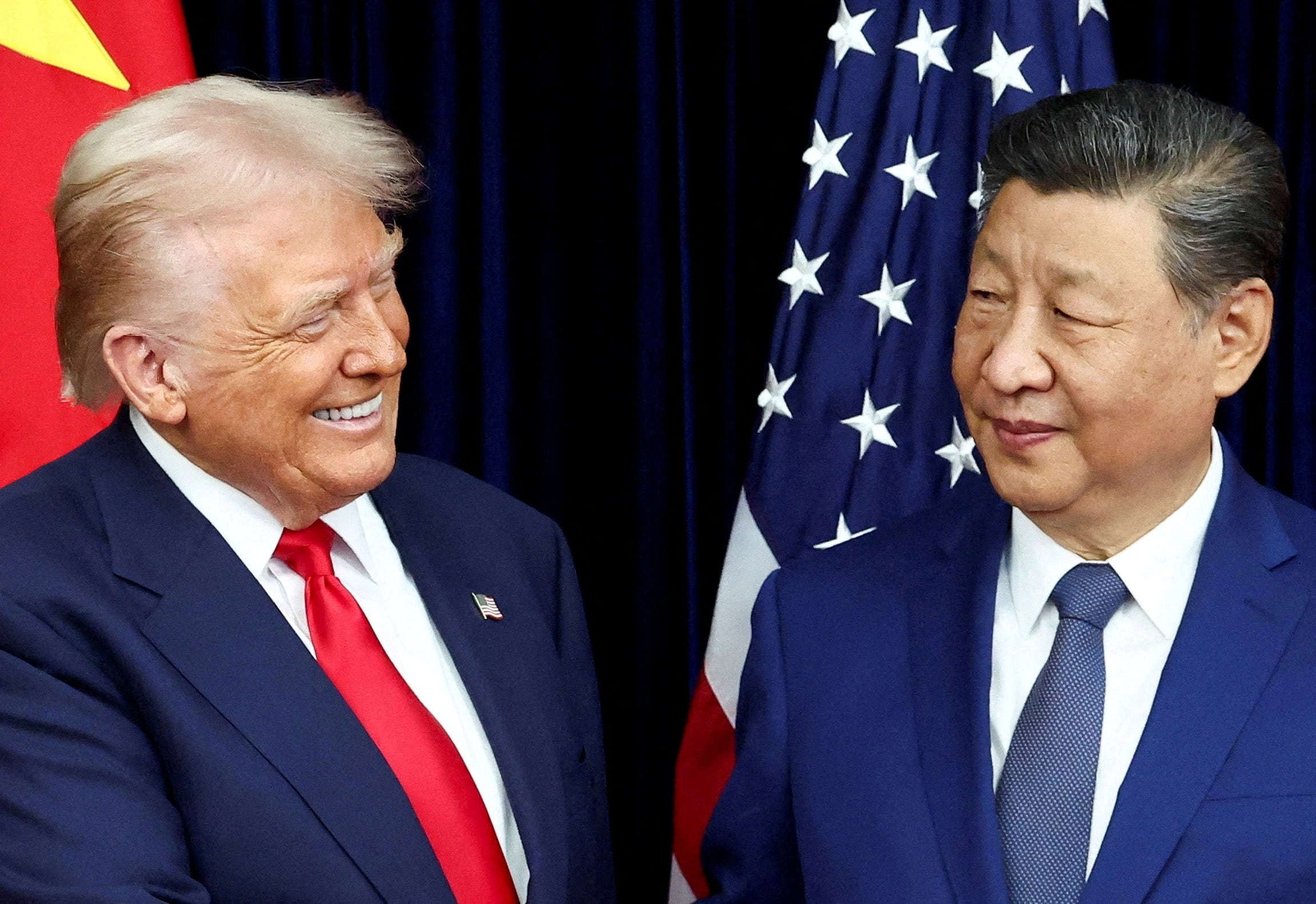
Faced with Donald Trump’s aggressive and erratic policies during his second term in the White House, his southern neighbors are increasingly looking more favorably toward China, the United States’ main strategic rival. The Asian giant is the only major power gaining prestige among Latin Americans, according to a survey conducted by the German Friedrich-Ebert-Stiftung Foundation, the magazine Nueva Sociedad, and the Diálogo y Paz group, released this week. China is gaining new supporters in the region (up by 6 points) while the positive image of the U.S. is plummeting (a 17-point drop) and that of Europe is declining, dragged down by Germany and France. Twelve thousand people in 10 countries participated in the survey.
Titled AMLAT Radar 2026, or Navigating Uncertainty: Latin American Perspectives on Europe and the World, the survey captures the current moment marked by global disorder and extreme uncertainty. It portrays the mood of 10 countries — Argentina, Brazil, Bolivia, Chile, Colombia, Costa Rica, Guatemala, Mexico, Uruguay, and Venezuela — regarding the world today. But it also allows us to appreciate the evolution of these perspectives in recent years, as it is the second iteration of a survey originally conducted in 2021-2022.
The authors highlight that, of the seven highest-rated powers/countries, China is the only one whose reputation has improved over the past four years. The rest are losing support. The analysis adds that “the leading countries of the Western world thus face a problem of declining reputation in the region, although they continue to top the list.” Spain leads with almost 31% positive mentions, followed less than a point behind by the United States and Germany. But the trend is clear: their popularity is currently in decline.
Browsing TikTok, shopping on Shein, and getting into or driving a BYD electric car are becoming increasingly commonplace for millions of people in Latin America. Over the past two decades, China has increased its presence to become South America’s leading trading partner, while the U.S. maintains that position in Mexico and Colombia.
China is once again the most frequent answer (36%) to the question of which country could serve as the best model for their country’s development. Japan follows (31%), and the United States is almost tied. The authors highlight the unique result for Venezuela, where the Chinese and American models appear virtually tied. The surveys were conducted before Trump’s military coup that decapitated the Chavista regime and before the United States, along with Israel, became embroiled in a war against Iran.
The authors of AMLAT Radar 2026 point out that Latin Americans do not consider China a threat but rather “as a pragmatic option associated with the value assigned to education, science, and technology.”
The United States is viewed primarily as a military and economic power. The damage to Washington’s reputation “reflects the costs of the Trump administration’s ill-timed and aggressive shift toward imposing a U.S. sphere of influence,” the report states. This shift has resulted in the current U.S. oversight of Venezuela, interference to ensure the victory of its preferred candidate in elections (as in Argentina and Honduras) or to try to prevent an ally like Brazil’s Jair Bolsonaro from being prosecuted, the use of military force to destroy alleged drug-running boats, and the inclusion of drug cartels on the U.S. list of terrorist organizations.
Latin Americans perceive Europe as having gradually distanced itself from Spanish- and Portuguese-speaking America. While it maintains a certain level of recognition, it carries “an image associated with the past, lacking dynamism and a clear or innovative role for the future.” This view emerges after several years in which Europe has grappled with the biggest war on its soil in decades, in Ukraine. But it also comes at a time when the European Union and Mercosur have created one of the world’s largest free trade zones, which will come into effect in a few days.
The authors draw attention to the low regard in which Mexicans hold their neighbor, the United States, three times less than that expressed for China. In contrast, in the other Latin American giant, Brazil, the opinion is the opposite.
In nine of the 10 countries analyzed, the impact of Trump’s policies is considered negative, a sentiment particularly strongly felt in Mexico. The exception is Venezuela, where the effect is perceived as slightly positive. When asked which leader they trust the least, Trump leads (25%), followed by Russia’s Vladimir Putin (12%), and Venezuela’s Nicolás Maduro (5%), who is almost tied with China’s Xi Jinping.
Some findings also stand out as emblematic. This is the case in Brazil, where a highly visible diplomacy coexists with a society that expresses the gravest doubts about its country’s foreign policy. Chileans are notable for their rejection of immigration, a factor that contributed to the electoral victory of the ultraconservative José Antonio Kast. And Mexicans and Chileans are the most reluctant to accept that the United States treats the region as its backyard, an opinion that likely underpins, according to the survey analysis, the high approval ratings of Presidents Claudia Sheinbaum and Gustavo Petro.
Sign up for our weekly newsletter to get more English-language news coverage from EL PAÍS USA Edition
















 %3 weeks ago
 Uncategorized4 weeks ago
 Uncategorized3 weeks ago