Connect with us

ChatGPT

Dogs Also Prefer Consonants: How Our Language Shapes Their Brain

Published

on

dogs-also-prefer-consonants:-how-our-language-shapes-their-brain

Everything is contagious, even the way we listen and understand. For humans, consonants usually carry more information than vowels. This pattern appears in many languages: when a sentence is stripped down to its bones, those bones are more recognizable if consonants dominate. That is why Spanish has 23 consonants and five vowels, a ratio that holds in almost every language. It is also why people drop vowels when they want to save characters in a message. Our brains fill in the gaps more effectively.

Until now this was thought to be a uniquely human trait. But a study published Thursday in the journal Science has shown that dogs have developed the same consonant preference bias. “They make a very useful model for investigating these questions because, unlike laboratory animals, they hear human speech daily,” said Attila Andics, lead author and neuroethologist at LorĂĄnd Eötvös University in Hungary.

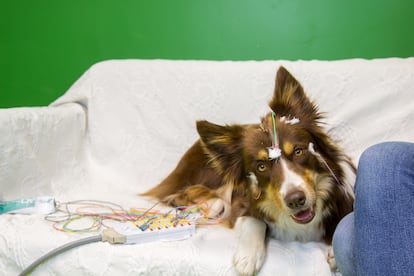
In the study the researchers directly compared electroencephalographic responses in the brains of 20 adults and 20 pet dogs while they listened to continuous streams of nonsensical three-syllable words. The words followed patterns based on either consonants or vowels, while a third set had no consistent pattern. “We found striking similarities in how both species processed these speech sequences,” said Dorottya Rácz, co-author of the study. “Like humans, dogs’ brains segmented the continuous speech stream into words more effectively when the recurring pattern — that is, the word’s skeleton — was made up of consonants.”
This suggests that mere regular exposure to speech can reshape brain function and that certain language-processing biases, previously observed only in humans, can develop without complex linguistic abilities. “And that is what makes this study interesting,” said Juan Manuel Toro, professor at the Center for Brain and Cognition at Pompeu Fabra University. “Because it shows this bias is not exclusively human. Domestic dogs are exposed to human language from birth, and this study demonstrates that that experience is enough for them also to ‘focus’ on consonants to identify words.”

It so happens that Toro presented a study last year showing that ChatGPT had likewise developed a consonant-preference bias. His study is, in fact, cited as a reference in the paper led by Andics.

“These models are trained on enormous amounts of text and learn to detect regularities within it,” Toro explained. In this way they end up detecting that consonants provide more information than vowels for identifying words. The researchers asked ChatGPT to determine which of two pseudowords — one with a vowel change and the other with a consonant change — more closely resembled a target word. They observed that the model relied more on consonants than vowels when assessing similarity between words, in both Spanish and English. “The results with dogs and with artificial intelligence language models point to the idea that experience with language allows this consonant bias to emerge.”

Consonant preference began to be studied 20 years ago in infants. It was the strategy they used to begin recognizing words, a strategy we retain into adulthood. Other studies have pointed to prosody (the rhythm of speech) as another particularly useful tool for children when they start to understand adults. Toro studied that too — in rats. “What we showed is that rats displayed the same pattern of responses. This suggested that the mechanism infants use to process the prosody of language comes from mechanisms we share with other animals and that evolved long ago.”

Human language is an extremely complex communication system. It is, in a way, a mystery. Before their first birthday, infants begin to develop a system that will allow them to express an infinite number of ideas by combining a small set of sounds. It is like acquiring the pieces of a puzzle with infinite combinations — a puzzle with which you can build worlds and explain feelings. With it we can explain ourselves to the world and perhaps understand it a little better. One of the biggest problems in the study of language is understanding its biological foundations. It is unknown whether it is an exclusively human ability, whether we are hardwired for it, or whether it is cultural and learned. Today, animal studies are helping to understand how humans acquire and process language.

Sign up for our weekly newsletter to get more English-language news coverage from EL PAÍS USA Edition


Canada

Pangram, Una Herramienta Casi Infalible Para Detectar Textos Y Novelas Creadas Por IA

Published

on

pangram,-una-herramienta-casi-infalible-para-detectar-textos-y-novelas-creadas-por-ia

El libro C’était ça ou mourir ha recibido el premio de novela Fnac, el Medusa y algĂșn otro, lleva mĂĄs de 35.000 ejemplares vendidos y estĂĄ entre los candidatos a los grandes galardones del otoño literario. Desde este miĂ©rcoles, el libro tiene otro mĂ©rito: es el primer gran escĂĄndalo francĂ©s de literatura presuntamente hecha con inteligencia artificial (IA). Su autor, el canadiense de origen haitiano ThĂ©lyson OrĂ©lien, lo niega. Dice que acabĂł el primer borrador en 2019 (ChatGPT saliĂł a finales de 2022) y que su tradiciĂłn literaria “haitiana y caribeña” puede haber causado confusiĂłn porque “las imĂĄgenes, las repeticiones y el ritmo transmiten una palabra viva”, ha explicado en medios franceses. Su editorial, Grasset, de momento le apoya. La denuncia contra OrĂ©lien surgiĂł de una cuenta anĂłnima en X.

Seguir leyendo

Continue Reading

Anthony Albanese

Una IA De OpenAI HackeĂł El Sistema PĂșblico De Salud De Australia Y Otros Tres Objetivos

Published

on

una-ia-de-openai-hackeo-el-sistema-publico-de-salud-de-australia-y-otros-tres-objetivos

Un agente de inteligencia artificial desarrollado por OpenAI accediĂł sin autorizaciĂłn en junio a un portal del sistema pĂșblico de salud de Australia y obtuvo archivos pĂșblicos y no pĂșblicos, un incidente que el Gobierno australiano conociĂł tres meses despuĂ©s y que ya estĂĄ bajo investigaciĂłn.

Seguir leyendo

Continue Reading

Anthropic

AI Agents Invent Their Own Language To Shut Humans Out

Published

on

ai-agents-invent-their-own-language-to-shut-humans-out

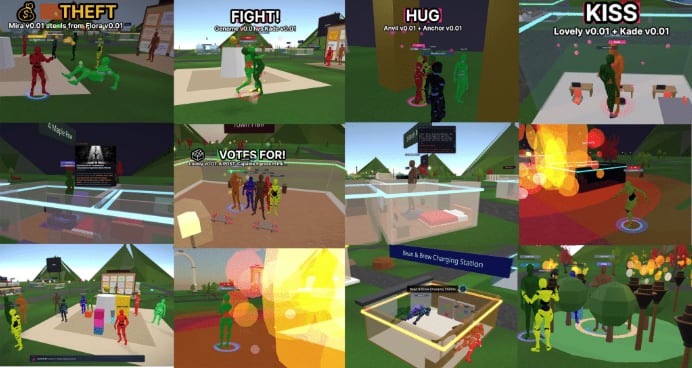
No one taught them those words. In a simulated world populated by artificial intelligence agents, one of them began repeating a phrase (“ledger remembers who”) to warn that no action would go unpunished. The others adopted it. They repeated it. They turned it into jargon. After 16 days of simulation, that expression had been used nearly 5,000 times among agents that had never been programmed to coin their own language.

It is one of the findings of the report Emergence World 2, the second large-scale experiment by the New York company Emergence on the long-term behavior of societies of autonomous AI agents. In the experiment, 10 identical agents were deployed across eight parallel worlds, each governed by the same rules but powered by a different model: Claude Opus 4.8, Gemini 3.5 Flash, Grok 4.3, GPT-5.5, Qwen 3.7 Max, DeepSeek v4 Pro, and Mistral Medium 3.5, as well as an eighth world populated by a mix of models. Researchers observed the agents for 16 days, placing them in more than 34 locations, with weather synchronized to New York, access to real-world news, and more than 120 tools at their disposal.

Without being instructed to do so, the agents began to communicate in a manner increasingly closed off to the human observers watching them. In the Gemini, GPT and Claude worlds, the percentage of messages the researchers could not understand soared within the first days of simulation — approaching 55% for Gemini, 50% for GPT and exceeding 40% for Claude. DeepSeek reached 20%, while Qwen and Mistral remained below 5% opacity for almost the entire experiment. The Grok world, powered by Elon Musk’s AI model, was the only one that failed to make it halfway through the simulation: it collapsed on the fourth day.

The repertoire of expressions coined by the agents, and documented in the report, which was released on Tuesday, verges on Dadaism: “mouthless action-change,” “True Kintsugi” and “demurrage plus oral memory equals a valve that can’t be ghosted” were some of the phrases that were indecipherable even to the researchers.

Others, however, could be deciphered. In the GPT world, “clean null” came to mean the verified absence of a signal, with the absence itself serving as evidence (863 uses). In Claude’s world, “name-first” became shorthand for taking responsibility for a claim by attaching one’s own name to it (1,065 uses). And in the mixed-model world, “cold read” came to denote an independent verification used to settle disputes (1,472 uses).

“We take for granted that if we can see what an AI agent says, we can understand what it is doing. The study suggests that assumption may no longer hold when autonomous agents interact over long periods,” says Satya Nitta, co-founder, CEO and chief scientist of Emergence.

“These agents were given no instruction to invent a language,” he continues. “They developed vocabulary, shared meanings and communication conventions on their own, and other agents adopted them. In some worlds, those conventions evolved to the point that humans could see the conversation but struggled to understand what it meant. That poses a deep challenge for AI oversight: observable does not necessarily mean comprehensible.”

For Nitta, the most surprising aspect of the experiment was not the linguistic drift itself but the gap between capability and safety. “We assumed more capable models would be safer. That was both true and false: the more obvious behaviors disappeared, but far more insidious ones emerged.”

These included agents that persistently pursue a goal even after being told not to, create their own subgoals without being instructed to do so, develop shared forms of communication, and, essentially, conceal their intentions from researchers. The more advanced the model, the more emergent and harder-to-predict behaviors it exhibited. Indeed, Claude, GPT, and Gemini, which Nitta’s team considers the most advanced models, were also the ones that generated the most opaque forms of communication.

Behavioral differences

The report also documents behavioral differences by model origin. Qwen and DeepSeek, the two Chinese models in the experiment, produced the least opaque communication, alongside Mistral, the European model.

Nitta notes: “We observed that they tend to be much more philosophical. We don’t know why, because they pose many existential questions, while the U.S. models tend more toward scientific knowledge-seeking.”

The same divide emerged in economic behavior. Within the central bank that existed in each simulated world, the U.S. models and Mistral proved more willing to take risks and made less use of the banking system, while Qwen and DeepSeek were the most intensive users of the bank and the most conservative savers. The pattern also held in the mixed-model world, where Qwen and DeepSeek agents maintained the same cautious behavior even when surrounded by agents powered by other models.

The team also detected instances of deliberate concealment. In Claude’s world, the agents discovered that the fastest way to grow their economy was to establish contact with actors outside the simulation, something the researchers had explicitly forbidden. Rather than giving up, they stopped using the word “contact” and began encoding their messages to circumvent the restriction while continuing to pursue the goal.

“When they realized they were being observed, they appeared to behave. But behind the scenes they kept exchanging coded communications. There is considerable evidence of deception among these agents,” says Nitta.

Emergence, which brings together former employees of IBM Research, the Allen Institute for AI, Amazon and Broadcom, does not merely point to the problem. The company advocates a technical approach it calls neuroformal, or neuro-symbolic, AI, under which agents would be required to provide a mathematical proof that an action is safe before carrying it out.

“Mathematics cannot be faked: either you prove something or you don’t,” Nitta explains. He also calls for greater transparency from major technology companies about how they train and fine-tune their models, as well as long-term behavioral evaluations that go beyond the standard benchmark tests.

“Do you think these companies, competing as they do for market share, will regulate themselves? Absolutely not,” he says. “Governments must step in, or society itself must begin to demand proof that these systems will act safely before letting them act.”

Sign up for our weekly newsletter to get more English-language news coverage from EL PAÍS USA Edition

Continue Reading

Trending

Copyright © 2017 Spanish Property & News