Connect with us

%

EU Launches Legal Action Against Spain Over ‘excessive’ Traveller Data Collection

Published

on

eu-launches-legal-action-against-spain-over-‘excessive’-traveller-data-collection

EU investigates Spain over excessive passenger data collection and retention. Photo Credit: Deniz Demirci / Unsplash

The European Union announced that it has launched infringement proceedings against Spain for failing to comply with its regulations on passenger data protection. The proceedings claim that the categories of data about passengers, as well as the time for which the authorities keep them, are excessive.

Spain’s data privacy issue: Too much data, held for too much time

To be specific, Spain requires travel accommodation providers, online booking platforms, and car rental companies to collect and store travellers’ personal data in a government database. However, the amount of data collected, as well as the categories, including payment information and GPS data, is the main point of contention. Additionally, Brussels alleges that law enforcement authorities have too broad access to this data without limitations.

Spanish authorities also retain the information for a period of three years, which Brussels states is “disproportionate.”

Brussels launches formal proceedings: What will happen if Spain does not correct the problem within 2 months

Brussels announced the proceedings on Thursday, June 4, having sent a formal notice letter to Spanish representatives. Spain now has two months to correct the system for collecting traveller data. If the issue is not resolved, Brussels can negotiate more time with Spanish authorities, but if an agreement is not reached, Spain could be denounced before the Court of Justice of the European Union (CJEU). 

If this occurs, and the CJEU rules that Spain has not complied with EU regulations, they could legally obligate the member state to comply, and in more extreme cases, impose strict fines on the country.

Travel organisations: Vindicated, but urging for immediate change

Following the announcement of the proceedings, FETAVE (the Spanish Federation of Territorial Associations of Travel Agencies), and UNAV (the Union of Travel Agencies), have put in a request for the Ministry of the Interior to suspend the application of the Royal Decree 933/2021, which obligates these agencies to collect, store, and send the data.

FETAVE, which is currently in the process of merging with UNAV, highlighted that it was the only Spanish tourism sector organisation that challenged the Royal Decree 933/2021 with European Union law, in January 2023. Since then, the organisation has consistently opposed the regulation.

Now, the two organisations state that the European Commission’s decision to impose sanctions on Spain confirms their suspicions about the “disproportionate” nature, “legal uncertainty” and “practical unfeasibility” of the obligations of the decree.

Carlos Garrido, President of the Spanish Confederation of Travel Agencies, stated, “the obligation to collect and communicate tens of thousands of personal data points from millions of travellers has placed a disproportionate administrative burden on travel agencies and other tour operators, without a convincing explanation for the necessity of much of this data.”

But what will change for travellers if Spain is forced to comply?

The review and change of this royal decree will not have a broad, obvious impact for travellers checking in to hotels or renting cars, but the new compliance may see holidaymakers with slightly less paperwork to do upon arrival (or less fields to fill on an online form), and more transparency from travel agencies and booking companies in Spain.

Could the Entry/Exit System be impacted by the decision?

The EES can be reviewed, examined by the CJEU, and changed, but only through an EU legislative process. As it stands, the data collected from the EES across the whole of Europe and the data collected specifically in Spain function as two separate systems, and changing the EES would be a Europe-wide review of the framework, not on a national level.

%

Murcia Golf Society Raises Vital Funds For Rescue Dog’s Life-Changing Surgery

Published

on

murcia-golf-society-raises-vital-funds-for-rescue-dog’s-life-changing-surgery

Golf fundraiser funds surgery, giving rescue dog Greta new life Photo Credit: PAPS

A local golf club fundraiser in Murcia has helped to change the life of a 12-year-old rescue dog, after raising enough money to cover her vital surgery. Greta is a long-time shelter resident at the PAPS animal shelter in San Javier, Murcia, and is deeply beloved by the workers at the shelter.

A gentle dog, beloved by the friends at the shelter

Greta, a gentle and affectionate dog, has been at the PAPS (Protectora de Animales Perros del Sol) animal shelter since 2018, and needed a vital surgery. “Unfortunately, she needed extensive surgery on her elbow. This involved many trips to the vets and weeks of staying with one of our volunteers. Greta made herself very comfortable on their sofa!” stated the animal shelter in a post about the donation.

After local golf society, the El Valle Golf Club, hosted a fundraiser, an astounding €500 was collected and donated to PAPS. The cheque was presented to the animal shelter by former club treasurer Sandy Clare.

“Huge thank you to Sandy Clare for his donation of €500,” stated PAPS.

Greta has made a full recovery following her surgery

The animal shelter stated that the funds went directly towards Greta’s surgery and offers her a better quality of life in her later years. The shelter even offered an update through a Facebook post thanking the golf society for its generous donation.

“I’m pleased to report that Greta has made a full recovery and is now back at PAPS,” the shelter stated.

How to help Greta and the other pups at PAPS

Shelters like PAPS heavily rely on donations to help cover veterinary costs, food, and daily care for abandoned and rescued animals. Those who are interested in donating to Greta or any of the other shelter dogs can get in contact with the shelter through email at animalesperrosdelsol@hotmail.com

“Let’s hope this surgery helps Greta find her forever home,” stated the PAPS animal shelter.

Continue Reading

%

1-Minute Bottle Trick For Clearing Of Flies

Published

on

1-minute-bottle-trick-for-clearing-of-flies

A Spanish summer is hard to beat. Long, late hot evenings, gorgeous sunsets with cocktails and al fresco dining. Its what makes life in Spain so special. But you have to take the rough with the smooth, as the heat also invites one of the country’s most frustrating and unhygienic seasonal pests. The common housefly.

The hotter it is, the faster food spoils, creating a breeding paradise for insects. Not only are they unbelievably annoying, they are also a health hazard, acting as vectors for diseases like salmonella, dysentery, and cholera.

To tackle the problem early on you can use a classic home remedy. It takes less than a minute to assemble, costs next to nothing, and offers a chemical-free way to protect your living spaces all season long.

How to build the classic plastic bottle fly trap

The plastic bottle fly trap works on a basic mechanical principle. Flies are drawn down into the structure by an enticing scent but are naturally unable to find the small opening to fly back out. To build, follow these three quick steps –

Take a clean plastic bottle and cut it roughly 10 centimetres below the cap, right where the plastic begins to widen.
Turn the top section upside down so the neck points downward like a funnel, and place it directly inside the bottom base. Leave a small gap of clear space between the mouth of the inverted funnel and the bottom of the bottle.
Secure the two pieces together by wrapping adhesive tape completely around the top rim. This keeps the structure stable and seals any tiny side gaps that a fly could use to crawl out.
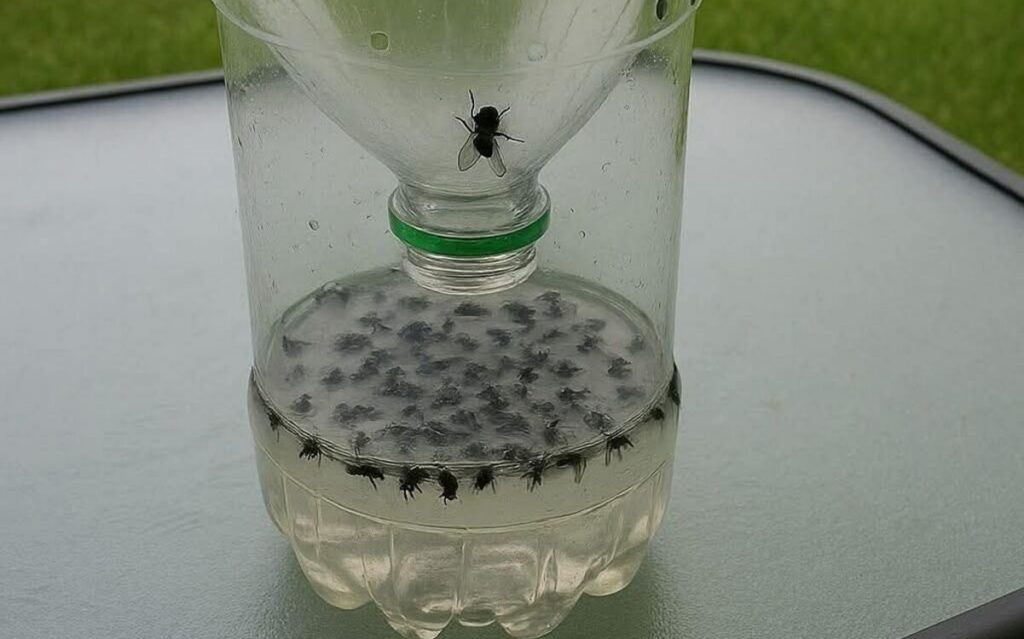
Homemade fly trap
Homemade trap
Credit:Zîî Noôu/FB

The right indoor and outdoor bait recipes for success

While many online guides suggest a blanket mixture of water, sugar, and vinegar, using the wrong recipe inside your home can backfire. Large houseflies have entirely different preferences than tiny fruit flies, so matching your bait to the location is key.

Best bait for outdoor terraces and gardens

If you are placing your trap out on a patio, courtyard, or balcony, use a mixture of water, sugar, and vinegar. The sweet, fermenting aroma is incredibly effective at pulling pests away from your outdoor dining table. Because of the sharp, pungent scent, this specific mixture is strictly recommended for well-ventilated outdoor areas.

Best bait for kitchens and indoor spaces

Avoid using vinegar indoors. Large houseflies are often naturally repelled by it, and the smell can quickly become overwhelming inside a house. Instead, fill your indoor trap with warm water and plenty of dissolved sugar. To supercharge this indoor mix, drop in a small piece of overripe fruit (like a slice of banana or melon) or a pinch of baking yeast. This creates a mild, low-odour fermentation process that houseflies find irresistible.

Easy natural alternatives using everyday items

Sticky homemade fly paper

You can easily create your own chemical-free fly ribbons. Cut strips out of a brown paper bag, punch a hole at the top of each, and thread a string through for hanging. In a saucepan over medium heat, warm equal parts water and sugar with three tablespoons of honey, stirring until it forms a thick, sticky glaze. Coat the paper strips in the mixture and hang them up in problem areas where insects tend to gather.

The diluted vinegar barrier spray

Because houseflies actively avoid the scent of vinegar, it makes a terrible trap bait, but an exceptional defensive barrier. To use it indoors without creating an overwhelming smell in your living areas, mix equal parts vinegar and water in a spray bottle. Instead of misting the air, spray it strictly onto targeted entry points—like exterior window frames, door tracks, and the inside base of household bins. The scent quickly fades for humans as it dries, but it remains strong enough to disorient flies and stop them from crossing into your home.

Potted aromatic plants that act as natural deterrents

Utilizing the power of aromatic plants is a stylish way to help move them along. These plants add beautiful decorative value to Spanish windowsills and balconies and also have natural essential oils doubling up as insect repellents.

Citronella and mintCitronella is the ultimate defender for outdoor terraces. Indoors, potted peppermint is incredibly hardy, easy to maintain on a windowsill, and releases a sharp mentholated fragrance that flies actively avoid.
Basil and sage – Broad-leaved basil varieties are perfect for kitchen counters, producing an aroma that disrupts a fly’s sensitive sense of smell. Sage releases strong essential oils that create a highly unattractive environment for flying insects.
Bay leavesBay leaves naturally contain organic compounds called cineole and eugenol, which are scientifically proven insect deterrents. You can place dried bay leaves inside your pantry cupboards or scatter them on windowsills to amplify the protective effect.

Top tip. To make your live plants work effectively as natural deterrents, remember to gently rustle or brush their leaves occasionally. This physical action breaks the plant’s oil glands and releases the defensive aromas into the air.

Combined with daily kitchen hygiene, wiping surfaces down, and emptying your household bins frequently, these natural tricks will help your Spanish summer stay peaceful and fly-free.

Continue Reading

%

Ryanair Flight Leaves 150 Passengers Behind

Published

on

ryanair-flight-leaves-150-passengers-behind

Passengers faced heavy congestion at Toulouse Airport, where long border control queues were blamed for travellers missing a Ryanair flight to London. Credit : BalkansCat, Shutterstock

Most travellers believe there is one simple rule when flying: arrive at the airport early and you’ll be fine. For around 150 Ryanair passengers at Toulouse Airport last week, that wasn’t the case.

Despite checking in, clearing security and making their way through the terminal, they never made it onto their flight to London Stansted. The aircraft took off without them after long queues at border control left hundreds of passengers stuck waiting while boarding was already underway.

The incident has sparked fresh concerns about growing delays at some European airports following the introduction of the EU’s new Entry/Exit System (EES). With the summer holiday season now beginning, many travellers are wondering whether arriving two hours before departure will still be enough.

According to passengers who were there, the problem was not a delayed flight or a last minute gate change. It was simply the sheer number of people trying to get through border checks at the same time.

For anyone planning a summer trip between the UK and Europe, the story serves as a reminder that the biggest obstacle may no longer be airport security. It could be what happens afterwards.

How 150 passengers ended up missing the same Ryanair flight

The flight involved was Ryanair service FR282 from Toulouse to London Stansted on 30 May.

Passengers described scenes of confusion near border control as hundreds of travellers attempted to reach departure gates for several flights scheduled around the same time.

One traveller told The Connexion that the area was packed with people and that there appeared to be no clearly organised queue system. Instead, passengers were trying to move forward through a crowd that she estimated included several hundred people.

Her description painted a picture many frequent travellers will recognise. Everyone could see the departure time approaching, yet nobody seemed to be moving fast enough to make progress.

She said there were between 400 and 500 people gathered in the area and described the situation as chaotic.

By the time many passengers finally reached the gate, boarding had already closed.

According to reports from passengers on board the aircraft, the pilot later announced that approximately 150 travellers had failed to make the flight because they were still stuck in the border control queue.

For those left behind, it was a frustrating end to a journey that had started exactly as planned.

Why border queues are becoming a bigger problem for travellers

The timing of the incident is significant.

European airports are currently adapting to the gradual introduction of the Entry/Exit System, commonly known as EES.

The new system is designed to modernise border management by collecting biometric information from non EU travellers entering the Schengen Area. Depending on the circumstances, this can include fingerprints and facial image registration.

The objective is to improve border security and create a more accurate record of entries and exits.

However, aviation industry groups have repeatedly warned that the transition period could create longer waiting times at some airports.

British travellers are among those most likely to notice the changes because they now pass through border procedures that differ from those in place before Brexit.

During quieter periods the impact may be limited.During school holidays, bank holiday weekends and peak summer travel days, even small delays can quickly build into much larger queues.

That appears to be what happened in Toulouse.

Ryanair has disputed claims that passengers were deliberately left behind.

In a statement, the airline said the issue resulted from border control staff shortages at Toulouse Airport. The carrier added that all passengers who reached the gate before boarding closed travelled without any issues.

What travellers can learn from the Toulouse incident

Nobody enjoys arriving at an airport hours before departure. Most travellers aim to leave enough time without spending half the day sitting near the gate.

The difficulty is that airport processing times are becoming harder to predict.

A passenger who flew through the same airport last month may have a completely different experience this month depending on staffing levels, passenger numbers and border procedures.

Travel experts continue to advise passengers to allow extra time when travelling internationally, particularly on routes involving passport checks.

For UK travellers heading to destinations within the Schengen Area, the first months of EES implementation may be less predictable than many people are used to.

The Toulouse incident does not mean every airport will experience the same problems.

It does, however, highlight how quickly delays can build once large numbers of passengers reach border control at the same time.

For the 150 travellers who watched their Ryanair flight leave without them, arriving at the airport was not the challenge.Getting through the final queue turned out to be the real problem.

Q&A section

Which flight was affected?

The incident involved Ryanair flight FR282 from Toulouse Airport to London Stansted on 30 May.

How many passengers missed the flight?

According to reports from passengers on board, around 150 travellers were unable to reach the gate before boarding closed.

Why were passengers delayed?

Travellers reported lengthy queues at border control, while Ryanair said border control staff shortages contributed to the delays.

What is the EU Entry/Exit System (EES)?

The EES is a new border management system that records biometric information from non EU travellers entering the Schengen Area.

Will all airports experience similar delays?

Not necessarily. Waiting times will vary depending on passenger numbers, staffing levels and how quickly airports adapt to the new procedures.

Should travellers arrive earlier at the airport this summer?

Many travel experts recommend allowing extra time for international flights, particularly when travelling between the UK and Schengen countries during busy holiday periods.

Continue Reading

Trending

Copyright © 2017 Spanish Property & News