
Foreign demand
Has foreign demand for Spanish property peaked? Latest figures suggest so

Foreign demand for Spanish property appears to be running out of steam after the extraordinary boom that followed the pandemic, according to the latest figures from the Spanish Land Registrars’ Association.
The latest numbers for Q1 2026 reveal that 24,791 Spanish home sales involved a foreign buyer, down 3% on the same period last year. That marks the third consecutive quarterly decline, suggesting that the foreign market has shifted from post-pandemic boom to gentle cooling phase.
A market losing momentum after the post-pandemic surge
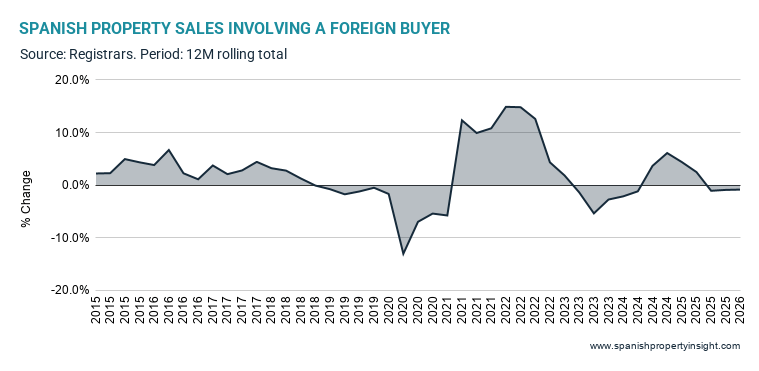
The foreign market has already had one false dawn. After cooling in 2023 following the frenetic rebound that came after Covid lockdowns, the market found a second wind in 2024 before slowing again. The latest figures suggest that second rebound has now also run its course.
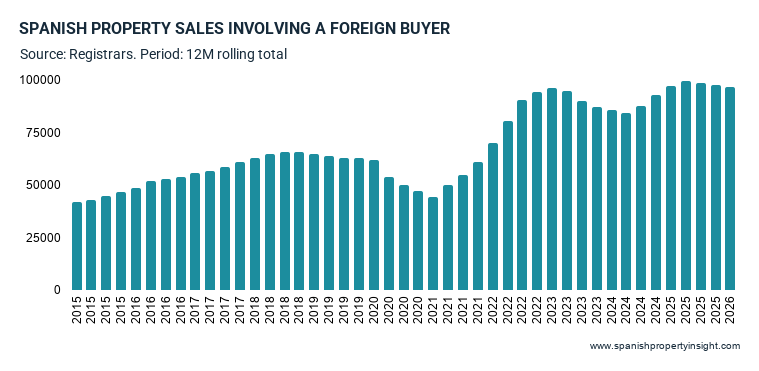
One of the best ways to understand the underlying trend is to look beyond volatile quarterly figures and focus instead on the 12-month rolling total of sales involving foreign buyers (chart above). This smooths out seasonal swings and gives a clearer picture of direction.
Using this measure, the transformation in the market over the last decade is striking. Before the pandemic, foreign demand typically hovered around 65,000 purchases every 12 months. In the wake of Covid, however, demand surged to above 90,000 as lifestyle changes, remote working, accumulated savings, and renewed appetite for sunshine destinations fuelled a buying spree across coastal Spain.
But the latest figures suggest that the market has now reached a plateau.
The 12-month rolling total peaked in Q2 2025 at 99,458 purchases involving a foreign buyer—just shy of the symbolic 100,000 mark—and has edged lower every quarter since. By Q1 2026 the rolling total had slipped to 96,696, down just under 1% compared to Q4 2025.
Still historically strong
Importantly, this is not a collapse. Foreign demand has now declined for three consecutive quarters both year-on-year and on a rolling 12-month basis, but the declines remain relatively modest—typically around 3% to 4% year-on-year, and closer to 1% when viewed through the smoother rolling-total lens.
In other words, the foreign appetite for property in Spain appears to be cooling rather than crashing.
And even after the recent softening, demand remains dramatically above the levels seen during most of the previous decade. The 2020s have, so far, been an exceptionally strong period for Spain’s foreign property market despite—or perhaps partly because of—the chaotic start to the decade with the pandemic.
Not all foreign markets are behaving the same
The headline numbers also conceal important differences between nationalities. Some buyer groups, such as the Polish market, continue to expand, while others—notably the British market—have been weakening.
So whilst the overall market may now be plateauing after the post-pandemic boom, beneath the surface the composition of foreign demand is still evolving. That, however, is a story for another day.
What this means for sellers
For sellers, the shift matters because foreign buyers have been one of the main engines driving many coastal and lifestyle markets in Spain over the last few years. If there are fewer buyers around, even modestly fewer, the balance of power in the market begins to change.
We are not yet in a full-blown buyers’ market. Buyers are not quite “in the saddle” yet. But the direction of travel increasingly suggests that negotiating power is slowly moving away from vendors and towards purchasers.
That means sellers will increasingly find themselves competing for a smaller pool of buyers, whilst also facing growing competition from new-build developments and professional developers who are often better prepared, better marketed, and more flexible on incentives.
In a market like that, simply putting a property online and hoping for the best may no longer be enough. Vendors will need to price more carefully, present properties better, sort out documentation and legal issues in advance, and think more strategically about marketing and negotiation.
In other words, as the post-pandemic frenzy fades, preparation and professionalism are likely to matter more than ever.
Thinking of selling a property in Spain?
A successful sale starts before you put your property on the market — and before you even speak to estate agents or lawyers. The first step is to understand what you own, what your property is worth, what sort of market you are selling into, how the sales process works, who you can trust, and what strategy makes most sense for you.
Too often, owners enter the process without independent advice and end up being steered by agents or others whose priorities may not fully align with their own. SPI offers expert guidance designed to put your interests first, helping you get organised, make sense of the market, and prepare for sale with a clear plan and personalised strategy.
Fill in the form below to find out more about the service.





Author:  Mark Stücklin
Posted on
When it comes to foreign buyers of second-homes in Spain, the Dutch are now important players on the Mediterranean coast, the Germans still rule the islands, the Brits are hanging on, and Americans have spread out across Spain.
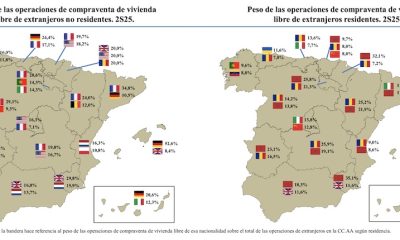
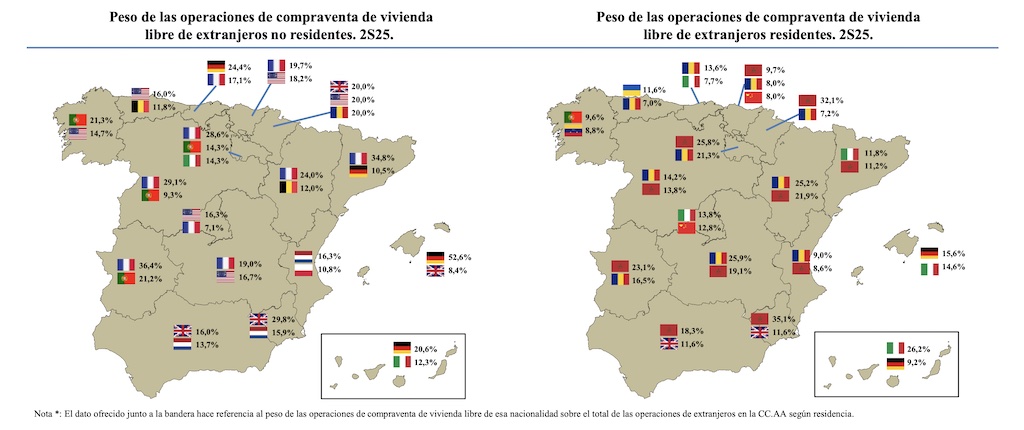
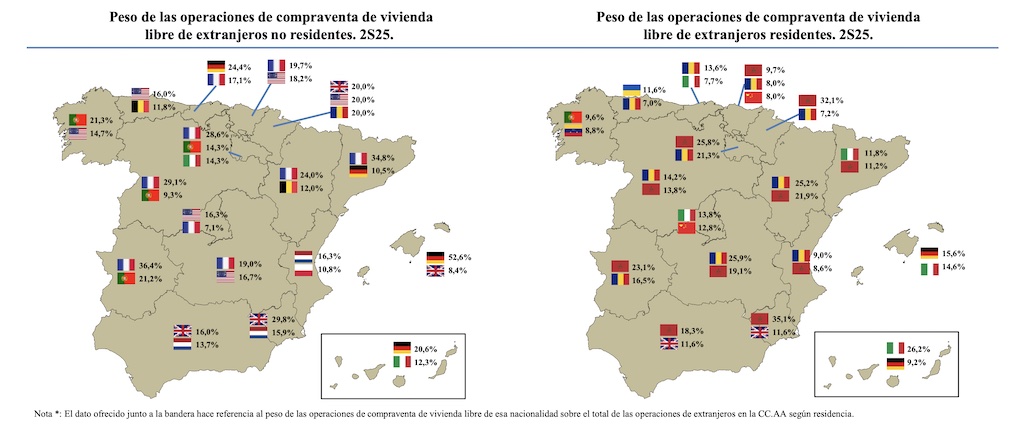
The Association of Spanish Notaries has recently published its latest report on foreign demand for property in Spain, including maps showing the top two foreign nationalities buying homes in each region, split between non-residents (typically second-home buyers) and foreign residents / expats living in Spain at the time of purchase (maps above).
The maps reveal how the geography of foreign demand keeps evolving — and in H2 2025 one trend stands out in particular: the rise of American buyers, who are now in the top two nationalities in six regions when it comes to non-resident buyers, putting them level with the French and well ahead of the British, who now only make the podium in four regions.
That’s quite a turnaround. A few years ago American buyers barely registered in the rankings outside a handful of luxury hotspots. Now they are becoming a meaningful force in Spain’s foreign second-home market, especially in higher-end destinations and lifestyle markets.
The Dutch, meanwhile, have quietly become one of the dominant nationalities in Spain’s non-resident market. According to the report, they account for 16pc of the foreign market in the Valencian Region, almost 16pc in Murcia, and nearly 14pc in Andalusia.
The Germans continue to dominate the islands, especially the Balearics where they make up more than half of all foreign non-resident purchases. They are also particularly important in the Canaries, Cantabria, Galicia, and Asturias.
The British, by contrast, continue their long slow retreat from the dominance they once enjoyed before Brexit. They remain highly relevant in Murcia and Andalusia, and still have a strong presence in the Valencian Region and the Balearics, but they no longer dominate Spain’s foreign market in the way they once did.
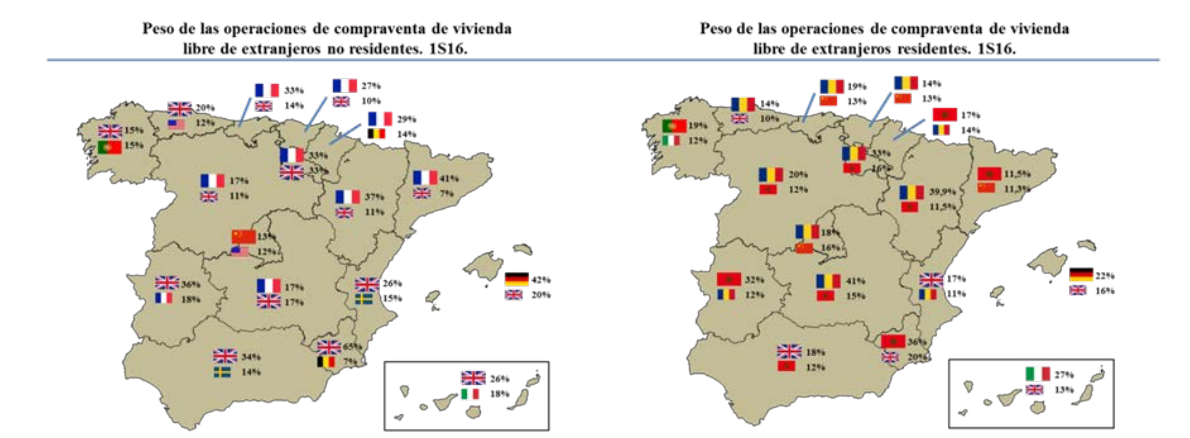
Just over a decade ago in H1 2016, British buyers were one of the top two foreign nationalities in fifteen of Spain’s seventeen regions. Today they are increasingly concentrated in a handful of traditional coastal strongholds.

Ojen & The Julio Iglesias Museum That’s Still On Hold

E

E

Dinero En Efectivo Guardado En Casa Y La Devolución De Los Gastos Del PSOE: La Expareja De Koldo Protagoniza La Cuarta Jornada Por El ‘caso Mascarillas’

Última Hora De La Guerra De Estados Unidos E Israel Contra Irán, En Directo | EE UU Asegura Que Dos De Sus Buques Militares Han Cruzado Ormuz Para Desminar El Estrecho E Irán Lo Niega

Mercedes F1 star Kimi Antonelli feeling the pressure after Italian heartbreak


-
 Caso Koldo4 weeks ago
Dinero En Efectivo Guardado En Casa Y La Devolución De Los Gastos Del PSOE: La Expareja De Koldo Protagoniza La Cuarta Jornada Por El ‘caso Mascarillas’
-
 Ataque contra Irán4 weeks ago
Última Hora De La Guerra De Estados Unidos E Israel Contra Irán, En Directo | EE UU Asegura Que Dos De Sus Buques Militares Han Cruzado Ormuz Para Desminar El Estrecho E Irán Lo Niega
-
 Uncategorized4 weeks ago
Mercedes F1 star Kimi Antonelli feeling the pressure after Italian heartbreak
-
DGT4 weeks ago
DGT launches week-long speed crackdown on Spanish roads
-

 New Developments3 weeks ago
How To Get A Tourist Rental Licence In Andalusia (Spain) – Step-By-Step Guide 2025
-

 Andalucia4 weeks ago
La Policía Detiene A Un Hombre En Córdoba Por El Asesinato De Su Pareja
-

 Uncategorized3 weeks ago
Max Verstappen Nurburgring LIVE: NLS5 Schedule, start times and free live streams
-

 %4 weeks ago
Young Engineers Hold STEM Day Workshop