
Latest
Inside The Ancient Town Of The ‘seven Sevens’: This Walled Gem In Aragon Offers A Perfect Weekend Escape


 THIS medieval town in northern Spain has preserved an obsession with the number seven behind one of the country’s longest defensive walls – and it’s perfect for a weekend getaway.









 A PLEASURE boat made a shocking find on Monday when its crew spotted a headless corpse floating in the water off the Valencia coast.

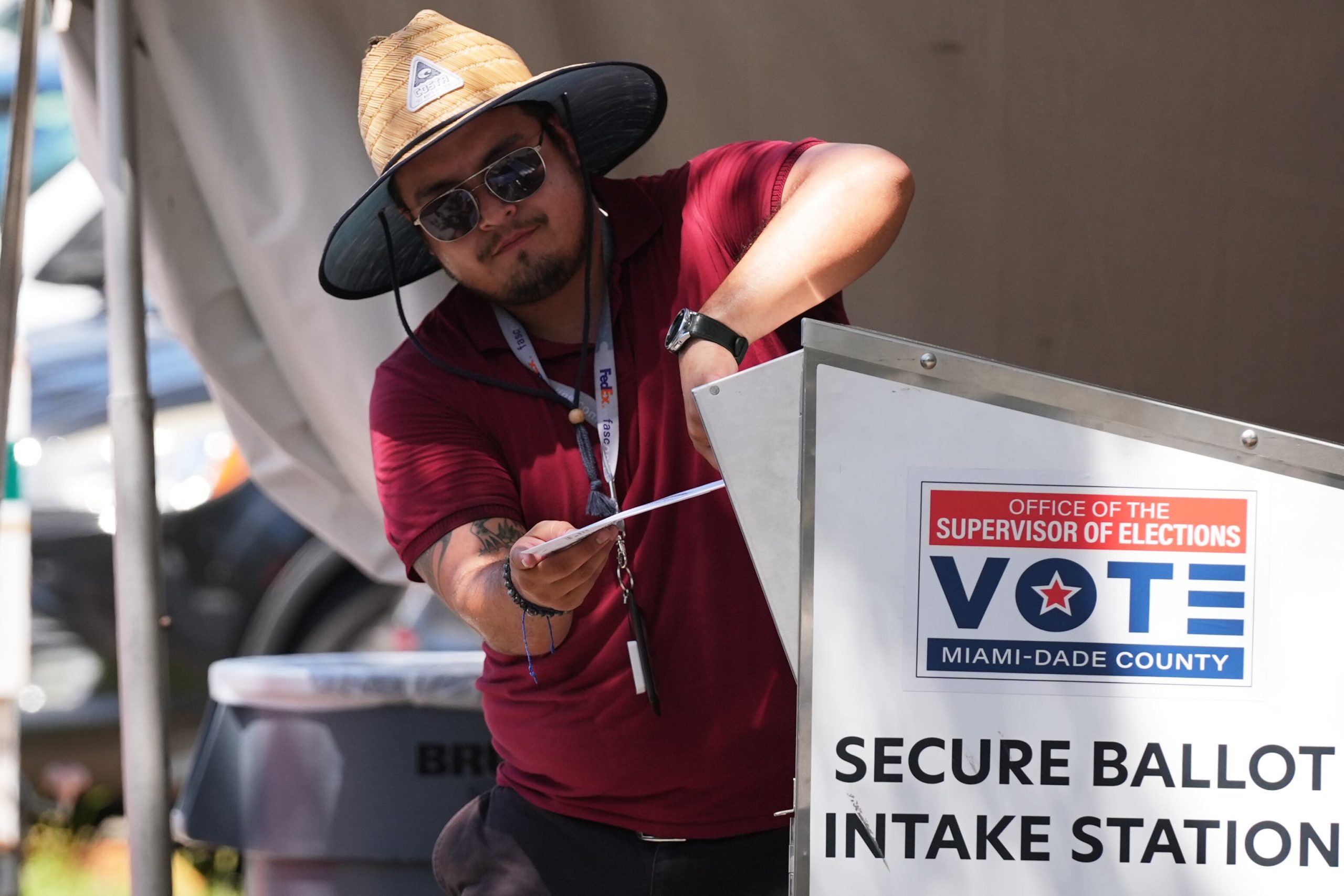
The Trump administration’s immigration policy and the state of the economy are prompting a shift of Latino voters back toward the Democrats. Although many remain undecided, a new poll shows that in the November midterms, Democratic congressional candidates will receive between six and 10 percentage points more of the Hispanic vote compared with Kamala Harris’s 2024 results. By contrast, Republicans would lose five points of the votes Trump won among this electorate. On November 3, all seats in the House of Representatives and one-third of the Senate are up for election, as well as 36 governorships.
That is what the poll conducted by BSP Research and Shaw & Co. for the American Business Immigration Coalition (ABIC) and American Families United (AFU) between September 4 and September 6 reveals, using a sample of 1,353 registered Latino voters in Arizona, Florida, Georgia, North Carolina, Ohio, Pennsylvania and Texas.
According to the survey, in House voting intentions the Republican Party would only hold the same level of support it received in 2024 in the state of Georgia, at 25%, although Democrats would gain three points to reach 63%. In Texas, Republicans would fall one point while Democrats would rise three. In Pennsylvania, the shift compared with the 2024 presidential election is larger: the Democratic Party would increase by 10 points to reach 60% of the Latino vote; the recovery is due to a drop experienced by the Republican Party in that state, which would lose 11 percentage points, falling from 37% to 26%.
Although favorable to Democrats, the Latino vote remains volatile, since neither political party commands overwhelming support: 39% have an unfavorable view of the Democrats in Congress, while 63% have an unfavorable view of the Republicans.
The Democrats’ recovery of part of the historic support they lost among Hispanics in the 2024 elections is driven by the community’s discontent with the state of the economy and with the president’s aggressive anti-immigration agenda.
Latino voters surprised in the last elections by contributing to Trump’s victory. Among Hispanic men, he obtained a majority over his Democratic rival for the first time.
Latinos trusted him to improve their economic situation and secure the border. The first has not been achieved, because the cost of living has soared—partly due to the war in Iran and rising fuel prices; as for the second, the border is secure, but the prevailing perception is that immigration policy has gone too far.
“Immigration is once again becoming a major issue for Latinos. And yes, we believe this is significantly harming Republicans in the current elections,” explained Matt Barreto, who oversaw the survey. “Many of them—as we’ve seen in the polls—say they have a personal connection to someone who is undocumented. They know someone [detained or deported], whether in their family or in their close community; likely even in their own church,” he added.

The poll shows that the majority of Latinos, including those who identify as Republicans, believe the Trump administration’s immigration policy—with the criminalization of migrants who had previously resided here legally, and the mass deportations—has gone too far. Sixty-three percent of Latinos in key states say treatment of immigrants is “one of my main concerns” for 2026, and 59% support creating a pathway to legal status for undocumented immigrants with family members who are U.S. citizens. Sixty-four percent of Latino Republicans, 68% of independents and 85% of Democrats say they will vote for candidates who prioritize legal status and work permits over mass deportations.
Letter to Trump
The poll’s findings were released during the launch of the Committee of 100’s Unity Campaign, through which more than 200 Hispanic leaders—among them elected officials and representatives of the business, religious, civil rights and community sectors—urge President Trump and congressional leaders to grant work permits and legal protections to long-standing undocumented immigrants.
“We may be MAGA supporters, progressives, or somewhere in between,” they wrote in a new letter to President Trump and congressional leaders. “We are all united in demanding that both Republicans and Democrats in Washington offer long-term solutions for undocumented immigrants who have been here for many years—many of whom have worked, paid taxes and contributed to our communities, families and workplaces for decades—solutions that allow them to live and work legally and without fear.”
Signatories of the letter include Democratic members of Congress such as Representative Delia Ramirez of Illinois and Representatives Sylvia Garcia and Veronica Escobar of Texas, and Republicans such as Florida state senator Ileana Garcia, founder of the group Latinas for Trump.
“Hispanic voters are fed up,” said Massey Villarreal, CEO of Precision Task Group and co-chair of the Committee of 100. “We are losing our workforce because of these deportations. Since January, we have lost 200,000 immigrant workers each month. Simply put, there is no way to sustain our economy without the long-standing immigrants who made our prosperity possible,” he said.
Leaders of several Latino and immigrant organizations, including LULAC, NALEO, UnidosUS, the National Hispanic Christian Leadership Conference and America’s Voice, joined the initiative.
Representative Sylvia Garcia criticized that the immigration issue is out of control and emphasized that the poll shows “the disconnect” with citizens, which “lies in the fact that Washington is not doing anything aimed at finding a real solution.” The congresswoman advocated passing the American Dream and Promise Act, which would open a pathway to legalize beneficiaries of DACA and TPS (Temporary Protected Status), programs that have been rescinded by the government.
Sign up for our weekly newsletter to get more English-language news coverage from EL PAÍS USA Edition
Desahucios
Acampada En Sol Por La Vivienda, En Directo | Feijóo Anuncia El Rechazo Del PP A Los Decretos De Vivienda: “Que No Cuenten Conmigo Para Estafar A Nadie”



Headless Body Found Floating In Sea Off Popular Beach In Spain

Democrats Regain Ground With Latino Voters Ahead Of The Midterms

Acampada En Sol Por La Vivienda, En Directo | Feijóo Anuncia El Rechazo Del PP A Los Decretos De Vivienda: “Que No Cuenten Conmigo Para Estafar A Nadie”

Detenido Un Hombre Por La Muerte De Una Mujer De 47 Años En El Distrito De Arganzuela De Madrid

British Actress Naomi Watts Attacks Ageism In Hollywood As She Picks Up Prestigious Donostia Award At San Sebastian Film Festival

Heartbreaking Instagram post reveals death of F1 star


-
 Arganzuela2 weeks ago
Detenido Un Hombre Por La Muerte De Una Mujer De 47 Años En El Distrito De Arganzuela De Madrid
-
 basque country1 week ago
British Actress Naomi Watts Attacks Ageism In Hollywood As She Picks Up Prestigious Donostia Award At San Sebastian Film Festival
-
 Uncategorized2 weeks ago
Heartbreaking Instagram post reveals death of F1 star
-
Best airlines2 weeks ago
Spanish airline Vueling named Europe’s best low-cost carrier for 2026
-

 %2 weeks ago
Mallorca Property Overrun By Wild Goats
-
2026 wildfires2 weeks ago
Spain’s wildfire toll revealed as almost 300,000 hectares go up in flames
-

 Claudia Sheinbaum2 weeks ago
The Azcatitlan Codex Returns To Mexico From Europe After Nearly Two Centuries
-

 Uncategorized5 days ago
F1 Qualifying Today: Azerbaijan Grand Prix schedule, times and TV channel