Connect with us

%

France Erupts Into Violence As Schools Burn, Firefighters Attacked And 2,000 Arrested

Published

on

france-erupts-into-violence-as-schools-burn,-firefighters-attacked-and-2,000-arrested

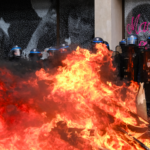
firefighters responding to a fire at Saint-Exupéry high school were surrounded by hundreds of young people. Photo credit: Alexandros Michailidis/Shutterstock

Schools have been damaged by fire and firefighters forced to flee an attack as France’s student protests turn increasingly violent. Nearly 2,000 arrests were recorded on Thursday alone, with fresh clashes on Friday leaving families facing uncertainty over when classrooms can safely reopen.

In Marseille, hundreds of young people surrounded a fire engine, forcing firefighters to abandon the vehicle before it was set alight. In Nantes, a blaze badly damaged a school’s entrance hall. Further arrests followed on Friday, October 2, as fires, blockades and confrontations with police continued. www.reuters.com

Scroll down to watch videos showing the fires, attacks and clashes across France.

The demonstrations began over teacher shortages, overcrowded classrooms and deteriorating school buildings. Those complaints have since been overshadowed by violence in several cities, with students, teachers and emergency services caught up in the unrest.

Schools in Spain have also faced strike calls over overcrowded classrooms and staffing shortages.

Schools set on fire as protests spread

The demonstrations began in the Paris region over complaints about overcrowded classrooms, teacher shortages, inadequate resources and deteriorating school buildings. But scenes on the streets have increasingly involved fires, damaged property and clashes with police. In Nantes, the entrance hall of the Nelson-Mandela high school was badly damaged by fire on Thursday. The school was evacuated and the damage was severe enough for officials to say it could remain closed for weeks. Fires have also affected schools in the Paris region, while the facade of another school in Le Havre was damaged. 

In Paris, firefighters were called to schools where fires had been started around entrances, while rubbish bins and other objects were set alight outside several establishments. In Strasbourg, at least one car was torched, while burning bins and other street fires have been reported in several cities. The damage is not confined to buildings. Public transport has been disrupted, bus shelters and other infrastructure have been damaged, and police have been brought in to deal with blockades and fires.

Parents told to keep children off the streets

The warnings have now gone beyond simply closing schools. Education Minister Édouard Geffray has urged parents to tell their children not to go to the protests, warning that young people are in danger on the streets.  In the Aix-Marseille region, more than 40 schools were due to move to remote teaching on Friday, with pupils no longer physically attending because of concerns over the potential for further unrest.

Local authorities said the measure was temporary and linked to the level of agitation expected. The government has also moved to restrict gatherings around affected schools, while public transport has been suspended in some areas when authorities have judged that the unrest could put passengers or staff at risk.

Qué bonita mañana para despertarse en Francia… pic.twitter.com/88bs2D9kGG

— Marcos (@marcosgonfer) October 2, 2026

Firefighters attacked in Marseille

Some of the most serious scenes have been reported in Marseille, at the Saint-Exupéry high school, hundreds of young people surrounded a fire engine that had arrived to deal with a blaze. According to authorities, firefighters were forced to leave the vehicle, which was then set on fire. Marseille’s public transport system was subsequently suspended after staff were injured during the unrest. At the nearby Victor Hugo high school, two teachers were splashed with petrol when a student attempted to throw petrol into a rubbish bin.

Earlier reports from prosecutors had described the teachers as having been assaulted and doused with petrol, although subsequent accounts said the petrol had been thrown towards the bin.  The incidents involving staff are not isolated. France’s Education Minister Édouard Geffray said 65 education staff had been injured since the movement began, including 40 high-school headteachers, while around 170 students had also been injured. More than 100 high schools have suffered serious damage. Authorities have responded by increasing security around schools, with some establishments switching to remote teaching where pupils and staff could not safely return.

Young second and third-generation migrants film a French firefighter after setting him on fire during the school protests in Bordeaux

🇫🇷 pic.twitter.com/QbJmDzyxbn

— Visegrád 24 (@visegrad24) October 2, 2026

Migrant background claims emerge

The violence has also prompted a separate debate over the background of some of those involved, with several European outlets reporting that young people from migrant families were among the groups involved in the attacks. Media outlets such as Visegrád 24 has described those involved in the Marseille attack on firefighters as second- and third-generation migrants, while other outlets including Proto Thema and Remix News have similarly linked most of the unrest to youths from migrant backgrounds.

Proto Thema has gone further, explicitly presenting the violence as evidence of what it describes as the failure of multiculturalism in France. French authorities have referred to students and to violent individuals who have joined the demonstrations, with the government saying some of those involved are not even students. The government has also accused La France Insoumise party of helping drive the movement, an allegation the party rejects.

A French woman tells one of the second and third-generation migrant rioter no to vandalize her city

He responds by trying to set her face on fire pic.twitter.com/1dkiVXmuhZ

— Visegrád 24 (@visegrad24) October 1, 2026

Barricades, tear gas and clashes

Lyon has also seen serious confrontations. Young people gathered around schools, built barricades and threw objects at police, who responded with tear gas and other crowd-control measures. Across the Rhône department, authorities reported rubbish-bin fires and fireworks, with arrests made during the morning. More than 1,000 French high schools were affected by protests, strikes or other actions on Thursday, including hundreds where access was blocked. 

In Strasbourg, police used tear gas as protesters confronted officers, while barriers were burned on tram tracks. Tram services were suspended in an attempt to restrict the movement of demonstrators. Transport has also been disrupted in other cities as authorities attempt to prevent further clashes.  Toulouse has seen clashes between riot police and young protesters, with fires and damage to bus shelters reported. In Lille, young people smashed the glass of a bus stop while firefighters dealt with burning rubbish bins. Rennes has also seen fires and a heavy police presence, while police used tear gas at a school in Brest. 

🇫🇷 FRANCE : PERTE DE CONTRÔLE TOTAL ?

Dans certaines villes, la situation devient telle que des sirènes d’alerte sont déclenchées et que les habitants sont appelés à rester chez eux.

Pendant ce temps, des groupes violents imposent leur loi dans les rues.

Quand un État en… pic.twitter.com/JKgzgXT2p1

— Sarah Adv (@Sarahsa09309757) October 2, 2026

Nearly 2,000 arrested

Around 2,000 people had been taken into police custody since the protests began, with around 90 per cent of them minors. On Thursday alone, the Interior Ministry recorded 1,949 arrests and said 305 police officers and gendarmes were injured. Rights groups have criticised the use of force against minors, while the government says officers are responding to increasingly violent incidents involving fires, projectiles and attacks on people and public property.  

But for students, teachers and parents, the immediate issue is whether schools can open safely. With hundreds closed, dozens of staff injured and fresh fires and clashes still being reported, a dispute over France’s education system has developed into a national security and public-order problem.

%

Gibraltar Patients Get Good News As Taxis To Spanish Hospitals Remain Available

Published

on

gibraltar-patients-get-good-news-as-taxis-to-spanish-hospitals-remain-available

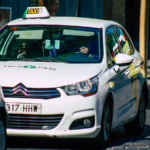
Taxis will remain available for patients who need them. Photo credit: Jose HERNANDEZ Camera 51/Shutterstock

If you have ever had to arrange transport for a hospital appointment, you will know that getting there can sometimes be almost as stressful as the appointment itself. Now imagine being referred for specialist treatment in another country and suddenly being told that the taxi taking you there may no longer be covered. That was the concern facing Gibraltar patients referred to hospitals in Spain after a Gibraltar Health Authority notice appeared to say that taxi journeys for these appointments would no longer be paid for.

For people who depend on the service because of their medical needs, it raised an obvious question: how are they supposed to get to hospital? There is now an answer. Gibraltar’s Health Minister, Gemma Arias-Vasquez, has confirmed that taxis will remain available for patients who need them, putting an end to fears that transport for medical referrals to Spain was being withdrawn.

Gibraltar patients can still get taxis to Spain

The clarification followed a notice from the Gibraltar Health Authority stating that taxis for tertiary appointments in Spain would no longer be paid for, with no petrol allowance available either. The wording caused concern among patients covered by Gibraltar’s Sponsored Patients system, particularly those who have to travel to Spain because the specialist treatment they require is not available in Gibraltar.

However, Arias-Vasquez said the notice had not been properly communicated to her ministry and did not accurately reflect the government’s position. Patients who genuinely require a taxi to attend their referral appointment will continue to have access to one. The change is instead intended to address situations where patients do not actually require a taxi for their journey. In other words, the transport provision is not being scrapped, but taxis will not necessarily be provided automatically to every patient travelling for treatment.

Why patients are sent to hospitals in Spain

Gibraltar has a small healthcare system and does not provide every type of specialist treatment locally. Patients can therefore be referred to medical centres outside the territory when the required care is unavailable through the Gibraltar Health Authority. The GHA’s Sponsored Patients Department manages these arrangements for patients requiring specialist treatment that cannot be provided in Gibraltar. Referrals are considered through the Tertiary Referral Board before treatment is authorised.

For some of those patients, hospitals in Spain are the most practical option because of their proximity. The arrangements can involve treatment in Spanish hospitals while the patient’s care remains funded and managed through Gibraltar’s healthcare system. That makes transport an important part of the arrangement, particularly for anyone whose medical condition means they cannot reasonably make the journey independently.

Confusion over the taxi notice

The original notice appears to have created the impression that patients would have to arrange and pay for their own journeys to Spain, regardless of their circumstances. That is not the position now being given by the Gibraltar Government. The Health Minister has made clear that anyone who needs transport to attend a specialist referral in Spain should not be left without it. The aim is to ensure that taxis are available where they are genuinely required, rather than treating every referral as automatically requiring one.

The clarification is particularly important for patients who may already be dealing with serious or long-term health problems. A journey across the border can involve additional planning, and removing an established transport arrangement could have created another practical obstacle between a patient and the treatment they had been referred to receive.

For now, those fears have been put to rest. Gibraltar is not ending its taxi provision for patients referred to hospitals in Spain, although the circumstances in which a taxi is provided are being tightened so that the service is used when it is actually needed. The GHA is expected to provide clearer information to patients about the arrangements, following the confusion caused by the original notice.

Continue Reading

%

The Sevilla Village Where The Housing Crisis Doesn’t Exist And Rent Costs Just €20

Published

on

the-sevilla-village-where-the-housing-crisis-doesn’t-exist-and-rent-costs-just-e20

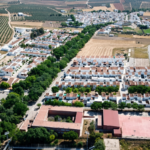
The municipality’s housing model has been operating for decades. Photo credit: Ayuntamiento de Marinaleda on Facebook

If you’re paying hundreds or even thousands of euros every month just to keep a roof over your head, the idea of renting a house for €20 a month probably sounds almost impossible. Yet in one small town in Sevilla province, that is the reality for residents who have lived in municipal homes for decades, while a new batch of properties is about to be offered at the same extraordinary price.

Welcome to Marinaleda, a town of around 2,600 people where the local housing system is very different from the private property market found across much of Spain. The municipality is now finishing 24 new social homes, which are expected to be rented to residents for between €15 and €20 a month.

The €20-a-month homes in Sevilla

The new houses are being built in two groups, with 10 semi-detached homes in one development and 14 in another. They are one- or two-storey houses rather than apartment blocks, following the type of housing traditionally used in Marinaleda. The properties will remain in municipal ownership, meaning residents cannot simply buy them and put them on the open market.

When a family leaves, the home can be allocated to another person who needs it. Applicants must also have been registered as residents of Marinaleda for at least two years, with their individual circumstances taken into account when homes are allocated. But the €15–€20 rent is not the result of someone finding a way to make normal private housing suddenly cost almost nothing. Marinaleda’s system has been built around public land, municipal control and, in some cases, the future residents helping to build their own homes.

Residents helped build their own houses

One of the clearest examples is Pilar Prieto, who has lived in her Marinaleda home since 1993. She and her family helped build the property despite having no previous experience in construction. Future residents worked as labourers during the building process, with the hours they contributed being taken into account when the final cost was calculated.

Pilar says she and her husband helped with jobs including digging foundations before eventually moving into the finished house with their young son. She has paid less than €20 a month ever since. The municipality’s housing model has been operating for decades. According to its own account, public land is made available to self-builders, while materials, technical support and construction assistance have been provided through agreements and public employment programmes. More than 350 homes have been built using the system.

A housing market without private speculation

Marinaleda’s approach is based on keeping housing outside the normal property market. The municipality says land was acquired and municipalised so that it could be used for housing rather than being left open to private speculation. That principle continues with the latest development.

The new homes will remain under municipal control, with the rent adjusted to residents’ circumstances rather than being set according to what a private landlord could charge. Mayor Sergio Gómez, who is also a history teacher, describes the system as management rather than a miracle. He also lives in a municipal home and pays rent to the Ayuntamiento like other residents.

Could the model continue?

The next 24 homes are already nearing completion, but the municipality wants to continue building more affordable housing. Gómez says Marinaleda needs support from the Junta de Andalucía to do so. The national Housing Plan for 2026–2030 includes €7 billion for Spain’s autonomous communities, with at least 40 per cent intended for the construction or acquisition of housing.

Andalucía has been allocated €718.2 million in state funding over the five-year period, alongside a minimum regional contribution of €478.8 million, according to figures cited by the mayor. For anyone struggling to find an affordable home elsewhere in Spain, Marinaleda’s figures are striking. While private rents continue to put pressure on household budgets, residents of this small Sevillian town can still find a municipal house for no more than €20 a month, with some families having stayed in their homes for more than three decades.

Continue Reading

%

Erly Thornton Opens Almuñecar’s Jazz In Autumn

Published

on

erly-thornton-opens-almunecar’s-jazz-in-autumn

Erly Thornton live on stage. Credit: ETFB

Sax fans on the Costa Tropical get a familiar face this Friday, when Erly Thornton opens the seventh Jazz en Otoño in Almuñecar. Nashville-born Thornton, a regular on southern Andalucian stages, shares the opening bill with Granada guitarist David Margam in a project called The Funk Assembly.

Jazz en Otoño runs from 9 to 11 October at the Auditorio Martin Recuerda, inside the Casa de la Cultura on Calle Puerta de Granada 19. Each night starts at 8pm. Organisers bill the cycle as the indoor autumn arm of Jazz en la Costa, the open-air July festival that began in 1988 in Parque El Majuelo, under Castillo de San Miguel. This October series itself dates from 2020, a shorter follow-on once the summer dates are done.

Friday’s funk bill with Erly Thornton and David Margam

Friday 9 October belongs to Erly Thornton and David Margam: The Funk Assembly. Thornton on saxophone lines up with Margam on guitar, Jaime Parrizas on drums, Miguel Angel Gil on bass, Jose Luis Lopretti on piano, Andres Garcia on guitar, Gaston Lopez on percussion and Sista Funk on vocals. Margam, founder of Funkdacion, is out with Magnetic, his second studio album, recorded with players from the United States and Europe. Their set pulls contemporary jazz, funk, soul and R&B into one groove-led night. Diputacion de Granada describes the band as built for a live room that wants rhythm first, and Thornton’s recent ties to the Andalucian scene are the reason his name sits at the top of the poster.

Jesse Davis and Ludovic Beier fill the weekend

Saturday 10 October brings Jesse Davis Quartet. Davis, a New Orleans saxophonist who studied with Ellis Marsalis, has shared stages with Clark Terry, Ray Brown, Milt Jackson, Kenny Barron, Benny Golson and Wynton Marsalis. He arrives with Reflections, a record that keeps a hard-bop line and a personal reading of the American jazz tradition.

Sunday 11 October closes on Ludovic Beier Montmartre Quartet. French accordion and accordina player Beier is joined by Pierre-Alain Goualch on piano, Gautier Laurent on double bass and Frederic Delestre on drums. Swing, West Coast jazz and Brazilian colour sit in the same set.

A school session tied to the cycle, backed by Fundacion SGAE, uses live music, projections and astronomy material for younger listeners.

Tickets, times and how this differs from September’s cycle

Single tickets cost €15. A three-night pass costs €30. Sales run on RedEntradas and at the Casa de la Cultura box office, Monday to Saturday from 10.30am to 2pm, plus an hour before each concert. Ayuntamiento de Almuñecar organises the dates, with the provincial culture office and the Jazz en la Costa technical office. Full listings also sit on Visit Almuñecar.

Readers who caught September’s II Ciclo de Jazz at the same hall were at a separate Juventudes Musicales programme. July’s open-air festival stays the big outdoor date. October’s bill is the closer indoor follow-on, and the town’s 500th anniversary of its coat of arms means Almuñecar already has a full cultural diary running through the same weeks.

Continue Reading

Trending

Copyright © 2017 Spanish Property & News