The European Union demanded Thursday that Google share data with other search engines and open up its Android system to rival AI services, but the US giant said the measures would put privacy at risk.
The move is the latest by Brussels against the behemoth as it seeks to flex its muscles over Big Tech.
The order was made under the EU’s flagship Digital Markets Act (DMA), which forces the world’s biggest tech firms to open to competition in a bid to give users more choice.
The DMA is the bete noire of US President Donald Trump’s administration, which accuses Brussels of unfairly targeting American companies.
Brussels said Google must start sharing search data from January 2027 and users would start benefitting from the changes to Android from July 2027.
“Thanks to these measures we hope to see emerging alternatives to Google Search and Google’s AI services, such as Gemini, and that users in the EU can enjoy greater choice of services,” EU tech chief Henna Virkkunen said.
For example, the EU said Android phone users should be able to use their preferred AI chatbot via voice commands, similar to the “Hey Google” command.
Privacy question
The EU said sharing search data would “rebalance the playing field” but Google pushed back, saying the measures “introduce unprecedented risks to user privacy, device security, and national security”.
But Google’s head of global affairs Kent Walker said the EU moves risked “undermining vital privacy and security guardrails for millions of Europeans”.
He said AI assistants already could access Android and by sharing search data, “Europeans’ private searches would be exposed to unfamiliar companies, without adequate anonymisation of the data and without user knowledge or consent”.
A senior European official insisted the EU “took integrity, security and privacy into utmost account”, and Brussels said the decision would ensure anonymisation of search data.
The demand is legally binding as part of a procedure launched in January, but it is not a formal probe that could lead to fines.
The scrutiny of Google does not end there, however.
The EU could hit Google with a fine next week in a separate investigation under the DMA law, sources close to the matter told AFP, confirming a report in the Financial Times newspaper on Wednesday.
The EU has the right to slap fines of up to 10 percent of a company’s total global turnover for violating the DMA.
Fines are nothing new for Google.
The EU hit the company with fines worth a total of 8.2 billion euros between 2017 and 2019 under different competition rules. And in September last year, Brussels imposed a 2.95 billion euro fine in a separate antitrust case.
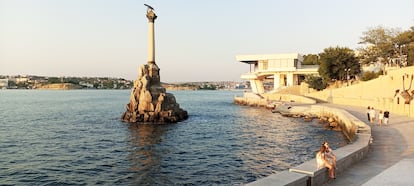
Something is changing in Crimea, the territory that represents the most valuable prize of the imperial plan launched by Vladimir Putin in 2014. The Russian president has long regarded the peninsula he seized from Ukraineas an impregnable fortress. The apparent normality, however, is a trompe-l’œil behind which Moscow is trying to mask significant blows, like those suffered in recent months by its fleet docked in Sevastopol and by its air-defense systems in that occupied stronghold.
Amid the offensive Kyiv has launched — in an attempt to choke the Russian-occupied territory logistically by bombing bridges, rail lines, roads, and infrastructure — reality calls Putin’s propaganda into question. “Ukraine has not renounced Crimea,” stresses Ukrainian historian and analyst Oleksii Otkydach, who was born on the peninsula.
Recovering Crimea, 12 years after losing it, is today less of a daydream for Kyiv than it was a few months ago, although authorities that hold power there alongside tens of thousands of Russians pushed there by the Kremlin have put down roots during the past decade.
That is why Volodymyr Zelenskiy’s government is sending, with this unprecedented offensive, a threefold message: to Russians, to the Ukrainian population, and to the more than two million people living in Crimea —both to those who support Moscow’s positions and to supporters of Kyiv. It reminds them that Ukraine has not forgotten Crimea, that it will try by all means to recover it and that, if it cannot, it will make life unbearable for the occupying forces.
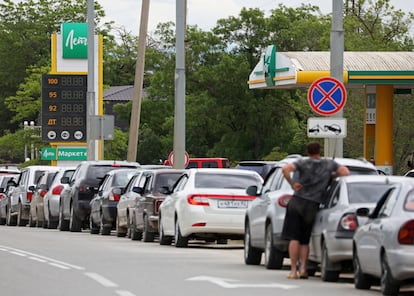
Sevastopol, the peninsula’s most populous city, cannot even guarantee power and must ration fuel against a background of explosions, as EL PAÍS’s special correspondent found at the end of June. Residents endure shortages and a sense of insecurity they had not experienced since 2014.
Most Ukrainians on the street have not shown optimism in recent years about the possibility of recovering the territory occupied by Russia — about 20% of the country, including Crimea. Pessimism spread especially after Russia’s full-scale invasion in February 2022. But now, with drone strikes against the enemy, public opinion is beginning to see a possible turning point, and the issue is aired daily by authorities and the media.
A calculated strategy
“For a long time, Crimea was a fetish, the crown jewel of Putin’s imperial myth. Now that fantasy is collapsing before our eyes,” says Alim Aliev, a human rights activist from the Tatar minority, an ethnic group whose persecution has intensified since 2014. “What we have witnessed in recent weeks is not simply a series of random attacks but a meticulously calculated military and diplomatic strategy,” he says. Ukraine’s goal: to turn the peninsula into an island cut off from supplies and without defenses.
After besieging the lines of communication — roads, bridges, and railways that move supplies — the next step will be to render unusable once and for all the famous and crucial Kerch Bridge that links Crimea with Russia, the Tatar activist predicts. According to Aliev, the aim is to deliver a blow that is not only logistical and military but also psychological, demonstrating the “dismantling of the Russian myth.”
Defending and maintaining the peninsula under occupation is proving increasingly costly for Moscow. Its geography and location, surrounded by the Black Sea, force it to pay a high — and rising — economic, logistical, military, and human price. At the same time, Russia must maintain military pressure elsewhere, such as in the Ukrainian Donbas region, in the Russian capital itself, and across a range of energy facilities in different regions of the country that Kyiv is targeting militarily.
The question posed by Ukraine’s recent weeks-long offensive against occupied Crimea — which it is trying to recover — and, simultaneously, against Moscow — which it is trying to weaken — is whether Russia can withstand pressure on all fronts and whether it will make significant changes to its deployments under the current circumstances, which could leave some areas more vulnerable.
“There is no way Russia can defend Moscow and Crimea without losing strength on other fronts,” says Oleh Rybachuk of the Centre of United Actions and a former Ukrainian deputy prime minister.
“The attacks on Crimea create a complex dilemma. If it does not reinforce its defense, the situation on the peninsula will continue to deteriorate,” agrees historian Otkydach. “If, on the contrary, Russia decides to bolster Crimea’s protection, it must allocate huge amounts of air-defense systems, fuel, vehicles and logistical resources. That means those resources will no longer be available elsewhere, creating opportunities for attacks on strategic targets in other regions, such as refineries in Moscow, Yaroslavl, or Ryazan,” he adds.
The deployment of modern drones built by Ukraine aims to complicate the already difficult supply effort the Kremlin must carry out in Crimea. “That territory is totally dependent on Ukraine: its water supply, its roads, its logistics… Everything depends on Ukraine. And now we are cutting the logistical routes,” explains Rybachuk.
The prelude to the current strikes on communication lines and energy infrastructure was months of weakening the Russian fleet docked in Sevastopol and its air-defense systems, this analyst recalls; for that reason, “now they [the Russians] are half blind.” Despite the high arms expenditure Kyiv is incurring, he estimates that, for now, they have a sufficient arsenal.
“Crimea could never exist without its connection to Ukraine, to the rest of the mainland,” Otkydach, who supports his country’s current strategy mainly through the use of drones, says. “Faced with a shortage of classic long-range attack means, such as ballistic missiles, cruise missiles or aerial bombs, the use of drones has become an effective alternative,” he adds. “They are significantly cheaper and, as recent events have shown, can inflict major damage on military and strategic targets.”
The peninsula “has enormous symbolic and political value for the Kremlin,” Otkydach stresses. “It is one of the main pillars of Vladimir Putin’s narrative, so any vulnerability there poses a significant political problem,” he continues. “The historic advantage of being an enormous country — the largest in Europe — has now become a weakness for Russia, since its military doctrine relied on the fact that it is a nuclear power and that no one would ever dare to attack its military infrastructure,” says Rybachuk. To try to hold Crimea, “the Kremlin is moving defenses from other parts of Russia, leaving those areas even less protected,” the former deputy prime minister adds.
The current situation, Otkydach notes, is seen differently by Crimea’s residents who support Kyiv and those who back Moscow. For the former, “these attacks represent hope.” For the latter, especially “many Russian citizens who moved illegally to the peninsula after the occupation, the situation generates fear and uncertainty.” The demographic picture has changed with the arrival of some 800,000 Russians since 2014, estimates Aliev.
They see their investments, properties, and new lives driven by the invasion at risk, the Tatar activist adds. Moreover, Otkydach adds, they face “having to answer for their illegal presence on Ukrainian territory” before the courts. This legal dimension is another of the strategies Kyiv seeks to advance in its attempt to recover the peninsula.
Rybachuk, optimistic, believes there is no doubt that sooner or later there will be an “exodus” of Russian officials and their families fleeing the peninsula. As a preliminary step, he predicts another push this coming autumn in Kyiv’s arms revolution, which will allow it to strike targets even farther inside Russia with ballistic missiles.
None of that appears likely, in principle, to happen in the short term. Meanwhile, according to the information Otkydach receives from inside Crimea, “the occupation authorities are trying to convey the image that everything is under control, following a Soviet-style communication model.” The historian admits it is increasingly difficult to communicate securely because of “restrictions on internet access and messaging services.” Meanwhile, those awaiting liberation rely on one message, says Aliev: “Ukraine has not forgotten us.”
Sign up for our weekly newsletter to get more English-language news coverage from EL PAÍS USA Edition
Where Is The Best Place To Watch Spain’s Upcoming Eclipse? The European Space Agency Reveals The Ideal Viewing Spots – And How To Make The Most Of The Historic Event
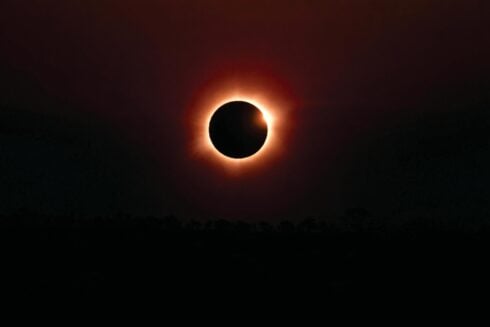
SPAIN is preparing for one of the most spectacular astronomical events in decades – a total solar eclipse on August 12 that will bring a rare moment of darkness to
SWARMS of Argentinian fans flooded one of Madrid’s most iconic squares last night after the Albiceleste secured their place in Sunday’s final against Spain. Viral footage circulating online shows hundreds


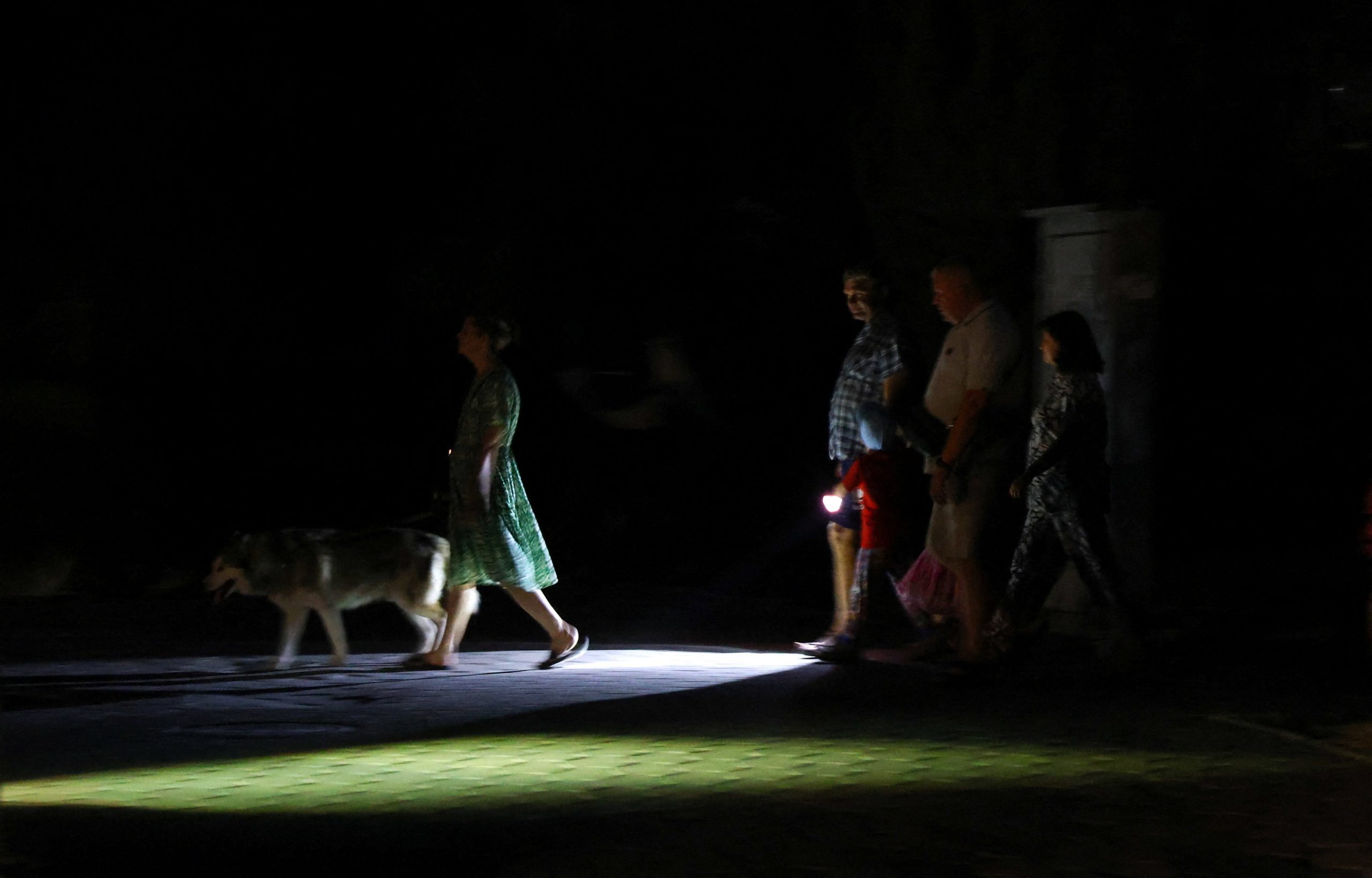

 SPAIN is preparing for one of the most spectacular astronomical events in decades – a total solar eclipse on August 12 that will bring a rare moment of darkness to
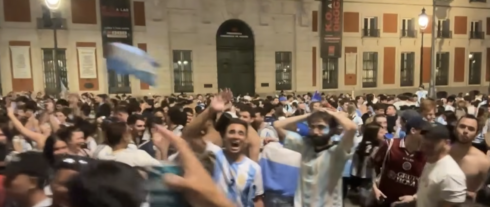
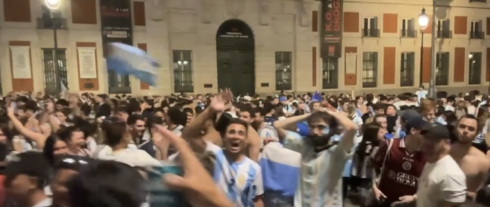 SWARMS of Argentinian fans flooded one of Madrid’s most iconic squares last night after the Albiceleste secured their place in Sunday’s final against Spain. Viral footage circulating online shows hundreds