Connect with us

%

Greece’s World-First Wildfire Satellites Could Spot Fires Before People Are Trapped

Published

on

greece’s-world-first-wildfire-satellites-could-spot-fires-before-people-are-trapped

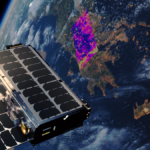
Greece’s new wildfire satellites aim to spot small fires before they become disasters. Credit: OroraTech

A fire breaking out above a village, beside an island road or near a holiday resort can become dangerous before anyone on the ground fully understands what is happening.

Greece is now trying to shorten that frightening gap between the first spark and the first emergency response. Four thermal satellites, built by German company OroraTech, were launched in May as part of the Hellenic Fire System, a national wildfire detection network developed with the Greek government and the European Space Agency (ESA). ESA has described it as a world first for a national satellite capability dedicated to wildfire detection and tracking.

How the new fire satellites could change the first warning

The system is designed to detect heat from space before a small fire becomes a major emergency. According to OroraTech, the satellites are equipped with thermal infrared cameras, supported by a ground station in Greece and a wildfire platform linked to the country’s emergency services. The company says the system can deliver fire data to Greek fire services with latency measured in minutes and identify hotspots as small as four by four metres.

The earliest minutes of a wildfire are often when decisions are most critical, therefore this new system could dramatically change how fire services tackle these situations from the beginning. A small fire in remote scrubland may not yet be visible from a village, road or beach. But if wind, heat and dry vegetation combine, it can move quickly towards homes, farms, power lines or tourist areas.

The Associated Press reported that Greece has become the first country to integrate a dedicated satellite array into its national firefighting system, with alerts able to provide commanders with information including location, size and intensity.

Europe is watching Greece’s wildfire satellite test

Greece has more reasons than most to move quickly. In 2018, a fire east of Athens killed more than 100 people. In 2023, the Alexandroupolis fire became the largest wildfire ever recorded in the European Union, according to Copernicus data, burning around 96,000 hectares.
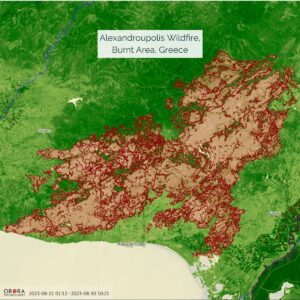
A view of the burnt area from the Alexandroupolis wildfire, Greece. Credit: OroraTech

However the problem is no longer only Greek. The European State of the Climate 2025 report, produced by the Copernicus Climate Change Service and the World Meteorological Organization (WMO), said Europe experienced record wildfire burnt areas in 2025, with around 1,034,000 hectares burned. The same report said at least 95 per cent of Europe experienced above-average annual temperatures.

For readers in fire-prone parts of Europe, the Greek system is a glimpse of how emergency services may try to deal with future summers when several fires can start at once and crews must decide where aircraft, engines and evacuation alerts are needed first.

How AI helps firefighters choose which blaze needs crews first

The satellites do not simply take images. They use thermal detection and artificial intelligence to help identify active fires and thermal anomalies. ESA says each satellite carries midwave and longwave infrared imagers, allowing the system to assess fire activity and fire radiative intensity, a measure linked to how strongly a fire is burning.

This could help commanders when several alerts arrive at the same time. AP quoted Fire Service Col. Zisoula Ntasiou, vice president of the International Association of Fire and Rescue Services, explaining that fire radiative power can help decide which ignition needs priority when multiple fires are burning.

Research into satellite wildfire detection is also moving quickly. Recent scientific work has explored how artificial intelligence can help turn thermal satellite images into faster fire alerts, but experts still stress that satellite warnings must work alongside firefighters, evacuation systems and prevention on the ground.

For now, satellites will not replace 112 alerts, firefighters or prevention

The new system does not mean Greece can suddenly relax on forest management, evacuation planning or public safety. Satellites are an extra layer, not a guarantee that a fire will be stopped immediately.

Existing satellite fire-detection systems already help emergency teams monitor wildfires from space, but they have limits. NASA guidance says some fires can still be missed if they are hidden by cloud, smoke or tree cover, if they are too small or cool to detect, or if they start and end between satellite observations.

The technology is still developing, but the direction it is taking us in is positive. Satellites and artificial intelligence are being used to shorten the time between a fire starting and emergency crews receiving a useful alert.

Greece’s 112 emergency system can send mass alerts when a natural disaster or dangerous situation is expected or already in progress, including instructions for self-protection. The Greek Civil Protection service says those alerts can arrive through mobile phone cell broadcast messages and other channels.

How Greece’s wildfire satellites could shape future summer fire protection

The Hellenic Fire System is still at an early stage. ESA said after the May launch that OroraTech would closely monitor and commission the satellites before they were ready for service in the following months.

The first real test will come during the Greek summer, when heat, wind and dry vegetation place extra pressure on fire crews. If the system helps authorities spot remote fires earlier, direct crews faster or issue warnings sooner, other Mediterranean countries will be watching closely and considering following suit.


%

Passengers Are Missing Flights As Planes Leave Half Full Across Europe

Published

on

passengers-are-missing-flights-as-planes-leave-half-full-across-europe

Airlines fear that if queues continue to grow, the number of passengers missing flights could increase. Photo credit: Minh K Tran/Shutterstock

As the summer holidays are about to kick off and airports being to fill, you’d expect planes to also be packed. Instead, airlines say some are taking off with rows after rows of empty seats, not because people didn’t book them, but because they never made it to the gate in time. According to the aviation industry  passengers are getting to the airport on time, checking in, dropping off their bags and making it through security, only to find themselves stuck in border control queues while boarding continues without them. By the time they finally reach the departure gate, their flight has already left.

Airlines say passengers are doing everything they’re supposed to do, yet some are still missing flights because they’re getting caught up in delays after they’ve already reached the airport. For airlines, it’s becoming an expensive problem. For travellers, it’s turning the start of a holiday into a stressful race against the clock. And with Europe’s busiest travel weeks still to come, the industry fears the problem could become even more noticeable.

How are planes leaving half full?

At first, it sounds impossible. Flights are selling out, airports are full of holidaymakers and airlines are putting on extra services to cope with demand. So how can an aircraft leave with empty seats? The answer, airlines say, is that the passengers are already inside the airport. They’ve checked in, dropped off their luggage and made it through security, but then become stuck in long border control queues while boarding carries on without them.

Airlines eventually have little choice but to close the aircraft doors and leave on schedule. Holding one flight for too long can trigger delays across the rest of the day’s timetable, affecting other passengers, aircraft and crews waiting for their next departure. The result is something nobody wants to see. Planes take off with seats that have already been sold, while the people who paid for them are still waiting to clear passport control.

For anyone travelling this summer, it’s a reminder that getting to the airport early may not be the only thing that matters. If queues become longer during the busiest weeks of the holidays, the biggest delay could come after you’ve checked in, not before.

When one missed flight turns into a ruined holiday

Missing a flight is frustrating enough. What comes next is often much worse. If you’ve booked a family holiday, a cruise or a trip with a tight connection, one missed departure can quickly throw the whole journey into chaos. A hotel room still needs paying for even if you arrive a day late. Airport transfers don’t wait forever. A connecting flight might disappear, and finding another seat during the height of summer isn’t always easy.

Families can also find themselves in an impossible situation. If one person gets through while another is delayed, nobody wants to leave a partner, parent or child behind. More often than not, the whole family misses the flight together. For passengers travelling to weddings, special celebrations or long-planned holidays, it’s not just an inconvenience. In some cases, it’s an event they can’t simply rearrange.

It’s costing airlines too

While passengers are left trying to rescue their holiday plans, airlines are dealing with the financial impact. Every empty seat represents a ticket that has already been sold but can no longer be used. Once the aircraft leaves, that revenue is effectively lost, even though the passenger was already inside the airport trying to reach the gate.

Airlines then face the additional challenge of dealing with frustrated customers, rearranging travel where possible and absorbing the knock-on disruption that follows missed departures. It’s one of the reasons they’re speaking out now instead of waiting until later in the summer.

Why the new border system is part of the conversation

The growing disruption is also why airlines and airport operators have asked for the EU’s Entry/Exit System (EES) to be temporarily suspended during periods of severe congestion, arguing that border staff should be able to switch back to manual passport stamping until queues return to manageable levels before resuming the digital checks.

The biggest test is still ahead

The industry’s biggest concern is that the busiest part of the summer hasn’t even arrived yet. July and August are when airports across Europe are at their busiest, with millions of families heading away during the school holidays. That’s when even a small delay at border control can quickly snowball as more passengers arrive at the same time.

Airlines believe that’s when the real pressure will be felt. That doesn’t mean every traveller is going to face long queues or miss their flight. Most people will still get through the airport without any problems.

But if you’re flying during the school holidays or through one of Europe’s busiest airports, it’s worth giving yourself a little more time than you normally would. It won’t guarantee a queue-free journey, but it could give you valuable breathing space if border control is taking longer than expected.

For now, airlines are hoping the warning comes early enough to prevent the problem from getting worse. Because while the industry is worried about flights leaving half full, most travellers have a much simpler concern: after paying for a holiday and doing everything right, they just want to make sure they’re actually on the plane when it takes off.

Continue Reading

%

Los Alcazares Pride Returns With Star-Studded Line-Up And Free Health Services

Published

on

los-alcazares-pride-returns-with-star-studded-line-up-and-free-health-services

Mar Menor pride festival returns with headliners Nebulossa and parades. Photo Credit: Los Alcazares Town Hall

Los Alcazares is set to celebrate diversity on the shores of the Mar Menor with the return of its annual Pride celebration. Running from Monday, July 6 to Saturday, July 11, this third edition of “El Mar Menor vibra con Orgullo” promises nearly a week of events dedicated to the LGTBIQ+ community, equality, and respect.

Star-studded line-up at Plaza de la Feria

The main stage at Plaza de la Feria will host as many as 30 diverse acts throughout the week. Acclaimed artists Nebulossa and Malena Gracia will top the star-studded bill, alongside popular performers like Satín Greco, Le Cocó, Pitita, Kuve, and Keunam.

The festival’s major highlights begin on Thursday, July 9, with the Gala Míster Orgullo del Mar Menor. This is followed on Friday by the colorful Gala Divas y Reinas. The celebrations reach their peak on Saturday, July 11, starting with a lively parade along the seafront at 19:00, marching from Plaza del Espejo to Plaza de la Feria.

Following the march, Mayor Mario Pérez Cervera and the “Lo tienes claro?” Association will deliver a pride manifesto, setting the stage for an opening speech and a massive closing gala, featuring unforgettable musical performances.

Highlighting health and advocacy on the coast

In addition to the fun aspect of the event, it will also have another main focus: public health. All day on July 10, and in the morning of July 11, organisers will provide quick, confidential, and free HIV tests at the Town Hall, available for anyone who wants to take one.

Local businesses along the Los Alcazares promenade are also actively participating, with many hosting themed events, decorative displays, and special promotions to welcome the influx of international and local visitors.

This vibrant coastal celebration will successfully blend high-energy entertainment with important advocacy, welcoming residents and visitors to honour equality and have fun together. Organisers suggest that anyone interested in attending arrive early to the event, and enjoy one of the most colourful and fun celebrations in the town’s local summer calendar.

Continue Reading

%

Pies, Pints & Pipas.

Published

on

pies,-pints-&-pipas.

Every country has its own way of fuelling matchday. Steak pies in England. Scotch pies in Glasgow, bags of pipas in Spain and sizzling choripan in Argentina, food is as much a part of the experience as are the roars from the stands. Food matchday traditions are part of what make football culture so unique.

England, the home of the pint and the pie

No country is more closely associated with football food than England. For generations, supporters have gathered in local pubs before kick-off, pint in hand, before heading to the ground for a hot pie. It’s a tradition that dates back to the late 19th century, when football clubs grew alongside Britain’s industrial towns and a hearty pie offered an affordable meal on a cold afternoon.

Today, pies are still a fixture at grounds across the country, classic steak and kidney and steak and ale, with Birmingham’s famous Balti Pie earning cult status among supporters.

Modern stadiums may now serve gourmet burgers and loaded fries, but for many supporters nothing beats the simple comfort of a pie and a pint before the first whistle.

As one Reddit fan put it “Football without a pie just doesn’t feel right.”

Scotland, where the Scotch Pie reigns supreme

Right far up north, the Scotch pie, a small, double-crust pastry traditionally filled with seasoned minced meat, has long been Scotland’s signature stadium snack and remains to this day a matchday institution. Macaroni pies, steak pies and sausage rolls are also popular choices

UEFA even notes that England and Scotland both love their pies and locals will happily debate the differences between them for hours, a rivalry almost as fierce as some of the matches themselves.

Spain, the kingdom of Pipas

Spain absolutely owns the sunflower seed. Few football traditions are as recognisable as supporters cracking open bags of roasted sunflower seeds, or pipas. The familiar crunch of shells has become part of the soundtrack at stadiums across Spain, and because fans eat pipas by the handful, stadium floors in Spain are famously left completely white with a literal “snowstorm” of discarded seed shells by the 90th minute. Many fans also arrive carrying a freshly made bocadillo, filled with jamon serrano, tortilla española or chorizo, with a cold cana before the match completing the experience.

Germany, bratwurst before kick-off

German football has arguably one of Europe’s best matchday experiences, and the food is no exception. Outside Bundesliga grounds, the unmistakable aroma of sizzling bratwurst fills the air long before kick-off.

Served in a bread roll with mustard, bratwurst is the classic choice, often accompanied by a giant pretzel and a locally brewed beer. It’s straightforward, satisfying and perfectly suited to watching the game

Argentina, football meets the barbequed meat

In Argentina, some of the best football food isn’t found inside the stadium but on the streets surrounding it. As supporters make their way to the ground, vendors fire up grills serving choripan, a grilled chorizo sausage in crusty bread topped with chimichurri. Empanadas are another matchday favourite, an easy snack to enjoy while soaking up the atmosphere.

North America. A taste of the 2026 World Cup

The 2026 FIFA World Cup has shown that football food is not restricted to pies, burgers and hot dogs. Across the United States, Canada and Mexico, supporters have been able to try the dishes each host city is known for, turning every match into an opportunity to experience local flavours as well as world-class football. Visitors have sampled everything from Texas barbecue and Philadelphia cheesesteaks to Canadian poutine, Miami’s famous Cuban sandwiches and authentic Mexican tacos.

Every stadium has its own flavour

Of course, these are just a few of football’s matchday food traditions. Dutch supporters are known for bitterballen, crispy, deep-fried meat croquettes that pair perfectly with a beer. In Italy, fans often grab pizza al taglio (pizza sold by the slice) or freshly made panini before heading to the stadium, while in Portugal, the bifana, a garlic and white wine-marinated pork sandwich is a matchday favourite. Belgian supporters rarely say no to a cone of crispy frites, traditionally served with mayonnaise, and in Brazil, coxinhas (golden chicken croquettes) and pão de queijo (warm, chewy cheese bread rolls) are popular pre-match snacks.

As football grips countries across the globe during the World Cup 2026 , cuisine will vary, but back home in your home ground, what do you eat at your matches?

Continue Reading

Trending

Copyright © 2017 Spanish Property & News