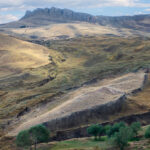
Formation contains the buried remains of Noah’s Ark and has described the latest evidence as confirmation that the formation is man-made. Photo credit: MehmetO/Shutterstock
For thousands of years, the story of Noah’s Ark has been one of those tales that refuses to disappear. Whether you see it as religious history, legend or one of the world’s great archaeological mysteries, there is one question that has never gone away: where is the ship? Now researchers investigating a strange boat-shaped formation in eastern Türkiye say they have found something beneath the ground that could change the search completely.
New scans have detected what appear to be straight lines, right-angle intersections and sizeable spaces beneath the formation, while drilling has recovered layers of organic material and encountered an exceptionally hard underground layer that reportedly broke the drill bit. The team behind the investigation has even claimed that the latest work has “100 percent confirmed” that the formation is man-made, but there is an important catch: nobody has actually uncovered Noah’s Ark, yet.
What has been found beneath the site?
The investigation is taking place at the Durupınar Formation, around 20 miles south of Mount Ararat. The site has attracted Ark hunters for decades because its outline looks remarkably similar to a ship when viewed from above.
It was first identified in aerial photographs in 1959 and measures around 157 metres long. Researchers have repeatedly debated whether the unusual shape is the remains of a vessel or simply the result of natural geological processes. This year, however, researchers have taken the investigation much further.
Radar reveals mysterious structures
An international team led by archaeologist Professor Cenker Atila of Sivas Cumhuriyet University has been carrying out geological and archaeological work using ground-penetrating radar, electrical resistivity tomography, LiDAR and core drilling. The project has official approval from Turkish authorities.
The radar surveys have produced some of the most intriguing results so far. Researchers say they have identified features that appear to form possible corridors, chambers and tunnels beneath the surface. One group of anomalies appears to extend for roughly 151 feet, with an average height of more than 14 feet.
Underground features raise new questions
Other areas detected by the radar reportedly measure around 26, 39 and 23 feet in height. There is also a particularly intriguing section where researchers say the underground features appear to divide into three layers. That has led the team to draw comparisons with the biblical description of the Ark as having three decks.
But radar cannot simply show archaeologists a photograph of a room buried underground. The equipment detects changes in materials and boundaries beneath the surface, meaning the features still have to be physically investigated before anyone can establish what produced them.
Then the drilling began
That is where the latest phase becomes particularly interesting. Researchers have taken core samples from inside and outside the boat-shaped formation, reaching depths of up to around 18 metres. According to the research team, the cores have produced layers containing large amounts of organic material. They are now being sent for laboratory testing to determine exactly what the material is and how old it might be.
At one point, the drilling reportedly stopped after the equipment struck an extremely hard layer around four to five metres beneath the surface. The drill bit broke when it hit the material. Andrew Jones, founder of Noah’s Ark Scans and vice president of the research project, said petrified or highly mineralised wood are among the possibilities being considered.
That is still only a possibility. The material has not been confirmed as wood, let alone wood from a ship. Independent laboratory testing, including dating, will be needed before researchers can establish what they have actually recovered. The team has also reported encountering several cavities during drilling, including one that filled with mud and water.
A robot could go inside
The next step could be even more dramatic. Researchers are preparing a small exploration robot called Gopher, designed to enter narrow spaces through the boreholes and capture video footage while collecting samples. The idea is to investigate the underground spaces identified by the radar without immediately cutting open large sections of the formation. If the cavities really do contain man-made structures, the footage could provide the first direct visual evidence of what lies beneath the mysterious mound.
Researchers have also collected around 1,000 soil samples from 150 locations and found pottery outside the formation dating from the Chalcolithic period through to the Iron Age. That shows people were using or visiting the area over a very long period, although the pottery does not prove any connection with Noah or the Ark.
Is Noah’s Ark really there?
This is where the extraordinary claims need to be separated from what has actually been established. Jones has said he believes the Durupınar Formation contains the buried remains of Noah’s Ark and has described the latest evidence as confirmation that the formation is man-made.
However, at the moment there is currently no peer-reviewed scientific study proving that the underground structures were constructed by humans, and no wooden vessel has been uncovered for them to be confirmed a peer review study would be necessary.
The mystery is far from settled
National Geographic has previously reported that many archaeologists consider the Durupınar formation a natural geological feature and that modern searches for the Ark remain highly controversial. The biblical reference itself says the Ark came to rest on the “mountains of Ararat”,over 4.300 years ago which does not necessarily identify the modern Mount Ararat or the Durupınar site. Even the project’s own Turkish website says its work is investigating the geological and geophysical evidence rather than authenticating the historical or religious claim.
So, after centuries of searching, there is still no confirmed Ark sitting beneath the Turkish mountains. What researchers do have is a very unusual formation, increasingly detailed images of what lies beneath it, physical samples now heading for laboratory analysis and a plan to send a robot into the unexplored spaces. And that means the next stage of the investigation may finally produce something much more useful than another photograph of a rock that looks like a ship: evidence that can actually be tested.








 Argentina2 weeks ago
 Alex Saab2 weeks ago
 New Developments2 weeks ago
 Uncategorized2 weeks ago
 %2 weeks ago
 %2 weeks ago