ElPais
How Betting Platforms Are Using Pop Culture To Attract Women
Published
23 hours agoon
“It’s not gambling, it’s girl math,” is the headline of an article by Nancy Walecki in The Atlantic, in which she reflects on how the gambling industry is trying to win over female audiences with matcha tea memes, girlboss-style advertising, and prediction markets tied to pop culture. On the popular prediction market platform Kalshi, some wagers focus on whether Timothée Chalamet and Kylie Jenner will get engaged this year, or whether Gigi Hadid or Adriana Lima will wear the coveted Fantasy Bra at the upcoming Victoria’s Secret fashion show.
Juan Francisco Navas, co-author alongside José César Perales of Trampas (Traps), explains that increasing importance is being placed on ensuring that women receive financial education and learn how to invest. Companies, however, are seeking to commercialize this trend through products linked not only to investing but also to speculation.
“The gambling industry tries to present the product it sells as an investment product, even when it is actually more closely related to risk-taking and speculating on a possible outcome,” he says. “In virtually all forms of gambling, a series of cognitive distortions are encouraged or, put another way, distorted ways of understanding how chance works.”
He continues: “The main one in the field of betting is the illusion of control, whereby a person believes they can control the outcomes that may occur. This is linked to a kind of illusion of mastery: ‘If I have specific expert knowledge, I will be able to predict the outcome.’ All of this reduces the perception of risk and turns betting into a false investment opportunity, while obscuring the issue of risk,” he argues.
He notes that the gambling industry targets the interests of very specific segments of the population and argues that it is currently diversifying into activities with greater appeal to female audiences.
“The boys can do the parlays and use words I’ve never heard of, but the girls can use their pop culture and educated guesses to make decisions and trade on Kalshi. I’ll say it time and time again: Kalshi is for the girls,” says one TikTok user. She is one of many women promoting the website on social media, emphasizing that it is the perfect place for women to capitalize on their knowledge of pop culture. Not everyone, of course, is pleased by this trend.
“Here’s the thing: if you’re a young woman who’s trying to use a Kalshi ad opportunity to get ahead, you’re getting blocked right away. And I suggest everyone does the same! You already turned your comments off but we are not going to support you building a platform off that,” says a visibly upset user. “Here’s the thing about women: we acutally have been oppressed for a really long time. And those of us who are awake and intelligent know how to recognize when things are being marketed to us for a bad reason.”
Spain’s Directorate General for the Regulation of Gambling (DGOJ) has produced an analysis of women’s participation in online gambling in Spain to examine how gender influences the sector. The number of female players increased by 23.53% in a single year, meaning that nearly 64,000 additional women engaged in online betting in Spain.
“Historically, gambling spaces were more male-dominated because they were located in environments more accessible to men, such as bars, gaming halls, pool rooms or casinos, closely linked to traditional masculinity,” says Navas. “That has not prevented women from participating in other forms of gambling such as lotteries, scratch cards, or bingo, although recently we’re also seeing many, especially young women, drawn to activities like roulette.”
He points out, however, that gambling promotion is now primarily digital and therefore highly segmented according to the interests of each demographic group. “Hence the push to link women’s financial interest and economic development with very specific bets that may appeal to this population group,” he says.
The Spanish Ministry of Social Rights, Consumer Affairs and the 2030 Agenda, which oversees the DGOJ, has opened sanction proceedings against the prediction-market platforms Polymarket and Kalshi for a possible violation of gambling regulations, as they may be operating in Spain without the required administrative authorization.
“Prediction markets are platforms where users buy and sell shares on forecasts about the outcomes of future events, assigning prices that reflect the probability of one outcome or another,” explains the ministry. “For this reason, they are also known as peer-to-peer betting. Unlike traditional betting, these platforms allow users to trade with each other within a market, with the platform acting as an intermediary, facilitating transactions and charging commissions.”
Navas argues that reframing gambling as an exercise in knowledge exploits cognitive distortions, the most important of which is the illusion of control, linked to an overestimation of a person’s ability to predict what will happen.
“The offer works like a kind of bait: although it may seem attractive at first glance, it encourages the person to take on disproportionate risk under the promise of higher returns,” he explains. “Even if they can or believe they can predict an outcome, it’s hard to profit because you’re always playing against the house.”
“In this context, the gambling industry will exploit the human vulnerability of overtrusting one’s predictions while misjudging risks,” he continues. “It will mobilize supposed expert knowledge, offering lots of information about odds, statistics, historical data or analytical charts to give the impression that we can place more trust in our prediction, even though that information is almost always useless for making a prediction that beats the odds the house offers.”
Navas adds that users should be aware that it is very difficult to profit from this kind of knowledge and recognize that the industry’s real purpose in presenting all this data is to make them feel more confident and encourage them to fall into the trap.
It is a trap that also relies on language. To attract more women, many platforms speak of “investment opportunities” and “financial empowerment,” deliberately distancing themselves from the word “betting.” Although pop culture often sits at the center of their marketing narrative, these platforms are, at their core, a form of high-risk financial speculation.
A woman named Rachel told The Cut that she had started using Kalshi to place bets on bitcoin-related markets. She admits that she now uses the app every day. “It’s all-consuming. I wouldn’t recommend it to anyone,” she says, explaining that whereas she used to read before going to work, she now spends an hour staring at her screen using the app. “I knew it was getting bad when I started seeing the chart in my dreams,” she confesses.
Navas warns that if the perception of risk is reduced and betting is presented as a leisure activity, or even as something constructive because it is associated with the idea of achieving financial success, people are ultimately likely to lose money.
“The entry point is to present a product that appears to involve very little risk as something normal and even positive. But gambling is an addictive agent, and great caution is needed when engaging with it,” he says. Because, in the end, the house always wins.
Sign up for our weekly newsletter to get more English-language news coverage from EL PAÍS USA Edition
You may like
ElPais
Floppy Disks, Faxes, Envelopes And Other Analog Fossils That Survive In Windows Imagery
Published
2 hours agoon
August 14, 2026
You’ve just finished writing an article and, almost mechanically, you click the small square in the top-left corner of the screen. Millions of people do this every day. But how many know what that icon actually means?
Older users will recognize it as the stylized silhouette of a 3.5-inch floppy disk, but many of those who now use it daily as the Save symbol have never held one in their hands.
Sony introduced that floppy-disk format in 1987 after experimenting with less capable systems, so the icon we click in Windows represents a device that is nearly 40 years old.
This small disk, which held 1.44 megabytes, quickly became hugely popular after it was adopted as a standard by IBM PS/2 computers and then by virtually all other manufacturers, including Apple. It was easy to carry and fast to load. Its hard plastic shell and a sliding metal shutter protected it from shocks, scratches and bending.
Yes, bending — because its predecessors, nicknamed floppys, were a thin mylar sheet inside a flexible cardboard sleeve. There were 5.25-inch disks, preceded by 8-inch ones used early on in large professional machines. The 5.25-inch format became widespread with the boom of the personal computer. When IBM launched its first PC in 1981, it offered a dual floppy drive, each capable of 160 kilobytes (later up to 640K). Today it’s hard to imagine how an operating system or a spreadsheet could fit in so little space.
Not even a moderately sized photo taken on today’s mobile phones would fit on one of those disks. Yet, in the late 1990s Sony introduced digital cameras that recorded directly onto 5.25-inch disks as if they were film.
IBM decided to name its floppy drives “A:” and “B:”, reserving “C:” for a future hard disk, which at the time was almost a rarity. The “C:” remains on our computers today; the other two drives fell into oblivion many years ago. In fact, if you still have floppies of those older formats, you most likely don’t have the proper drives. If you urgently need to read one, try secondhand shops or eBay. Connecting them to your machine is another matter. Some later models use USB, but direct connection to the motherboard can be more complicated.
That is the problem of technological obsolescence — archivists’ nightmare. A 11th-century parchment can still be read; an inscription on the walls of Luxor can still be read; a file recorded on a floppy in the 1980s, using a long-forgotten processor and operating system, probably cannot.
Floppies were slow to die. In an attempt to delay the inevitable, IBM released a double-capacity version that met with little success. In the mid-1990s a company called Iomega, specialized in mass-storage media, introduced the Zip, a disk the same size as the classic 5.25 but with the astonishing capacity of 100 megabytes.
The Zip was a phenomenal hit, but it didn’t last long, partly because of a nasty tendency for its heads to go off-track and destroy data, and mainly because of the arrival of a new optical medium: CDs and, later, DVDs. Although burning data to them made them somewhat cumbersome for everyday use.
The article is finished and saved. To retrieve it I’ll click the corresponding icon: a half-open cardboard folder. When was the last time I held a physical cardboard folder? Yet another icon that evokes an almost vanished object.
And how do I send my article to the paper? By email, of course. I just click another icon, the one that shows an envelope (or sometimes a paper airplane like the ones we folded in school). An envelope? Do I have a single unused envelope at home? When did I last write a handwritten letter myself? The few times I need one, I have to overcome the laziness of going to the stationery shop — and then to the tobacconist for a stamp. Except for some utility bills, it’s rare that I receive a letter in an envelope anymore. Yet that symbol persists on my computer screen.
New phones, old symbols
Next: to make a phone call or a WhatsApp call the icon shows a handset like those on old desk phones — the kind with a rotary dial or a numbered keypad that have disappeared from many homes. Ironically, it’s the same symbol that appears on mobile phones.
In some audio apps you can still see cassette-tape icons. In some video apps the record command is shown as a camera with two film reels, like those used in Hollywood’s silent era.
Windows’ icon collections still include images of CRT monitors, film cameras, CDs, DVDs, analog videotapes and even a fax terminal.
For younger generations, these symbols have lost much of their original meaning. Much like Egyptian hieroglyphs, where each sign could have several interpretations depending on context, but rarely referred to the actual object. A loaf of bread followed by a wavy snake simply meant “father”; a cartouche around a group of signs identified a proper name, such as a pharaoh.
With the spread of the cloud, new symbolic needs have emerged. And, surely, other icons we take for granted today will disappear. The USB flash drive, for example? Or the image of a desktop computer, replaced by one of the new fist-sized PCs or a tablet?
But the modest floppy icon as a synonym for “save” remains. All the designers’ attempts to create alternatives have met with little success or have simply been unintelligible to the average user. The small square drawing remains on our computers, even if for many it is now just an archaeological artifact.
Sign up for our weekly newsletter to get more English-language news coverage from EL PAÍS USA Edition
Carrefour
Aquaculture Is Depleting The Oceans: A Farmed Salmon Can Consume More Than Six Times Its Weight In Wild Fish
Published
20 hours agoon
August 13, 2026By
Ian Urbina
Empty fish counters. That is what shoppers found when they arrived at Madrid’s Mercado de la Paz last September. The stock had not sold out. Instead, they were looking at an advertising campaign organized by Apromar, Spain’s aquaculture industry association, which wanted people to imagine a country without farmed fish.
“Seafood could become a luxury affordable only to a few,” the ads warned, before adding: “The real fortune is living in a country where aquaculture exists and guarantees fish for everyone.”
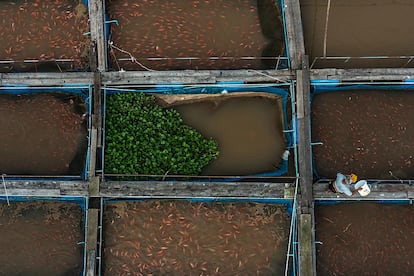
The message was straightforward: consumers want more fish, wild fish stocks are being harvested to their limits, and fish farming is the way to meet growing demand while preventing the collapse of the oceans. This same logic, producing more to catch less, drives a global aquaculture industry worth €270 billion ($311 billion), the fastest-growing food sector in the world. Today, half of all seafood products come from aquaculture, and Spain is the European Union’s largest producer by volume.
There is, however, a problem. “The industry’s sales pitch is incorrect,” says Daniel Pauly, director of the Sea Around Us project at the University of British Columbia.
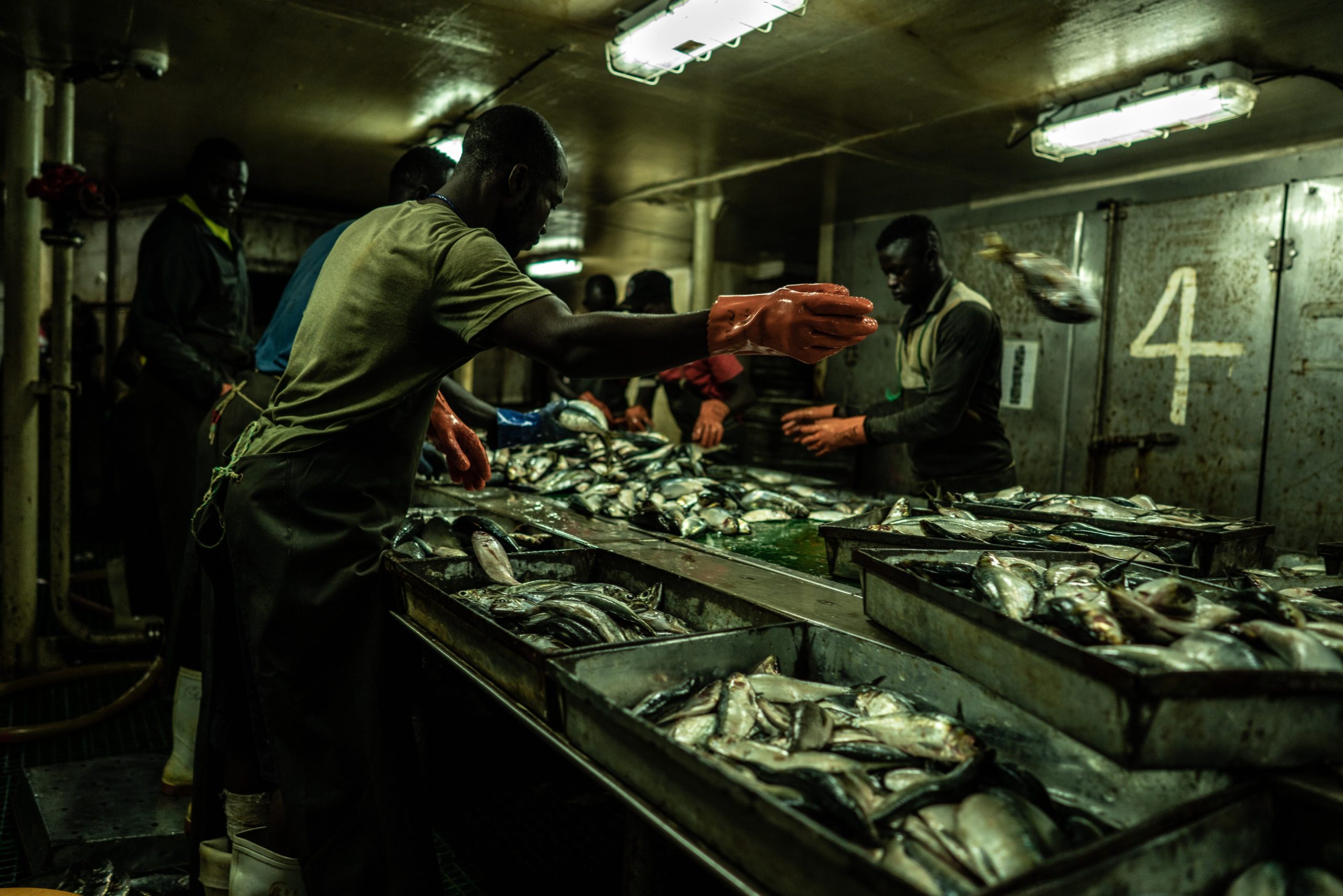
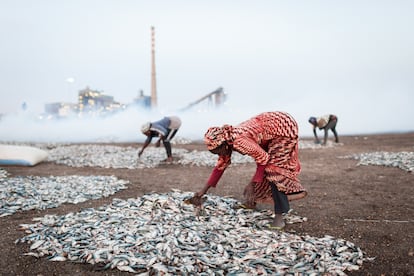
The most popular farmed seafood products in Spain and other countries, including salmon, shrimp, trout, sea bass and sea bream, are fed with the very same wild fish species that aquaculture claims to be saving, thereby accelerating ocean depletion. Two-thirds of global aquaculture raises species that are fed fishmeal and fish oil, ingredients made by cooking and grinding fish caught in the wild. Before reaching the market, a farmed salmon may consume, in some operations, more than six times its own weight in wild fish.
An investigation by The Outlaw Ocean Project, a Washington, D.C.-based journalism organization, uncovered a range of impacts linked to the industry, including the loss of jobs in small-scale fisheries, chronic exposure to chemicals, preventable workplace deaths and violent protests, mostly triggered by the unbearable stench of fishmeal plants. The investigation concluded that these social and environmental costs fall largely on poorer countries where the raw material is caught and processed, far from the places where the seafood products are consumed.
In Gambia and Mauritania, the investigation documented how the industry worsens food insecurity as fish that once sustained local communities are increasingly diverted to fishmeal factories for export. On remote islands in Russia’s Far East and in China’s Xinjiang region, reports described the use of forced labor on fishing vessels, farms and in factories.
In other countries, including India and Peru, the industry was linked to at least 80 episodes of social conflict, some of them violent, typically involving labor strikes and community protests sparked by water pollution or the stench from factories processing thousands of tons of rotting fish.
For example, shrimp sold by major retailers in Spain, including El Corte Inglés, E.Leclerc and Carrefour, and raised on farms in Ecuador, is fed with fishmeal sourced from plants across Latin America that have been linked to at least five worker deaths, 20 cases of illegal fishing and more than half a dozen protests over odors from fishmeal factories, according to Bait to Plate, an online tool that tracks the seafood industry and its supply chains.
Carrefour Group said it had launched an investigation into issues related to its supply chain and would “take all necessary measures if violations are confirmed,” including potentially excluding suppliers that fail to meet its ethical and environmental standards. El Corte Inglés and E.Leclerc did not respond to requests for comment.
The investigation, which took two years to complete, mapped virtually the entire global fishmeal industry, including more than 1,400 plants operating in 64 countries, and traced supply chains from fishing vessels to processing plants, feed mills, fish farms and seafood retailers.
The study found that the fishmeal industry also contributes to geopolitical tensions. In 2021, for example, about a dozen Turkish bottom trawlers fishing illegally in the Aegean Sea allegedly attempted to ram a Greek research vessel after scientists began filming their activities. In 2018, riots broke out in Saint-Louis, Senegal, after a fisherman was shot dead by Mauritanian coast guards during what Mauritanian authorities described as a cross-border incursion by a vessel linked to the fishmeal industry.
Since the mid-1970s, Morocco has maintained military control over Western Sahara, a presence deemed illegitimate by more than 10 rulings of the Court of Justice of the European Union. Nevertheless, Moroccan vessels routinely fish in Western Saharan waters and process their catches into fishmeal at plants located in the territory before exporting it to aquaculture farms around the world labelled as Moroccan.
In 2020, a violent confrontation involving several trucks, many of them carrying fish and fishmeal from Western Sahara, led to the collapse of a 29-year ceasefire. Until 2024, a fishmeal plant in Western Sahara supplied fishmeal to Irida, a company that manufactures feed for many fish farms in Greece, including those supplying farmed sea bream and sea bass to Mercadona, Spain’s largest supermarket chain. Irida and Mercadona did not respond to requests for comment.
A significant share of the fishmeal used by Spanish fish farms, around 128,000 metric tons in 2024, is imported, linking Spanish consumers to these hidden and cross-border social impacts. Some 70% of Spanish aquaculture production consists of bivalves such as clams, oysters, scallops and mussels. These species are comparatively more sustainable because they generally do not require feed and need relatively little land and freshwater. Among species whose production depends on fishmeal, the most common in Spain are European sea bass and gilthead sea bream.
The investigation examined more than 2,400 vessels involved in fishmeal production operating in the waters of at least 30 countries. Most vessels in the global fishmeal fleet were purse seiners or trawlers, which use large nets to capture dense schools of fish, indiscriminately sweeping up substantial amounts of bycatch and non-target species. At least half of the species landed by the vessels analyzed had been classified as “overexploited” by scientific studies.
More affordable products
Modern aquaculture also has its benefits. In India, for example, it is a key source of employment, especially for women. In Bangladesh, its expansion has helped drive down prices, making seafood more affordable for lower-income households. The industry’s carbon emissions are also considerably lower than those from beef or pork production.
Bivalve farming has an especially low carbon footprint. As early as 2022, roughly one-third of global aquaculture production required no external feed inputs. Even so, more than two-thirds of farmed seafood today still depends on feed from the sea. According to the Food and Agriculture Organization of the United Nations, global fishmeal consumption is projected to increase by nearly 10% between 2022 and 2032.
Asked about concerns over the sustainability of her sector, Véronique Jamin, spokesperson for IFFO, the international fishmeal and fish oil association, said aquaculture is “the most efficient animal protein system.” She added that “sustainability frameworks will not work if they ignore the economy of the real world,” and argued that seafood companies must respond to “what people actually want to buy and eat.”
Researchers have explored alternative protein sources such as algae, cassava waste, black soldier fly larvae and even single-cell proteins derived from fungi or bacteria, but none are yet affordable at scale. For now, the pattern remains the same: wild fish are caught and converted into feed, while the costs of this production are borne elsewhere.
The investigation revealed the hidden role that forced labor and land dispossession play in the expansion of China’s aquaculture industry. China now farms more than four times the amount of fish it catches from the wild. One of the industry’s fastest-growing regions is the mountainous and desert interior of western China, particularly Tibet and Xinjiang, two areas known for intense political repression.
The investigation identified more than 1,000 aquaculture farms in Xinjiang and Tibet producing farmed seafood worth an estimated €436 million ($502 million) annually, much of it exported to more than a dozen countries. China’s push to expand fish farming in these regions is facilitated by extensive state repression, including widespread land seizures, intensive surveillance, and the imprisonment of tens of thousands of people. European Union legislation does not specifically target China, but it does prohibit the importation or sale within the EU of products made using forced labor.
Seafood companies are also facing growing legal challenges related to problems in their supply chains. Since 2020, at least nine lawsuits alleging deceptive marketing practices have been filed against six seafood companies across six U.S. jurisdictions. The cases center on a common pattern: marketing claims portraying products as sustainable or ethically sourced despite supply-chain evidence suggesting otherwise.
Plaintiffs challenged terms such as “sustainable,” “eco-friendly,” “all natural,” “wild-caught,” and “from the coast of Maine,” as well as claims of superior labor standards. The Outlaw Ocean investigation reviewed more than 500 seafood companies making similar, and in some cases even stronger, marketing claims and found that more than half had documented violations or irregularities within their supply chains.
Sign up for our weekly newsletter to get more English-language news coverage from EL PAÍS USA Edition
Cantabria.
The Rest That Wears You Out: Why A Day At The Beach Can Be Exhausting
Published
20 hours agoon
August 13, 2026
Every day, a community garden and a seaside promenade are all that separate Carmen Gutiérrez from Sardinero Beach in the Spanish city of Santander. As director of the Cantabria School of Film and Television, she could practically jump onto the sand from the privileged location of its main campus in Santander. Even so, she tries not to do so when she has an afternoon of work at the computer ahead of her.
“Because the beach is tiring,” she says.
In fact, if she returns home after a few hours by the sea, “I don’t feel like unpacking my beach bag. I just want to lie down on the sofa,” she admits.
The feeling will be familiar to any holidaymaker. Although, in theory, few activities seem more relaxing than spending hours stretched out on a towel under the sun, soothed by the breeze and the sound of the waves, it is common to return from a day at the beach feeling drowsy and low on energy. But how is it possible to end up exhausted after enjoying what is supposed to be the ultimate summer retreat?
A body that never goes on vacation
“People think the body is resting, but it’s doing enormous metabolic work,” Javier Ceballos, a sports medicine specialist and former doctor for Racing Santander, tells EL PAÍS.
Ceballos has been retired for several years and is a well-known figure in Santander. He spends much of his time playing beach paddle, a traditional paddle game popular along this coastal region.
Ceballos attributes the sensation of beach fatigue to three physiological mechanisms. The first is thermoregulation. “When ambient temperature rises, the body’s priority is to keep our temperature stable at around 37ºC [98.6ºF],” he says. To achieve this, the body activates a complex physiological system that consumes energy even if we are motionless under a beach umbrella. “While we’re lying on the towel, the body is working to prevent overheating.”
When the hypothalamus, the brain’s thermostat, detects excess heat, it instructs superficial blood vessels to dilate and activates sweating. As sweat evaporates, it helps cool the body. But although these processes often go unnoticed, they come at a cost. “The body is constantly making adjustments: blood flow to the skin increases, the heart has to work harder, and all of that ends up producing a feeling of fatigue,” the expert explains.
That demand is compounded by fluid loss. “Even if you’re still and lying down, you continuously lose fluid because of the heat, the breeze and sweating. Even mild dehydration makes the heart work harder and that also contributes to tiredness,” says Ceballos.
According to the Mayo Clinic, exposure to high temperatures — especially when combined with high humidity — can lead to a range of heat-related disorders, from muscle cramps to heat exhaustion and, in severe cases, heat stroke, a potentially life-threatening medical emergency. Symptoms include fatigue, dizziness, weakness, headache, nausea and difficulty concentrating.
Young children and older adults are the most vulnerable groups, since their ability to regulate body temperature is less effective, Ceballos warns. “In older people, the sensation of thirst appears later, which is why it’s so important to drink before you feel thirsty.”
The third mechanism involves the body’s defense against solar radiation. Even when sunburn does not occur, ultraviolet rays can generate oxidative stress and damage skin cells, triggering an inflammatory response. “The sun acts as an aggressor and the immune system responds,” says the expert.
As part of this process, the body releases immune-signaling molecules known as cytokines, which are also associated with the fatigue experienced during some infections. “They send signals that promote tiredness and force the body to rest in order to repair the damage,” Ceballos adds.
The beach is also not as passive an environment as it appears. Fatigue may begin even before setting foot on the sand. During summer, people often sleep poorly because of the heat or changing schedules, and waking up early to secure a good spot on the beach hardly helps.
Then comes carrying umbrellas, coolers, and beach gear, a physically demanding task, especially for those who lead sedentary lifestyles. And after that there are walks, swimming, games with children, or activities such as paddle and frisbee. Even walking on sand requires considerably more effort than many people realize.
An Italian study estimated that walking on sand requires nearly twice as much energy as walking on a firm surface. Researchers attributed the difference to the fact that the body recovers movement energy less efficiently with each step on sand, forcing the muscles to work harder to move forward.
“You have to keep lifting your foot because it sinks, and that requires a lot more energy,” says Ceballos, adding that he becomes particularly aware of this when he is playing beach paddle.
Precisely because he understands this physiological toll so well, Ceballos limits his time at the beach. “I stay two hours, two and a half at most.” His routine consists of playing beach paddle for just over an hour, staying hydrated throughout, going for a swim, enjoying a little sun while always protected, and then heading home.
Recommendations
To reduce the strain, Ceballos’ recommendations are simple. The first is to hydrate before feeling thirsty. “A sip of water every hour is essential.” He also warns against some false remedies: “Alcohol and sugary juices dehydrate you more. I would drink water and perhaps a beverage with electrolytes — sodium and potassium — but without sugar or not excessively sugary.”
He also emphasizes another basic rule: avoid the hours when solar radiation is strongest. “The worst hours are between 12 p.m. and 4 p.m.” He adds other precautions: avoid heavy meals, “which divert more blood to the stomach,” use appropriate sun protection, and take regular breaks in the shade.
Everything suggests that beachgoing should be enjoyed in moderation. “It’s not psychological; the body is working constantly,” he summarizes.
In fact, many people report feeling even more exhausted the following day. Ceballos explains that cellular repair, rehydration, and the restoration of the body’s internal balance all take time. “It’s the bill the body charges you.”
Perhaps that is why Carmen Gutiérrez has adopted her personal rule. Even though Sardinero Beach is only a few steps away from her workplace, she avoids going there if another afternoon at the office lies ahead. Simply because, as she puts it, “it’s tiring, and it gets everything sandy.”
Sign up for our weekly newsletter to get more English-language news coverage from EL PAÍS USA Edition
Los Demócratas Denuncian Las Malas Condiciones Que Sufren Los Marineros Del Portaaviones ‘Abraham Lincoln’ Desplegado En El Golfo
🌅 Stunning Penthouse With Panoramic Sea & Mountain Views Benalmádena
Manchester City’s Rodri Takes Ryanair Flight To Liverpool Ahead Of Transfer Speculation
Tags
Trending
-
easyJet2 weeks ago
First EasyJet passenger from UK refused entry to Gibraltar after new treaty
-

New Developments2 weeks agoInside The Most LUXURIOUS Apartment Building In Spain!
-

Uncategorized1 week agoLewis Hamilton hits gold with $10bn jackpot but British star snubs Monaco move: F1 News Recap
-

Latest2 weeks agoSuspect In Murder Of Hungarian Woman In Benahavis Attempts To Slit His Own Throat As Guardia Civil Make Arrest
-
2 wheel case2 weeks ago
To push, pull or carry? Which luggage option is best for your posture and journey.
-

Uncategorized1 week agoRacing star was destined for F1, now he
-
Charity padel tournement2 weeks ago
Nueva Alcantara Club and children’s charity come together for a padel weekend with a purpose
-
Mallorca1 week ago
Palma mayor fights to keep TUI water bus project afloat