
America
In Miami, Food Banks Are Overflowing Ahead Of Thanksgiving

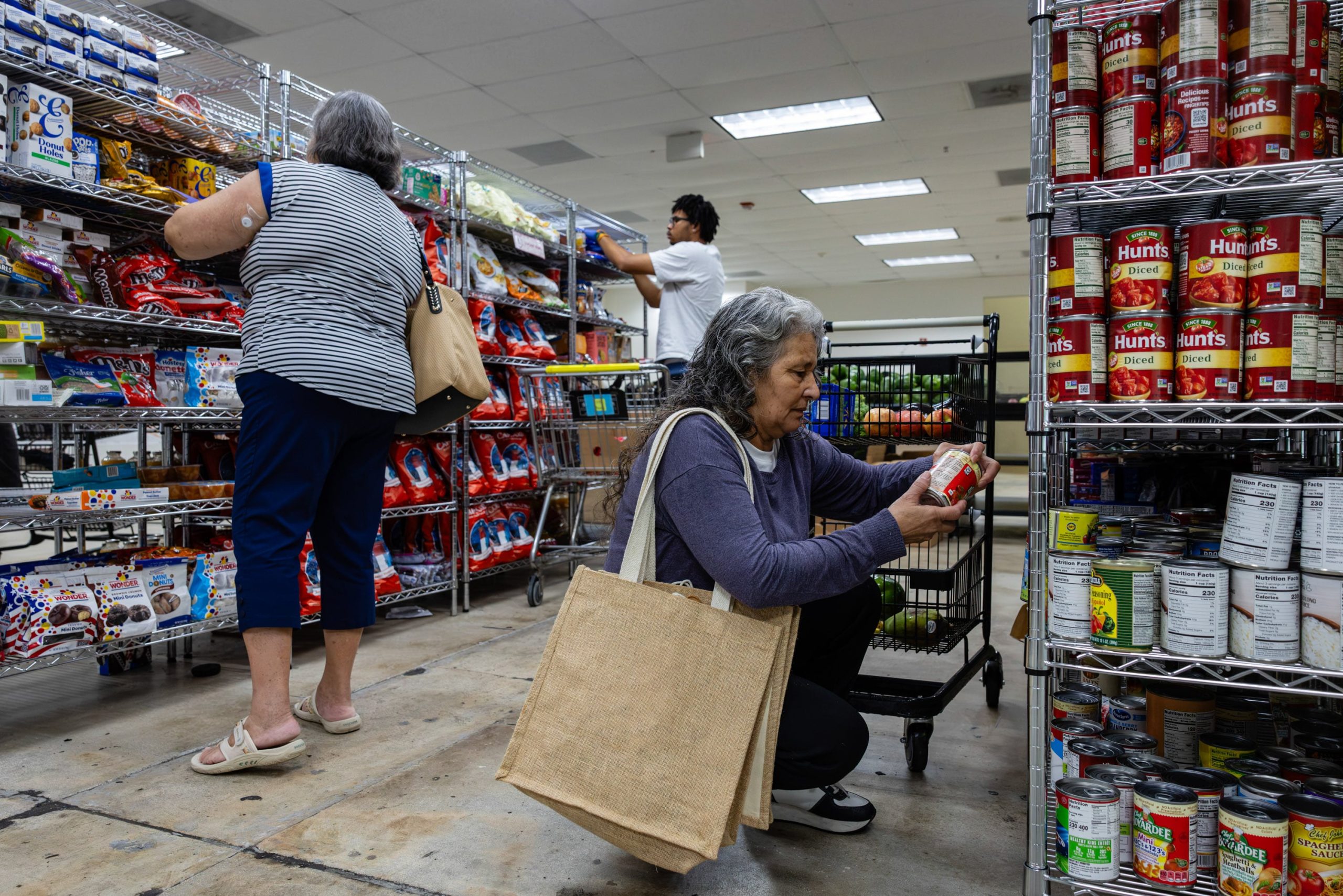
There are times of the year like Thanksgiving, when schools where some children receive food are closed, and the hunger crisis in Miami —one of the most expensive cities in the United States — is most noticeable. Despite heavy rains and the risk of flash flooding this Wednesday, hundreds of people, mostly working families, turned to free food pantries and food banks to secure a turkey and vegetables for the traditional dinner, and to offset the expenses that keep rising with inflation and the war against Iran.
At 60 years old and with three jobs, Sonia still needs to go at least once to pick up free food to complete the month’s diet. She cleans houses, takes care of children and pets, and earns $15 an hour. She bikes to work so she doesn’t have to spend on car, insurance, and fuel. What she earns goes to pay rent, electricity, and her son’s university in Chile, her home country. There she worked almost two decades as a secretary in a local government, and in the U.S. she has been changing fields as opportunities arise. She is now saving for dental treatment, which without health insurance costs thousands of dollars.
“I’ve been coming for about eight months and I keep seeing more people,” says Sonia, who prefers not to use her full name. She’s not surprised, because all the prices of all the products have gone up, “even at Dollar Tree,” the American store chain that boasted of selling all its products for one dollar.
The cost of living in Miami has risen so much that many families’ incomes are not enough to pay the minimum: shelter, food, and utilities.
In a 2026 survey conducted by Aspect Strategic for No Kid Hungry Florida, 82% of respondents said that the cost of food had increased more than their income in the past year. Around 70% indicated that their economic situation has worsened as a result of rising food prices, and 49% admitted to going into debt to cover that expense. One in two families also say they skip meals or eat less, and two out of three families have had to choose between buying food or paying essential bills.
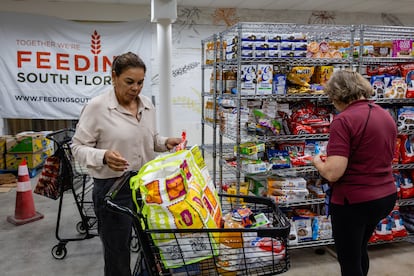
Demand for free food pantries has skyrocketed, explains Jessica Benites, chief of staff at Feeding South Florida, a nonprofit organization that receives and distributes donations in four counties in the region through 300 branches. “We are experiencing a very large increase in families coming to Florida to ask for food aid and we’ve had to expand our operations. Before, we served until 5:00 p.m., now we are serving until 8:00 p.m. We also had to increase Saturdays and Sundays to meet the very high demand we have now,” she says.
Federal and state aid for low-income families and elderly people to buy food has been reduced. Just over a year ago, the Donald Trump Administration approved the largest reduction of the Supplemental Nutrition Assistance Program (SNAP) since its creation in 1939. As a result, about two million people lost the benefit. In Florida alone, enrollment in the program fell by 22%, according to data calculated by the Associated Press agency.
The federal government’s immigration policy, which has set out to deport as many undocumented immigrants as possible, has also added pressure to the hunger crisis in the southern part of the state. Miami and the surrounding cities are home to the largest diasporas of Haitians and Venezuelans and other communities that have lost work permits and protections granted by TPS, the Temporary Protected Status that Trump has been chipping away at since returning to the White House.
On an average day, about 200 families look for food at Feeding South Florida’s largest location, in the Hallandale Beach area, about half an hour from downtown Miami. Many of them are immigrant families who have lost their work permits and mixed-status families—where at least one member has U.S. citizenship and access to public benefits—who have chosen not to apply for the SNAP benefit for fear of retaliation.
“Many people are already afraid to share the information, and sometimes people prefer not to apply because they feel exposed and don’t receive as much money as they used to,” says Benites. “And with TPS, people could work and can’t anymore, and when they lose their jobs, they have to look for organizations that can help them. In our case, with food.”
Sign up for our weekly newsletter to get more English-language news coverage from EL PAÍS USA Edition









America
Abraham Jiménez, On Florida’s Most Radical Exiles: ‘They Don’t Realize It, But They Have A Fidel Castro Inside Of Them’

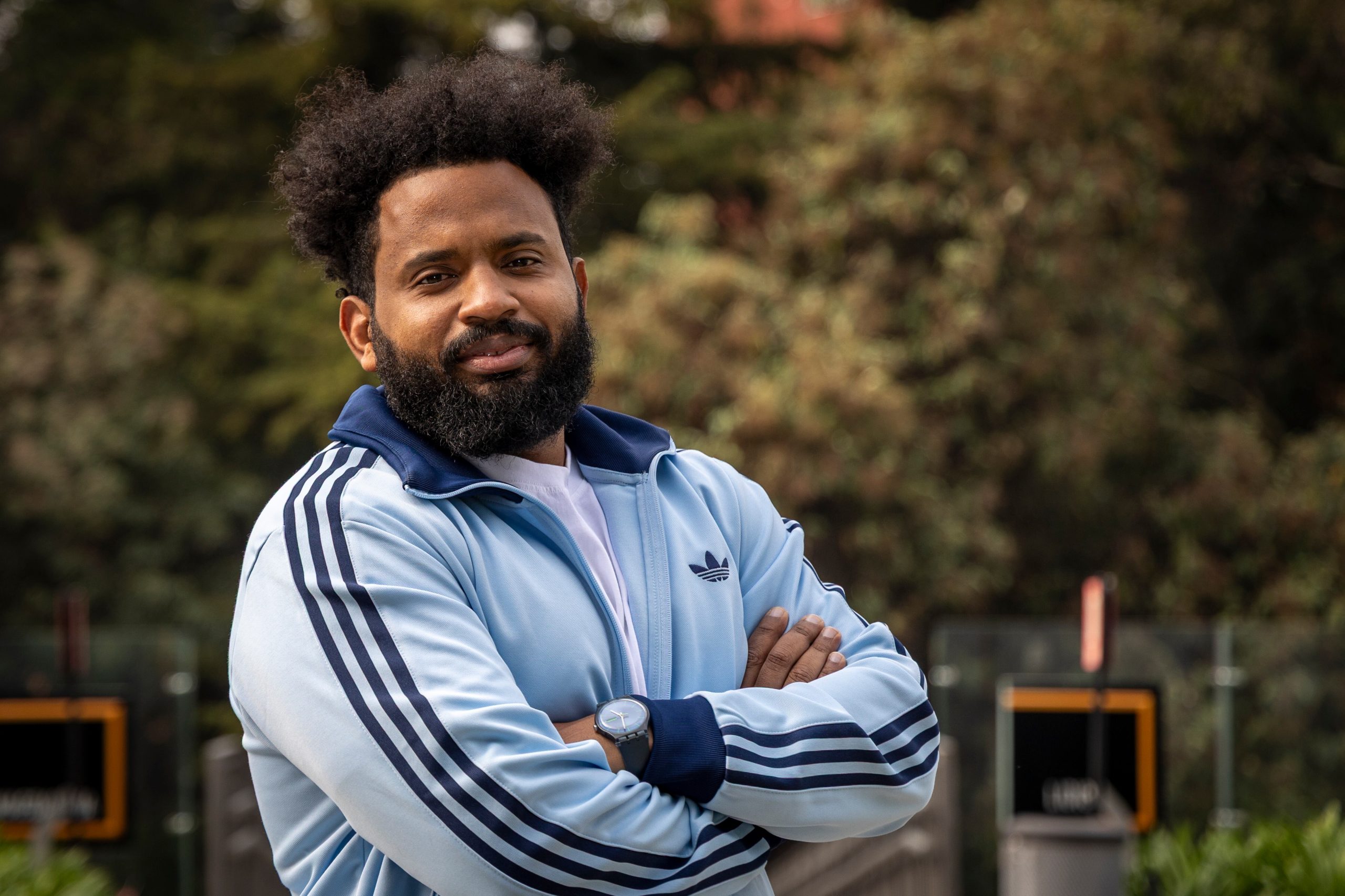
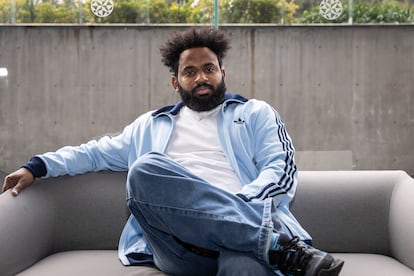
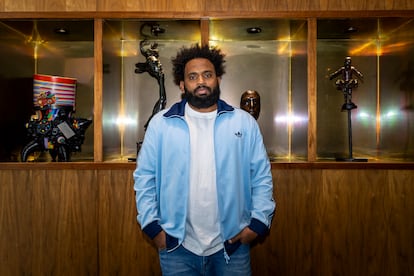
Talking about Cuba again has been a painful process for Havana native Abraham Jiménez Enoa, 38. The image of State Security agents — the relentless political police — ordering him to undress inside a prison cell bored holes in his mind for years. It was the greatest humiliation of his life.
As one of the founders of the independent magazine El Estornudo, Jiménez’s crime was doing journalism. Publishing a column in The Washington Post could only mean being on the CIA payroll. When he returned home, state television broadcast his interrogation. Confinement alone was not enough. He had to be turned into a pariah.
His grandmother couldn’t contain her rage. Abrahamcito, raised like a son, is the grandson of a former bodyguard of Fidel Castro and Che Guevara; he used to ask his grandfather to tell him stories of the Revolution; he is also the son of a counterintelligence professor at the Ministry of the Interior. And now, suddenly, he was… a gusano (a worm, meaning a counterrevolutionary). Even thinking about it was painful. In January 2022, Jiménez went into exile, to the Spanish city of Barcelona. His grandmother died three months later.
Jiménez recounts his process in the 2024 book Aterrizar en el mundo (Landing in the World). He also recounts how, across the ocean, he has encountered another kind of monster: xenophobia and racism. The Cuban journalist spoke with EL PAÍS in a hotel in Mexico City, where he was participating in an academic event about Cuba. Talking is no longer impossible. But it still hurts.
Question. What has it been like to talk about Cuba again?
Answer. It’s strange. It’s a love-hate relationship. Geography isn’t to blame for what happened to me. But inevitably I translated all that into repulsion. I would go to a bar, hear a Cuban accent, and leave… Suddenly, one Saturday, we were having breakfast at home, a Carlos Varela song played, and I started crying. That’s when reconciliation began.
Q. In the midst of all that process, you were expelled from the country. You went forth into the outside world for the first time. How much has it changed you?
A. A lot. I’ve become colder. My partner works, goes to an office and is there all day, but I don’t see anyone. Because I’m freelance and also because I don’t feel like it. All that has affected my character: I used to be a person who interacted a lot, and now I’m absolutely the opposite. I don’t know if I’ll manage to heal all the effects of what I went through.
Q. And what has it been like to be a migrant?
A. I always make the nuance: I am an exile. I live in another dimension of migration. I didn’t leave because I decided to. They made me leave. And that implies a permanent existential dissociation: my body is in Barcelona, but my mind is not. When it’s my mother’s birthday or someone gets sick, I can’t go see her. You don’t belong anywhere…
Q. In the book, you recount how the harassment by the Cuban State Security caused you a deep depression. What motivated you to be honest like that?
A. When the persecution intensified, I couldn’t leave the house. Even in that situation, I absolutely broke down. There were days when I didn’t get out of bed. There’s that idea in activism: “We are unbreakable.” It seems to me, first, a lie, and second, a deception. There’s nothing more powerful and beautiful than saying: “You are such sons of bitches that you’ve broken me.”
Q. There are quite a few households in Cuba where revolutionaries and dissidents coexist. Do you think those two Cubas will ever reconcile?
A. The hardest thing that ever happened to me, beyond the day I was stripped, was that family breakup. Every Sunday we used to go to lunch with my grandparents and had after-dinner conversation. That got messed up. I became an outcast. No one is going to give me back those Sundays I lost.
With my father it’s the same: today our relationship is marked by all that. I don’t know if I’ll ever see him again. He had a stroke. If he dies, the last times I was with him were extremely cold. In the ideal Cuba, that reconciliation would exist: in the end, there is something above ideology, which is the land. And it is very sad, because I don’t see it; I see it getting worse and worse.
Q. In the book, you recount what has caught your attention about life outside Cuba. Were you surprised to see how many people who are not Cuban have an opinion about your country?
A. It happens to me all the time in Spain.
Q. How do you handle it?
A. Very badly. I think it’s an insult. There are many gurus around. I’ve been in Spain for five years; who am I to tell a Spaniard what Spain is like? They’re Europeans and they’re white, they think they have the last Coca-Cola in the desert and they come to explain to me what my country is like. A country, moreover, from which I was kicked out.
Q. Do you get the impression that they use Cuba as part of cultural battles?
A. They don’t care about us. They talk about Cuba, but as an abstraction that people use at will. It happened with the international flotilla. It was regrettable. You look at that and you can’t be against it, because it’s true that there’s no food or electricity on the island. But you can’t profit politically from that, nor walk around like it was a safari. In Spain, the left still doesn’t acknowledge the lack of human rights in Cuba. So what happens? That [the far-right party] Vox and the [mainstream conservative] PP welcome the dissidents.
Q. There are precisely groups in exile, especially in Florida, that embrace the far right…
A. I went to Miami for the first time in 2024 and it was unbelievable. It’s like a trip to the past. But, at least in my case, I had the bad experience of realizing that it’s Cuba, but from the opposite end of the political spectrum. Like calling ICE and saying: “There’s an illegal guy here, go take him away”… I stayed in Hialeah and saw all the Trump flags. They do the same thing as the Cuban government. They don’t realize it, but they have a Fidel Castro inside of them.
Q. You have spoken about the racist episodes you experienced in Barcelona. Are you afraid that Vox will govern Spain [which is holding a general election this coming Sunday]?
A. I’m very scared. Not even for me, but for my daughter. She’s one of the few Black kids in her school. I was surprised by the racism. I had experienced it in Cuba, but not so explicitly. And the beautiful thing about all that is that I’ve rediscovered myself as Black. I was on the plane and the idea of another exile crossed my mind.
Q. Would you leave Spain?
A. For my daughter, I would do anything.
Sign up for our weekly newsletter to get more English-language news coverage from EL PAÍS USA Edition

España – Austria, En Directo, Los Cuartos De Final De La Copa Davis En Vivo | Rodionov Se Lleva El Primer Set Ante Jódar

Elon Musk To Give Two Shares Of SpaceX To Every Child In The US In A Deal Worth $18 Billion

Spain Approves Ban On Flavoured Vapes Likened To ‘poison With Strawberry Flavour’


-

 New Developments4 weeks ago
Luxury Villas For Sale, Estepona – ProjectL1
-

 New Developments3 weeks ago
The San Roque Club – Townhouses For Sale
-
costa blanca live music4 weeks ago
Beatles tribute: The Liverpool Band returns to Orihuela Costa
-
countryside4 weeks ago
Rural revival: Five Almeria villages make moving inland easier and more enticing
-

 New Developments4 weeks ago
Stylish 3-Bedroom Apartment With Panoramic Sea Views – Benalmádena
-

 America3 weeks ago
Así Ha Sido La Primera Jornada Del World In Progress 2026: Del Anuncio De Sánchez De Ayudas Para Las Víctimas De Urda A La Reivindicación De Rebeca Grynspan Del Papel De La ONU
-
Eating out in Gibraltar4 weeks ago
Young woman left horrified after Gibraltar restaurant receipt carries shocking racist slur
-
All Saints4 weeks ago
Driving to Andalucía this weekend? DGT warns of extra traffic after train crash