






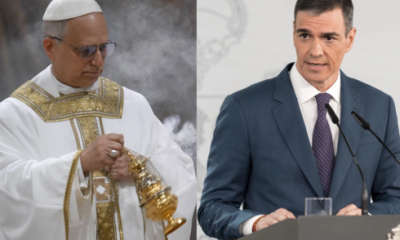





While Sánchez’s international profile has risen amid clashes with US President Donald Trump and criticism of Israel’s war in Gaza, graft scandals involving relatives and former close political allies have eroded his standing at home.
Andalusia, known for its whitewashed villages and Costa del Sol beach resorts, is Spain’s most populous region with about 8.7 million inhabitants, roughly 18 percent of the country’s total.
For nearly four decades, the southern region was governed by the Socialists before they ceded power to the mainstream conservative Popular Party (PP) in 2019.
Polls suggest the PP is close to retaining its absolute majority in Andalusia’s 109-seat parliament, while the Socialists are set to finish second with what could be their worst-ever result in the region.
The Socialists’ candidate is María Jesús Montero, who stepped down as Sánchez’s finance minister and deputy prime minister to contest the regional election.
Sánchez is “taking a big risk because the person who would be defeated is precisely someone who until very recently was his right hand in government and in the party”, political scientist Cristina Monge told AFP.
“Symbolically, it would be a very hard defeat.”
READ ALSO: Who will win Andalusia’s elections and why does it matter for Spain?
The PP has won regional elections in Extremadura, Aragón and Castilla y León in recent months, though short of outright majorities.
That has forced it to form coalition governments with the far-right Vox party in Extremadura and Aragón, with talks underway for a similar pact in Castilla y León.
In exchange, Vox has pushed for access to state benefits to be based on a principle of “national priority”, which would give preference to those with a “real” link to a territory.
Sánchez has said the policy promotes “xenophobia, racism, segregation and confrontation”.
‘Fiscal hell’
Andalusia’s PP leader, Juan Manuel Moreno, has said he would like to renew his absolute majority to govern without Vox.
He has framed the election as a choice between “harmony or discord”, accusing Montero of turning Andalusia into a “fiscal hell” due to her tax policies as finance minister.
Montero, in turn, has attacked Moreno over a healthcare scandal that emerged last year involving delays in follow-up screenings for hundreds of women who later developed breast cancer.
She has accused his administration of failing to provide transparency on the number of affected patients.
“Why don’t they release the data? Are they afraid the truth will be known?” she said during a televised debate, questioning how many women might have died as a result of delayed diagnoses.
Whatever the outcome of Sunday’s vote, the PP’s strategy of using the series of regional elections to highlight the Socialists’ “moment of weakness” will have succeeded, Monge said.
But she cautioned against reading too much into the Andalusian result for national politics. Sánchez, she said, was likely to shift focus to international affairs or Spain’s relatively strong economic growth ahead of the general election expected in 2027.