
ElPais
Microsoft Fails To Restore Services After More Than 12 Hours Of Global Disruption






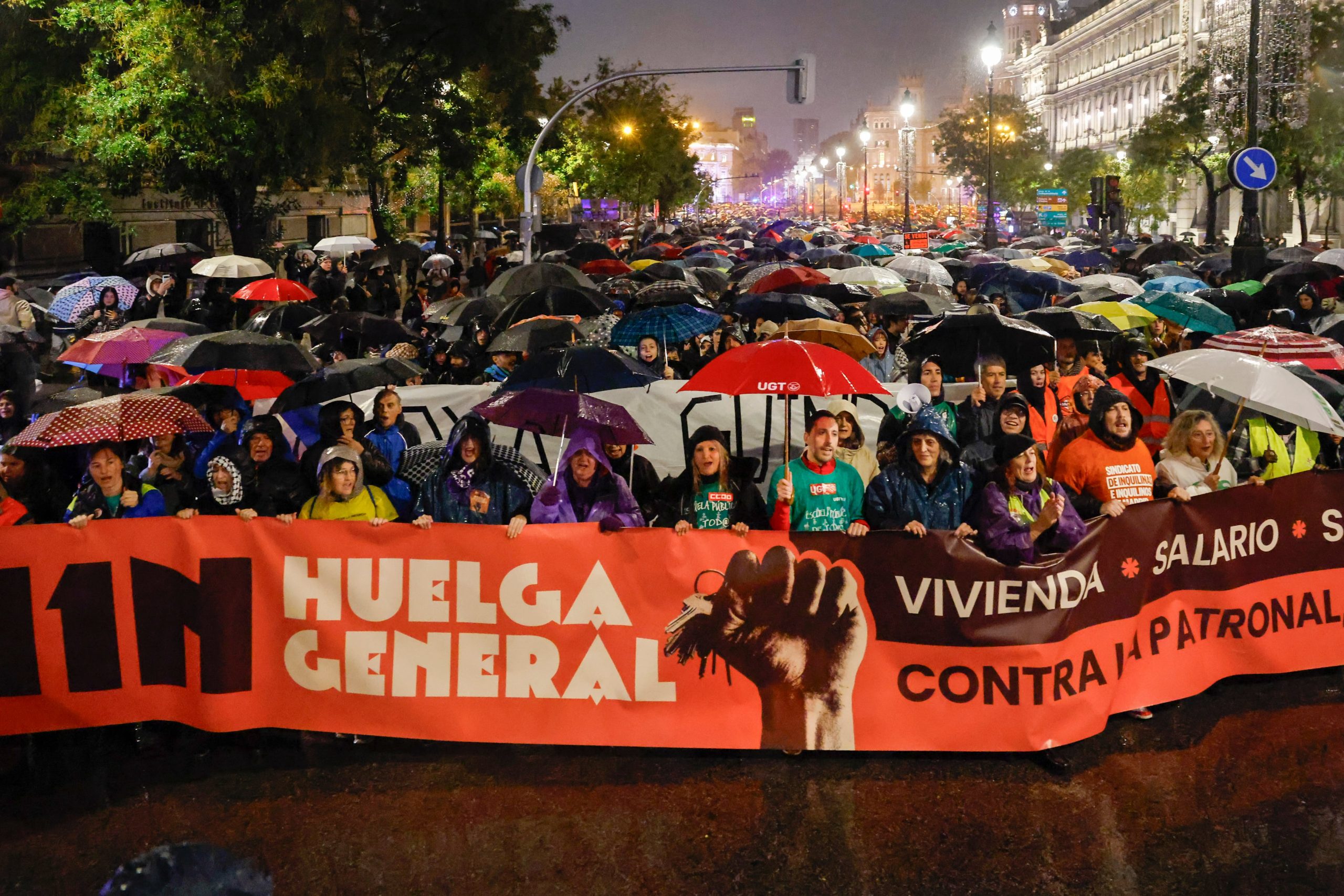
Spain’s main unions used the November 11 general strike to send a warning to the government that will emerge from the snap election of November 29: it will have to negotiate with workers’ organizations and address their demands, regardless of its own political color. “If they reach power, they will have to reach an understanding with us,” UGT general secretary Pepe Álvarez warned, alluding to the People’s Party (PP), which is currently in the opposition but leading voting intention polls. The PP had criticized the stoppage, calling it a “preventive electoral strike” against the mainstream conservatives, led by national PP leader Alberto Núñez Feijóo.
The day unfolded across Spain under very inclement weather, with driving rain in many cities and the effects of Storm Charles, which forced the cancellation of marches scheduled in Andalusian capitals. The impact of the strike was more visible on the streets, roads and access points to logistics hubs than in stores or workplaces themselves, in part because of the extent of remote work and the mobility difficulties.
The demonstrations were overwhelmingly peaceful, although clashes were recorded in Madrid, where there were police charges, and in Barcelona. In the Catalan capital the protest descended into looting by groups of hooded individuals, who also launched pyrotechnic devices at the regional police force, the Mossos d’Esquadra, near Plaça de Catalunya. During the day there were more than 1,500 incidents across the territory involving pickets and demonstrators, according to the Interior Ministry. More than 50 people were arrested at pickets and that total rose to almost 70 in the subsequent disturbances.

Union leaders criticized the police response as excessive and for the use in some cases of pepper spray. The two main unions, CC OO and UGT, denounced disproportionate use of police force and announced they would study possible legal actions. The employer associations CEOE and Cepyme condemned the vandalism and demanded respect for the right to work of those who wished to go to their jobs.
In Madrid more than 120,000 people, according to the Government Delegation’s estimate (between 600,000 and 750,000, according to the organizers) took part in the demonstration at 6.00 pm. A tide of demonstrators defied the bad weather, from university students to government employees and pensioners, illustrating the breadth of the social concerns, which include a lack of affordable housing, low salaries and cost of living concerns. The march set off from Atocha station, passed along Gran Vía and reached Plaza de España, where a police cordon had been deployed.
Chanting “This is class struggle” and “Madrid will be the tomb of rentiers,” protesters marched through the capital’s streets in heavy rain at the end of a day of strike action that began to take shape after the eviction of Maricarmen Abascal, an 87-year-old Madrid resident who died on October 7, two weeks after being forced to leave her home. Her fight, and her call for young people to “fight for what’s yours,” inspired a prolonged encampment in Sol square and led a group called the Tenants’ Union (Sindicato de Inquilinas) to make the first call for a nationwide strike.
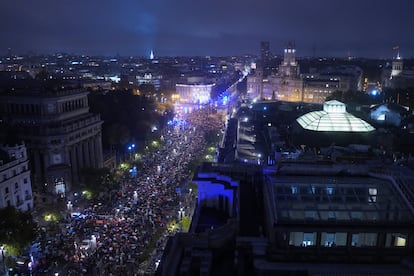
The unions highlighted the high turnout in industry, automotive, logistics, energy and port facilities. By contrast, public administrations, health, education and much of the services sector registered a more limited impact. The unions placed territorial participation in a range from 41% in regions such as Castilla-La Mancha and Extremadura to more than 80% in Catalonia and Andalusia.
Transportation was one of the areas most affected by the strike. The state railway company, Renfe, reported 6.83% participation among its night and morning shift workers. However, 24% of high-speed and long-distance commercial services were cancelled and 10.17% of scheduled Cercanías, Rodalies, Avant and medium-distance public services were suspended. In air travel, the airport operator Aena recorded 234 cancellations out of 4,529 scheduled flights until 10.00 am, representing 5.16% of the total.
Madrid concentrated some of the most serious incidents of the day, particularly at the wholesale food market Mercamadrid and at EMT bus depots. There were also temporary closures on roads, including the M-30, the A-42, the A-5 and the A-6. In Catalonia pickets blocked access to Barcelona and caused restrictions on the AP-7, the A-2 and the Ronda Litoral.

There was no widespread closure of retail stores. Supermarkets and major distribution chains kept their establishments open, although with staffing and schedule variations. The unions put participation at 60.8%, while employers said that small shops operated practically normally.
On television, the main national channels maintained their broadcasts, although there were two notable episodes in the public audiovisual sector: Canal Sur interrupted its programming, and RTVE Catalonia had to move the program Cafè d’idees to another set after a group of demonstrators entered the facilities.
An ‘unorthodox’ strike
Under the slogan Salaries, housing, prices, it was the first general strike called by the unions in 14 years, and even then it was viewed as “unorthodox” since it was not a response to a specific piece of legislation or to any single government body. Instead it grew out of a wave of public outrage over an eviction and out of protests organized by a group that is not a labor union. It also falls 18 days before a general election, and it comes after a train accident that has brought about “a certain shift in the country’s mood,” according to CC OO leader Unai Sordo.
Sign up for our weekly newsletter to get more English-language news coverage from EL PAÍS USA Edition
california
‘Endeavour,’ The First Space Shuttle To Be Seen In A Museum, Finds Permanent Home In Los Angeles

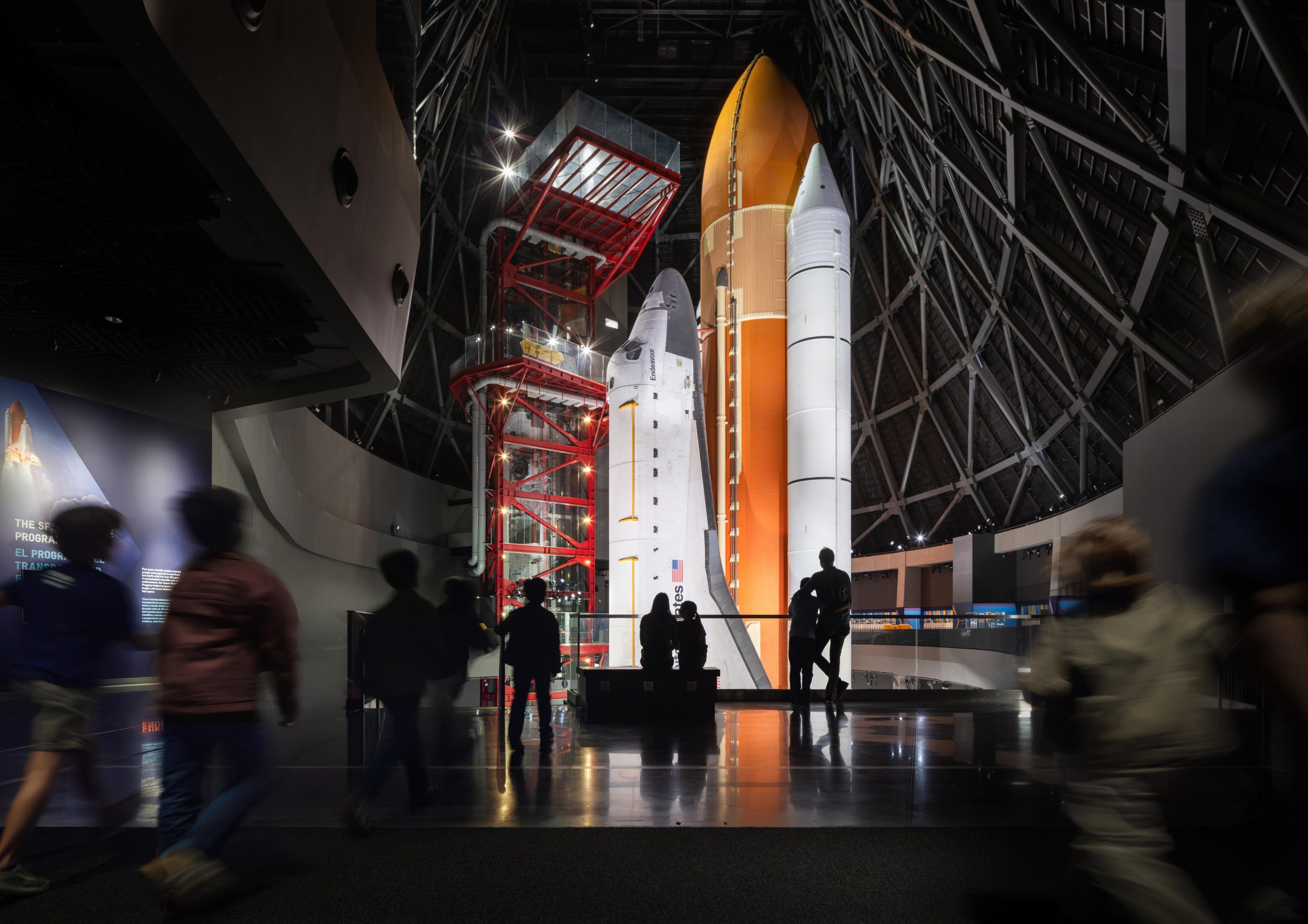
Fifteen years have passed since the Endeavour last watched sunrises from space. After 25 missions over 19 years, it was in May 2011 that the famed space shuttle began its final flight and separated from its longtime companion, the International Space Station. It was its final major flight, but not its last. After landing in Florida, the shuttle was, curiously, flown by airplane to Los Angeles, California. It has spent the intervening years under wraps. Now, at last, it will be exhibited to the public.
The California Science Center (CSC) is showing the Endeavour in all its glory. It is a milestone for Los Angeles and notable because the CSC becomes the first museum in the world where a space shuttle can be viewed. After arriving in October 2012 and being moved from the airport along barely two miles of streets in a complex operation lasting several hours, 14 years later the Endeavour is finally on public display. On November 13, the ribbon will be cut to give a second life to the ship that succeeded the Challenger.
A couple of weeks earlier, museum officials and state authorities came to view the shuttle, already in place, and to present it to the press. Among them was then–California governor Gavin Newsom, in one of his last public acts before finishing his double term, shortly before being succeeded by fellow Democrat Xavier Becerra. Newsom said he was amazed by the Endeavour, and he congratulated and posed for photos with technicians, museum officials, and Lynda Oschin, the widow of Samuel Oschin — the businessman and philanthropist who gives his name to the CSC’s new wing, built for the occasion — and president of the family foundation. The Oschin family have been the $450 million-project’s main donors.
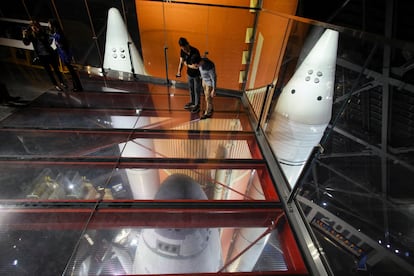
Entering that new area, visitors find themselves at mid-height beside the imposing, fully restored orbiter. To reach it they can take stairs (regular or escalator), an elevator… or a tubular slide built through the core of the museum that is the fastest route. Having descended, they can see its engines, its turbines, the base of the whole structure, and separately the cockpit interior. Then they take an elevator that rises to a height equivalent to a 20-storey building in a matter of seconds to view the top of the Endeavour. It is unsuitable for those who suffer from vertigo — it is fast and transparent.
Beside the orbiter sits an immense orange tank, known as the ET (for external tank), which has been repaired for the exhibition, as Rosemary Garista, the center’s community programs manager, explains. “It contained the liquid fuel and the boosters, but it is empty now. It was missing some pieces, so we fully restored it,” she told EL PAÍS. The tank is the last ET-94 built to propel these ships into space.
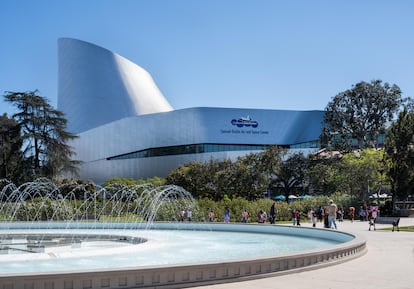
Garista and the rest of the more than 300 staff members (some state employees, some museum employees) were excited to finally be able to show the craft to the world. They were also pleased that it would become a tourist draw that would encourage visitors to the museum’s other two wings, which display some of the machines that helped build those spacecraft, as well as various aircraft, including a Boeing with a simulated flight from Los Angeles to Seoul. Guides expect a flood of visitors and insist tickets be reserved in advance.
The entire new wing — which is dark and austere on the inside, with the Endeavour taking center stage — took over a decade to build. Those in charge say that while transporting the spacecraft from Houston, Texas, to this location was a major challenge, constructing the building (with grants and funding; in fact, $35 million remains to be paid, for which they are seeking donations) was no less so. Now, it can be seen from the rest of the city as a sort of wide metal chimney gleaming in an elevated area. The museum shares space with the newly opened Lucas Museum of Narrative Art, which opened in late September, and the century-old Memorial Coliseum — currently undergoing renovations — which will host the opening ceremony of the Los Angeles Olympic Games in the summer of 2028.
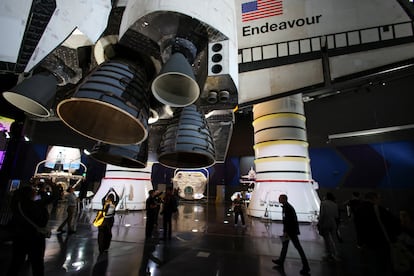
During his visit to the museum, Newsom expressed pride that the ship had been built in California and that it had returned there as a final destination to be seen by millions of people. “California has never been a state that waits for the future. We build it. We’re a state of dreamers and doers, where world-class engineers and scientists are leading the way in aerospace innovation. That’s the California spirit — investing in what’s next, pushing the limits of what’s possible, and proving once again that the future happens here first,” he said.
Never one to shy from the spotlight, Newsom rode the slide down to the base of the new wing, which has been named the Samuel Oschin Air and Space Center. It covers up to 200,000 square feet, doubling the museum’s exhibition space, its president Jeffrey N. Rudolph said in presenting it, while explaining it will feature 100 new artifacts and another 100 interactive experiences. “Today, that 1992 dream is now reality,” he said.
Ken Phillips, the museum’s exhibitions director, told the audience emotionally that he had worked at the museum for 37 years and after all the waiting could not believe the day had finally come for the world to see the Endeavour and its new home: “It’s inspiring; I hope it will be transformative, but above all, it’s an invitation — because we hope that people who haven’t had this experience will be convinced and surprised to discover that there’s a place for them in this technologically advanced society we’re moving toward.”
Sign up for our weekly newsletter to get more English-language news coverage from EL PAÍS USA Edition

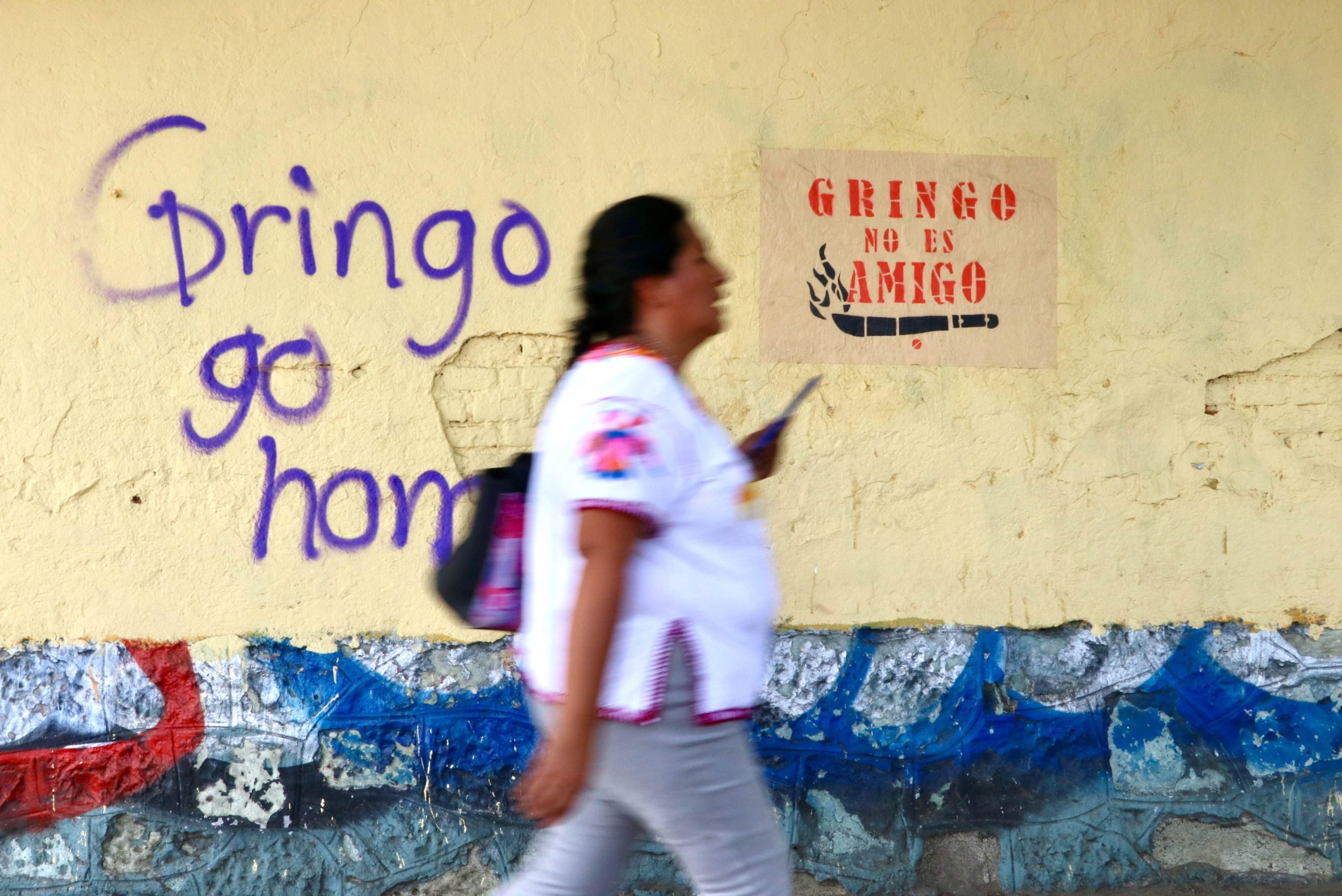
The unusual scene of a tourist demanding a Sinaloa band stop playing on Mazatlán beach sparked a national debate about foreigners who commit xenophobic attacks against Mexicans at home. The incident took place in April of last year, and since then similar occurrences have continued to surface as complaints on social media. In the last few months alone, there have been a series of incidents, including an argument in a café where a woman asked an employee to take down a Mexican flag during the month of national celebrations; a DJ who told two young women to speak more quietly in a restaurant; a foreigner who tried to force a young man filming a video on a public street to speak English instead of Spanish; and a physical assault by an American woman on workers at a taqueria in Mexico City. These incidents are fueling discontent over gentrification, dispossession, and racism within Mexico’s borders.
One of the most recent incidents took place in one of the capital’s wealthiest neighborhoods. A month ago, “El Costa,” a content creator, was filming a video for his channel on a bench on Presidente Masaryk Avenue when a foreigner interrupted him: “We’re in Polanco — speak English.” Days later, the scene shifted to Taquería Orinoco in Mexico City’s Condesa neighborhood, a spot famous among tourists. In the footage, an American woman lunges forward, trying to strike the workers, who stand motionless as she hurls one insult after another: “What’s your salary, 500 U.S. dollars a year?” “loser,” “damn losers.” A few weeks ago, New Zealand musician DJezmo told female customers at a sidewalk business that this was not “their space” or “a public space” and that their laughter and conversation were “disrespectful to everyone.” Months earlier, a tourist posted a video in which he said that the residents of Playa del Carmen “should invest a little in their English skills.”
The arrogant behavior of the “ladies” or “lords” — as those who commit these acts of discrimination and violence are called — exposes the tension between locals and foreigners who want to impose their way of life on the country. A significant number of these incidents involving foreigners have occurred in the neighborhoods hardest hit by gentrification, the effects of which are increasingly angering locals. In Mexico City neighborhoods such as Polanco, La Condesa, and La Roma, the presence of outsiders is palpable in the rent prices that have driven out original residents and businesses, as well as in the cafes and restaurants catering to their interests — where English is the predominant language and the streets’ aesthetic reflects their tastes. Even the reduction in the level of spiciness at street food stalls frequented by tourists has become a topic of discussion.
El Costa reacted to the argument he had with the American who demanded that he speak English: “We don’t hate all the foreigners who come to Mexico to sightsee, but there should be some control. We’re often too kind, too helpful, and too eager to give the best experience to someone coming from abroad, even though not everyone deserves it.” Other users have chimed in: “Why should a Mexican have to stop speaking Spanish?” “We’re helpful and friendly, but there’s a huge difference between visiting and expecting the country to act differently just so tourists feel comfortable.”

In 2023, the number of people residing in Mexico who were born in another country totaled 1,168,000, according to the National Institute of Statistics and Geography (INEGI)’s Population and Housing Census. Most came from other countries in the Americas, primarily the United States, although there was also a notable presence of people born in Europe, with Spain among the main countries of origin. They are concentrated in Baja California, Mexico City, and Jalisco — regions where coexistence between the local and foreign populations continues to grow.
Racist outbursts are nothing new in Mexico, but the only case that resulted in penalties occurred last year when Ximena Pichel, an Argentine national, assaulted a police officer in Mexico City: “For sure, I hate Black people like you — I hate them — because they’re rednecks”; “Don’t talk to me like that, you fucking Indian”; “This guy’s just a bitter loser — he sees I’m driving a Mercedes, and you don’t have a single fucking peso, you asshole.” She faced legal proceedings and had to pay fines. Insults like these are part of a repertoire of contempt that is perpetuated within the country itself and finds some of its roots in skin color and economic status.
The 2022 National Survey on Discrimination, conducted by INEGI, paints a picture of this reality. Twenty-eight percent of the Indigenous population and 35.6% of people of African descent reported having experienced discrimination in the previous year. Among the most common reasons cited were clothing style and skin tone. Nearly 40% of both groups felt that their rights were not respected, and one in five members of the Indigenous population reported having been denied a job opportunity because of their ethnic background. In Mexico City, moreover, the proportion of people who reported experiencing discrimination rose from 23.7% in 2017 to 29.6% in 2022.
Insults hurled in public spaces — in front of workers and residents who record and share the incidents — spark a collective response on social media, where the debate over coexistence with tourists or foreign residents in Mexico continues to grow.
Sign up for our weekly newsletter to get more English-language news coverage from EL PAÍS USA Edition

Microsoft Fails To Restore Services After More Than 12 Hours Of Global Disruption
Deadly rabies case confirmed after dog enters Spain from abroad

Deadly Rabies Case Confirmed After Dog Enters Spain From Abroad
Viral video in Spain sparks fury over drivers who ‘have no idea how to drive’
Spain’s pet owners face fines of up to €200,000 for animal welfare offences
Halloween lunch sells out as 51 join Marbella get-together


-
DGT4 weeks ago
Viral video in Spain sparks fury over drivers who ‘have no idea how to drive’
-
Keeping cats and dogs outside4 weeks ago
Spain’s pet owners face fines of up to €200,000 for animal welfare offences
-
Age Concern Marbella - San Pedro2 weeks ago
Halloween lunch sells out as 51 join Marbella get-together
-
Council tax (IBI)4 weeks ago
Barcelona plans 150% property tax increase on tourist flats ahead of 2028 ban
-
Consumer Rights Spain4 weeks ago
EU offers extra year of warranty on phones, but Spain faces delays
-

 New Developments2 weeks ago
How To Get A Tourist Rental Licence In Andalusia (Spain) – Step-By-Step Guide 2025
-
airports4 weeks ago
Travelling between Spain and Italy? The extra border checks could soon end
-

 %4 weeks ago
Santa Pola Museo Del Mar