Connect with us

%

Moved To Spain? Expats Reveal What They Wish They Had Known Before Relocating

Published

on

moved-to-spain?-expats-reveal-what-they-wish-they-had-known-before-relocating

The climate was not everyone’s idea of paradise. Photo credit: NewJadsada/Shutterstock

Moving to Spain can mean leaving behind family, friends and familiar surroundings for sunshine and a fresh start. But once the excitement wears off and everyday life takes over, do you ever wonder whether you would do anything differently? We asked readers who have made Spain their home about their biggest regret. Others shared personal losses and unexpected challenges.

Wishing they had moved sooner

For several, the regret was not moving earlier. Mark from Fuengirola said he wished he had moved to Spain when he was younger, while James wished he had done it 35 years sooner. Anne, who left Ireland, summed up the difference between her old and new lives: “In Ireland we were existing. In Spain we are living.”

Peter from San José, spent a year in a small Spanish fishing town, described how his priorities had changed since arriving. He appreciates café visits, walking rather than relying on a car and the local culture. Looking out at the sunrise each morning, he still finds it hard to believe he lives there.

The language and employment reality

Several wished they had learned Spanish before moving. One regretted not being fluent, while David urged newcomers not to be put off. He learned by working alongside Spanish people and believes newcomers can pick up the language after arrival.

Cathy, who has lived in Spain for 26 years, learned by visiting Spanish cafés and bars and talking to locals. Finding work is harder. Peter warned that anyone relying on Spanish wages should think carefully before relocating. Helen, who has lived in Spain for 20 years and works full-time, complained about low wages and high taxes. Despite speaking Spanish, she said she still felt like an outsider.

What they left behind

For some, the biggest regret is family. Sarah from Mallorca shared that her parents and mother-in-law died shortly before her family moved to Spain. She wishes she could have shared Spain with them. Diane also said she misses her children and grandchildren.

Practical concerns also emerged. Steven advised newcomers to check that their private health insurance is accepted by medical centres in their area before needing treatment. Brexit’s 90-day rule was another frustration for readers wanting to spend longer in Spain. Property also featured. One reader regretted buying a house in Spain 25 years ago, saying the money would have been better invested in a property in the UK.

Would they make the same decision again?

Despite the difficulties, many had none. Robert, who has spent 21 years between Lorca and Águilas, called it his best decision. Julia, now living in Lanzarote, said she was a proud and happy immigrant and had never regretted leaving Vienna. The climate was not everyone’s idea of paradise. One reader joked that he would rather be back in the rain in Glasgow, while another admitted he had underestimated how cold Spanish winters could feel.

Gary, who moved back to New Zealand, said only after leaving did he realise he had left his heart in Spain. Another reader said the noise in their small village, particularly frequent fireworks, had become a daily frustration. Moving abroad does not leave every problem behind. Employment, bureaucracy, retirement, healthcare and family separation can all affect the experience, and Spain is not right for everyone. But many readers have found something they value more than the comforts they left behind. For them, the biggest regret is not what Spain has failed to offer, but how long they waited to make it home.

%

Michael Jackson’s Only Ever Posed-For Painting Goes Up For Auction In Paris For €500,000

Published

on

michael-jackson’s-only-ever-posed-for-painting-goes-up-for-auction-in-paris-for-e500,000

Strong and Jackson maintained a close artistic relationship over the years. Photo credit:CC BY-SA 2.0 on Wikipedia

A rare opportunity to own a piece of Michael Jackson’s personal history is coming up at auction in France, where an original portrait of the late singer is expected to fetch up to €500,000. What makes the painting particularly unusual is that Jackson did not simply inspire the artwork: he personally posed for it and even took part in its creation. Titled The Book, the portrait was painted by Australian artist Brett-Livingstone Strong in December 1989, when Jackson was at the height of his international fame.

It is believed to be the only painted portrait for which the King of Pop ever agreed to sit as a model. The original artwork is now being offered by French auction house Aguttes, with an estimate of between €300,000 and €500,000. It will go under the hammer on Thursday, November 26, at the auction house’s premises in Neuilly-sur-Seine, just outside Paris. It was displayed publicly for the first time in Europe on Friday, November 20.

A painting Jackson helped create

The involvement of Jackson himself is what sets The Book apart from other celebrity portraits. According to Arthur Perault, head of Aguttes’ Pop Culture and Memorabilia department, the singer took an active interest in the work alongside Strong. Photographs from the period show the two men together in the artist’s studio, with Jackson apparently enthusiastic about the creative process. Perault described the painting as almost a joint creation between the singer and the artist.

Completed in December 1989, the portrait shows Jackson seated in a red velvet outfit, looking towards the viewer with his hands resting on a closed book. The elaborate composition features columns, decorative drapery and a landscape in the background, giving the scene an almost theatrical quality. There are also references to Neverland, Jackson’s famous private estate and personal retreat. A depiction of Tinker Bell, the fairy from Peter Pan, appears within the composition, reflecting his fascination with the fictional world and its themes of childhood and escapism.

The story behind the book

The title is not simply an artistic choice. The book represents the notebooks Jackson used to record his ideas, drawings and song lyrics, offering a glimpse into the creative world behind some of his music. The portrait was officially unveiled on January 26, 1990, at the Beverly Hilton in Beverly Hills, with Jackson present. At the time, it attracted considerable attention, with contemporary press reports describing it as the most expensive portrait of a living celebrity.

Strong and Jackson maintained a close artistic relationship over several decades, eventually establishing the Jackson-Strong Alliance. The artist has also described Jackson as a mentor and friend. The original painting remained in private hands for many years before being exhibited again in Harlem in July 2009, just days after Jackson’s death on June 25 2009.

Its authenticity is supported by archival material, including provenance documents and photographs from its original unveiling. More than three decades after it was created, The Book is now returning to public view, offering collectors the chance to acquire an original work with a direct connection to one of the most recognisable performers in music history.

Continue Reading

%

Spain’s Traffic Authority Buys New Drones

Published

on

spain’s-traffic-authority-buys-new-drones

New drones taking over from helicopters. Credit: DGT

Drivers across Spain could soon face a new set of eyes in the sky after the Dirección General de Tráfico (DGT) signed an emergency €1.3 million contract for more capable drones. Officials hope the purchase will plug gaps left by the grounding of the entire Pegasus (blue and yellow) helicopter fleet.

All 11 helicopters belonging to the Aerial Means Unit now sit in storage at the Cuatro Vientos base in Madrid. Eliance, the firm contracted to operate and maintain the aircraft used for road surveillance and issuing fines, has entered insolvency proceedings (concurso de acreedores). It can no longer guarantee the safety of the helicopters, so the DGT ordered them moved to the capital and placed in preservation.

Euro Weekly News previously reported how the crisis began to bite when helicopters stopped flying from bases including Malaga, Seville and Santiago de Compostela. Spain’s €51m Pegasus helicopters grounded: Questions raised over traffic fines

Why drones are the stop-gap solution

Earlier this month the DGT began relying more heavily on its existing drones to keep some form of aerial monitoring going. Those units have drawn heavy criticism from unions, which described them as little more than “toys”. In eight years they recorded barely 500 flying hours. Some Thyra models had to be withdrawn after becoming uncontrollable and causing accidents near roads.

Fernando GarcĂ­a Castro at the Ministry of the Interior, said the new drones will still have serious limits. They can only reach 120 metres altitude, top out at 80 km/h and stay aloft for about 40 minutes. That means they can spot illegal turns or drivers jumping stop signs, but they cannot measure or fine speeding offences. He added that the new machines are unlikely to be ready before next year at the earliest.

Union wants the helicopters flying again

The union representing the helicopter pilots, CCOO, has called for an emergency contract covering fuel, spare parts and engineering work so the helicopters parked at Cuatro Vientos can return to service. Pilots warn that leaving the aircraft stored for long periods risks mechanical problems that could make them harder to bring back into operation.

Workers from the Aerial Means Unit and traffic control centres staged a protest this week, arguing that staff shortages combined with the Eliance collapse are putting road safety at risk.

What drivers should expect on the roads

Fixed and mobile speed cameras, average-speed sections and unmarked patrol vehicles continue operating as normal. Aerial enforcement of pure speeding offences is currently limited, though drones can still catch other dangerous manoeuvres. Recent reports have also covered hooded saboteurs destroying Seville speed cameras and tighter pedestrian crossing rules enforced by the DGT. Drivers can check official guidance on the DGT website.

Continue Reading

%

Missing Woman Found Alive In Stream

Published

on

missing-woman-found-alive-in-stream

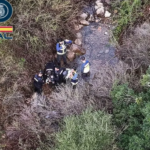
The woman was found in a difficult-to-reach stream bed near Alcolea Credit: PoliciaNacional

After five days without news of a missing loved one, every passing hour can bring fresh anxiety and uncertainty. But for one family in southern Spain, a desperate search finally ended with the news they had been hoping for.

A woman who vanished from her home in CĂłrdoba province was discovered alive on Thursday, November 19, after spending several days outdoors in an isolated area.

The woman was found in a difficult-to-reach stream bed near Alcolea, where emergency services launched a rescue operation to bring her to safety.

Despite surviving several days exposed to the elements, she was suffering from symptoms of hypothermia and required hospital treatment.

Her discovery brought an end to five days of searching by Spain’s National Police, who had been working to locate her since her family reported her disappearance.

Woman vanished from her home without warning

According to Spain’s National Police, the woman left her home in the Alcolea area on the morning of Saturday, November 14, without informing any members of her family.

When she failed to return, relatives began making their own enquiries in an attempt to establish her whereabouts.

However, their efforts were unsuccessful.

Growing increasingly concerned, a family member visited a police station to report her missing.

Officers activated the established missing-person procedure and began searching Alcolea and its surrounding countryside.

Police also circulated the woman’s photograph and physical description in the hope that members of the public might recognise her or provide information about where she had been seen.

As the search continued, there was still no confirmed information about her whereabouts.

Police make breakthrough after five days

The breakthrough finally came at approximately 11am on Thursday, November 19.

During their search, National Police officers spotted a woman in a stream bed in the Encinares de Alcolea area, on the outskirts of CĂłrdoba.

The location was particularly challenging because the terrain was difficult to access.

Firefighters were called in to assist officers with the rescue, helping emergency teams reach the woman and bring her out of the isolated area.

The discovery marked a significant turning point in a search that had lasted five days.

However, the ordeal had taken a physical toll.

After spending several days exposed to outdoor conditions, the woman was showing symptoms of hypothermia.

She was subsequently transferred to Reina SofĂ­a Hospital in CĂłrdoba for medical attention.

Her family was informed that she had been found alive.

Police thank public for helping missing-person searches

Following the rescue, Spain’s National Police thanked members of the public and the media for their cooperation in helping locate missing people.

Officers highlighted the importance of sharing reliable information when someone disappears, explaining that public awareness can play a valuable role in search operations.

The police also used the incident to remind families of an important point that is sometimes misunderstood. There is no requirement to wait 24 hours before reporting someone missing in Spain.

Anyone concerned about a disappearance can contact the National Police immediately by calling 091, which operates 24 hours a day, every day of the year.

Questions remain over woman’s disappearance

Although the woman was successfully located, the circumstances surrounding her disappearance have not been publicly explained.

Authorities have not disclosed her age, why she left home or how she came to be in the remote stream bed.

There has also been no further confirmed information about her recovery following admission to hospital.

What is known is that a five-day search ended with the woman found alive, thanks to the efforts of police officers and firefighters working together in challenging terrain.

For her family, the discovery brought an end to days of uncertainty, while the case served as a reminder of the importance of reporting disappearances promptly.

Continue Reading

Trending

Copyright © 2017 Spanish Property & News