Connect with us

%

Murcia Breaks Donor Record After Historic Bone Marrow Campaign

Published

on

murcia-breaks-donor-record-after-historic-bone-marrow-campaign

Murcia exceeds donor target early after record-breaking marrow campaign. Photo Credit: Murcia City Hall / Instagram

The Region of Murcia has reached an astounding donor record after a historic campaign. After the bone marrow donor recruitment campaign, held in tandem with the 2nd Regional Solid Organ and Bone Marrow Donor Day and the 3rd Region of Murcia Match, more than 2,100 residents of Murcia have registered as new donors, doubling the figures from previous years.

More than 30,000 people now registered as bone marrow donors in Murcia

With this new development, more than 30,000 people in total are now registered in the Region. The Regional Transplant Coordination had originally set this amount as a target for 2026, meaning Murcia has blown the record out of the water several months ahead of schedule. Murcia is also now one of the autonomous communities with the highest number of donors, proportionally to the population.

The campaign was carried out between May 10 and May 13 in the Region of Murcia’s various hospitals, health centres, universities, the Regional Blood Donation Centre, and various other points and establishments throughout the Region. The campaign has been a booming success; in previous editions of the campaign, 1,000 new donors were registered in 2023 and just 950 in 2025. The strong participation this year bodes well for the involvement of the people of Murcia in donation and solidarity.

The Fun Run united thousands of participants in the Region

One of the major points of the campaign was the “Run to Give Life” Fun Run, a sporting event held on Sunday, May 10, in which more than 3,000 people participated. During the event alone, some 350 people registered as bone marrow donors, showing the power of these kinds of fun and active initiatives to get the community involved.

Dozens of centres participate in the campaign this year

This edition of the campaign involved the collaboration of 10 public hospitals, 44 health centres, the 061 emergency medical service which set up a field hospital in Plaza de la Merced, the Murcia and Cartagena Blood Donation Centre, UCAM in both its Murcia and Cartagena campuses, the Polytechnic University of Cartagena, the El Palmar Health Campus, and the Espinardo Campus.

By the numbers, hospitals and primary care centres recruited 1,200 new donors. Following them were UCAM, with 201 registered new donors; the 061 emergency medical service, with 109; the Blood Donation Centre with 123 registered donors in its Cartagena and Murcia locations; the UPCT, with 44 registered donors; and the University of Murcia, with 56 new registered donors across its two campuses.

The campaign reached the smaller towns of Murcia as well as the larger ones. Amazingly, the hamlet of Barranda, in Caravaca de la Cruz, set up a table in the town square and was able to  obtain 28 new donors, despite having a population of fewer than 800 inhabitants.

A show of commitment and solidarity by the people of Murcia

With this incredible show of commitment by the people of Murcia, in municipalities and areas both large and small, the Costa Calida has made itself known for its healthcare solidarity initiatives in Spain and will continue to help save lives, stand with neighbours and residents, and support health centres in the Region of Murcia.

%

Lightning Bolt Forces EasyJet Flight Emergency Landing

Published

on

lightning-bolt-forces-easyjet-flight-emergency-landing

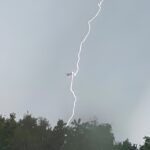
EasyJet flight getting a nasty shock. Credit: Viral photo on X

An EasyJet flight bound for Italy returned to London Gatwick this afternoon after a huge lightning bolt struck the aircraft shortly after takeoff.

Flight U28305 using an Airbus A319 registered as G-EZDH departed Gatwick runway 08R at 2.22pm GMT on Thursday, May 14.

Ground witnesses looked on nervously as they saw the stormy conditions around the airport during departure. Lightning then dramatically struck the aircraft as it climbed through the clouds. The pilots then decided to continue the initial climb to around 16,000 feet while checking all systems.

However, it was then that the pilots declared priority status and requested an immediate return to London Gatwick under standard safety procedures.

Air traffic control guided the aircraft back for an immediate approach. A safe and normal landing followed on the same runway just 27 minutes after the initial departure. EasyJet confirmed the diversion in an official statement as a precautionary step.

Crew members then assisted passengers with updates on replacement aircraft or revised schedules while emergency services met the plane on arrival as routine practice.

Lightning strike details on the easyJet flight

Witness reports and flight data confirm the incident occurred during the climb phase in stormy weather. Mandatory post-strike inspections will have followed to verify all avionics and airframe components remained intact.
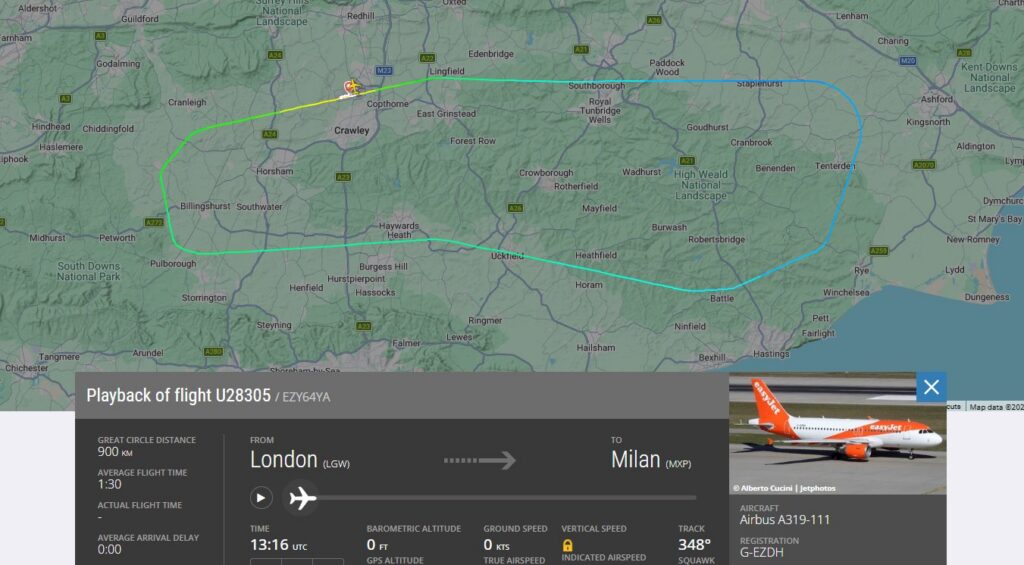
flight map

What happens when lightning hits an aircraft?

As aircraft climb through clouds, lightning can attach to extremities such as the nose or wingtips. Electricity then flows along the conductive outer skin and exits at another point like the tail. Passengers notice a bright flash or loud bang, while instruments may flicker briefly.

Modern fuselages function as a Faraday cage to direct electric current safely around the exterior and away from the cabin interior. Flight crews are trained in protocols to follow to assess systems before deciding on any diversion.

Can lightning cause serious damage to aircraft?

Design standards require aircraft to be able to survive high-current strikes without loss of control. Surface marks or pitting might appear at entry and exit points, and in many cases damage stays cosmetic.

Engineers conduct detailed checks afterward to rule out any internal effects on wiring or fuel systems. Commercial jets experience such strikes several times yearly with passengers and crew remaining safe throughout, and often none the wiser.

Rare historical incidents led to improved bonding and protection features now standard across fleets. This EasyJet event is in line with routine outcomes where aircraft land safely after precautionary returns. But, it was exciting, nonetheless!

Continue Reading

%

EU Plans Single Ticket For Europe Train Travel

Published

on

eu-plans-single-ticket-for-europe-train-travel

The EU wants to make international train travel easier with a single ticket covering journeys across multiple European countries. Credit : European Union – 2025

The European Commission wants to make train travel across Europe much simpler by allowing passengers to buy one single ticket covering journeys operated by different rail companies across multiple EU countries. Under the proposed reform, travellers would also receive stronger passenger protections if delays or cancellations cause them to miss connections during international journeys.

For many travellers, booking flights across Europe with different airlines is already straightforward. Doing the same by train can quickly become complicated, expensive or sometimes impossible, especially when multiple operators are involved. Brussels now wants to change that as part of a broader effort to make rail travel more attractive across the European Union.

The proposal would force train operators to share ticketing data with online sales platforms and, in some cases, even allow competitors to sell their tickets. EU officials say the goal is to remove barriers that currently make cross border rail travel frustrating for millions of passengers.

The reform could become one of the biggest changes to European rail travel in years if approved.

Why train travel across Europe can still feel surprisingly difficult

Travelling across several European countries by train sounds simple in theory. In reality, many passengers discover the system becomes far more complicated once different national operators are involved.

A traveller going from Spain to Germany or from Belgium to Italy may need to buy several separate tickets across different websites, each with different rules, conditions and refund policies.

Sometimes routes are not even displayed together despite connecting perfectly in practice.

One of the biggest problems appears when delays happen. Under current rules, if passengers buy separate tickets and miss a connection because the first train arrives late, they are not always protected for the rest of the journey. In some cases, travellers must buy completely new tickets themselves.

That uncertainty has discouraged many people from choosing rail for long international trips, even as Europe pushes greener transport alternatives.

The European Commission now wants to simplify the process by encouraging what it calls ‘multimodal cross border journeys’ through integrated ticketing systems.

EU Transport Commissioner Apostolos Tzitzikostas said the reform is designed to make travelling across all 27 member states “simpler, smarter and more comfortable”.

According to the Commission, passengers should eventually be able to plan, compare and buy international rail journeys much more easily through online platforms.

What the new EU train ticket rules would actually change

The proposed legislation would require railway companies to make ticket and timetable data available to online booking platforms.

That means passengers searching for routes across Europe could see different operators combined within the same booking system rather than needing to jump between multiple websites.

The proposal also targets competition inside the rail market.

If a railway operator controls more than 50 per cent of a market, it may be required to display competing offers and even allow rival companies to sell its tickets if requested.

Brussels believes this could help increase transparency and keep prices competitive for passengers.

Online ticket platforms would also have to present offers “neutrally and transparently” under the proposed rules. But for many travellers, the biggest change concerns passenger rights.

The Commission wants passengers buying multi operator journeys in a single transaction to receive one combined ticket covering the entire route. That would mean stronger legal protections if disruptions occur during the trip.

If a delay causes a missed connection, passengers could gain access to rerouting, reimbursement, accommodation assistance and compensation rights even when different companies operate different parts of the journey.

Responsibility would be shared between operators.

The company causing the delay would have to handle reimbursements or compensation, while the operator responsible for the missed onward connection would need to help passengers continue their journey.

At the moment, those protections often disappear once separate tickets are involved.

Brussels sees rail reform as part of Europe’s green future

The Commission also sees the reform as part of its broader climate and transport strategy.

European officials have spent years trying to encourage more people to switch from short haul flights and car travel towards rail, which generally produces lower emissions.

Transport accounts for roughly a quarter of greenhouse gas emissions inside the EU, making it one of the most difficult sectors for Europe’s climate ambitions.

Brussels believes simpler ticketing could help convince more travellers to choose trains for international journeys. There is also clear public demand for easier booking systems.

A recent Eurobarometer survey found that around one in four Europeans experienced problems trying to book rail journeys involving different train operators. For people living near borders or in rural areas, fragmented rail systems can make international travel unnecessarily stressful.

European Commission Vice President Raffaele Fitto said improving rail connectivity is also about strengthening cohesion and reducing invisible barriers inside the single market.

The reform still needs approval from EU member states and the European Parliament before becoming law, meaning implementation could take time.

Even so, the proposal signals how serious Brussels has become about reshaping European rail travel.

For travellers frustrated by juggling multiple bookings, unclear passenger rights and disconnected train systems, the changes could eventually make cross border rail journeys feel much closer to booking a single international flight.

And for Europe’s rail industry, it may mark the start of a more connected network where travelling from one side of the continent to the other becomes far easier than it is today.

Continue Reading

%

Spain Warns Of Disinformation Targeting Police

Published

on

spain-warns-of-disinformation-targeting-police

Spain’s National Security Department says police and military forces are increasingly being targeted by online disinformation campaigns. Credit : Ivanb.photo, Shutterstock

Spain’s National Security Department says online disinformation campaigns linked to extremist groups, anti European narratives and pro Russian networks are increasingly trying to influence members of the police, Civil Guard and armed forces. The warning appears in the country’s latest national security report, which says these operations are becoming more sophisticated and are now focused not only on the public, but also on state institutions themselves.

According to the report, some campaigns are attempting to erode institutional neutrality by spreading narratives about insecurity, migration and the supposed ‘moral decline’ of Europe. Spanish authorities say the aim is to push parts of society, including public servants, towards more radical and destabilising ideas while weakening trust in democratic institutions.

The report also warns that artificial intelligence and newer social media platforms are helping false or manipulated information spread faster and appear more convincing than before.

Officials believe the threat has been steadily growing since 2023 and could continue intensifying over the next five years.

Spanish authorities say online manipulation is becoming more aggressive

For years, concerns around fake news largely focused on misleading headlines, conspiracy theories or political propaganda aimed at the general public.

But Spain’s latest security assessment suggests the situation has evolved.

Authorities now say some online campaigns are trying to influence the people responsible for maintaining public order and national security themselves.

The report points to narratives aimed at police officers, Civil Guard members and military personnel that present Europe as weak, socially divided or increasingly unsafe.

According to officials, these messages are often carefully framed around emotional topics such as migration, crime, national identity and distrust of institutions.

Security experts say the concern is not simply that false information exists online. The bigger issue is how coordinated campaigns can slowly shape perceptions over time, especially when repeated constantly across different platforms.

The report says these narratives often attempt to create the illusion that extreme or marginal views are widely accepted by society when that is not necessarily the case.

Spanish authorities believe this tactic is designed to deepen division and encourage mistrust inside institutions as well as among the wider public.

The armed forces have also reportedly been targeted through campaigns questioning their operational effectiveness and the legitimacy of overseas military missions.

According to the report, some narratives try to damage public confidence in Spain’s military role abroad by portraying operations as ineffective or politically manipulated.

Russia remains a major concern for Spain’s security services

Spain’s National Security Department identifies Russia as one of the main actors continuing to develop disinformation campaigns targeting Spain and other European countries.

The report says pro Kremlin networks have adapted quickly to changing technology and social media habits.

Officials claim these operations increasingly use platforms such as TikTok and Discord, which until recently were seen as less central in political disinformation campaigns. Artificial intelligence is also becoming part of the problem.

According to the report, AI tools are being used to produce larger volumes of misleading content and make fabricated information appear more believable. That includes manipulated images, videos and coordinated narratives designed to look authentic.

Spanish authorities say these campaigns often intensify during politically sensitive periods such as elections, geopolitical crises or major emergencies.

The report points to the war in Ukraine, migration tensions and energy issues as recurring themes frequently used to generate fear, anger or distrust online.

There is also concern over increasingly hostile rhetoric targeting LGBTQ+ communities and the rise of strongly anti European narratives during recent elections in Eastern Europe.

Officials believe many of these campaigns are specifically designed to polarise societies by turning sensitive issues into constant sources of confrontation.

Natural disasters and migration debates are also being exploited

The report says one of the clearest patterns in recent years has been the exploitation of real world crises.

Spanish authorities point to the deadly floods in Valencia, where 229 people died, as an example of how quickly tragedies can become fuel for online conspiracy theories and disinformation.

According to the report, false narratives linked to the disaster attempted to portray Spain as chaotic and incapable of responding effectively to emergencies.

Officials claim some campaigns used the catastrophe to spread distrust towards institutions and amplify political anger online.

The same pattern has reportedly appeared in debates around migration.

The report highlights events in Torre Pacheco, Murcia, during July 2025 as a major example of how online narratives about immigration and insecurity escalated before violence occurred in the real world.

Authorities say there was a surge in online content linking illegal immigration to crime and insecurity before tensions intensified on the ground.

Security experts believe the speed at which inflammatory content spreads online is now creating genuine public security concerns.

Social media algorithms, viral videos and coordinated messaging campaigns can amplify emotional reactions within hours, particularly during moments of crisis or uncertainty.

Spanish officials warn that many users may not realise where this content originates or how organised some influence operations have become.

That is one reason the government now considers disinformation one of the country’s main national security threats.

The concern is no longer only about fake stories appearing online. Authorities say the bigger risk lies in the gradual erosion of trust between citizens, institutions and public servants.

And in a period marked by geopolitical tension, social division and rapid technological change, Spain’s security services believe those risks are becoming increasingly difficult to ignore.

Continue Reading

Trending

Copyright © 2017 Spanish Property & News