Connect with us

%

Orihuela Embraces Smart Tourism

Published

on

orihuela-embraces-smart-tourism

Tourism councillor, Gonzalo Montoya, presenting NaviLens tourism technology. Credit: Ayuntamiento de Orihuela.

Orihuela is making it easier than ever for visitors to explore its rich history and culture, thanks to a series of new accessibility projects designed to remove barriers and improve the tourist experience.

One of the biggest additions is the installation of NaviLens technology at 50 tourist sites across Orihuela and Orihuela Costa. Using a smartphone, visitors can scan special codes to access information about monuments, museums and historic landmarks.

Unlike traditional QR codes, NaviLens can be detected from up to 15 metres away and without needing to point a camera directly at the code. The system is particularly useful for visually impaired visitors and can provide information in up to 36 languages, automatically adapting to the language settings on a user’s device.

The free NaviLens and NaviLens GO apps also offer multimedia content, simplified text and a range of accessibility features designed to make cultural information available to as many people as possible.

Alongside the digital improvements, Orihuela has installed 16 new information totems at some of its most important heritage sites, including the Cathedral, the Miguel Hernández House Museum, the Episcopal Palace, Teatro Circo and the famous San Isidro murals.

Each totem includes tactile relief elements that allow visually impaired visitors to explore architectural details through touch, creating a more inclusive way of discovering the city’s history and architectural heritage.

The projects form part of wider efforts to modernise Orihuela’s tourism offering while preserving and promoting the area’s cultural attractions for future generations.

Scooter Rollout Hits Turbulence

While Orihuela is receiving praise for improving accessibility, another recent initiative has faced a far more challenging start.

Electric scooter rentals have finally arrived in Orihuela Costa under the town hall’s new single-operator system, but the launch is already surrounded by controversy.

The service was originally expected to begin in December, with the full fleet deployed by January. However, the scooters only started appearing recently, around five months behind schedule.

According to the concession contract, delays of this type could qualify as a very serious breach, potentially leading to penalties or even cancellation of the agreement.

One of the main concerns involves the scooters themselves. Industry sources claim some of the vehicles currently operating in Orihuela Costa carry certification plates linked to international operator Bolt rather than Vamoz. Bolt, which also participated in the original tender process, is reportedly considering legal action.

There are also questions over whether the deployed fleet matches the specifications originally presented during the bidding process, including requirements relating to vehicle age and model type.

Municipal sources have attributed part of the delay to recent changes in DGT regulations concerning insurance and civil liability requirements for electric scooters.

Despite the controversy, the service was introduced to improve mobility in Orihuela Costa, where residents and tourists often rely on alternative forms of transport because of dispersed urbanisations and limited public transport connections.

How the situation develops in the coming weeks could prove significant, both for the operator and for local residents who have long called for better transport options across the coastal area.

%

The Cost Of Falling Ill Abroad: What British Travellers Could Face In Spain, Portugal And Beyond

Published

on

the-cost-of-falling-ill-abroad:-what-british-travellers-could-face-in-spain,-portugal-and-beyond

A major concern is medical evacuation. In cases involving serious illness or injury. Photo credit: gpointstudio/Shutterstock

As many of us are preparing for our summer trips abroad, there is one thing many of us tend to brush off. Travel insurance is often viewed as an optional extra when booking a holiday. However, figures from the insurance industry show that becoming ill overseas can leave travellers facing bills running into thousands, and sometimes tens of thousands, of pounds.

Data published by Spain’s insurance association, UNESPA, highlights the financial consequences of medical emergencies abroad. The organisation reported cases where travel insurers paid more than €113,000 for treatment in Malawi and more than €21,000 in the United States, illustrating how quickly costs can escalate when serious illness strikes overseas.

For British travellers, understanding healthcare costs before departure is essential. While some countries offer access to state healthcare through the UK’s Global Health Insurance Card (GHIC), others require visitors to cover the full cost of treatment themselves.

Spain

Spain remains one of the most popular destinations for British holidaymakers. Travellers carrying a valid GHIC can access medically necessary treatment through the Spanish public healthcare system under the same conditions as Spanish residents.

However, the card does not cover every situation. Private healthcare, mountain rescue, repatriation to the UK and certain additional expenses are excluded.

For those requiring treatment in a private facility, costs can mount quickly. A consultation with a private doctor may cost between €50 and €250, while an emergency department visit can range from around €100 to €500. Hospital stays frequently cost several hundred euros per day and can exceed €2,000 daily for specialist treatment.

The greatest financial risk often comes from medical repatriation. Returning a seriously ill patient to the UK with medical supervision can cost many thousands of pounds.

Portugal

In Portugal the country operates a public healthcare system (SNS), and UK travellers with a valid Global Health Insurance Card (GHIC) can access medically necessary treatment in state hospitals on the same basis as local residents.

In practice, emergency treatment in Portugal is generally of a good standard, particularly in larger cities such as Lisbon, Porto and Faro. Hospitals are modern, and medical staff are experienced in treating international patients.

However, the GHIC does not cover private healthcare, which is commonly used by tourists seeking faster access to treatment. Private consultations typically cost between €50 and €120, while diagnostic tests such as scans or X-rays can range from around €100 to €300. Private hospital stays can cost several hundred euros per night, depending on the level of care required.

While overall healthcare costs in Portugal are typically lower than in non-EU destinations, expenses can still increase significantly in more serious cases.

Outside the EU

Outside the EU, including destinations such as Egypt, Morocco and Turkey. British travellers are generally responsible for the full cost of any medical treatment unless they have comprehensive travel insurance.

Morrocco

Morocco has become an increasingly popular destination among British tourists, particularly for city breaks and winter sunshine holidays. However, unlike Spain and France, it is not covered by the GHIC scheme.

Routine medical consultations are often cheaper than in many European countries. However, costs rise substantially when hospital treatment is required. Private hospitals may request proof of insurance or advance payment before providing non-emergency care.

The importance of adequate cover is reflected in the experiences of travellers themselves. Tomas Kirkeni, tells us how his choice made all the difference when he decided to get insurance before his trip.

“I got very sick three years ago in Morocco and had the best care only because of my insurance, I did, at the time, think I wouldn’t need it but im glad I made the right choice, the outcome could of been very different” he said.

A major concern is medical evacuation. In cases involving serious illness or injury, transferring a patient to another country for specialist treatment can cost many thousands of pounds.

United States

The United States still remains one of the most expensive places in the world to require medical treatment.

British travellers have no access to subsidised healthcare and are responsible for the full cost of care unless covered by insurance. An emergency room visit can cost hundreds if not thousands of dollars before treatment even begins. Hospital stays routinely cost several thousand dollars per day, while surgery and specialist treatment can produce bills reaching tens of thousands of dollars.

According to UNESPA data, insurers have paid claims of more than €21,000 relating to a ‘‘mild’’ medical incidents in the United States. In severe cases, the total cost can be far higher.

The Foreign, Commonwealth and Development Office consistently advises travellers to obtain comprehensive insurance before visiting the country because of the potential cost of healthcare.

Travel Insurance Questions Answered

Does a GHIC replace travel insurance?

No. A GHIC allows British travellers to access medically necessary state healthcare in participating countries on the same basis as local residents. However, it does not cover everything. Private medical treatment, mountain rescue, repatriation to the UK, lost luggage, theft and travel disruption are not included.

Will travel insurance cover pre-existing medical conditions?

Many insurers do provide cover for pre-existing medical conditions, but travellers must declare these conditions when purchasing a policy. Failure to disclose relevant medical information could invalidate a claim. Premiums may be higher depending on the condition and the level of risk involved.

What should I do if I need medical treatment abroad?

Contact your travel insurer as soon as possible, particularly if treatment involves a hospital stay or specialist care. Insurers often have emergency assistance teams that can direct travellers to approved medical facilities and help coordinate treatment. Following your insurer’s guidance can also help avoid unexpected costs and complications when making a claim.

Travel Insurance Remains Vital

Medical emergencies abroad are impossible to predict, but the financial consequences can be severe. While Spain and Portugal offer some protection through reciprocal healthcare arrangements, travellers can still face costs for private treatment, medication and repatriation. In Morocco, visitors are generally responsible for their medical expenses, while in the United States even relatively minor treatment can result in substantial bills.

Travel adviser Darren Miller says that many holidaymakers misunderstand what the GHIC actually provides. Speaking to EWN, he explained:

“People forget that a GHIC just allows you to be treated as a local would, but travel insurance covers much more, including lost baggage and theft, and can allow access to private hospitals,” he said. 

Miller also added that travellers should familiarise themselves with their insurer’s procedures before departure.

“If anything does happen, I recommend people make sure they use the right places and follow their insurer’s guidance, as this can make the process much smoother when seeking treatment abroad.”

However, some travellers argue that obtaining suitable cover can be challenging especially after a certain age or particularly for those with existing health conditions.

Tony Brice explains shares his thoughts as an over 70’s traveller coming to Spain for the first time : “I wish the insurance companies would find a better way of handling medical pre-existing conditions. If you mention you have a health issue it makes applying for insurance a lot more harder, It shouldn’t be that way”

Consumer groups have long highlighted concerns that travellers with medical conditions can face higher premiums or more limited cover options than those without existing health issues. For British holidaymakers, travel insurance remains one of the most important purchases made before departure. While many people focus on the cost of a policy, experts say the potential financial consequences of travelling without adequate cover can be far greater than the price of the insurance itself.

Continue Reading

%

Murcia Golf Society Raises Vital Funds For Rescue Dog’s Life-Changing Surgery

Published

on

murcia-golf-society-raises-vital-funds-for-rescue-dog’s-life-changing-surgery

Golf fundraiser funds surgery, giving rescue dog Greta new life Photo Credit: PAPS

A local golf club fundraiser in Murcia has helped to change the life of a 12-year-old rescue dog, after raising enough money to cover her vital surgery. Greta is a long-time shelter resident at the PAPS animal shelter in San Javier, Murcia, and is deeply beloved by the workers at the shelter.

A gentle dog, beloved by the friends at the shelter

Greta, a gentle and affectionate dog, has been at the PAPS (Protectora de Animales Perros del Sol) animal shelter since 2018, and needed a vital surgery. “Unfortunately, she needed extensive surgery on her elbow. This involved many trips to the vets and weeks of staying with one of our volunteers. Greta made herself very comfortable on their sofa!” stated the animal shelter in a post about the donation.

After local golf society, the El Valle Golf Club, hosted a fundraiser, an astounding €500 was collected and donated to PAPS. The cheque was presented to the animal shelter by former club treasurer Sandy Clare.

“Huge thank you to Sandy Clare for his donation of €500,” stated PAPS.

Greta has made a full recovery following her surgery

The animal shelter stated that the funds went directly towards Greta’s surgery and offers her a better quality of life in her later years. The shelter even offered an update through a Facebook post thanking the golf society for its generous donation.

“I’m pleased to report that Greta has made a full recovery and is now back at PAPS,” the shelter stated.

How to help Greta and the other pups at PAPS

Shelters like PAPS heavily rely on donations to help cover veterinary costs, food, and daily care for abandoned and rescued animals. Those who are interested in donating to Greta or any of the other shelter dogs can get in contact with the shelter through email at animalesperrosdelsol@hotmail.com

“Let’s hope this surgery helps Greta find her forever home,” stated the PAPS animal shelter.

Continue Reading

%

1-Minute Bottle Trick For Clearing Of Flies

Published

on

1-minute-bottle-trick-for-clearing-of-flies

A Spanish summer is hard to beat. Long, late hot evenings, gorgeous sunsets with cocktails and al fresco dining. Its what makes life in Spain so special. But you have to take the rough with the smooth, as the heat also invites one of the country’s most frustrating and unhygienic seasonal pests. The common housefly.

The hotter it is, the faster food spoils, creating a breeding paradise for insects. Not only are they unbelievably annoying, they are also a health hazard, acting as vectors for diseases like salmonella, dysentery, and cholera.

To tackle the problem early on you can use a classic home remedy. It takes less than a minute to assemble, costs next to nothing, and offers a chemical-free way to protect your living spaces all season long.

How to build the classic plastic bottle fly trap

The plastic bottle fly trap works on a basic mechanical principle. Flies are drawn down into the structure by an enticing scent but are naturally unable to find the small opening to fly back out. To build, follow these three quick steps –

Take a clean plastic bottle and cut it roughly 10 centimetres below the cap, right where the plastic begins to widen.
Turn the top section upside down so the neck points downward like a funnel, and place it directly inside the bottom base. Leave a small gap of clear space between the mouth of the inverted funnel and the bottom of the bottle.
Secure the two pieces together by wrapping adhesive tape completely around the top rim. This keeps the structure stable and seals any tiny side gaps that a fly could use to crawl out.
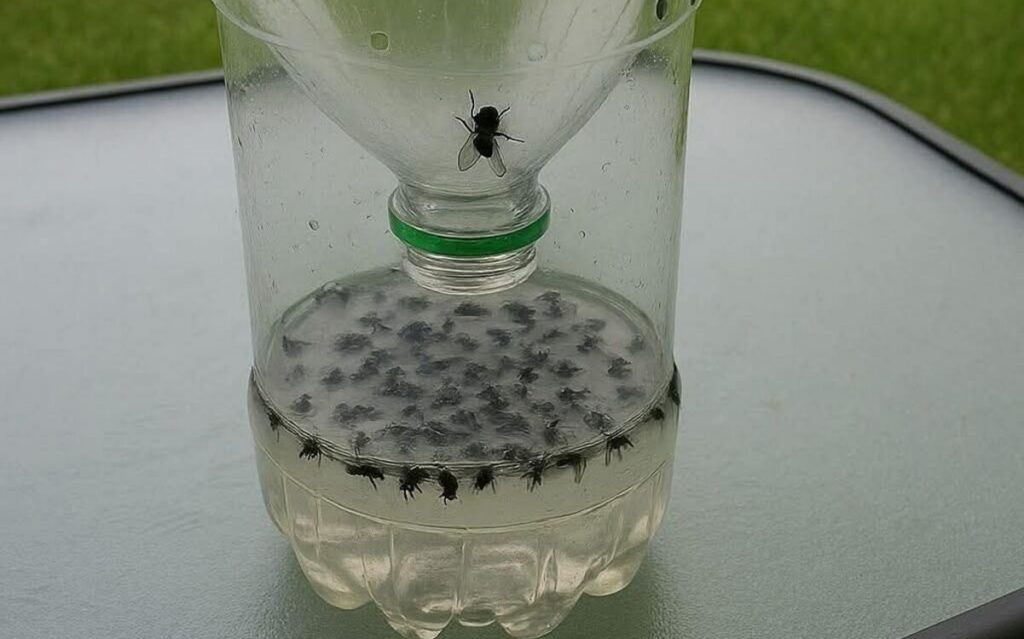
Homemade fly trap
Homemade trap
Credit:Zîî Noôu/FB

The right indoor and outdoor bait recipes for success

While many online guides suggest a blanket mixture of water, sugar, and vinegar, using the wrong recipe inside your home can backfire. Large houseflies have entirely different preferences than tiny fruit flies, so matching your bait to the location is key.

Best bait for outdoor terraces and gardens

If you are placing your trap out on a patio, courtyard, or balcony, use a mixture of water, sugar, and vinegar. The sweet, fermenting aroma is incredibly effective at pulling pests away from your outdoor dining table. Because of the sharp, pungent scent, this specific mixture is strictly recommended for well-ventilated outdoor areas.

Best bait for kitchens and indoor spaces

Avoid using vinegar indoors. Large houseflies are often naturally repelled by it, and the smell can quickly become overwhelming inside a house. Instead, fill your indoor trap with warm water and plenty of dissolved sugar. To supercharge this indoor mix, drop in a small piece of overripe fruit (like a slice of banana or melon) or a pinch of baking yeast. This creates a mild, low-odour fermentation process that houseflies find irresistible.

Easy natural alternatives using everyday items

Sticky homemade fly paper

You can easily create your own chemical-free fly ribbons. Cut strips out of a brown paper bag, punch a hole at the top of each, and thread a string through for hanging. In a saucepan over medium heat, warm equal parts water and sugar with three tablespoons of honey, stirring until it forms a thick, sticky glaze. Coat the paper strips in the mixture and hang them up in problem areas where insects tend to gather.

The diluted vinegar barrier spray

Because houseflies actively avoid the scent of vinegar, it makes a terrible trap bait, but an exceptional defensive barrier. To use it indoors without creating an overwhelming smell in your living areas, mix equal parts vinegar and water in a spray bottle. Instead of misting the air, spray it strictly onto targeted entry points—like exterior window frames, door tracks, and the inside base of household bins. The scent quickly fades for humans as it dries, but it remains strong enough to disorient flies and stop them from crossing into your home.

Potted aromatic plants that act as natural deterrents

Utilizing the power of aromatic plants is a stylish way to help move them along. These plants add beautiful decorative value to Spanish windowsills and balconies and also have natural essential oils doubling up as insect repellents.

Citronella and mintCitronella is the ultimate defender for outdoor terraces. Indoors, potted peppermint is incredibly hardy, easy to maintain on a windowsill, and releases a sharp mentholated fragrance that flies actively avoid.
Basil and sage – Broad-leaved basil varieties are perfect for kitchen counters, producing an aroma that disrupts a fly’s sensitive sense of smell. Sage releases strong essential oils that create a highly unattractive environment for flying insects.
Bay leavesBay leaves naturally contain organic compounds called cineole and eugenol, which are scientifically proven insect deterrents. You can place dried bay leaves inside your pantry cupboards or scatter them on windowsills to amplify the protective effect.

Top tip. To make your live plants work effectively as natural deterrents, remember to gently rustle or brush their leaves occasionally. This physical action breaks the plant’s oil glands and releases the defensive aromas into the air.

Combined with daily kitchen hygiene, wiping surfaces down, and emptying your household bins frequently, these natural tricks will help your Spanish summer stay peaceful and fly-free.

Continue Reading
Advertisement
Advertisement

Spanish Real Estate Agents

Tags

Trending

Copyright © 2017 Spanish Property & News