
ElPais
Ozempic Culture: The Obsession With Beauty And Youth Shapes Film, TV And Books


Every era has imagined its ideal body. Ours, moreover, demands that we achieve it to retain even a minimal sense of worth as individuals. For years now, we have witnessed the return of extreme thinness, the cult of youth and flawless beauty as moral imperatives of our time.
Ozempic, along with other drugs in the GLP-1 family — initially used to treat diabetes and obesity — has become, in less than five years, the symbol of a new body economy. Injectable weight-loss medications, anti-aging treatments, regular doses of Botox, hyaluronic acid or salmon sperm, as well as filters and other image-altering technologies, promise to correct any deviation from the new social norm. Since the pandemic, when health concerns took center stage in everyday life, the discourse has taken on a totalitarian tone, amplified by powerful propaganda machines: social media.
Ozempic is a weight-loss drug, but it is also the symbol of a new era in which the body is understood — even more than in the past, which is saying something — as something perfectable to the point of exhaustion. Beauty, youth and thinness have always been signs of virtue: they convey values such as discipline, self-control, willpower and even purchasing power. In late capitalism, new meanings have been added to these: an acceptable body signals that its owner knows how to manage themselves. Conversely, a tired, wrinkled, overweight body, or one with unconventional contours, is interpreted as a symptom of poor self-management.
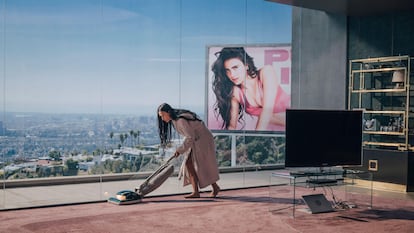
The culture of our time has absorbed this shift in the climate. There is no shortage of works that can be interpreted as parables of the culture surrounding Ozempic and similar drugs, even some that were conceived before these drugs became widely popular. For the most part, they are expressionist laments about bodies made ill by their desire for thinness, their fantasies of eternal youth, and the constant impulse to compare themselves with other bodies.
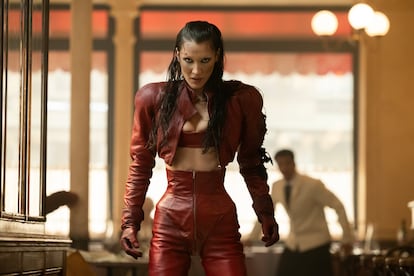
This is the subject of recent films such as Coralie Fargeat’s The Substance, which in 2024 turned anxiety about the passage of time and bodily perfection into raw material for a cruel fable in which a television star fired upon reaching middle age — played by a stunning Demi Moore — tries an experimental drug that creates a younger, smoother and more commercially viable version of herself.
Aaron Schimberg’s A Different Man explores similar territory, in which an actor with neurofibromatosis undergoes an experimental treatment to transform his face, eventually taking on the attractive features of actor Sebastian Stan, though losing his facial deformity does nothing to resolve any of his insecurities. Jessica Hausner’s Club Zero stars a teacher at an elite boarding school who turns so-called “mindful eating” — a euphemism for plain and simple deprivation — into a doctrine of austerity and purity. Emilie Blichfeldt’s The Ugly Stepsister, released in theaters after its screening at the Sitges Film Festival, is a body horror reimagining of Cinderella in which the imperative of beauty demands that one undergo atrocious treatments. And The Ugly Ones, a feature film released on Netflix, is a terrifying dystopia where cosmetic surgery becomes mandatory upon reaching adolescence.
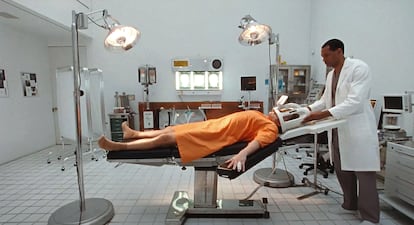
Added to this list is Insatiable, an Australian horror film set to hit theaters in late July, in which a medical student obsessed with losing weight discovers a new drug made from human ashes.
Television is also beginning to reflect this unease. The Beauty, a series created by Ryan Murphy, who has always been attuned to the excesses of the present, imagines a sexually transmitted disease that makes infected people physically perfect, though with a rather inconvenient side effect: the virus beautifies first, but then kills. The series has been available on Disney+ for the past few months.
Meanwhile, the exhibition The Cult of Beauty at the CCCB contemporary arts center in Barcelona explores this obsession from a historical perspective. The exhibition offers a journey through the evolution of beauty ideals, the construction of aesthetic standards and the vindication of bodies excluded from the norm. Its central thesis is that art and visual culture have served for centuries to construct and promote these standards, and that today these ideals are being revived on social media, red carpets and other facets of popular culture. Its effects are far from abstract: a radical resurgence of fatphobia and ageism — if they ever truly went away — coupled with aesthetic pressure that falls primarily on women, though men are not exempt either.
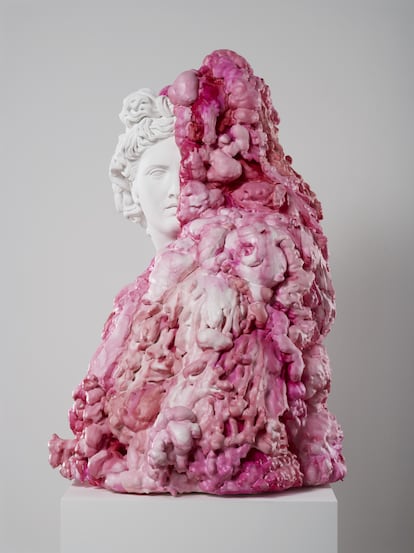
“The fear of aging, of fat or of bodily transformation is not a new phenomenon, but today it appears cloaked in new technologies and the language of individual choice that often conceal the power structures that underpin it,” observe curators Júlia Llull and Blanca Arias. Their exhibition reminds us that, throughout art history, beauty has been associated with proportion, harmony and virtue. This equivalence was reinforced with the emergence of Judeo-Christian morality, when beauty ceased to be a mere aesthetic quality and became an indicator of righteousness as well. Meanwhile, ugliness, deformity or difference were seen as signs of disorder, sin or deviance.
That is why it is no coincidence that the figure of the monster has made such a powerful comeback in the contemporary imagination. “At a time when pressure on bodies is intensifying through image culture, body-modification technologies and the notion of body optimization, the monster emerges as the figure that embodies everything the canon seeks to expel,” the curators say.
This is exemplified by Elisasue, the hybrid creature from The Substance — as tender and pathetic as any human — among other recent instances of body horror, a genre that has become fashionable in contemporary horror for good reason: “It’s a subgenre that expresses the anxieties of a culture that demands constant intervention on one’s own flesh to keep it young, productive, thin and desirable.”
In that sense, Ozempic is not so much an anomaly as a sign of the times. “It reveals that the canon stubbornly refuses to disappear,” the curators state. Yet their exhibition also offers a glimmer of optimism, reminding us that no aesthetic dogma lasts forever: “Even if the norm presents itself as natural, immutable or inevitable, it is as fragile as any historical construct. What has been constructed can also be dismantled.”
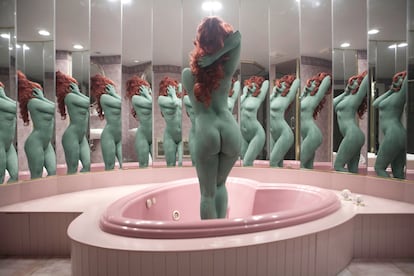
A very similar conversation is taking place in bookstores. Christopher E. Forth’s monumental book Fat: A Cultural History of the Stuff of Life reconstructs the long Western history of aversion to fatness and reminds us that, contrary to certain common assumptions, distrust of the plump body has run through history since classical antiquity, linked to excess, animality, filth, aporophobia and moral suspicion.
However, the author himself — a history professor at the University of Kansas — acknowledges that the phenomenon is reaching new heights today. “Diet, exercise, treatments, and drugs are part of an invisible regimen that has almost become an obligation for the neoliberal subject,” Forth says in an email.
The historian traces the origin of this obsession with the body, which has existed since the dawn of humanity but has intensified in recent decades, to the origins of cinema. “The advent of the cinematic close-up made the face more scrutinizable: its features and flaws were magnified. At the same time, it turned movie stars into new models of health and beauty,” he explains. “With social media filters, we become the stars of our own movies; we can correct our image, look for a moment like an improved version of ourselves, and then try to make our real bodies match that retouched selfie.”
His book finds a contemporary counterpart in a series of titles that view thinness and beauty as battlegrounds marked by social violence. Manual para romper un cuerpo (Manual for Breaking a Body) by Lara Gil draws on the author’s experience with bariatric surgery to debunk the promise that losing weight is enough to fix a life. Cinco lorzas metafísicas (Five Metaphysical Rolls of Fat) by María von Touceda combatively rejects the obligation to correct being overweight. Leticia Sala’s short essay Dame veneno que quiero vivir (Give Me Poison, I Want to Live) delves into the skincare industry (valued at over $150 billion), the fear of aging and the normalization of anti-aging rhetoric. And Las niñas bonitas no pagan dinero (Pretty Girls Don’t Pay), by Clara Nuño, brings that pressure into the realm of fiction, examining beauty standards passed down from mothers to daughters and the damage wrought by exposure to social media from an early age.
These books demonstrate how deeply rooted aesthetic and body-related pressures have become in contemporary Spanish literature, particularly in works written by women. “The body was already present in the work of many earlier female authors. What has changed is that certain bodily experiences, and a woman’s relationship with her own body, are no longer viewed as trivial or lacking in universal relevance,” notes Rosario Villajos, author of La educación física (Physical Education) and winner of the 2023 Biblioteca Breve Prize. Set in the early 1990s, her novel follows Catalina, a teenager navigating that precise moment when a woman loses control over her own body: the moment it begins to be observed, judged and desired by others.
Women who were teenagers in the 1990s grew up, Villajos recalls, with a demanding ideal of thinness. Today, aesthetic pressure is amplified by even more powerful channels. “In the past, the beauty ideal reached us via magazines, television or advertising; now, it comes through a screen that never turns off. Back then, the ideal was nearly impossible to attain; now, there seems to be an added obligation to pursue it. We live in an era where we are told that if we aren’t thin, young or attractive, it is because we haven’t tried hard enough,” the writer observes. “Beauty is no longer perceived as something one either has or doesn’t have; it has become an individual responsibility. It is as if failing to be young, thin or attractive today is, above all, a personal failure.”
This culture of self-optimization produces bodies that are considered desirable, but also others that are punished and excluded, especially when they do not conform to accepted norms. This is the context for Gorda sinvergüenza (Shameless Fat Woman), by Aida González Rossi, an essay that addresses fatphobia through the lens of language. Her starting point is the word fat, historically used as an insult, yet she also explores the possibility of inhabiting the word differently: stripping away some of its derogatory weight and transforming it into an identity in its own right, much as others have done with slurs reclaimed by gay and lesbian communities.
González Rossi, however, does not idealize the previous wave of body-diversity discourse embraced by fashion magazines as the supposed end of the longstanding obsession with thinness. The illusion did not last long. “The body-positive discourse, so visible between 2016 and 2021, contains many pitfalls. In the end, what it does is create another beauty standard: you have to be fat in that way, or be a fat woman who loves everything about herself,” she says. “That leads us to think a lot about our appearances. And capitalism has a strong interest in us doing that, which is why this discourse has been so thoroughly absorbed by the system.”
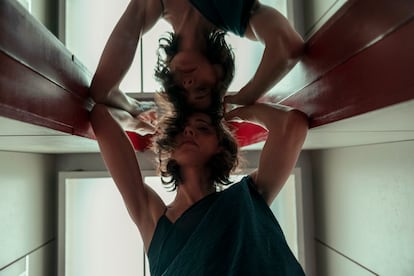
How far will this phenomenon go? The film The End of It, shot in London by Catalan director Maria Martínez Bayona and screened at the Cannes Film Festival, envisions a future where aging is a treatable medical condition and death has become optional. The protagonist is 250 years old; she renews her blood via a machine and has replaced her bones with more durable materials. In this story, the very concept of age has been abolished. “Even though the film is set in the future, we aren’t that far from that reality,” the director says. “Today, there are already mothers and daughters who, almost bizarrely, look the same age. Medicine has achieved things that once sounded like science fiction, and there’s a real debate about what our biological limits are.”
Martínez Bayona wrote the screenplay before Ozempic became mainstream, although these questions had been in the air for a long time. “The idea of finding an elixir of eternal youth is as old as humanity itself, but in the last five or six years, the focus on longevity has intensified greatly. An entire industry is emerging, with gurus like Bryan Johnson, who claims he’s going to live forever.”
Ozempic culture isn’t just a cult of thinness. It is also one that resists any sign of decline or human finitude. “I don’t know if we’ll live to be 250 years old, but I have no doubt that people will try,” says the director.
Her remarks recall, in a far less grotesque form, Kim Kardashian’s famous admission in 2022. Asked what she would do if she were told that eating excrement every morning would make her look younger, she replied: “I might, I just might.” Body horror, as we said, even though there is less and less need to rely on special effects.
Sign up for our weekly newsletter to get more English-language news coverage from EL PAÍS USA Edition

Donald Trump
Loyalty, Telegenic Appeal And Testosterone: Hegseth’s Extraordinary Run At The Head Of The Pentagon


At a meeting held in the tea room of Donald Trump’s Mar-a-Lago mansion/hotel where it was decided on November 11, 2024, that Pete Hegseth would be the next U.S. secretary of defense, the then president-elect offered two arguments he considered decisive. “Nobody has performed better on camera than that guy” was one. “He’s always treated me very well,” was the other.
Loyalty and telegenic appeal are two virtues the Republican president prizes. And at that meeting — the details of which await the reader of Regime Change: Inside the Imperial Presidency of Donald Trump, written by Maggie Haberman and Jonathan Swan of The New York Times and revealing the inner workings of the current White House — Trump praised Hegseth’s campaign in defense of three veterans of Iraq and Afghanistan accused of war crimes. For the future president, those efforts proved why his administration needed a candidate at the Pentagon who was “willing to stick up for the tough guys.”
Last Wednesday, that man — a former Fox News morning host and a military veteran — went a step further in his plan to reshape the U.S. military around his vision of masculinity by announcing he will require soldiers over 30 to undergo annual testosterone testing; testing will be optional for those younger than that.
Concern about low levels of the male hormone among military personnel predates Hegseth and has been addressed by Congress from a medical standpoint: low testosterone can be a symptom of stress, and can cause loss of muscle mass and sexual desire, obesity, or erectile dysfunction, or be associated with more serious conditions such as diabetes, osteoporosis, or depression. The difference this time is that the secretary of defense made the announcement with the highest possible profile, in a solemn social media video that seemed scripted by the writers of Saturday Night Live, the comedy show in which his character, played by Colin Jost, is as recurring as it is successful.
With his self-confidence and fraternity-member manner, Hegseth often gives the impression that he does not mind being fodder for parody. He was mocked when, to demonstrate his committed adherence to Christian nationalism — the belief that the United States’ destiny is inexorably linked to the teachings of the Bible — he recited at a Pentagon religious service a passage he believed came from the Old Testament but that was actually a fictional monologue spoken by Samuel L. Jackson’s character in Pulp Fiction. Or when he used press briefings on the progress of the offensive in Iran to speak voluptuously about the “pure destruction” he sought to unleash on the enemy and about the “violence” of war, which he called, in this case, “holy.”
A “feminized” military
His obsession with masculinity goes back further. In his 2024 memoir, The War on Warriors, he warns of the dangers of a “feminized” military; he refers to “Pentagon pussies” as the principal enemy because they prevent soldiers from acting with the full “lethality” at their disposal, and lays out the theory that would underpin his diversity-hostile program at the head of the Department of Defense (which he likes to call the Department of War, though he lacks the necessary congressional approval to do so).
“In their zeal to fight racism, generals provoke racial conflict,” Hegseth writes in the book. “By pushing gender equality, they weaken unit readiness. By trying to eradicate ‘extremism,’ they expel patriotic rank-and-file soldiers (like myself). By sheltering trans soldiers, commanders are forced to walk on eggshells instead of forming warriors. Killers.”
In the 15 months since he took office, he has had ample time to apply those ideas. After surviving a Senate confirmation that nearly collapsed amid accusations of sexual assault that he denies and coworker testimony about his fondness for alcohol, Hegseth has purged a significant number of senior officers and hindered military careers, especially those of women and Black men.
Last week, his week of testosterone, a new episode in that systematic campaign went largely unnoticed amid news that the secretary of defense blocked five officers — all women or people of nonwhite race — from being promoted to admiral. The decision means that, for the first time in over a decade, no woman will be promoted to admiral in the United States.
Although his animus also extends to certain men who do not fit his vision of what a soldier should be. The secretary has outlawed bellies, long hair, and facial hair, and declared war on trans service members. The latter has led many to point out the irony that the optional testosterone-replacement treatments he offers to troops found to have low levels closely resemble gender-affirming treatments used by trans men in the military.

A convert to Christianity, Hegseth is not only the secretary of defense who has done the most to politicize the institution; he has also infused it with an extreme evangelism. He has the Jerusalem cross tattooed on his chest and “Deus Vult,” the crusaders’ battle cry in their holy wars against Muslims, tattooed on his right biceps. He has also instituted the practice of monthly prayer breakfasts at the Pentagon headquarters. And he has brought his pastor, a man named Doug Wilson — who argues that women should not have the right to vote and that suffrage should be decided at the family level (patriarchal, of course) — out of the margins.
With all those outbursts, and given the clearly limited success of the U.S. war in Iran, the question in Washington has often been when Trump would decide to remove him from the Cabinet, since after a year of relative calm in the White House the first purges have already begun (mainly targeting women: from Pam Bondi, attorney general, to Kristi Noem, secretary of homeland security, and national intelligence director Tulsi Gabbard).
But Hegseth appears to still enjoy the boss’s favor, someone for whom what sufficed the day he chose him for the post seems to still be sufficient. For the president of the United States, an irresistible combination of loyalty, telegenic appeal and, now more than ever, testosterone.
Sign up for our weekly newsletter to get more English-language news coverage from EL PAÍS USA Edition


Amazon Prime Video
Inside ‘Fallout’: When A Video Game’s Science Fiction Becomes A Tangible Hollywood Blockbuster


To reach the hidden soundstages where Fallout is filmed, you have to leave Los Angeles (which is hardly a small city) far enough behind that you start to see open countryside. So much so that the studios call themselves The Ranch, with a faint Old West flavor and a sense of grandeur. They have both in spades: their vast grounds make the famed Stage 8 one of the largest shooting stages in the industry, at nearly 5,200 square meters. Fallout deserves no less: you need room to find shelter and comfort in its vaults, the bunkers where part of the action takes place.
Since Fallout premiered almost two and a half years ago, expectations have been high. The video game it’s based on was already a huge global hit, and the series was too: its first season made it the fifth most-watched series on streaming platforms in the United States. That’s why they went all out for the second season, and will continue to do so for the third, which is expected to premiere next year. Everything is being, and will be, filmed on this vast location that creates a world you can touch and feel, entirely realistic — or as realistic as a post-apocalyptic dystopia populated by androids and outlaws can be.
El equipo de producción muestra un Garra Mortal.
In the basements, as you’d expect, beneath Stage 8 north of Los Angeles, lies the world of Fallout, and there also are its stars: Ella Purnell (Lucy), Aaron Moten (Maximus) and Walton Goggins as The Ghoul, although on this June day he looked happier and smiled more than his character does. He spoke informally with EL PAÍS — invited on the tour by Prime Video — to praise Madrid, his favorite city, which he had just returned from and will visit again soon, he said, and to praise the work of the creators of this world: artisanal, hands-on and meticulous. He was talking from a corridor in one of the vaults, between an office and a dormitory, alongside Jonathan Nolan, the show’s executive producer, and Howard Cummings, a veteran production designer with some 50 titles to his name.
What those behind the Emmy-winning series explain is that fans always want to compare it to the video game, but they also want to know where the story is headed. “But our writers are very clever, because we’re not doing the actual game story,” Nolan says (yes, he is the brother of Christopher Nolan — acclaimed director of Oppenheimer and The Odyssey — with whom he regularly collaborates). Fans are the biggest supporters but also the toughest critics: if something doesn’t fit, they won’t hesitate to say so plainly. “I verify things, I don’t want to do something that doesn’t fit within their world, but they also give me great freedom to mix and match and do what I want,” Cummings adds.

01:01
Dentro del estudio de grabación de ‘Fallout’
One example: screws. A seemingly small detail. “I remember the first review that came out, it was like, they did the triangular bolts that are in the hallway,” recalls the production designer and the person responsible for the vault’s flawless look. “And I looked at them and thought, these are weird. But I just said, ‘it’s so weird, let’s just do it.’ So I found out later, they did that because when you’re building the game, it uses more memory to use a five-sided bolt than a double or a four-sided one. So they wanted a triangular bolt. I didn’t know that, I just did it. So there’s really fun things that I learned,” he admits.
During the visit, a few meters past the offices and the school classrooms, a deathclaw, a hideous monster over two meters tall, appears: in the Fallout universe it belongs to a species that’s a mix of highly capable soldiers and chameleons and other animals. Fast and deadly, viewers might assume they were created with visual effects — post-production — but they are there physically, with sharp claws, scales, and pointed teeth, taking photos with journalists. They are what are called animatronics, a kind of hyperreal puppet.

Obviously, they receive additions in post-production, where their movements are scanned and visual effects are added, the team explains. But for the most part they are controlled by technicians operating their arms and lower parts, like a giant puppet. “Basically, you can see that there’s a performer in the suit, those two puppeteers, and then another one kind of controlling the facial expressions that Carrie and her team at Legacy put together, [for] this amazing deathclaw, as well as the power armor suits, which are fully practical,” explains Casey O’Neill, stunt coordinator. Because, yes, there are many of them in the series. “We have stunt performers in those too, that do all the stuff, whether it be wire work, falling down, all the things you’ve seen in the episodes so far on season one and two. And then it’s just bringing those two things together: The realities of what this is capable of doing and then choreographing how that all works and what looks the most dynamic, obviously taken off the page, based on Gen’s [Geneva Robertson-Dworet, creator, also present on the visit] creative writing. Bringing the script to life and bringing action to the screen is the goal.
In a school classroom, young actress Ella Purnell and costume designer Dayna Pink told this newspaper they have only two or three months to create the garments for all the characters and that, above all, what matters to their team is “hoping to keep the spirit in everything that we do,” Pink says. Sometimes, for example, the challenge isn’t making many costumes but a single one: for the second season, there was only one dress for Purnell. “The pressure, you know what I mean?” she laughed. “It has to say everything is so important, this dress meant so much.” So she chose a classic cut, high-necked, one that evoked the era, and a striking yellow tone with careful embroidery. “Yellow won for several reasons. You know, it looked the best, but also I love that it’s sunshine; to me that was sort of perfect and then it had to also make her feel a certain way when she put it on. And that’s part of our job, when we’re putting an actor into an outfit, and then you zip someone into something, they stand a little differently, you put shoes on, they walk a little different.”
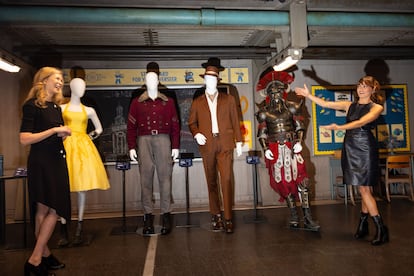
In fact, for this dress — although several options were tested — the team opted for boots. “It had to be the boots,” Purnell says. “But for me the dress really symbolizes just how much Lucy has changed; it slightly reminds me of her wedding in the first episode of season one. What great adventures she’s had.” The costume creator agrees and feels her work is fully integrated with storytelling.
In the end, as they explain, it’s about building “a collaborative, creative process that we all get to come together and create the sequence together,” sums up O’Neill, the head of stunt doubles. “We’ve been working together for so many years, that’s one of the other things that’s super gratifying,” he adds. For the actors, stepping into that world, sitting in those chairs, wearing those costumes, fighting those beasts — having it all be real — helps. Or putting on a robotic suit, like the T60, another classic of the series that’s not easy to handle, but is real. As Aaron Moten, who plays Maximus and has worn it, laughingly says, “people sort of move out of your way when you’re walking by in it.” “It does a lot for your imagination without having to work too hard for it,” he reflects. “I think it was like maybe three weeks before I was ever on set with a deathclaw; they brought me in look at it and even just being able to know that this is what I get to play with it’s so much better than a person on stilts with dots on their face.”


Beach Panic In La Manga As Mysterious Package Sparks Major Police Response

Palma Prepares For Atlàntida Film Festival

Las Celebraciones De Los Campeones Del Mundo, En Directo | Cientos De Miles De Aficionados Arropan A Los Campeones Del Mundo En Su Recorrido Por Madrid


-

 New Developments1 week ago
Luxury Villas For Sale, Estepona – ProjectL1
-

 New Developments2 weeks ago
How To Get A Tourist Rental Licence In Andalusia (Spain) – Step-By-Step Guide 2025
-

 New Developments1 week ago
Stylish 3-Bedroom Apartment With Panoramic Sea Views – Benalmádena
-
Cataluña wildfire2 weeks ago
Spain travel chaos as Cataluña wildfires close major roads and suspend trains
-
Cheap food options2 weeks ago
Public supermarkets could be coming to Spain. Could they make food cheaper?
-
calpe2 weeks ago
Calpe seafront makeover backed by €278,000 in EU funding
-

 Uncategorized1 week ago
F1 season ticket announced for 2027 and it
-
 Bélgica1 week ago
Bélgica No Logra Repetir La Gesta De 1986: “Pero Hemos Jugado Bien”