Connect with us

Latest

Pet Passports Set To Be Restored Between The EU And The UK

Published

on

An agreement set to be announced at the upcoming EU-UK summit could mark the return of pet passports allowing easier travel across the Channel for holidaymakers with dogs, cats and ferrets.

The EU and the UK are negotiating a package of measures to bring cooperation closer as part of the “reset” of the relationship promised by former Prime Minister Keir Starmer and taken on by current PM Andy Burnham.

These measures should be announced at the summit planned on 20 November in Brussels.

READ MORE: ‘A lot of arguing to be done’: What’s at stake in the upcoming EU-UK summit?

The deal will include a sanitary and phytosanitary (SPS) agreement on food trade, the UK access to the EU electricity market, and the establishment of a youth mobility scheme.

Get our essential newsletter for Britons living in and moving to Europe

The SPS, considered the easiest part of the deal, will remove checks on food and animal products, and restore the use of EU pet passports for holidaymakers from the UK. In exchange, the UK will apply EU rules on animal and food standards and ensure that imports from non-EU countries meet EU requirements.

Pet passports issued by authorised veterinarians allow multiple trips within the bloc for dogs, cats and ferrets. British travellers lost the opportunity to use them after the withdrawal from the EU, as the UK was classified as a third country. As a result, travellers from Great Britain to the EU need an Animal Health Certificate for every trip (while Northern Ireland remains part of the EU pet travel scheme).

On April 22nd 2026 more rigorous EU rules on pet passports also took effect, excluding from the scheme residents of England, Scotland and Wales from the scheme.

But the situation is likely to change in the future. According to a UK government statement, if the SPS agreement will be approved as foreseen, “pet owners will be able to get a multi-use pet passport valid for EU travel, rather than obtaining a new animal health certificate for each trip.”

The agreement should become effective around mid-2027. Until then, “owners will still need an animal health certificate for their dog, cat or ferret if they are travelling from Great Britain to an EU country,” the statement says.

Details on how to bring a pet into the EU from a non-EU country are available here.

Continue Reading
Click to comment

Leave a Reply

Your email address will not be published.

Brighton & Hove Albion

El Brighton Deja Sin Margen De Error Al Getafe En La Conference

Published

on

el-brighton-deja-sin-margen-de-error-al-getafe-en-la-conference

Al Getafe se le está haciendo muy cuesta arriba la Conference League. El equipo de Bordalás dio una buena imagen ante probablemente el rival más duro que les deparó el sorteo. Estuvo metido en el partido en todo momento. Pero no le dio. El Brighton, con varias rotaciones en su once, logró romper el buen hacer defensivo del Getafe este jueves con un cabezazo de Yalcouye en uno de los pocos despistes de la zaga local y hurgó en la herida del conjunto madrileño, que se queda sin margen de error.

Seguir leyendo

Continue Reading

california

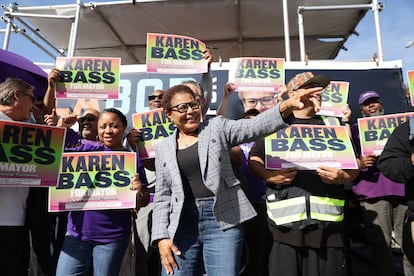
Nithya Raman Defeats Karen Bass To Become Los Angeles’ First Asian-American Mayor

Published

on

nithya-raman-defeats-karen-bass-to-become-los-angeles’-first-asian-american-mayor

Karen Bass, a Democrat, had never lost an election. Until now. It became clear on Thursday that Nithya Raman, also a Democrat, will be the next mayor of Los Angeles.

Raman, who was born in India, graduated from Harvard University and is the mother of two children, will take the helm of the second-most-populous city in the United States, behind only New York City. She will be only the second woman to hold the office, following her predecessor, Bass, whom she defeated by a margin of 35,000 votes out of 824,000 counted. She will also be the first person of Asian descent, specifically South Asian, to serve as mayor of the city.

With 76% of ballots counted on Thursday morning, more than 36 hours after polls closed, Raman — a council member representing the Fourth District — held a commanding lead with 52.1% of the vote, compared with 47.9% for her opponent.

The results took time to emerge from an election night that also determined control of the federal Congress and saw Democrat Xavier Becerra elected governor of the state of California.

For several weeks, polls had projected Raman as the winner. Some showed her leading by only a couple of points, while others gave her an advantage of as much as 11. Yet just a week before Election Day, local media reported that Bass had closed the gap.

On Election Day, the race was effectively tied, and the gap between the two candidates remained razor-thin for hours. The final results, however, showed that Raman, as most forecasts had suggested, would ultimately prevail and take office.

Nithya Raman

Raman was virtually unknown outside local political circles until this summer, when she launched her primary campaign. But she steadily gained ground with voters through her ability to explain her ideas in simple terms and her focus on everyday concerns such as street maintenance, pollution and taxes. Some residents of her Fourth District, however, have criticized her precisely for what they see as a poor record on those bread-and-butter issues. When she entered the race, not a single member of the city council, on which she serves, endorsed her.

But Bass had been losing support after a difficult term, particularly because of her handling of the wildfires that swept through Pacific Palisades in January 2025. The blazes, which also devastated Altadena and Pasadena, although those areas are outside her jurisdiction, burned through 16,000 hectares, killed 25 people, forced 180,000 residents to evacuate and caused billions of dollars in damage, including the destruction of more than 11,000 homes.

“Where is our mayor?” That was the question Raman posed in a recent campaign video, underscoring her argument that Bass had failed to deliver on key promises, among them tackling homelessness.

On her first day in office, in December 2022, Bass made the issue a top priority, declaring a state of emergency and launching initiatives aimed at getting unhoused people off the streets and into permanent housing. But she failed to reverse the trend. In fact, the numbers have worsened in recent months: more than 73,000 people are homeless in Los Angeles, according to a report commissioned by the city. From 2025 to 2026, the homeless population increased by 3.4% in the city and 1.2% across Los Angeles County.

Karen Bass

From now on, Raman will try to tackle those challenges, as well as the city’s housing crisis, a pressing issue in a place where the median home value stands at $928,000, according to the real estate website Zillow.

She has pledged to streamline the lengthy and cumbersome permitting process for new construction and create an office dedicated to protecting tenants. She has also promised greater transparency in the use of tax revenues, including the creation of a financial watchdog position that does not currently exist at City Hall.

The mayor-elect also plans to launch crews to repair streets and streetlights, hire more 911 operators, and expand the use of unarmed patrols and rapid-response teams to assist homeless residents and people experiencing mental health crises. She aims to open more parks, revitalize the city’s major thoroughfares, including the semi-neglected Hollywood Boulevard, and improve connections between Los Angeles and its main airport.

One of the biggest challenges Raman will face, and one that is likely to define her legacy, is the 2028 Olympic Games. The event will make Los Angeles a three-time Olympic host, the only city in the Americas to achieve that distinction.

In just 600 days, a sprawling and often chaotic city, with limited housing options, a deep reliance on cars, inadequate public transportation, chronic traffic congestion and poor links to its main airport, will have to welcome some four million visitors in need of accommodation and transportation.

How Los Angeles rises to that challenge will shape Raman’s tenure and may ultimately define it.

Sign up for our weekly newsletter to get more English-language news coverage from EL PAÍS USA Edition

Continue Reading

Donald Trump

Data Centers Also Lost At The Ballot Box In The United States

Published

on

data-centers-also-lost-at-the-ballot-box-in-the-united-states

The aftershock of the political earthquake that shook the foundations of U.S. politics with the Republican Party’s crushing defeat in the midterms has hit the artificial intelligence industry. Voters have overwhelmingly decided to put the brakes on the sector’s most visible symbol: data centers.

The Democrats’ decisive victory threatens to usher in moratoriums and stricter regulations on these facilities. A growing chorus of critics accuses them of driving up electricity bills in the communities where they are built, consuming excessive amounts of water in drought-prone areas, lacking transparency in permitting processes and tax incentives, and creating other problems that have fueled NIMBY (“Not In My Backyard”) movements.

In Tuesday’s midterm elections, voters were not only choosing all 435 members of the House of Representatives and renewing one-third of the Senate’s 100 seats. They also voted on governors, mayors, a host of other public offices, and numerous local measures and ballot initiatives, including several aimed at restricting the development of data centers.

Of the 41 votes on data-center projects put to referendum across 10 states, only one passed, according to a Ballotpedia report. That was in Harwood, a town of just over 1,000 residents in North Dakota, where voters rejected a proposal to revisit requirements for industrial projects.

The Democrats’ victory gives them control of both chambers of Congress. The electoral shift opens a new chapter for the AI and technology industries, which now face a more challenging landscape in Washington. Technology stocks took a significant hit on Thursday in response.

Many companies in the sector invested heavily in supporting Republican candidates. Elon Musk, for example, poured away $474 million backing conservative candidates in Texas.

Opposition to data centers

Voters in California, Florida, Illinois, Kansas, Maine, New Jersey, Nevada and Wisconsin delivered a strong rebuke at the ballot box to the construction of data centers in their communities. But three states have been particularly affected by the backlash against data centers, which have become a symbol of public anxiety over the rapid expansion of AI: Ohio, Texas and Virginia.

Half of the data-center proposals rejected in the midterms were in Ohio, where 21 projects failed to secure approval from local communities. The state’s new governor, Amy Acton, a physician, defeated Republican businessman Vivek Ramaswamy.

Acton, who faced intense personal attacks during the campaign, supports a moratorium on new data-center developments until operators commit to covering the full cost of the public services they consume and allow workers hired to build these vast server-filled facilities to unionize.

Alongside Virginia and Texas, Ohio has become one of the industry’s main hubs. OpenAI has planned what would be the world’s largest AI data-center campus there, backed by a consortium of investment banks and Nvidia. According to CNBC, the project could ultimately exceed $500 billion in investment.

Newly elected Democratic Senator Sherrod Brown of Ohio was among the most outspoken critics of data centers during the campaign. “I will always be on your side — always. I do not work for the utility companies. I do not work for data centers. I do not work for Wall Street. I work for you. I work for Ohio,” he said in his victory speech last Tuesday.

“With the continued contentiousness surrounding data centers, it is likely both legal and political action will continue in future years,” researcher Nicol Turner Lee wrote in a report for the Brookings Institution. “Organizers across the country have turned to ballot referenda, campaigns for public office, and protests designed to slow or stop data center development.”

This expert also pointed to the lack of transparency surrounding some of the agreements local governments have signed with data-center companies, concealing local or state tax exemptions, subsidies and other benefits from taxpayers.

“The widespread use of nondisclosure agreements between data center developers and local officials has fueled public opposition to data centers and encouraged suspicions of private deals benefitting insiders,” he said.

Coco Zhang, a researcher at ING Research, reflected on the impact that the Democrats’ landslide midterm victory could have on the expansion of data centers. “The data center industry is facing heightened local opposition. Recent polls suggest that around one in seven Americans is concerned about or opposes data centre development in their neighbourhoods,” she said in an ING report released Thursday.

UBS estimates that as much as 30% of the additional data-center capacity planned in the United States by 2028 could be at risk because of potential construction delays or disruptions.

Texas has become a magnet for technology companies and data centers relocating from California, attracted by lower taxes and generous incentives. The state hopes to become the world’s largest data-center market by 2030.

Musk, the founder of Tesla and SpaceX, moved the headquarters of his companies to Texas, a shift that other Silicon Valley firms have increasingly followed. But frustration over data centers, combined with growing concerns about the risks posed by AI, has fueled public discontent.

Republican Texas Governor Greg Abbott went so far as to block the construction of data centers in an attempt to slow the rise of his Democratic rival, Gina Hinojosa, who ultimately won the governorship.

According to Zhang, “There is likely to be tighter data centre regulation. State-level policy will be more important to watch, as action is politically and practically easier at this level. The most likely approach is targeted regulation, much of which is already emerging. This includes data center-related taxes, reduced tax incentives, environmental standards, and requirements for developers to bear relevant cost increases.”

Darrell West, a senior fellow at the Brookings Institution, agreed: “Public policy is going to reflect public opinion, and there’s been a very substantial change in public opinion just over the last year.”

But the ING Research analyst argues that federal legislation targeting these facilities may prove difficult because U.S. President Donald Trump could use his veto power to block any such measures passed by Congress.

Sign up for our weekly newsletter to get more English-language news coverage from EL PAÍS USA Edition

Continue Reading

Trending

Copyright © 2017 Spanish Property & News