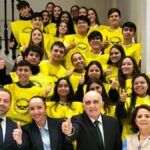
Feijóo has also pledged to change the Criminal Code. Photo credit: PP.es
Endless scrolling, late-night screen time and the temptation to watch just one more video are not problems exclusive to teenagers. Adults spend hours doing exactly the same thing, often without realising how much time has passed. Now, the Partido Popular wants social media companies to change some of the features designed to keep users glued to their screens, while banning under-14s from accessing social networks and requiring parental permission for those aged 14 to 16.
The proposals form part of the PP’s election programme, which Alberto Núñez Feijóo is due to present on Tuesday, November 10, ahead of Spain’s general election on November 29. They would place new responsibilities on the companies running the platforms, rather than leaving users to manage their screen time entirely themselves.
Children under 14 would be barred from social media
Under the plan, children younger than 14 would not be allowed to access social media. Those aged between 14 and 16 would need express permission from a parent or legal guardian before using the platforms. Companies would also have to introduce compulsory age-verification systems. That would mean platforms could no longer rely simply on users ticking a box to confirm they were old enough to open an account.
The PP wants them to take responsibility for checking who is signing up, alongside making parental controls mandatory. The restrictions would also cover what young people can see once they are online. Access to adult content and gambling platforms would be prohibited for minors, while companies would have to introduce content labelling so users can identify the material being shown to them.
Platforms would have to limit endless scrolling
The proposal goes beyond setting an age limit. The PP also wants social networks to change features that encourage users to remain online, including infinite scrolling. The function allows new posts and videos to appear continuously as someone moves down the screen, without reaching a natural stopping point. Under the party’s plan, platforms would have to limit this feature and introduce maximum usage times.
They would also be required to offer night-time digital breaks. The aim is to prevent children and teenagers from continuing to use social media during hours when they should be sleeping, although the latest electoral proposal does not specify the precise hours or how the restrictions would operate. These measures would make the platforms responsible for introducing limits within their own services, rather than relying entirely on individual users to monitor their screen time.
Companies could face fines based on turnover
The PP is proposing financial penalties for companies that fail to meet the new requirements. Fines would be linked to their turnover, meaning sanctions would take account of the size of the business rather than being a fixed amount for every platform. The programme also includes measures to support people targeted by online harassment, with channels for reporting abuse and assistance for victims of digital bullying.
Feijóo has also pledged to change the Criminal Code so that behaviour considered a crime in the physical world is treated as a crime when it takes place online. The party wants to agree a national anti-bullying protocol with Spain’s regional governments, requiring schools to identify cases early and coordinate their response with health and social services. It also wants to end the practice of victims being moved to another school after being bullied. Under the proposed approach, pupils responsible for bullying would face sanctions with an educational and restorative element, rather than the victim having to leave their school.
The proposals are not yet law
The measures are election commitments, not restrictions that users or platforms can expect to see introduced immediately. They would depend on the PP winning the November 29 election, forming a government and then taking the proposals through the legislative process. The party has raised similar ideas before. In an amendment submitted to the parliamentary bill on protecting minors in digital environments in November 2025, it proposed preventing under-14s from accessing social media and requiring parental consent for those aged 14 to 16.
That amendment also suggested a digital rest period for under-16s between 10pm and 8am. The new programme brings those restrictions together with further demands on platforms, including limits on infinite scrolling, maximum usage times and compulsory parental controls. The PP is not alone in seeking tougher rules. France requires parental consent for social media users under 15, while Australia has introduced a minimum age of 16 for social media accounts.
Spain had also been considering legislation to strengthen protections for children online, but that parliamentary process fell when the early election was called. For users, the proposals could eventually mean changes to how social networks operate, from the content they can access to how long platforms encourage them to stay online. Whether those changes become reality will depend on the outcome of the election and the legislation that follows.
A small donation at the supermarket till this weekend could help ensure families across Malaga have food on the table this winter. Bancosol, the Costa del Sol Food Bank, is holding its Great Food Collection, or Gran Recogida de Alimentos, on Friday, November 13, and Saturday, November 14. Residents throughout the region are being encouraged to take part.
Andalucia’s delegate for Social Services, Families and Equality, Laura Valle, has called on people across Malaga and the Axarquia to show commitment, generosity and solidarity.
How residents can donate
It is easy to take part. Shoppers can visit a participating supermarket and ask staff to add a donation to their receipt. Contributions start from just €1, making the campaign accessible to anyone who wants to help but cannot give a large amount.
People who prefer to give from home can use Bizum, Spain’s instant mobile-payment service, with the code 00887. Donations can also be made at the checkout in participating supermarkets across the province.
Support for vulnerable families
Bancosol hopes to raise more than €450,000 during the two-day campaign. Funds will help the organisation continue providing food support to 20,589 vulnerable people through 129 social organisations across the area.
Nearly a third of those receiving help are children or young people. Bancosol says rising living costs and ongoing hardship mean public generosity is essential to maintaining supplies for families who might otherwise go without.
A community effort in the Axarquia
Volunteers will be at collection points to explain the campaign, encourage donations and thank shoppers for their support. Around 4,000 people are expected to help across Malaga province, including students from the Santa Rosa de Lima education centre.
Local organisations in the Axarquia have long played an important role in the annual collection. Past campaigns have involved town halls, charities and volunteers from local towns including Nerja and Velez-Malaga, helping bring the province-wide effort closer to neighbourhoods across the region.
Last year’s Great Food Collection raised €450,000, and Bancosol is hoping the community will help it surpass that total in 2026. Every donation, however small, contributes to a wider network of support for households in need.
Supermarkets joining the appeal
Major supermarket chains are taking part, including Grupo MAS, Carrefour, El Corte Ingles, Alcampo, Eroski, Dia, El Jamon and Mercadona. With 285 stores involved, shoppers in Axarquia towns and villages should easily be able to find a nearby collection point.
Basílica de Santa María, Palmeral de Elche. Credit: tolobalaguer.com / Shutterstock.com
Music lovers can enjoy two free organ concerts in one of Elche’s most beautiful buildings this November, with internationally acclaimed musicians performing at the Basilica of Santa Maria. The concerts form part of the 13th International Organ Festival, La Musica del Cielo (Music from Heaven), bringing leading European organists to the city for two special Friday evening performances.
International Organ Festival brings world-class musicians to Elche
The 13th International Organ Festival, La Musica del Cielo, continues this November with two concerts featuring musicians who have performed at some of Europe’s most prestigious churches and cathedrals.
Both performances take place at the Basilica of Santa Maria in central Elche, giving audiences the opportunity to hear organ music in a historic setting.
Admission is free, with both concerts beginning at 9:00 PM and no advance tickets required.
The programme offers music lovers the chance to experience the basilica’s magnificent organ, an instrument closely connected to the city’s religious and musical heritage.
November 13: Polish organist Michal Markuszewski performs
Polish musician Michal Markuszewski performs on Friday, November 13.
A professor at Warsaw’s Fryderyk Chopin University of Music, he has given around 800 concerts across Europe, America and Asia, including performances at Notre-Dame Cathedral in Paris and St Paul’s Cathedral in London.
His international experience brings an impressive musical background to the Elche festival, with audiences able to enjoy his performance without an admission charge.
The concert begins at 9:00 PM at the Basilica of Santa Maria.
November 27: Milika Radovanovic closes the festival
The final concert, on Friday, November 27, features Serbian-born organist and pianist Milika Radovanovic, who lives in Norway.
Her performances have taken her to Westminster Abbey and several major European cathedrals, with music ranging from Bach to contemporary compositions.
Radovanovic’s appearance will bring the 13th edition of the festival to a close, offering another opportunity to hear an internationally experienced musician perform in Elche.
The concert begins at 9:00 PM, with free admission.
Owners have been told to stop using the bottle straight away. Credit: Mo Photography Berlin / Shutterstock
Anyone who’s been filling up an 800ml Vital Sport aluminium bottle bought through Decathlon in the last 14 months should stop using it straight away. The bottle may release aluminium into whatever’s inside it, and the barcode is the quickest way to tell whether yours is one of them.
Buyers told to stop using the bottle immediately
Shoppers who picked up the Vital Sport aluminium bottle, an 800ml sports bottle with a safety cap, have been told to stop using it immediately as it’s been withdrawn from sale over a risk of the metal moving from the bottle into the drink.

The Vital Sport bottle in question. Credit: Decathlon.
The warning was flagged by FACUA-Consumidores en Acción, the Spanish consumer rights organisation, on Tuesday November 10, which said the aluminium released into the contents could be harmful to people’s health.
The bottles affected were sold between Friday August 1 2025 and Thursday October 1 2026. So anyone who’s bought one in the past year or so could well still be reaching for it today, whether that’s at the gym, on the bike or at their desk.
Check the barcode on yours
The bottle to look for carries the EAN code 8437021197198 under the barcode. If the numbers match, it’s one of the bottles affected.
Vital Sport isn’t one of Decathlon’s own in-house brands, though. Its bottles have been listed on Decathlon’s online marketplace, where independent sellers trade through the retailer’s website, and the withdrawal notice names Soluciones Técnicas 2000 SL as the business that detected the safety problem.
Owners are being asked to contact the company at administracion@soltec2000.es for information on the withdrawal and how each case will be handled. The notice doesn’t mention refunds, and it doesn’t say whether any of the bottles were sold in Decathlon’s shops either.
Why aluminium in your drink is a concern
Neither Decathlon nor the seller has explained what went wrong with the bottle or how much aluminium could end up in a drink.
Aluminium bottles are normally coated on the inside so the liquid never actually touches bare metal. A good bit of info to know is that acidic drinks pull far more metal out than plain water does, which matters for anyone filling up with fruit juice, lemon water or many sports drinks.
The body holds on to aluminium, which is why the European Food Safety Authority (EFSA) sets its safe limit as a weekly one: 1mg for every kilo of body weight. It’s also said many Europeans may already go over that through their normal diet, with children and young people the most exposed, before a drinks bottle adds anything at all.
Animal studies have linked high exposure to effects on the nervous system, although EFSA said it didn’t consider aluminium in food to be a risk for Alzheimer’s disease.
Now, researchers at Germany’s Hessian State Laboratory found in their worst-case scenarios that tea kept in an aluminium bottle could be enough to take a small child weighing 15kg past that weekly limit. Those tests weren’t carried out on this bottle, but they show why a faulty one isn’t something to shrug off.
What to do if you’ve got one at home
First of all stop filling it, even with plain water, until you’ve heard back from the seller. The notice also asks people to pass the warning on to family and friends, particularly if the bottle was given as a present, lent out or sold on second-hand. Sports bottles are an easy thing to hand down, so it’s worth a quick message to anyone who might have ended up with yours.